
- When a PO Box Fails as a Business Address
- When a PO Box Is Allowed
- What Makes a Virtual Address Different from a PO Box?
Q: Can I use a PO Box as my LLC’s business address?
A: For most official purposes, no. Most states prohibit PO Boxes for LLC registration filings, and the IRS requires a street address for EIN applications via Form SS-4. A PO Box can be used for some IRS mailing correspondence, but it cannot serve as your principal business address or registered agent address.
Using a PO Box for your LLC sounds practical. It is affordable, it keeps your home address private, and you can set one up in an afternoon. For most LLCs and small businesses, though, it does not actually work.
Most states will not accept a PO box for LLC formation filings, the IRS will not take it for the street-address portion of an EIN application, and it cannot stand in as a registered agent address.
There are a few specific situations where a PO Box is perfectly acceptable, and several filing types where it is firmly off the table. This guide walks through both sides, including a state-by-state breakdown, the exact IRS distinction that confuses most founders, and the compliant alternatives worth considering.
You are not alone in asking the question. Roughly 5.62 million new business applications were filed in the U.S. in 2025, up from 5.48 million in 2024, according to the U.S. Census Bureau. Every one of those businesses needs a valid, legally compliant address.
The confusion is understandable. A PO Box and a business address feel like they should be interchangeable, since both are places mail arrives. But state agencies and the IRS draw a hard line between an address that simply collects mail and an address that represents where a business legally exists. Once you understand that line, the rest of the rules fall into place.
When a PO Box Fails as a Business Address
Most of the time, a PO Box fails because the address is tied to a legal requirement that calls for a physical location. There are three places this comes up most often:
- Registered agent laws require a physical street address in most states.
- Most state LLC formation forms prohibit PO Boxes for the principal business address.
- IRS Form SS-4 requires a street address (not a PO Box) for EIN applications.
Picture how this plays out in practice. A founder forms an LLC, lists a PO Box as the principal address on the Articles of Organization, and the state accepts the filing without flagging it, since not every state’s intake process catches the error immediately.
Six months later, the founder applies for a business loan, and the bank’s underwriting team cross-checks the address against the state’s public record. The PO Box doesn’t satisfy the bank’s know-your-customer requirements, the loan stalls, and the founder now has to amend a state filing under time pressure instead of getting the address right from the start.
This is the pattern that shows up again and again: the PO Box doesn’t fail at the moment of filing. It fails later, when someone with a reason to verify the address actually looks.
Each of the above three places is worth understanding on its own, because the reasoning behind them tells you where a PO Box will and will not hold up.
If a PO Box won’t work for your filings, Alliance’s guide to virtual mailboxes vs. PO Boxes breaks down the compliant alternative in more depth.
State LLC Registration: The PO Box Prohibition
Virtually every state requires a physical street address for the principal business address and the registered agent address on LLC formation documents. A PO Box is explicitly excluded. When you submit your Articles of Organization through your secretary of state LLC filing, a PO Box in the principal-address field will typically get the filing rejected or flagged for correction.
The logic is straightforward. The state wants a real location where the business can be found and where legal documents can be served in person. A box at the post office does not satisfy that test, which is why state formation requirements treat it as invalid for registration.
There is a second reason worth knowing. Your principal business address becomes part of the public record once your LLC is formed, and the state expects that record to point to an actual place of business.
If you list a PO Box and the filing is accepted in error, you can run into problems later when a bank, a lender, or a licensing board cross-checks your registration. Getting the address right at formation saves you from amending filings down the road.
IRS Form SS-4: Mailing Address vs. Street Address
This is the single most misunderstood point, and it is worth slowing down on. IRS Form SS-4, the form behind every EIN application, has two separate address fields that follow different rules:
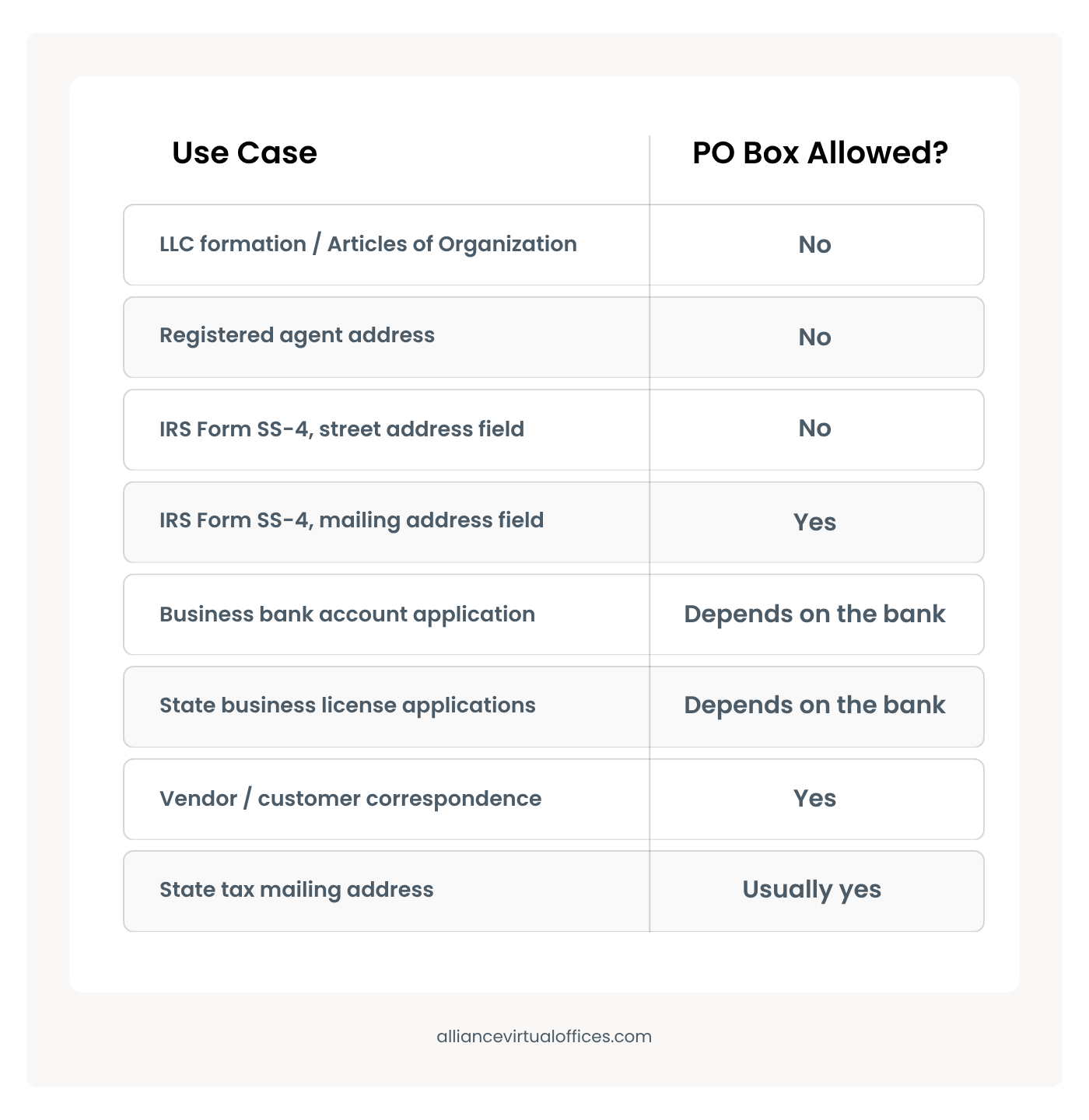
The mailing address is where you want IRS correspondence sent, and a PO Box is fine there. The street address is meant to be your actual physical location, and the IRS instructions for Form SS-4 state plainly that you should not enter a PO Box number in that field. So, a PO Box can receive your IRS mail, but it cannot serve as the physical address the IRS expects for the business itself.
This single distinction is the source of most of the confusion around a PO box business address. Founders see that the IRS accepts a PO Box somewhere on the form and conclude it is acceptable everywhere. The form is more precise than that. If you only have a PO Box, you can still receive IRS letters there, but you will need a real street address to complete the application correctly.
The same logic carries over to most other official forms you will encounter as your LLC grows.
Registered Agent Address: Physical Presence Required
Every state requires an LLC to maintain a registered agent with a physical street address inside the state of formation. The registered agent is the person or company authorized to receive lawsuits and official state notices on the LLC’s behalf, so the address has to be a place where someone can physically accept those documents during business hours.
A PO Box cannot do that job. If you list one as your registered agent address, the filing will not be accepted.
This is also why many owners who form an LLC in a state where they do not physically live end up hiring a registered agent service or using a provider with a staffed location in that state. The registered agent address has to be inside the state of formation and has to be a place where a person is present during normal hours.
A PO Box meets neither condition, which makes it a frequent cause of rejected or delayed filings for first-time founders.
Read More: What Is a Statutory Agent? The Registered Agent Requirement Explained
When a PO Box Is Acceptable for Business Use
A fair answer to “can an LLC use a PO box” has to acknowledge the cases where it works. A PO Box is a legitimate tool for receiving mail. It simply is not a substitute for a legal business address. Here are the situations where a PO box for business is genuinely fine.
IRS Mailing Correspondence
As covered above, the IRS accepts a PO Box for the mailing-address field on Form SS-4 and for general correspondence. If your only goal is a separate place to receive IRS letters, a PO Box handles that without any issue.
State Tax Filings (State-Specific)
Some state tax agencies accept a PO Box for mailing purposes, separate from formation documents. This varies by state and by the specific form, so it is worth confirming with your state’s department of revenue before you rely on it.
Internal Business Mail and Vendor Correspondence
A PO Box can handle everyday operational mail, vendor invoices, and customer correspondence, as long as that address is not the one listed on your state or federal filings. Plenty of business owners use a PO Box this way while keeping a compliant street address for their official records.
The practical pattern that works for many LLC owners is to separate the two functions. Use a compliant street address for anything that touches a legal filing or a public record, and route low-stakes mail wherever is most convenient. The problem only appears when a PO Box is asked to play both roles at once, because that is when it collides with the rules in the previous section.
To keep all of this straight, here is a quick reference on where a PO Box is allowed and where it is not:
Unlock Our Current Virtual Office Offers
Enter your email below and we’ll send you the latest available promotions and monthly specials for Virtual Offices, Meeting Rooms, and Live Receptionists.
State-by-State PO Box Rules for LLCs
Address rules are set at the state level, which is why a setup that works for a friend in one state may not work for you in another. The pattern is consistent on the core question: no major state allows a PO Box for either the principal business address or the registered agent address. Where states differ is on annual reporting and fees, which shape the broader cost of staying compliant.
A few patterns are worth pulling out of the table. Privacy-focused states such as Wyoming keep fees low and reporting simple, which is part of why they attract remote owners. High-cost states such as California apply an $800 annual franchise tax regardless of income, so the address question sits inside a larger compliance budget.
New York adds a publication requirement for new LLCs on top of its biennial filing. None of that changes the address rule, but it does explain why the cost of staying compliant varies so widely.
State fees change, so confirm the current figures with your secretary of state before filing. The takeaway holds regardless of the numbers: using a PO box for LLC registration is not a state-by-state gray area. It is a consistent no across every state in the table.
Why a Virtual Address Is the Legally Compliant Alternative
If a PO Box cannot serve as your principal business address, and you would rather not publish your home address on public state records, a virtual business address is the option most LLC owners land on. It solves the compliance problem and the privacy problem at the same time.
What Makes a Virtual Address Different from a PO Box
The difference comes down to what the address actually is. A virtual address is a real commercial street address at a staffed location, not a numbered box at the post office. That distinction is what makes it work where a PO Box does not.
A virtual business address typically gives you:
- A real street address with a suite number, with no “PO Box” in the address line
- An address accepted for state LLC formation filings and business registration address fields
- An address most banks will accept for a business account application
- An address the IRS accepts for both the mailing and street fields on Form SS-4
- A professional appearance for your website, invoices, and directory listings
Banking is where this distinction often becomes concrete. When you open a business bank account, the bank verifies your business under know-your-customer rules and generally wants a physical address that matches your formation documents.
A real street address clears that check in a way a PO Box usually cannot. The privacy benefit is just as practical: your home address stays off the public business record, which is something a home address simply cannot offer.
USPS CMRA Compliance: Why It Matters
There is a regulatory layer here that often goes unmentioned. A legitimate virtual address provider registers as a USPS CMRA (Commercial Mail Receiving Agency) under 39 C.F.R. § 111, which authorizes the provider to receive mail legally on behalf of other businesses.
You complete a USPS Form 1583 to grant that authorization. A standard PO Box does not carry this commercial mail-receiving capability, which is part of why it cannot fill the same role.
This matters for more than paperwork. Roughly 49% of all USPS PO Boxes nationwide sat vacant in FY 2023, with vacancy rates climbing each year, according to the USPS Office of Inspector General. A box that simply holds mail is a different product from an address built to support a registered business.
The CMRA framework is also what lets a virtual address support real mail handling rather than just storage. Because the provider is authorized to receive on your behalf, it can scan, forward, or hold your mail, and many businesses use that to stay reachable while working remotely.
With more than 21.6 million active LLCs operating in the U.S., each required to keep a compliant business address under state law, this kind of stable, manageable address has become a standard part of how small businesses set up.
Why Banks Care About the Same Distinction
Banks aren’t enforcing an arbitrary rule when they push back on a PO Box. Federal know-your-customer requirements under the Bank Secrecy Act obligate banks to verify a business’s physical location as part of opening a commercial account, and a PO Box doesn’t satisfy that verification the way a real street address does.
Some banks will accept a PO Box as a secondary mailing address once the account is open, but almost none will accept it as the primary address of record during account opening. This is a separate hurdle from the state filing issue, but it’s driven by the same underlying logic. Institutions that carry legal or financial risk want a real, verifiable place, not a mail slot.
Cost Comparison: PO Box vs. Virtual Address
Cost is usually the reason people consider a PO Box in the first place, so it is worth comparing honestly. A USPS PO Box runs between $60 and $1,316 per year depending on size and location, and competitive-location pricing rose an average of 5.7% effective January 2026, per the USPS 2026 rate chart. A virtual business address commonly starts around $49 per month.
The PO Box can be cheaper at the low end. What you are weighing is not just price, but whether the address you are paying for can legally do the job your LLC needs it to do. A cheaper address that gets your formation rejected, or that a bank declines, costs more in lost time than the difference in monthly fees.
For business owners who need a real street address accepted by all 50 states’ secretary of state offices, Alliance Virtual Offices provides CMRA-registered business addresses at locations across the U.S., with current pricing listed by location.
It also helps to think about the full picture rather than a single line item. A compliant address typically covers your formation filing, your EIN application, your bank account, and your public-facing presence in one move.
A PO Box, even at a low monthly rate, leaves most of those needs unsolved and usually has to be paired with another address anyway. When you add the pieces together, the gap in real-world cost is smaller than the sticker price suggests.
Read More: How a Virtual Mailbox Works
PO Box vs. Virtual Address vs. Home Address: A Side-by-Side Comparison
Most LLC owners are really choosing among three options: a PO Box, a virtual address, or their home address. Each has trade-offs across compliance, cost, and privacy, and seeing them together makes the decision clearer.
The home address wins on cost and works for filings, but it puts your personal address on the public record. The PO Box protects privacy but fails the core compliance tests. The virtual address is the option that covers compliance and privacy together, which is why it is the common choice for owners who want both.
The three-option framing also clarifies a question a lot of founders don’t think to ask until later: what happens if you need to change your mind? Switching from a home address to a virtual address after formation means filing an amendment with your state, updating your bank records, and updating any licenses tied to the old address.
That takes time and can briefly complicate active business relationships. Switching from a PO Box is usually simpler, since a PO Box was never valid for these filings in the first place, meaning there’s no amendment to walk back, just a first-time compliant filing to complete correctly. Getting the address right at formation avoids both problems entirely.
NEXT STEPS: Find a compliant virtual business address near you
The Short Answer: Why a PO Box for Your LLC Doesn’t Cut It, and What Does
So, can you use a PO box for an LLC? For the filings that matter most, the answer is no. A PO Box fails for LLC formation, it fails as a registered agent address, and it fails for the street-address field on an IRS EIN application. Those are the three places your address has to be legally sound, and a PO Box does not meet the standard in any of them.
It is fair to keep the narrow exceptions in view. A PO Box is fine for IRS mailing correspondence, for many state tax mailing purposes, and for routine vendor and customer mail. If that is all you need, it does the job.
For a single address that satisfies state formation requirements, works for your EIN application, and keeps your home address off the public record, a virtual business address is the more complete answer. Alliance Virtual Offices provides CMRA-registered addresses starting at $49 a month. It gives your LLC a real, compliant home from day one.
Frequently Asked Questions
Can I use a PO Box as my LLC’s business address?
Does the IRS accept a PO Box for a business address?
What if I don’t have a physical address for my LLC?
Why can’t I use a PO Box for my LLC?
Is a virtual address better than a PO Box for an LLC?
Further Reading