
- What Is a CMRA?
- Why the USPS Regulates Virtual Office Addresses
- What Is USPS Form 1583?
- How Alliance Virtual Offices Meets USPS Requirements
Q: Are virtual office addresses legal under USPS rules, and what does CMRA compliance actually require from me as a business owner?
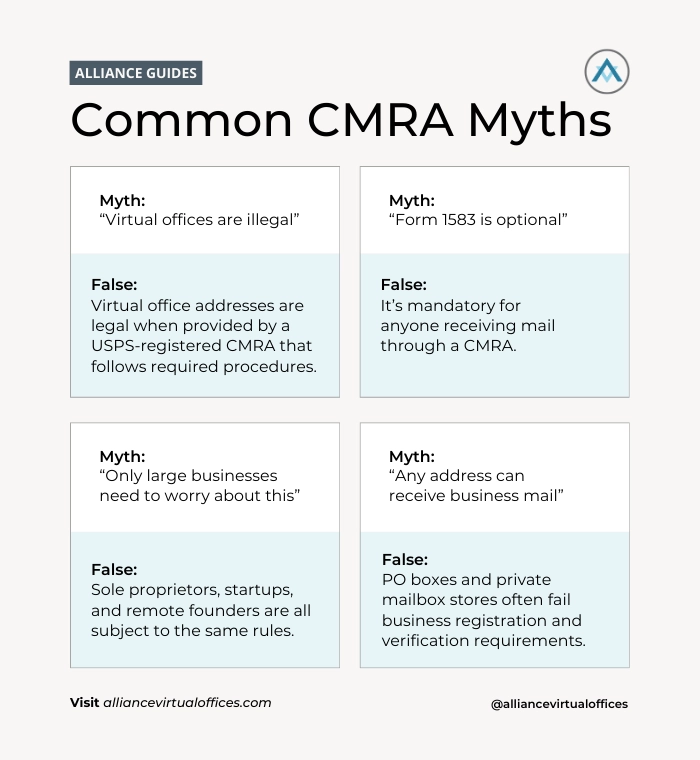
A: Yes. Virtual office addresses are legal when provided by a USPS-registered Commercial Mail Receiving Agency (CMRA). To remain compliant, business owners must authorize mail handling by completing USPS Form 1583, verify their identity, notarize the form, and keep authorization details up to date.
Running a business today often means operating without a traditional office. Remote teams, home‑based founders, digital nomads, and international companies all rely on professional mailing addresses to stay credible and functional.
That’s where confusion usually starts.
Search online and you’ll see a lot of conflicting information about USPS rules, Form 1583, and virtual office addresses. Much of that confusion comes from misunderstanding how Commercial Mail Receiving Agencies work and what the Postal Service actually requires.
The reality is straightforward: virtual offices are legal when they operate in line with USPS CMRA rules.
This guide breaks down those rules in plain English. No scare tactics. No legal jargon. Just a clear explanation of what’s required, why it exists, and how to protect your business by choosing the right provider.
Unlock Our Current Virtual Office Offers
Enter your email below and we’ll send you the latest available promotions and monthly specials for Virtual Offices, Meeting Rooms, and Live Receptionists.
What Is a CMRA?
CMRA stands for Commercial Mail Receiving Agency.
According to the United States Postal Service, a CMRA is any business that receives mail on behalf of others. This includes:
- Virtual office providers
- Executive suite centers
- Business centers
- Mail forwarding services
If a company accepts mail for clients, it falls under CMRA rules. That applies whether the address looks like a traditional office or not.
The USPS treats CMRAs differently from residential addresses because mail is being handled on behalf of multiple recipients. That distinction is about accountability, not restriction.
How the USPS Defines and Oversees CMRAs
USPS authority over CMRAs comes from the Domestic Mail Manual (DMM 508), which outlines how third-party mail recipients must operate.
Under these rules, a CMRA must:
- Register with the USPS
- Maintain records authorizing each mail recipient
- Verify identities before accepting mail
- Make records available for USPS inspection when requested
These requirements ensure that every piece of mail delivered through a CMRA has a clearly authorized recipient.
CMRA vs Residential Address vs PO Box
Not all addresses are treated equally by the USPS.
Residential addresses receive mail directly tied to an individual occupant. PO boxes are USPS-controlled mail receptacles with limited business use.
CMRAs sit in between. They are private businesses authorized to receive mail for multiple people or companies under strict conditions.
This is why a virtual office address is fundamentally different from a PO box or private mailbox store. The rules governing it are more robust, not more permissive.
Virtual office providers legally operate as CMRAs by following these standards, registering properly, and maintaining ongoing authorization records for every client.
The Small Business Administration emphasizes that business addresses must be real, verifiable locations capable of receiving official correspondence. CMRA-compliant virtual office addresses meet these criteria when they are properly authorized and operated.
Why the USPS Regulates Virtual Office Addresses
USPS regulation exists for one primary reason: mail security.
The Postal Service has a responsibility to prevent fraud, identity misuse, and unauthorized mail handling. When mail is routed through third-party providers, additional safeguards are required.
That’s why the USPS regulates how CMRAs operate.
Regulation vs Restriction
This is where most of the confusion comes from.
Regulation doesn’t mean something is banned. It just means there are rules around how it’s done.
The USPS doesn’t prohibit virtual offices. It sets standards so mail can be received, authorized, and handled properly.
When you see headlines suggesting virtual offices are “illegal,” they’re usually pointing to providers that aren’t following the rules, or situations where an address is being misused—not the virtual office model itself.
Alliance Virtual Offices, for example, operates fully within those USPS CMRA standards. Each location is properly registered, mail handling is authorized through USPS Form 1583, and addresses are tied to real, staffed office space. That’s why they’re widely accepted by banks, regulators, and licensing bodies.
Why Regulation Is Increasing, Not Decreasing
As remote work, digital businesses, and international entrepreneurship have expanded, the USPS has increased oversight of third-party mail handling.
This isn’t targeted at legitimate businesses. It’s designed to prevent:
- Identity fraud
- Shell company abuse
- Financial crimes enabled through anonymous mail access
For legitimate business owners, regulation creates a safer system. It ensures that when you use a virtual office address, that address carries verifiable legitimacy rather than ambiguity.
What These Rules Actually Protect
USPS CMRA rules protect:
- Mail recipients, by preventing unauthorized access
- Financial institutions, by ensuring address legitimacy
- Government agencies, by maintaining traceable correspondence
- Businesses, by preserving address credibility
When followed correctly, CMRA rules create clarity and trust across the entire mail ecosystem.
What Is USPS Form 1583?
USPS Form 1583 is the authorization document that allows a CMRA to receive mail on your behalf.
It’s required for every individual or business using a virtual office or mail‑receiving service. There are no exceptions based on company size, location, or how often you receive mail.
The form exists to create a clear, verifiable chain of custody for mail. In simple terms, it answers one question for the USPS:
Who is authorized to receive mail at this address?
Without that answer, the Postal Service cannot legally allow mail to be delivered through a third party.
The form serves three critical purposes:
- Confirms your identity
- Confirms your consent
- Creates a permanent authorization record tied to the address
The USPS requires two forms of valid identification.
One must be photo‑based, such as:
- Driver’s license
- Passport
- State‑issued ID
The second confirms identity or address, such as:
- Utility bill
- Bank statement
- Lease or mortgage document
These requirements help ensure that mail cannot be claimed or redirected by unauthorized parties.
Why Notarization Is Mandatory
Notarization is not a formality. It is a safeguard.
A notary verifies that the person signing the form is present, identifiable, and acting willingly. This step dramatically reduces mail fraud and identity misuse.
Both in‑person and approved online notarization are acceptable under USPS rules. Providers that eliminate notarization entirely are not operating compliantly.
Who Stores Form 1583 and Why It Matters
Once completed, your CMRA provider must securely store the form and associated identification.
The USPS may request these records during audits or investigations. Providers are required to produce them promptly.
This is why secure handling matters. Improper storage, missing forms, or expired authorizations put both the provider and the client at risk.
CMRA rules apply broadly, but certain situations deserve additional clarity.
Businesses With Multiple Recipients
Companies can authorize multiple individuals to receive mail at the same address. Each authorized recipient must be listed correctly to avoid delivery issues.
Personal vs Business Mail
USPS authorization distinguishes between personal and business identities. Businesses should ensure the entity name is clearly listed, not just an individual.
International Business Owners
International founders are fully subject to CMRA requirements, even if they do not live in the United States.
Non-U.S. business owners must still establish clear authorization for mail handling. This includes:
- Completing USPS Form 1583
- Providing acceptable identification, such as a passport
- Listing authorized recipients accurately
This step is especially important for international companies that:
- Register U.S. LLCs or corporations
- Apply for EINs
- Open U.S. bank accounts
- Receive IRS or regulatory correspondence
Failure to complete authorization correctly can result in mail delays or address rejection during financial or regulatory reviews.
What Happens If You Ignore CMRA Rules
Ignoring CMRA requirements doesn’t usually cause immediate issues. Mail may still arrive at first, and everything can appear to be working normally.
The problems tend to surface later, when your address is relied on for something important.
That’s because CMRA compliance is often checked indirectly. Not by the USPS day-to-day, but by banks, government agencies, and platforms that depend on mail authorization being valid behind the scenes.
When those checks happen, missing or incomplete authorization becomes visible very quickly.
Short-Term Consequences
In the short term, the most common issues are operational.
Mail may be rejected or suspended if authorization cannot be confirmed. In some cases, delivery is paused until proper documentation is provided.
Government or legal notices can be delayed or returned. This includes correspondence from state agencies, the IRS, courts, or licensing bodies.
Missed deadlines are a frequent result. When time-sensitive mail doesn’t reach you, filings, renewals, or responses can lapse without warning.
These issues often feel sudden because the failure point happens upstream, before you ever see the mail.
Long-Term Business Risks
Over time, unresolved CMRA authorization issues create larger credibility problems.
Banks may question the legitimacy of your address during account setup or periodic reviews. If mail handling authority cannot be verified, additional documentation may be required, or accounts may be restricted until verification is complete.
Licensing agencies may delay or deny applications if official mail is returned or if the address fails validation checks. This can slow business launches, renewals, or expansions.
Re-verification requests become more frequent. As institutions tighten identity and address controls, businesses using unclear or non-compliant addresses are more likely to be flagged for repeated reviews.
In the worst cases, an address that develops a pattern of authorization issues may be treated with increased scrutiny across multiple institutions, even if the business itself is legitimate.
This is why CMRA compliance matters most before there’s a problem. When authorization is handled correctly from the start, your address works quietly in the background. When it isn’t, friction tends to appear at the exact moment you can least afford it.
Real-World Scenarios Business Owners Encounter
A bank requests address verification during account setup or periodic review. If your Form 1583 is missing or improperly completed, the address may be rejected.
A licensing agency sends time-sensitive documents that are returned because authorization isn’t on file.
A compliance review flags your address as non-verifiable, triggering additional documentation requests.
In more serious cases, repeated violations at a location can cause the address itself to be scrutinized across institutions.
Why Cheap Providers Create Risk
Low-cost address services often skip enforcement.
They may:
- Delay or avoid collecting Form 1583
- Fail to verify identification
- Lack secure mail handling procedures
When that happens, the liability doesn’t disappear. It shifts to the business using the address.
CMRA compliance protects legitimate businesses by creating clear authorization and accountability.
How Alliance Virtual Offices Meets USPS Requirements
Alliance Virtual Offices operates within USPS CMRA rules across its nationwide network of real business centers.
Compliance is built into the process from day one.
That includes:
- Proper CMRA registration at each participating location
- Secure collection and storage of notarized USPS Form 1583 documents
- Identity verification aligned with USPS standards
- Ongoing monitoring to maintain address integrity
Mail is received by onsite staff in professional office environments, logged securely, and handled according to postal guidelines.
Why Real, Staffed Space Matters for Compliance
Many address services exist purely online. While they may appear similar on the surface, their operational reality is different.
Addresses tied to real, staffed office locations demonstrate:
- Physical presence
- Controlled access to mail
- Accountability for handling procedures
- Consistency over time
These factors matter during bank reviews, licensing checks, and regulatory verification.
This is why Alliance Virtual Offices addresses are widely accepted by:
- Banks
- Licensing agencies
- Government offices
- Corporate partners
Compliance here isn’t about box-checking. It’s about preserving long-term credibility for your business address.
Why Banks, Regulators, and Platforms Care About CMRA Compliance
For many business owners, USPS rules feel disconnected from day-to-day operations. But CMRA compliance regularly shows up in places you don’t expect.
Banks, payment processors, licensing agencies, and online platforms increasingly rely on address verification as part of their risk controls. When an address cannot be clearly authorized, it raises questions about legitimacy—even if the business itself is real.
Banking and Financial Institutions
When opening or maintaining a business bank account, institutions often verify:
- Whether the address is a real commercial location
- Whether mail can be legally received there
- Whether authorization exists for third-party mail handling
A missing or improperly completed Form 1583 can trigger additional reviews, document requests, or outright rejection. This is especially common during periodic account re-verification, not just initial setup.
Licensing and Government Agencies
State agencies, tax authorities, and licensing boards rely on mail delivery for official correspondence. Returned or rejected mail can delay approvals, renewals, or compliance notices.
Because CMRA authorization is tied to address legitimacy, agencies may question addresses that lack clear USPS authorization.
Online Platforms and Marketplaces
Many platforms now conduct address and identity reviews to combat fraud. If an address appears inconsistent or unsupported by proper mail authorization, accounts may be flagged for additional verification.
In all of these cases, CMRA compliance functions as infrastructure. When it’s in place, things work quietly in the background. When it’s missing, friction appears fast.
Final Takeaways for Business Owners
CMRA rules aren’t complicated once you understand them.
They exist to protect mail access, business identity, and address credibility. When handled correctly, they create confidence, not friction.
The key is choosing a provider that follows the rules instead of avoiding them.
A compliant virtual office address supports your business registration, banking relationships, and long‑term stability. It’s a safeguard, not a barrier.
If you’re evaluating virtual office providers, make sure USPS authorization is part of the process. Your business depends on it.
A compliant address protects more than your mail. It protects your business credibility.
Alliance Virtual Offices provides USPS-compliant business addresses tied to real, staffed office space, so you can move forward with confidence.