
- The best answering services for small businesses at a glance
- How much does an answering service cost?
- Live, AI, or virtual: which type of answering service fits your business?
Q: What is the best answering service for a small business?
A: For most small businesses, Alliance Virtual Offices’ Live Receptionist offers the best balance of US-based live answering, published pricing, and value, starting at $125 a month. PATLive is the strongest option specifically for round-the-clock coverage, and Smith.ai leads on AI answering.
A customer calls while you are on a job site, sitting in a meeting, or driving between appointments. The phone rings four times and lands in voicemail.
Most of those callers will not leave a message. A 2024 study by 411 Locals monitored calls to 85 businesses across 58 industries and found that only 37.8% were answered by a live person, with the rest going to voicemail or getting no response at all.
That gap is why an answering service for small business owners has shifted from a nice-to-have into a standard line item. The tricky part is not deciding whether you need call answering.
It is working out which type you need, and what you should reasonably expect to pay.
The market has changed quickly too. Two years ago the choice was a human team or voicemail, and now AI voice agents sit between those options at a lower price point.
This guide compares live, AI, after-hours, and budget options side by side.
The best answering services for small businesses at a glance
The best answering services for small businesses fall into three broad camps, and the camp matters more than the brand name. Human-first services put a trained agent on every call, AI-first services use a voice agent that can escalate to a person, and budget services trim minutes or features to hit a lower monthly price.
Price structure differs too. Some providers bill by the minute, some bill by the call, and the two models produce very different invoices at the same call volume.
Coverage is the third variable. A provider staffing agents at 3am on a Sunday carries a payroll cost a business-hours team does not, and that shows up in the entry price rather than the feature list.
If any of these terms are new to you, our guide to what a live receptionist actually does is a useful primer before you start comparing plans.
Here is how the leading options compare on the things that actually change your monthly bill.
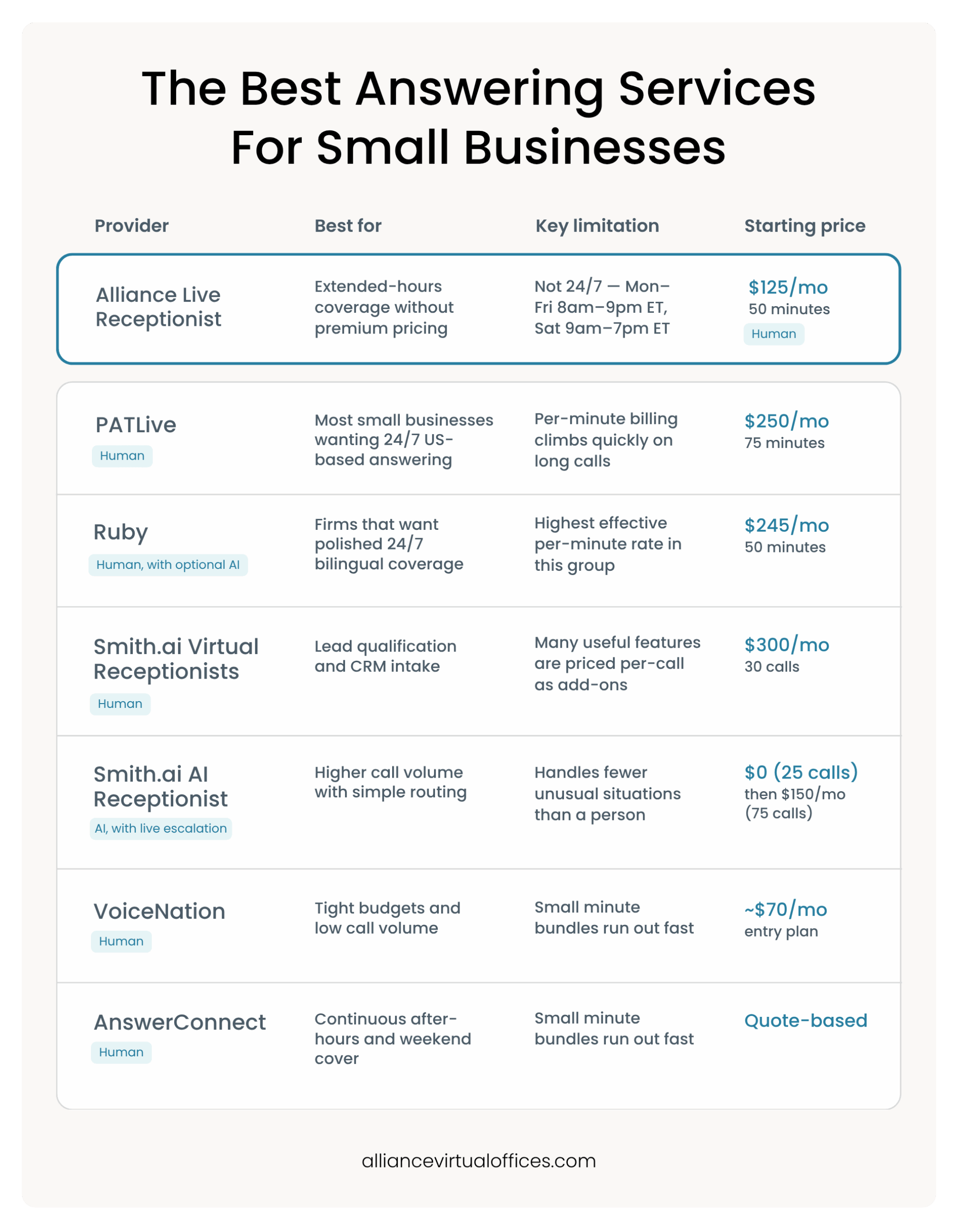
Two notes before you scan that table again. Starting prices are entry tiers, so the realistic monthly cost for a business taking 20 to 40 calls a month usually sits one tier higher.
And after-hours coverage is a genuine differentiator rather than marketing gloss. Providers that staff nights, weekends, and holidays charge more for it, and providers with narrower hours pass that saving on.
One more thing the table cannot show. Two providers quoting similar monthly figures can still produce invoices that differ once overage and add-ons are applied.
Best answering service for small business needs: six clear picks
The right answer depends on your call volume, your hours, and how much judgment you need an agent to exercise. A roofing contractor fielding emergency calls at 11pm has a different problem than a consultant who wants three calls a day screened properly.
Below are six verdicts, each with the reason behind it.
Best overall: Alliance Live Receptionist
Alliance is the strongest overall pick for most small businesses: US-based live agents, published pricing starting at $125 a month for 50 minutes, no setup fee, and the lowest overage rate in this comparison at $1.75 per minute. Every tier includes a dedicated business number and virtual phone system bundled in, which most competitors charge for separately.
Every tier includes a dedicated business number and virtual phone system bundled in, which most competitors charge for separately.
The trade-off is honest rather than hidden. Coverage runs Monday to Friday, 8am to 9pm Eastern, and Saturdays 9am to 7pm Eastern, which is not 24/7. For the large majority of small businesses whose calls arrive during extended business hours, that’s a non-issue and the value is hard to match at this price.
Worth sizing before you sign: the 100-minute tier at $175 a month is the common starting point for a business taking steady daily calls, with room to move up or down as your real volume becomes clear.
NEXT STEPS: Compare Alliance Live Receptionist plans and pricing
Best for 24/7 coverage: PATLive
PATLive publishes its rates, staffs US-based agents around the clock, and scales in sensible steps. Plans run from a Starter tier at 75 minutes for $250 a month up to a Pro tier at 600 minutes for $1,170, with additional minutes billed between $2.00 and $2.35 depending on the plan.
Every tier includes one phone number and ten users, with no contract and no setup penalty. For a service business that needs real people answering at unpredictable hours, that combination is hard to beat at the price.
The caveat is the billing model. Per-minute pricing rewards short, efficient calls and punishes long ones, so a practice with detailed intake conversations may burn through a bundle faster than expected.
Worth sizing before you sign: 75 minutes is roughly 25 to 30 calls at a typical two-to-three minute length. Most service businesses taking calls all day will sit on the 200-minute tier.
Best premium live option: Ruby
Ruby is the most polished human service in this comparison and prices accordingly. Its published plans start at $245 a month for 50 minutes, rising through 100, 200, and 500-minute tiers as volume grows.
What you get for the premium is 24/7 answering including holidays, bilingual English and Spanish handling, appointment scheduling, payment collection, and more than 5,000 integrations. Ruby also states there are no extra fees for activation, onboarding, or customization, which removes a common source of bill creep.
At a high effective per-minute rate, Ruby is a considered purchase rather than an impulse one. Law firms, medical practices, and high-value service businesses tend to justify it on a single retained client.
Read More: AI Receptionist vs. Live Receptionist
Best AI answering service: Smith.ai AI Receptionist
AI has changed the low end of this market more than any other development in the past two years. Smith.ai’s AI Receptionist starts free with 25 calls a month, then scales up from there as call volume grows.
The reason it leads the AI category is the escape hatch. Calls start with the AI, and anything complicated can transfer to a live North America-based agent, so callers are not trapped in a loop with a voice agent that cannot help them.
An AI answering service works best when your calls are repetitive. Appointment requests, hours and location questions, basic qualification, and routing are all well within range. Nuanced complaints, sensitive conversations, and anything requiring genuine judgment still favor a person.
Best after-hours answering service: AnswerConnect
If your problem is specifically the 6pm to 8am window plus weekends, an after-hours answering service is the narrower and cheaper fix. AnswerConnect staffs agents continuously in English and Spanish, takes messages, follows your scripts, and routes calls according to rules you set.
The drawback is transparency. AnswerConnect does not publish rates, so you will need a quote, and third-party guides report figures too varied to plan against.
Worth knowing: many providers, including Alliance and Smith.ai, let you forward calls only during chosen hours. You can often build after-hours cover from a standard plan rather than buying a separate product.
Best cheap answering service: VoiceNation
For owners who want a person on the line without a premium invoice, VoiceNation is the most accessible entry point in this group. Plans start around $70 a month for a small minute bundle, with per-minute billing above the included allowance.
A cheap answering service earns its place when call volume is genuinely low. Ten or fifteen calls a month, mostly short, is the profile where a small bundle works.
The risk is overage. Entry plans are sized tightly, and a single busy week can push you past the allowance at a rate that makes the next tier up look like the better deal all along.
How to Get A FREE Live Receptionist
Request Your Code Below and Get a FREE
Live Receptionist for 1 Month!

How much does an answering service cost?
Most small businesses pay between $125 and $400 a month for live call answering covering 50 to 200 minutes, or roughly 30 to 60 calls. AI-only services typically land between $25 and $250 a month, and premium human services with 24/7 bilingual coverage commonly run $400 to $1,700.
Those ranges hold across the published pricing in this article. What moves you inside the range is the billing model, so it helps to understand all three.
Here is the practical way to compare two quotes. Estimate your monthly call volume, multiply by your average call length, then price the same volume under both models, or use our live receptionist calculator to see the numbers for your own call pattern.
A business taking 40 calls a month at three minutes each needs 120 minutes. Under per-minute pricing at $2.20, that is roughly $264. Under per-call pricing at $10.00, the same 40 calls cost $400.
Now flip the assumption. If those 40 calls average eight minutes, per-minute pricing jumps past $700 while per-call pricing stays at $400.
Setup fees, overage rates, and add-on charges are where quoted prices and actual invoices part ways. Ask specifically about activation fees, per-call charges for appointment booking or CRM sync, minimum billing increments, and how spam calls are counted.
Smith.ai is a useful illustration because it publishes its add-on list. Appointment booking is $1.50 per call, SMS or Slack notifications are $0.50, call recording and transcription is $0.25, and a dedicated Spanish line is $1.00 per call.
None of those are unreasonable individually. Stack four of them on a 90-call plan and you have added several hundred dollars a year that sat outside your original comparison.
Overage is the other line item that surprises people. Published rates here range from $1.75 per minute to $11.50 per call, so guessing your call volume wrong costs very different amounts depending on the provider.
The return side of the equation is easier to reason about than most cost calculators suggest. Research published in Harvard Business Review found that firms contacting an inbound lead within an hour were nearly seven times as likely to have a meaningful conversation with a decision maker as those that waited just one hour longer.
Answering the phone is the fastest version of that response. If your average client is worth several hundred dollars, one recovered call a month can cover the cost of the service, which is why owners often start with a US-based live receptionist rather than a bare-bones message-taking plan.
Live, AI, or virtual: which type of answering service fits your business?
The category labels overlap, which makes shopping confusing. A traditional answering service takes messages and passes them on.
A live receptionist answers in your company name, screens, schedules, and acts as an extension of your team. A virtual answering service is the umbrella term for any off-site call handling, human or automated.
That distinction matters because pricing follows capability. Message taking is the cheapest tier of call answering, and full receptionist duties cost more because they need training, scripting, and access to your calendar.
It also shapes how callers perceive you. A virtual answering service that only takes messages signals a switchboard, while a receptionist who can book the appointment signals your business.
A virtual answering service that only takes messages signals a switchboard, while a receptionist who can book the appointment signals your business.
Use this framework to narrow it quickly.
Choose live human answering if your calls involve money, health, legal matters, distress, or negotiation. Callers in those situations judge your business on the first thirty seconds, and a person handles ambiguity better than a script.
Choose an AI answering service if your call volume is high, your questions are repetitive, and speed matters more than nuance. AI answers instantly at 2am without an overnight staffing premium, and modern voice agents handle scheduling and routing competently.
Choose a hybrid if you sit between those two, which most growing businesses do. AI takes first contact and filters spam, then live agents pick up the calls that carry real value.
There is a fourth option worth naming honestly. If you receive fewer than five calls a month, a well-recorded voicemail greeting plus a same-day callback habit may serve you better than any subscription.
Call volume is the variable that should drive this decision, and most owners guess it rather than measure it. Your phone system or mobile carrier can usually export a call log, and thirty days of real data beats an estimate.
Read the timestamps on missed calls rather than the headline count. Calls you returned within minutes are not lost revenue; calls that rang out mid-afternoon probably are.
A frequent objection is that outsourced answering sounds impersonal. In practice the opposite problem is more common: callers reaching a rushed owner who is clearly doing something else.
The wider case for delegating the phone is laid out in 9 reasons to use a telephone answering service.
How to choose the right answering service in six checks
Once you have shortlisted two or three providers, the decision usually comes down to operational fit rather than headline price. These six checks surface the differences that show up after you sign.
1. Agent location. US-based agents typically cost more than offshore teams and tend to score better on accent familiarity and local context. Ask where agents sit and whether that holds outside core hours, since some providers use offshore overflow teams overnight.
2. Actual coverage hours. Confirm the published schedule rather than assuming continuous cover. Ruby, PATLive, Smith.ai, and AnswerConnect all staff 24/7, while other providers run business-hours schedules at a lower price.
3. Scripting depth. Ask how much of the call flow you control, including greeting wording, screening questions, transfer rules, and what agents say when you are unavailable. Thin scripting is the most common reason owners feel a service is not representing them well.
4. CRM and calendar integration. Message taking is only useful if the message reaches your workflow. Check whether call details push automatically into your CRM or calendar, and whether that sits in the base price.
5. Contract flexibility. Month-to-month terms are now standard among the providers listed here. Check the cancellation notice period, since 30 days is common and easy to miss.
6. Bilingual capability. If a meaningful share of your callers speak Spanish, verify it is included rather than billed per call. Ruby includes bilingual handling in its plans, while Smith.ai lists a dedicated Spanish line as a per-call add-on.
A seventh check worth adding for growing teams: escalation clarity.
Most comparisons stop at the six checks above, but one more matters once your business has more than one person who might need to take a call. Ask the provider exactly what happens when a call needs a human decision the agent can’t make on the spot.
Does it go to a manager on their end, to you directly, to a specific team member, or does it wait in a queue until someone follows up? Vague answers here are a warning sign, since a good provider should be able to describe the escalation path in one sentence, not a paragraph of caveats.
This matters more than it sounds like it should. A roofing contractor with two crew leads and an office manager needs calls routed differently depending on the hour and the nature of the request, and a provider that only knows how to route to “the business owner” will create bottlenecks the moment you’re not available.
Ask for a real example from onboarding, not a hypothetical, and if the provider can walk you through how a genuinely awkward call gets handled today, that’s a good sign the answer isn’t theoretical.
Run those six checks against your shortlist and the answer usually becomes obvious. One provider will match your hours and your billing model better than the others.
Then test before you commit. Most providers run test calls during onboarding, and calling your own new number as a stranger would is the fastest way to hear what your callers hear.
Listen for three things: answer speed, whether your business name is said correctly, and whether the agent sounds like they know what you sell. Fix the script before you go live rather than after your first real client hears it.
For owners who spend most of the week away from a desk, coverage and mobile notifications carry more weight than integrations. Our comparison of the best virtual receptionist services for mobile professionals breaks that scenario down further.
Choosing the best answering service for your small business
The best answering services for small businesses are the ones sized to your real call volume, not the ones with the longest feature list. Start with your hours, then your monthly minutes, then the billing model that matches how long your calls actually run.
If continuous overnight cover is the requirement, PATLive and Ruby are the strongest human options and their pricing reflects that. If your calls are repetitive and volume is climbing, an AI answering service with human escalation will cost less and answer faster.
For businesses that want US-based people on the phone during extended working hours, Alliance’s Live Receptionist service is worth a look. Plans are published, there is no setup fee, and every tier includes a dedicated business number and virtual phone system.
Additional minutes are billed at $1.75, which is the lowest published overage rate among the live services compared here. The receptionist team is US based and answers Monday to Friday from 8am to 9pm Eastern and Saturdays from 9am to 7pm Eastern.
That schedule is the honest trade. It is not 24/7, so businesses needing overnight cover should look at the continuous providers above.
For the many small businesses whose calls arrive during extended business hours, it typically delivers US-based live answering at roughly half the entry price of the premium alternatives.
Pick the option that matches your hours and volume, run it for 60 days, then review the call logs. The data will tell you whether to move up a tier, down a tier, or stay put.
Frequently Asked Questions
What is the best answering service for a small business?
How much does an answering service charge?
How much does an AI answering service cost for a small business?
What is the difference between an answering service and a live receptionist?
Do I need a 24/7 or after-hours answering service?
Further Reading