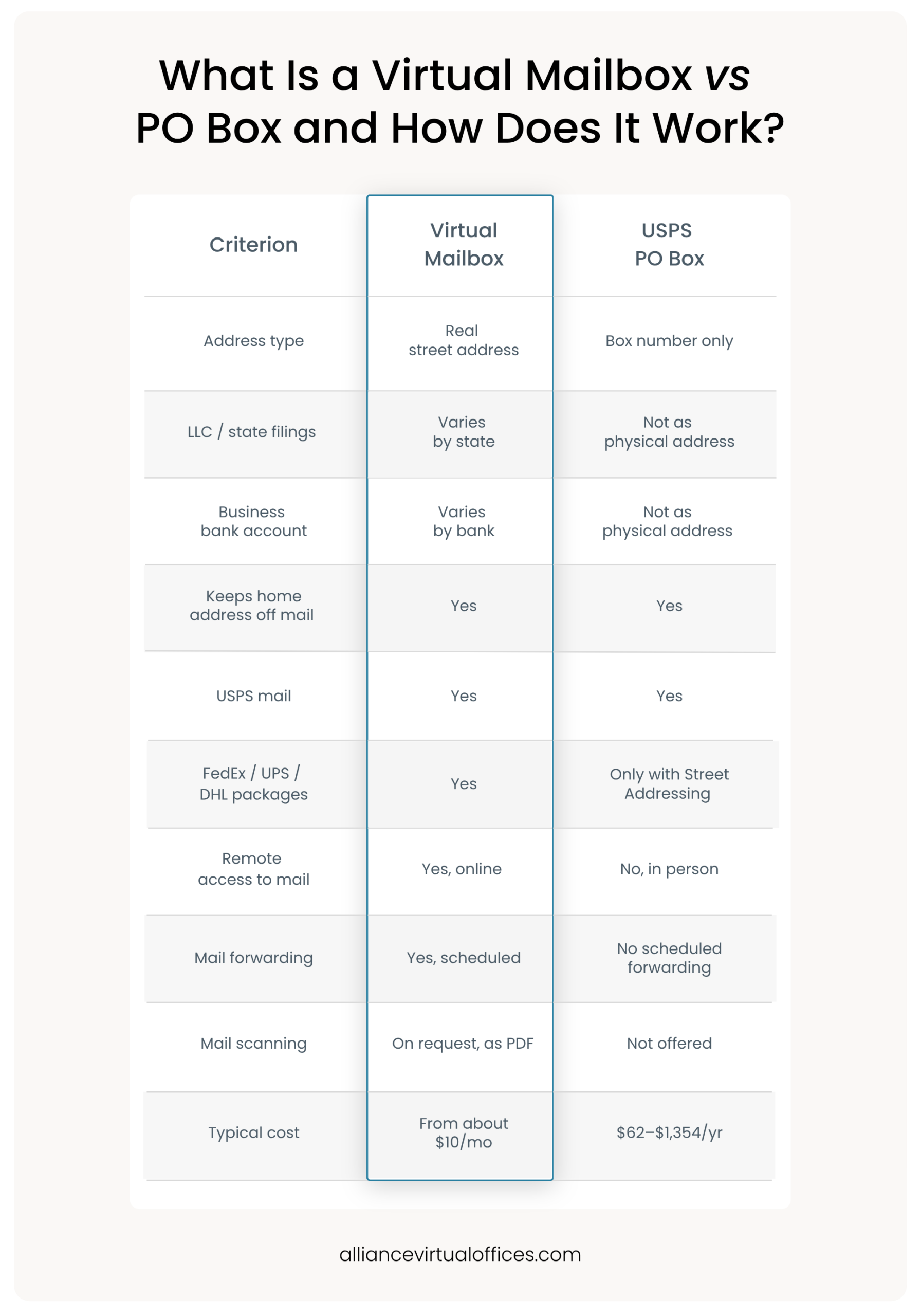
- Virtual PO Box vs USPS PO Box for Business: Side-by-Side
- What Is a USPS PO Box, and What Does One Cost in 2026?
- Will a Virtual PO Box for Business Work for LLC Registration and Banking?
Q: Can you use a virtual PO Box for business?
A: Yes. A virtual PO Box, more accurately a virtual mailbox, gives you a street address for business mail, your website, and invoices, and you may be able to use it on state filings and bank accounts, depending on your state and bank. A USPS PO Box gives you a box number, not a street address.
There are 30,427,808 nonemployer establishments in the United States, and they make up 78.4% of all U.S. establishments, according to the U.S. Census Bureau. For many of those owners, the only address on hand is home.
The business still needs an address for the Secretary of State, the bank, the tax forms, and its clients, and the risks of using your home address for business start once that address lands on a public filing. A virtual PO Box for business and a USPS PO Box are the two cheapest fixes, and they are not interchangeable.
Here is what each option costs in 2026, using the prices USPS publishes, and how each one fares with your state, your bank, and your carriers. The side-by-side comes first.
Virtual PO Box vs USPS PO Box for Business: Side-by-Side
The two options overlap on one job: keeping your home address off your mail. Here is how a virtual PO Box for business and a USPS PO Box compare on the ten criteria that matter to a business owner.
Fee group and box size drive the PO Box range, and the 2026 USPS rate table below shows how far it moves.
Read More: How a Virtual Mailbox Works: Mail Forwarding and Scanning
What Is a Virtual Mailbox, and How Does It Work for Business?
A virtual mailbox is a real street address at a commercial building where staff receive your business mail, scan it, and store, forward, or shred each piece on your instructions. You see every envelope online and decide what happens to it without visiting the building.
That definition answers what is a virtual mailbox, and it also answers what is a virtual PO Box, since both names describe the same product. Alliance walks through the full workflow in how a virtual mailbox works.

How Does a Virtual Mailbox Work Day to Day?
Mail arrives at the building, staff log each item, and an image of the envelope appears in your online dashboard. You choose what happens next for every piece.
Open and scan the contents, forward the item to wherever you are, hold it for pickup, or shred it. Nothing moves until you decide.
Key features
If you’re asking how does a virtual mailbox work for a business, the feature list below provides the answer. Name each feature precisely when you compare plans, because the vague version makes every service sound alike.
- A street address in a commercial building for business mail, your website, and invoices
- Envelope imaging, so you see what arrived before you decide anything
- Content scanning on request, delivered as a PDF
- Physical forwarding on a schedule you set
- Package acceptance from USPS and from private carriers
- Shredding and disposal of items you don’t want
Mail scanning and forwarding turnaround
Mail scanning turnaround is usually same business day or next business day, depending on when your mail arrives relative to the daily sort.
Mail forwarding runs on a cadence you set instead of on request. Daily, weekly, biweekly, and monthly are the standard options.
Cadence matters more than it sounds. A consultant who gets one check per month wants monthly forwarding and a low bill, and an e-commerce seller waiting on supplier documents wants daily.
Compare the mail forwarding options for business before you pick a plan. Remote access is the reason many owners buy a virtual mailbox in the first place.
In 2025, 35% of employed people did some or all of their work at home on days they worked, up from 33.4% in 2024, according to the Bureau of Labor Statistics American Time Use Survey. A mail service that needs a trip to a counter doesn’t fit that pattern.
CMRA status and USPS Form 1583
A Commercial Mail Receiving Agency (CMRA) is a private business registered with USPS to receive mail for other people at its own street address. Every legitimate virtual mailbox provider operates as a CMRA, and USPS requires it to verify who each mailbox belongs to before it accepts mail.
Every legitimate virtual mailbox provider operates as a CMRA, and USPS requires it to verify who each mailbox belongs to before it accepts mail.
USPS Form 1583 (PS Form 1583) is the USPS authorization that names you as the addressee and permits a CMRA to receive mail on your behalf. You sign it, show current government-issued identification, and the CMRA keeps the form on file.
Two details trip people up. Your ID has to be current, and you need a new form whenever any detail on the old one changes, including your name, your address, or the list of people allowed to receive your mail.
USPS now runs these forms through an electronic database instead of paper files at the local Post Office. USPS revised DMM 508.1.8 effective July 1, 2023, in part to support that database.
You can complete USPS Form 1583 with our guided wizard instead of working from the raw form. For the regulatory detail, see what a CMRA is and how it differs from a PO Box.
How to set up a virtual mailbox
Once the question of what is a virtual mailbox is settled, setup is quick. Most of it happens online, in this order.
- Choose a provider and an address, and confirm the building is a commercial site.
- Check your state’s filing rules and your bank’s address requirements before you commit.
- Complete USPS Form 1583 and verify your identity, which many providers handle with remote notarization.
- Pick a forwarding schedule and any mail scanning options you want.
- Update your address with vendors and clients, and on filings where your state allows it.
Unlock Our Current Virtual Office Offers
Enter your email below and we’ll send you the latest available promotions and monthly specials for Virtual Offices, Meeting Rooms, and Live Receptionists.
What Is a USPS PO Box, and What Does One Cost in 2026?
A USPS PO Box is a locked mailbox inside a Post Office, addressed by a box number and rented in three-month or six-month terms. It holds your mail until you collect it, and it gives you a box number in place of a street address.
The product runs at national scale. USPS manages more than 21 million Post Office Boxes, which generated $1.5 billion in revenue in FY2023, according to the USPS Office of Inspector General’s Service Optimization: Post Office Boxes audit.
Those boxes sit inside 30,972 retail offices, made up of 26,147 Post Offices and 4,825 stations, branches and carrier annexes in FY2025.
The network delivered to 170.4 million delivery points and handled 108.7 billion pieces of mail and packages in FY2025.
Key features of a USPS PO Box
A PO Box does one job, and its feature list is short. Here is what you get:
- A locked box inside a Post Office lobby
- A box number address, not a street address
- Five box sizes
- Three-month or six-month rental terms
- Optional USPS Street Addressing at participating Post Offices
- In-person pickup during lobby hours
Who uses PO Boxes
The typical PO Box holder isn’t a business. People rent them because home delivery is unreliable, because they move often, or because they want a locked box instead of a curbside one.
Businesses rent them for a narrower reason. They want mail kept away from the house without paying for other services.
What a USPS PO Box costs in 2026
The figures here use USPS prices effective June 15, 2026, from the official USPS 2026 PO Box price file. The file publishes three-month and six-month terms only, with no 12-month tier.
That means any annual PO Box price is derived. The annual figures here are six-month rates doubled, and they’re labeled as derived.
Pricing runs on two schedules. Market Dominant covers Fee Groups 1 through 7 at standard Post Offices, and Competitive covers Fee Groups C30 through C44, boxes in competitive markets priced well above the rest.
Here is the Market Dominant six-month schedule by fee group and box size.
Three-month rates run from $21.00 (Size 1, Fee Group 7) to $339.00 (Size 5, Fee Group 1). Competitive six-month rates run from $80.00 to $677.00.
The headline figures:
- Cheapest PO Box: $21.00 for three months or $31.00 for six months (Size 1, Fee Group 7), or $62.00 a year derived
- Most expensive published PO Box: $677.00 for six months (Size 5, Fee Group C30), or $1,354.00 a year derived
- Full derived annual range: $62 to $1,354
- Extra fees: $6.00 key deposit, $14.00 key duplication or replacement, and $30.00 customer-initiated lock replacement
Same box, different town. A Size 1 box costs $31.00 for six months in Fee Group 7 and $170.00 for six months in Fee Group C30, a 5.5x spread on an identical box.
Fee group belongs to the individual Post Office. Check the price for the box you want at usps.com before you budget around any figure here.
Can FedEx, UPS and DHL deliver to a PO Box?
Yes, under two conditions.
USPS Street Addressing is an opt-in USPS service that lets a PO Box holder receive mail and packages at the Post Office’s street address, with the box number written as a unit or suite number. It is the mechanism that makes FedEx, UPS, and DHL delivery to a PO Box possible.
First, the local Post Office has to offer Street Addressing, and not every one does. Second, the box holder has to opt in.
Exclusions apply even then. Alcohol isn’t accepted, nothing over 70 pounds is accepted, and anything prohibited from the mail stays prohibited.
A PO Box can take a FedEx or UPS parcel at some Post Offices and not at others, and you won’t know until you ask. A virtual mailbox at a commercial street address accepts carrier packages as a standard feature.
Read More: Virtual Office vs PO Box vs CMRA: Which Business Address Solution Is Right for You?
Key Differences Between a Virtual Mailbox and a PO Box for Business
Knowing what is a virtual PO Box and what a PO Box costs doesn’t settle the virtual mailbox vs PO Box choice. Price is the usual starting point, and the differences that decide the purchase are structural.
Physical vs. digital
A PO Box is a physical destination you visit. Mail sits in a metal box, and retrieving it means going there.
A virtual mailbox is a physical destination someone else visits for you. The interface is a screen, and the mail moves only when you tell it to.
Address type
This is the distinction that decides most forms. In the PO Box vs virtual address question, a PO Box gives you a box number at a Post Office, and a box number is not a street address.
A virtual mailbox gives you the street address of a commercial building, with a unit or suite designation. That is the format a physical-address field expects.
Additional services
A PO Box does one thing: it holds mail until you collect it. It has no scanning, no content review, no forwarding schedule, and no disposal service.
A virtual mailbox is a service built around an address. Scanning, forwarding, shredding and package handling are the product, not extras bolted on.
Suitability for business use
A PO Box suits a business that receives low-volume paper mail and doesn’t need its address on a filing. It’s a mail drop, and it works as one.
A virtual mailbox suits a business whose address has to work for a Secretary of State, a bank, a supplier, and a courier.
Privacy and security: where each one wins
Neither option wins outright here. Each one solves a different privacy problem.
The PO Box case is real. A locked box inside a Post Office is a secure receptacle, and mail theft is a live problem.
News12 reported more than 800,000 mail theft complaints filed nationwide between 2023 and 2025. That figure cuts both ways, because it also argues for moving mail out of an unsecured curbside box, which both options do.
The virtual mailbox case is different in kind. It can keep your home address off public filings where your state accepts the address, and it puts your mail behind a staffed front desk instead of an unattended slot.
Will a Virtual PO Box for Business Work for LLC Registration and Banking?
These two questions decide whether a mail product is usable for a business. Here are the answers, with the reasoning behind each one.
LLC registration and state filings
A USPS PO Box is not a street address, so most Secretary of State offices reject it as a principal or physical address. Some states accept a PO Box as a separate mailing address.
A virtual mailbox address is the street address of a commercial building, and many states let you use it on formation documents. Some restrict it: Oregon currently bars a CMRA, mail forwarding business, or Virtual Office from its principal and registered office fields, and Texas does not allow a commercial mail box as a registered office unless that business is also the registered agent.
The PO Box vs virtual address question comes down to that one field, and filing requirements vary by state and entity type. Confirm address requirements with your Secretary of State before you submit.
For the mechanics, see using a business address for state LLC filings. For the permission question, see whether you can use a PO Box as your business address.
Registered agents are a separate role
A business address and a registered agent do different jobs. Every state requires a registered agent with a physical in-state address, and you may need a separate registered agent service even with a virtual mailbox.
Business bank accounts
Banks record a physical location for every business account, and a box number doesn’t identify one. A USPS PO Box can serve as a mailing address, but it won’t satisfy the physical-address field.
A virtual mailbox address can fill that field, but banking acceptance depends on the institution and its verification standards. Expect a request for formation documents and ID either way, and ask your bank before you apply.
The account is one of several things your address touches. See how your LLC address affects banking and legal standing.
Tax forms
Tax forms may distinguish mailing, principal, and physical-location addresses. Confirm the correct field for a commercial street address with the IRS or a tax professional.
This section is informational, not legal advice. Address requirements vary by state, agency, and institution.
When a USPS PO Box Is the Right Choice for Your Business
A PO Box wins on price and simplicity. For low-volume personal mail, a $62-a-year box in a low fee group does the job for a fraction of what any virtual mailbox costs.
The same goes for a side project that receives nothing but paper statements. If you want a locked box and nothing else, a PO Box is the right buy.
If you want a locked box and nothing else, a PO Box is the right buy.
Here is how the decision lands by business type.
What Alliance provides
Alliance sells the Virtual Office, which includes a business address at a staffed Coworking Center, not a mailbox store. Mail handling, scheduled mail forwarding, and access to Meeting Rooms come with the address.
Plans start at $49/month, and setup is free. Pricing varies by city because every address is a real Center.
Mail forwarding runs daily, weekly, biweekly, or monthly, on the schedule you set. Mail scanning is available as an add-on, so you can read contents without waiting for a forwarded envelope.
Each Alliance Coworking Center that receives your mail is a USPS-registered CMRA, so USPS Form 1583 is part of setup. Alliance includes the form, remote notarization and onboarding at no setup cost, and the guided wizard walks you through it.
The network covers 1,400+ locations. If someone looks up the building, they find a Center with a front desk and Meeting Rooms, and you have the option to meet a client when one asks.
NEXT STEPS: Browse Virtual Office locations
Choosing a Virtual PO Box for Business in 2026
On virtual mailbox vs PO Box, the numbers settle most of it. A USPS PO Box costs $62 to $1,354 a year for a box number that most filings won’t take as a physical address, and it’s the right buy for low-volume personal mail.
A virtual mailbox gives you a street address, scheduled forwarding, and package handling. An Alliance Virtual Office adds a staffed Coworking Center with Meeting Rooms, starting at $49/month with free setup, so pick a location and check the plan for your city.
Frequently Asked Questions
Does the IRS accept a virtual address?
Can I get a free PO Box for my business?
Do banks accept virtual mailboxes?
Can I open a PO Box virtually?
Can I use a PO Box for my LLC?
How much does a PO Box cost per year?
Further Reading