
- What HIPAA Actually Requires From a Phone System
- Can You Use Your Personal Cell Phone for Therapy Sessions?
- What HIPAA Enforcement Actually Looks Like
Q: What makes a phone system HIPAA compliant?
A: A HIPAA-compliant phone system encrypts calls and voicemails, restricts who can access protected health information, maintains audit logs, and is covered by a signed Business Associate Agreement with the provider. Consumer services such as personal Google Voice do not qualify, because no BAA is available for them.
Choosing a HIPAA-compliant phone service is one of the first real compliance decisions a therapist makes in private practice, and it usually arrives before there is any budget for an IT consultant, often alongside the question of how to keep a personal phone number private from clients.
The rules that apply to a solo practice are the same rules that apply to a hospital system. The enforcement data is not hypothetical either.
In 2024, the HHS Office for Civil Rights resolved 22 investigations with resolution agreements or civil money penalties totaling roughly $9.9 million. Most of those cases began as breach reports or complaints rather than random audits.
This guide covers what HIPAA actually asks of a phone system, whether a personal cell phone can be used for client calls, and how the main categories of solution compare on cost and fit. The goal is a setup you can document and defend, not a longer list of software to buy.
What HIPAA Actually Requires From a Phone System
HIPAA does not certify phone systems. There is no approved products list, and no vendor logo that settles the question for you. What the Security Rule does is describe safeguards your practice must have in place, which means the burden of proof sits with you rather than with the provider.
That distinction matters when a vendor markets itself as “HIPAA ready.” Readiness is a claim about capability; compliance is a claim about how you configured and documented the service.
Readiness is a claim about capability; compliance is a claim about how you configured and documented the service.
The Four Technical Safeguards for Phone Communications
For phone communications specifically, four safeguards do most of the work. Each one has a plain-language test you can apply to any provider you are evaluating.
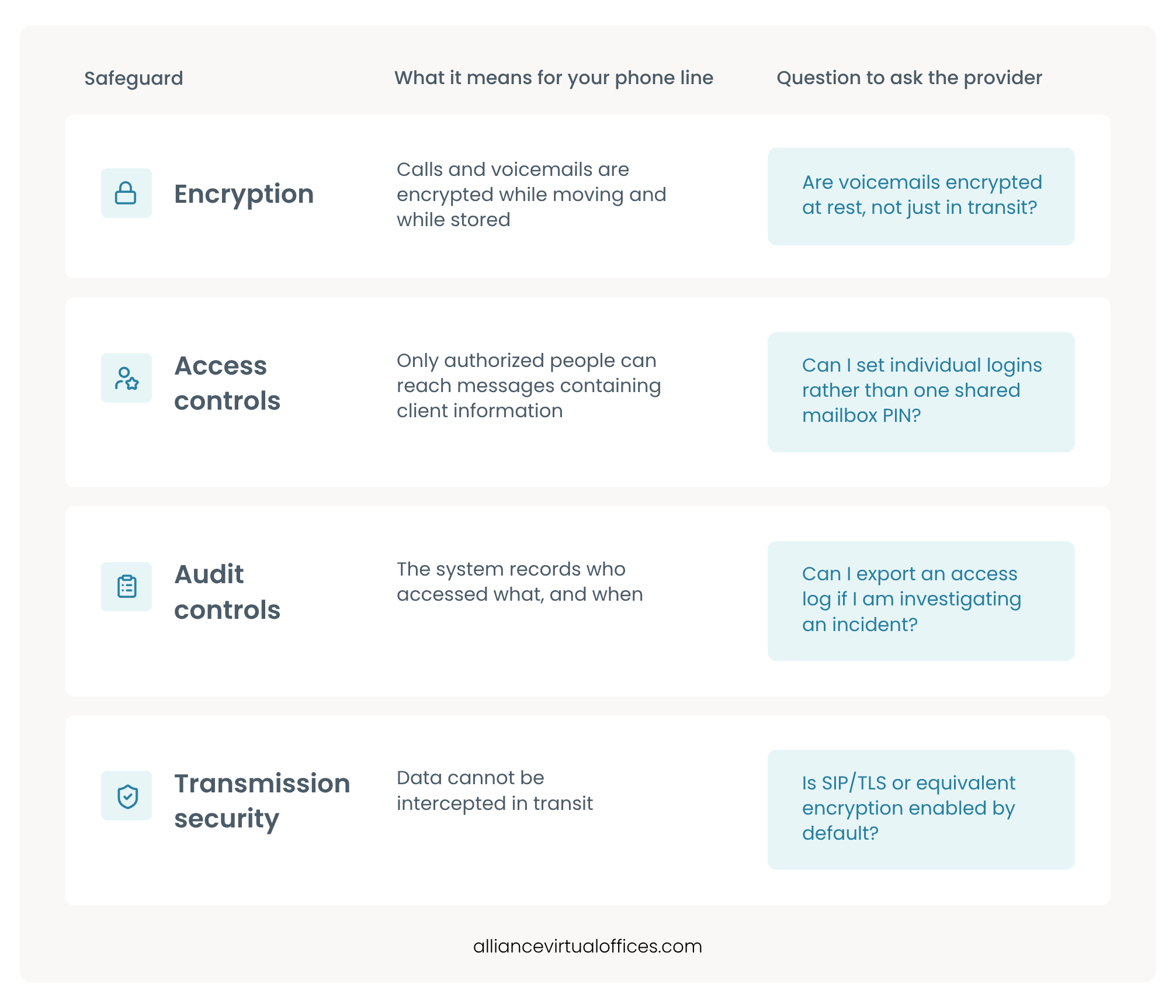
Underneath all four sits the Business Associate Agreement. If a vendor stores or transmits client information on your behalf and will not sign a BAA, the safeguards above are beside the point.
Complaint volume gives a sense of scale here. HHS reported receiving more than 374,321 HIPAA complaints since April 2003, as of its October 31, 2024 enforcement summary.
Voicemail, SMS, and Call Recordings Each Have Different Rules
Practices tend to treat “the phone” as one system. HIPAA treats each channel separately, and the differences are where most solo practices are quietly exposed.
A voicemail that includes a client’s name alongside an appointment time or a treatment reference is protected health information. Standard carrier voicemail is generally not encrypted at rest, which is the specific gap that matters.
Text messaging is the weaker channel. SMS is not encrypted in transit by default, so appointment details sent by text travel through infrastructure your BAA does not cover.
Call recordings raise the bar again. Recording a clinical conversation typically requires patient authorization on top of HIPAA-compliant storage and retention handling, so many small practices decide not to record at all.
Can You Use Your Personal Cell Phone for Therapy Sessions?
The short answer is no, at least not as your only line. Consumer mobile carriers do not sign Business Associate Agreements, so any client information that lands in your personal voicemail or text history sits outside a compliant arrangement.
This is worth being direct about, because the workaround many new practitioners reach for is simply not answering calls from unknown numbers. That does not resolve the underlying problem.
The Privacy Risk Goes Both Ways
Using a personal cell also exposes you. Your mobile number appears on caller ID, in returned voicemails, and in any client’s phone contacts indefinitely, which is a boundary issue as much as a compliance one. There are reasons not to use your personal phone for business that apply well beyond healthcare.
The device itself becomes a liability. A lost or stolen phone holding unencrypted client voicemails and texts can constitute a reportable breach, with the notification obligations that follow.
Scale is what makes regulators attentive to device-level failures. The 2024 Change Healthcare ransomware incident was ultimately confirmed at 192.7 million individuals affected, the largest healthcare breach recorded to date.
What a Separate Business Number Actually Solves
A dedicated business number is not itself a compliance control. What it does is create a clean boundary, so client communications flow into one system you can govern, encrypt, and audit rather than into a personal device you cannot.
That separation makes the rest of the work possible. You can apply a BAA, access rules, and retention settings to a business line in a way that is simply unavailable on a consumer mobile plan.
Alliance Virtual Offices offers virtual phone numbers that serve this separation role. Whether a given plan can be covered by a BAA is a separate question to settle with the provider before any client calls route through it.
What HIPAA Enforcement Actually Looks Like
Enforcement is less arbitrary than it is often portrayed. Cases generally begin with a complaint or a breach report, and the investigation then examines whether reasonable safeguards were documented at the time.
Penalty exposure scales with culpability rather than with practice size. Civil money penalties start at $145 per violation and reach $2,190,294 at the highest tier, with the amounts adjusted for inflation annually.
The pattern in the underlying allegations is stable. HHS reports that the issues most often alleged are impermissible uses and disclosures of protected health information, lack of safeguards, and lack of patient access to their own records.
For a small practice, the practical takeaway is narrow. A signed BAA plus documented safeguards moves you out of the “no reasonable measures in place” category, which is the category that drives the higher penalty tiers.
Documentation does not have to be elaborate to count. A dated file holding your signed BAAs, a short written note of which encryption and access settings you enabled, and a record of when you reviewed them will satisfy most of what an investigator asks for.
What tends to cause problems is the gap between intention and record. Practices often configure their systems correctly and then have nothing on paper showing that they did, which leaves them arguing from memory during an inquiry.
When you evaluate any provider, Alliance included, ask for the BAA before setup and keep the executed copy in the same dated file as your configuration notes.
How to Get A FREE Live Receptionist
Request Your Code Below and Get a FREE
Live Receptionist for 1 Month!

Your Options for HIPAA-Compliant Phone Communication
Three categories of solution cover almost every small practice. They differ less in quality than in what they are built to do, so the right choice depends on how many providers you have and how calls actually reach you.
Business Phone Numbers as a Separation Layer
A virtual business number works alongside the phone you already carry, routing practice calls to your existing device without publishing your personal number. The setup cost is lower and there is no new hardware.
The compliance question here is entirely about the provider. Some virtual phone providers will execute a BAA and some will not, so treat BAA availability as a requirement to confirm in writing rather than an assumption.
If line separation is your immediate problem, a virtual phone number from Alliance Virtual Offices starts at $30 per month with local or toll-free options and free number porting. Confirm BAA coverage with any provider, including Alliance, before routing client calls through it.
NEXT STEPS: Compare virtual phone number plans for your practice
HIPAA Live Answering Services
An answering service adds trained people rather than software. Calls are answered by a live receptionist working from your script, which is useful when the alternative is a voicemail box you check between sessions.
This category earns its cost in after-hours and overflow coverage. As with virtual numbers, confirm that the provider signs a BAA and trains staff on PHI handling before you route clinical calls to it. If you are weighing the monthly figure against the calls you currently miss, a live receptionist calculator will give you your own numbers.
“Ask how the service handles a caller in distress. A receptionist working from a generic small business script is a poor fit for a mental health practice, so the escalation instructions you provide matter more here than the per-minute rate.”
Also check the coverage window against your actual call pattern. Many answering services quote business hours by default, and evening coverage is often priced as a separate add-on rather than included in the base plan.
Read More: Automated Phone System for Small Business
What to Look for in a HIPAA-Compliant Phone Provider
Six criteria separate a provider you can document from one you are hoping is fine. Work through them in order, because the first one is disqualifying.
- A BAA in writing before setup. Not “available on request,” not mentioned in a sales call. Signed.
- End-to-end encryption for calls and voicemail. Ask specifically about voicemail at rest.
- Support staff trained on HIPAA. You will eventually need to ask a support question that involves PHI.
- Access to audit logs. You cannot investigate an incident with data you cannot export.
- Pricing that fits a small practice. Per-user enterprise pricing rarely works for a solo caseload.
- No long-term contract. Practices change shape in the first two years.
Setting Up a HIPAA-Compliant Phone Service Your Practice Can Actually Afford
A HIPAA-compliant phone service is less about finding the right product than about closing a specific gap: client communications currently sitting on a device or carrier account that no BAA covers.
The decision path is short. A solo practitioner who mainly needs separation from a personal cell should start with a dedicated business number and a signed BAA. A practice with several providers or EHR integration needs is better served by dedicated HIPAA VoIP. A practice losing calls outside office hours should look at live answering before adding another platform.
Whichever route you take, get the BAA executed before the first client call routes through the system, and keep a written record of the safeguards you configured. That documentation is what an investigation actually asks for.
If line separation is your first step, Alliance’s virtual phone plans start at $30 a month; confirm BAA availability before routing client calls through any provider.
Frequently Asked Questions
What makes a phone system HIPAA compliant?
Can therapists use their personal cell phone for client calls?
Is Google Voice HIPAA compliant?
Is VoIP HIPAA compliant?
What is a BAA and does my phone provider need one?
Further Reading