
- Why Your LLC’s Address Matters More Than You Think
- How Banks Evaluate Your Business Address
- Legal Standing, Compliance, and Official Notices
Q: Does my LLC’s business address affect banking approval, taxes, and legal standing?
A: Yes. Your LLC’s business address is used by banks, the IRS, and state agencies to verify legitimacy, assess risk, and determine where official correspondence and legal notices are sent.
When forming an LLC, most business owners focus on the obvious steps: choosing a business name, filing formation documents, obtaining an EIN, and opening a bank account. The business address is often treated as a formality; something selected quickly just to complete the paperwork.
In reality, your LLC’s business address plays a much larger role than many founders realize. It is one of the primary data points banks, tax authorities, and state agencies use to verify legitimacy, assess risk, and determine how your business is classified. The address you choose can directly influence whether your bank account is approved, how tax correspondence is handled, and whether your company remains in good legal standing.
Using the wrong address can create problems that surface slowly, often at the worst possible time. Using the right address can quietly remove friction across banking, compliance, and daily operations. Understanding the difference early can save time, money, and unnecessary stress later.
This guide explains why your LLC’s business address matters, how different institutions evaluate it, common mistakes to avoid, and why a compliant virtual office tied to real workspace is often the most practical solution for modern businesses.
Why Your LLC’s Address Matters More Than You Think
Your business address is more than a mailing location. It acts as a signal of where your business exists legally and operationally. Banks, government agencies, and regulators rely on address information to confirm that a company is real, reachable, and operating within appropriate boundaries.
Once your LLC is formed, your address is recorded across multiple systems, including state business registries, IRS records, banking databases, payment processors, and licensing authorities. These systems do not always update automatically or reconcile discrepancies easily. When address information does not align, it can raise red flags or trigger manual reviews.
Address consistency matters because it helps establish continuity and trust. When your IRS records, state filings, and bank applications all reflect the same type of legitimate commercial address, your business appears organized and compliant. When those records point to a residential address, a registered agent address, or a mail-only service, institutions may question whether your business meets their requirements.
In short, your address helps answer a fundamental question regulators and financial institutions are asking: where does this business actually operate?
How Banks Evaluate Your Business Address
Why addresses matter in bank approvals
Banks are required to follow strict Know Your Customer (KYC) and Anti-Money Laundering (AML) regulations. These rules are designed to prevent fraud, shell companies, and illicit financial activity. As part of that process, banks must verify that a business has a legitimate physical presence.
Your business address plays a central role in that verification. It helps banks determine whether your company is tied to a real location rather than an anonymous or temporary setup. This is why many founders ask whether they can use a virtual office address for an LLC without triggering additional scrutiny during the bank approval process.
Why certain addresses are rejected
Many business owners are surprised to learn that banks routinely reject applications based on address type alone. Common problem addresses include:
- P.O. Boxes, which are not considered physical business locations
- Mail-only virtual addresses that resemble mailbox services
- Residential addresses that suggest informal or personal use
- Addresses that do not match EIN or state filing records
Even when a bank does not immediately reject an application, these address types often lead to delays, additional documentation requests, or manual reviews that slow the approval process.
EIN mismatches and verification failures
Another common issue arises when the address used to apply for an EIN does not match the address used in a bank application. Banks frequently cross-check EIN records against IRS databases. If the address on file appears inconsistent or non-commercial, the application may be flagged.
This issue has become more common as banks and fintech platforms rely increasingly on automated verification systems that leave little room for explanation or context.
Business Addresses and IRS Tax Implications
Federal tax correspondence and reliability
The IRS uses your business address to send official correspondence, including notices, requests for information, and audit documentation. If your address is unreliable, outdated, or tied to a service that does not handle mail consistently, you risk missing critical communications.
Missing IRS notices can escalate minor issues into major problems, including penalties, interest, or enforcement actions. Address reliability is not just about convenience. It is about ensuring your business receives and responds to time-sensitive information.
State tax nexus and exposure
Your business address can also influence how states interpret where your company operates. In some cases, an address can contribute to the creation of tax nexus, which determines whether your business owes state income tax, franchise tax, or sales tax.
Using a residential address can blur the line between personal and business activity, while using an address that does not clearly represent legitimate operations can raise questions during audits or filings.
It is important to note that using a virtual office is not tax evasion. A compliant virtual office tied to a real commercial location provides clarity rather than concealment. It establishes a legitimate business base without overstating operational presence.
Legal Standing, Compliance, and Official Notices
Why address accuracy affects good standing
States rely on your business address to deliver official notices related to annual reports, fees, lawsuits, and compliance requirements. If these notices are missed, your LLC can fall out of good standing without warning.
Loss of good standing can affect your ability to enter contracts, obtain financing, or defend your business legally. In some cases, it can even lead to administrative dissolution.
Service of process and legal risks
Legal documents such as lawsuits or subpoenas are often delivered through registered agents, but business addresses still play a role in maintaining accurate records. Confusion between registered agent addresses and business addresses is a common source of missed notices and administrative errors.
A reliable, professional business address helps ensure that important communications are handled properly and documented correctly.
Residential vs Commercial vs Virtual Business Addresses
Not all addresses are treated equally. Understanding the differences can help you avoid costly mistakes.
Residential home address
Using a home address is legal in many states, but it comes with drawbacks. It exposes personal information on public records, can create credibility issues with banks and clients, and may blur personal and business tax considerations.
P.O. Box
P.O. Boxes are not considered physical business locations and are typically rejected by banks and government agencies for official use.
Virtual office address
A compliant virtual office provides a real commercial address in a staffed office environment. It is designed to meet banking, IRS, and state requirements while allowing business owners to work remotely.
Coworking space address
Some coworking spaces allow address use, but availability and compliance vary by location. Not all coworking addresses are accepted for banking or licensing purposes.
A compliant virtual office tied to real workspace offers the most balance between flexibility, credibility, and administrative simplicity.
At this point, many business owners explore options for a professional virtual business address that meets banking and regulatory expectations while avoiding the cost of a full-time office.
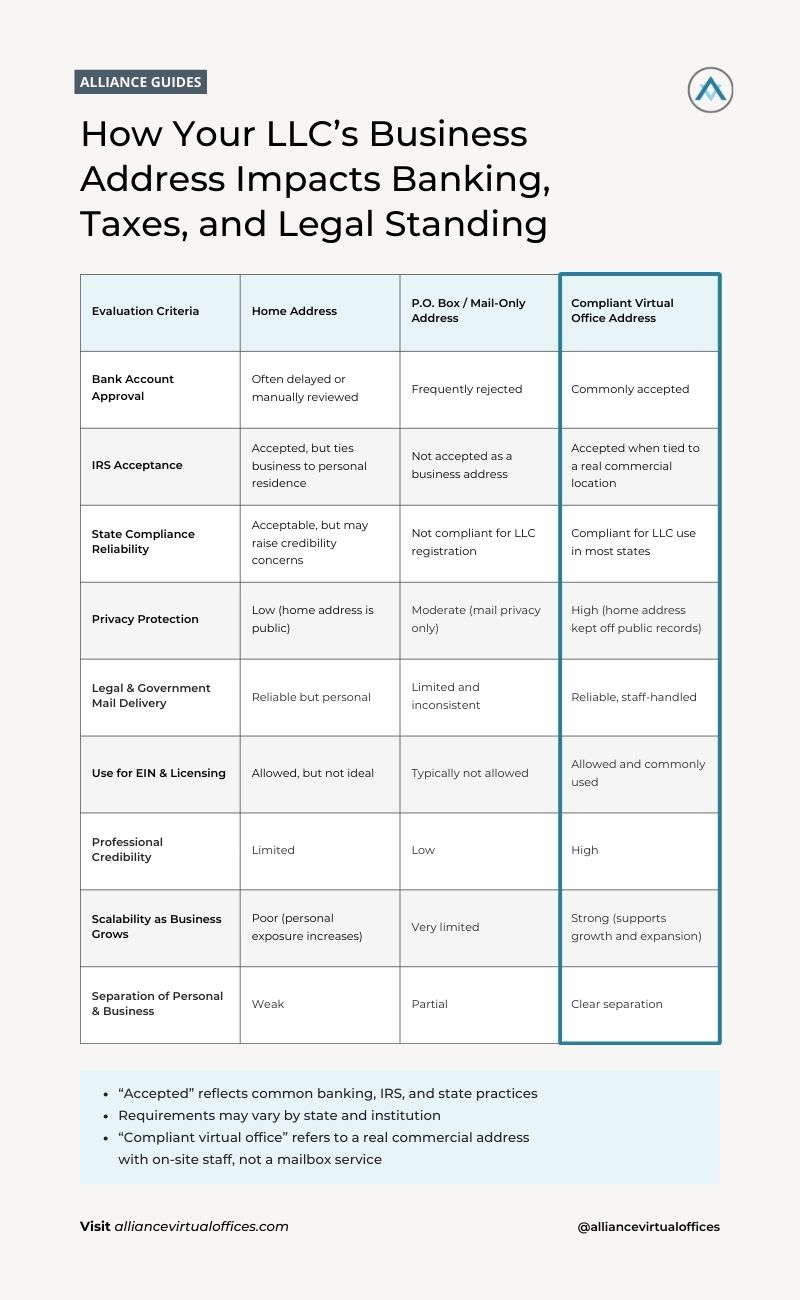
Not all business addresses are treated the same. Banks, tax authorities, and state agencies evaluate address types differently, which can affect approval, compliance, and long-term stability.
Common LLC Address Mistakes That Cost Founders Money
One of the most expensive mistakes founders make is assuming all addresses are treated the same. Common issues include:
- Using a home address everywhere without considering privacy or banking impact
- Treating a registered agent address as a business address
- Choosing cheap mail-only services that are not bank-friendly
- Failing to update address changes consistently across systems
These mistakes often surface during critical moments, such as applying for financing or expanding into new markets.
Why a Compliant Virtual Office Solves These Issues
A compliant virtual office address is designed specifically to meet the expectations of banks, tax authorities, and state agencies. Founders assume a registered agent and business address serve different purposes, which can lead to mismatched records and verification failures.
With a virtual office from Alliance Virtual Offices, your business address is tied to a real commercial location with on-site staff, mail handling, and access to workspace when needed. This structure aligns with how institutions evaluate legitimacy.
Key advantages include:
- A commercial address accepted by banks and the IRS
- Reliable mail handling for tax and legal correspondence
- Privacy protection by keeping your home address off public records
- Flexibility to operate remotely without sacrificing credibility
- The ability to scale into new locations without long-term leases
This approach allows your business to appear established and professional while maintaining operational flexibility.
For many LLC owners, especially remote-first founders and international entrepreneurs, a compliant virtual office offers the simplest path to long-term stability. The decision to change addresses starts with protecting their home address from public records and unwanted exposure.
Final Takeaways for LLC Owners
Your LLC’s business address is not a minor detail. It affects how your business is verified, taxed, and perceived at every stage of growth.
Choosing an address that meets banking and regulatory expectations helps prevent avoidable delays, protects your privacy, and supports long-term credibility. Choosing the wrong address can create friction that compounds over time.
If you are forming an LLC or reassessing your current setup, it is worth taking a closer look at whether your address supports your goals today and in the future.
A compliant virtual office tied to real workspace offers a practical solution for modern businesses that want flexibility without sacrificing legitimacy.
Next Steps: Choosing the Right Business Address for Your LLC
- What Is a Virtual Office?
- Can I Use a Virtual Office for My LLC?
- Registered Agent vs Business Address
- Why Privacy Matters When Running a Business From Home
Explore virtual office options with real commercial locations and see how the right address can support your LLC as it grows.
Need more guidance? We’re happy to answer your questions and help you get set up.