
- Definitions that Matter in Court
- Registered Agent: Legal Requirements by Design
- Virtual Address: What It Is-and Isn’t-for Lawyers
Q: Can a virtual address serve as a registered agent address?
A: Not quite. They’re two different things. A registered agent is a legal role that requires a physical in-state street address and personnel available during business hours to accept service of process and official notices.
A large part of our clientele are solo attorneys who advise startups and small businesses.
One lawyer client in Texas called us worried. Her client, a small e-commerce startup, had listed a virtual office address as their registered agent. A lawsuit was served at that address, but no one was physically there to accept it. By the time the client discovered the case, a default judgment had already been entered against them.
Many entrepreneurs – and even some lawyers – conflate a virtual address with a registered agent. On paper, both involve listing an address. But if no one’s at the front desk receiving the lawsuit, then that’s where the distinction becomes critical.
A client who substitutes a virtual office address for their registered agent risks missing a lawsuit, losing good standing with the state, or even facing dissolution. For counsel, the challenge is to clarify the distinction and architect a compliant solution that addresses both statutory obligations and practical client needs like confidentiality, professionalism, and saving time and money.
This article breaks down the two concepts in detail, supported by statutes, ABA ethics guidance, and decision tools you can bring directly to client conversations.
Definitions that Matter in Court
Courts, regulators, and statutes use these terms with legal precision, and lawyers advising clients must do the same.
Registered Agent / Registered Office
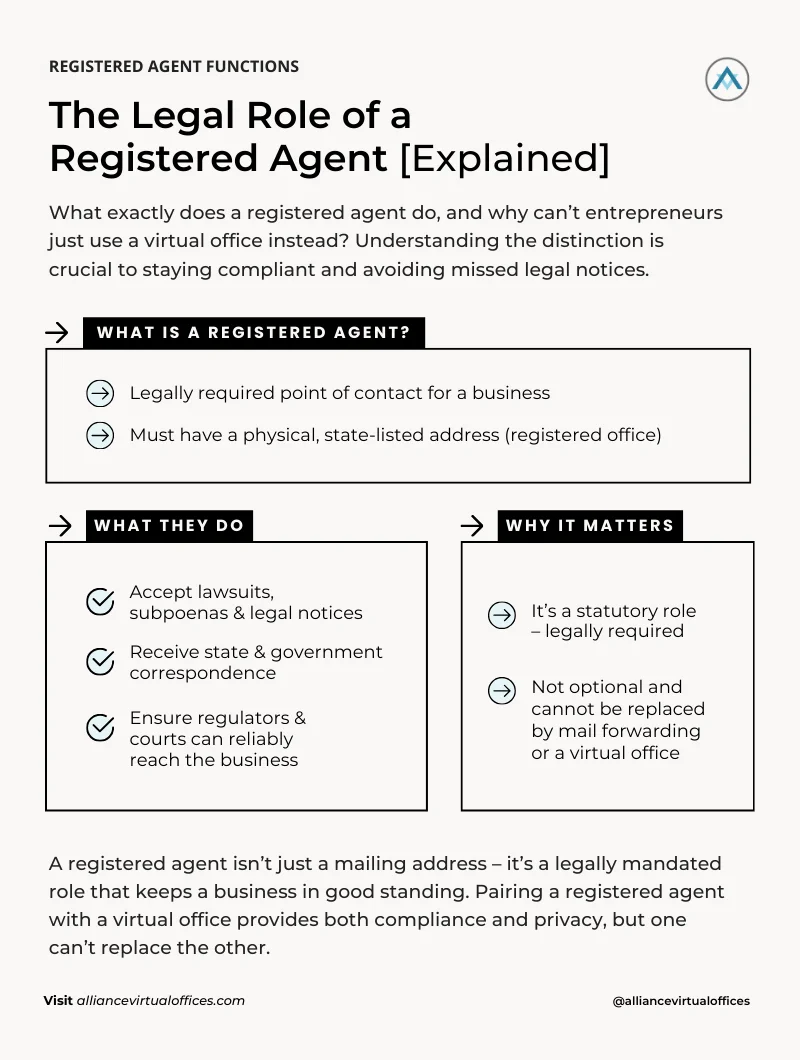
Core functions of the Registered Agent include:
- Accepting lawsuits, subpoenas, and summons on behalf of the company.
- Receiving official correspondence from the secretary of state or regulatory agencies.
- Maintaining a stable, public-facing contact that ensures courts and regulators can reach the business.
Statutory requirements vary by state, but common threads include:
- Delaware requires every corporation to maintain a registered office in the state with a designated agent at that location (8 Del. C. § 132).
- Florida specifies that registered agents must be available during ordinary business hours, with at least a two-hour daily window for SOP acceptance (Fla. Stat. § 48.091).
- Texas requires that a person be physically present at the registered office during business hours to accept service (Tex. Bus. Orgs. Code § 5.201).
READ MORE: Why a Virtual Address for LLC Registration is Good
The takeaway: a registered agent is a statutory role. It’s not optional, and it can’t be replaced by mail forwarding.
Virtual Address
A virtual address is a mailing address provided by a Commercial Mail Receiving Agency (CMRA). To establish one, the business completes USPS Form 1583, which authorizes the CMRA to receive mail on its behalf. The form requires two forms of ID, and the CMRA itself must be registered with the USPS via Form 1583-A.
Practical functions include:
- Providing a professional street address for client correspondence.
- Offering privacy for home-based professionals who don’t want their residential address on public record.
- Centralizing mail handling, with options for scanning, forwarding, and digital archiving.
But here is the critical distinction: a virtual address is not recognized by state law as a substitute for a registered agent. It is a useful tool for branding and privacy, but not for compliance.
Principal Office vs. Registered Office
Business formation documents often ask for both. The principal office is the entity’s operational headquarters. The registered office is the location of the registered agent, maintained solely for SOP and state notices. Clients sometimes assume these can be the same or substitute a virtual address for one or both. Clarify the distinction early in the formation process.
READ MORE: Principal Office or RA Address?
Registered Agent: Legal Requirements by Design
Legislatures across the country have designed this role to guarantee that every entity has a reliable point of contact for lawsuits and government communications.
Availability & Physical Presence
At the heart of RA statutes are two consistent requirements:
- Physical address requirement. The registered office must be a street address in the state of registration. P.O. boxes are not allowed.
- Business hours coverage. A registered agent must be available during ordinary business hours to accept SOP. Florida requires availability from 10 a.m. to 12 noon each business day. Texas requires that an employee or agent be present during all standard business hours.
These requirements eliminate the possibility of evasive or “phantom” entities and keep service of process reliable.
Consequences of Failure
- Service defaults to the secretary of state. Many states allow plaintiffs to serve the SoS if no RA is available, meaning clients may not learn of a lawsuit until it’s too late.
- Administrative dissolution. Oregon, for example, authorizes the secretary of state to dissolve an entity that fails to maintain a registered agent.
- Default judgments. Courts may proceed without the defendant if SOP goes unanswered.
Telling a client to save a few hundred dollars by skipping a professional registered agent might look smart at first, but if a lawsuit slips through the cracks, the result could be a default judgment worth millions.
Virtual Address: What It Is – and Isn’t – for Lawyers
Unlike registered agents, virtual addresses are designed for convenience and marketing presence. They’re valuable, but only when used for the right purposes.
Use Cases for Lawyers
Virtual addresses can be especially beneficial for law firms and their clients in several scenarios:
- Privacy protection. Solo practitioners working from home may not want their residential address made public in state filings or court documents.
- Centralized mail handling. Firms with multi-state clients can receive all correspondence in one place, with digital scanning and forwarding.
- Professional branding. A downtown address can bolster credibility, especially for small or virtual firms.
Limitations and Marketing Caveats
- Virtual addresses cannot satisfy registered agent requirements under state law.
- Regulators may scrutinize filings if a business lists a virtual office as its principal place of business.
This is where lawyers step in to clarify expectations and prevent clients from overpromising on their filings or marketing.
READ MORE: Can I Be My Own Registered Agent?
Decision Tools: Comparison Table
Clients often need a clear, side-by-side view of what these tools do.

Use the following decision framework to advise clients on which setup fits their situation:
| Client Situation | Recommended Setup | Why |
|---|---|---|
| Single-state LLC with existing office address | Registered agent only | Client already has a business address; only needs legal compliance coverage |
| Single-state LLC, home-based, privacy matters | Virtual address and registered agent | Virtual address handles daily operations and privacy; registered agent handles legal compliance |
| Multi-state LLC | Virtual address and registered agents in each state | State-specific RA is required per jurisdiction; a central virtual address keeps operations unified |
| Solo practitioner or client-facing professional | Virtual address and registered agent | Meeting rooms, receptionist, and professional address strengthen credibility with clients |
| E-commerce business with no client meetings | Virtual address (verify registered agent eligibility) | Mail handling and privacy are the priority; confirm whether the virtual address provider can also fulfill RA duties |
Cost Comparison: What Each Service Actually Costs
Cost questions come up early in client conversations, especially for solo founders and small LLCs. Understanding the cost of a registered agent vs a virtual address helps you advise clients on what to budget for, and where overlapping services may create unnecessary spend.
| Service Type | Typical Cost | What It Covers | Best Fit |
|---|---|---|---|
| Standalone Registered Agent | $49–$299/year | Legal document receipt and forwarding only | Compliance-only needs |
| Virtual Mailbox | $10–$50/month | Mail scanning and forwarding; no legal compliance role | Mail-only needs, not a substitute for RA |
| Virtual Office (Platinum Plan) | $49–$150/month | Business address, mail handling, CMRA certification | Professional address and mail management |
| Virtual Office (Platinum Plus) | $100–$300/month | Everything above plus meeting room hours | Client-facing practices needing meeting space |
| Combined Virtual Address and Registered Agent | $49–$150/mo + $100–$200/yr | Full business infrastructure plus legal compliance | Most law firm clients seeking complete coverage |
A standalone registered agent handles one narrow function for $100–$200 per year. A virtual address at $49–$150 per month covers a professional address, mail forwarding, privacy protection, and (depending on plan) meeting rooms and receptionist support.
For clients operating in multiple states, the math scales favorably. They pay a registered agent in each state (typically $125–$200 per state per year) but generally need only one virtual address as their primary business location. The registered agents handle state-by-state legal requirements, while the virtual address centralizes daily business operations.
READ MORE: Best State for LLC Formation
How to Set Clients Up the Right Way
The safest and most effective approach is to treat virtual addresses and registered agents as complementary, not interchangeable.
Recommended Stack


This checklist can serve as a client handout or part of your firm’s onboarding package.
Protect Your Clients: Pair a Virtual Address with a Registered Agent
A virtual address is not a registered agent. A registered agent is mandated by every state, with strict requirements for physical presence and SOP acceptance. A virtual address is an optional but valuable tool for privacy, branding, and mail management.
Treat them as complementary. Advising clients to maintain both ensures statutory compliance, reduces litigation risk, and supports professional credibility.
Further Reading: