
- Why Modern Professionals Crave Connection
- The Business Value of Community Events and Networking
- Who Benefits Most From Community-Centered Offices
- How Flexible Offices Support Networking Without Overhead
Q: What’s the point of office space if my team works remotely?
A: An office still matters, but only if it functions as a hub for connection, not just a desk.
In today’s work environment, the value of an office is not square footage or daily attendance. It’s access to people, relationships, and opportunities. Community events, shared professional spaces, and meeting rooms create the social capital that drives collaboration, referrals, credibility, and growth, without the overhead of a traditional office.
Flexible office environments, especially when paired with a virtual office, deliver that connection on demand.
The Office Is No Longer Just a Place to Sit
For decades, offices were designed around one core idea: a desk, a chair, and a door that closed. Productivity was measured by hours spent inside a physical space, often in isolation. That model worked when work was centralized, and teams showed up to the same building every day.
That world no longer exists.
Today’s professionals work across time zones, juggle hybrid schedules, and build businesses that are not tied to a single location. Technology has made work more flexible, but it has also quietly removed something essential from daily professional life: organic connection.
In a remote and hybrid environment, connection has become a competitive advantage. The most valuable thing an office can offer is no longer square footage or a dedicated desk. It is access to people, conversations, and opportunities.
That is why the modern office is evolving from a place to work into a place to connect.
Offices that function as hubs rather than isolated workstations help professionals grow faster, collaborate more effectively, and build stronger professional networks. Community events, shared spaces, and intentional design now play a direct role in business growth.
Community office networking has become one of the most effective ways for modern professionals to rebuild connection without returning to traditional offices.
This shift is redefining what professionals should expect from an office and why flexible, community-driven environments matter more than ever.
Why Modern Professionals Crave Connection
Remote work unlocked flexibility, but it also removed many of the informal interactions that once powered professional growth.
Forbes doubles down on that power of connection: “In today’s increasingly hybrid world, the art of networking has become more complex yet more crucial than ever.”
The quick conversations after meetings. The introductions made in hallways. The casual lunch that turned into a referral or partnership. These moments rarely show up on calendars, yet they often lead to the most meaningful opportunities.
When work moved online, those moments largely disappeared.
The Hidden Cost of Isolation
Isolation does not just affect morale. It impacts creativity, learning, and long-term growth.
Professionals who work primarily alone often face:
- Fewer referral opportunities
- Limited exposure to new ideas and perspectives
- Slower relationship building
- Reduced visibility within their industry
Over time, this isolation can stall momentum, especially for entrepreneurs, consultants, and growing teams that rely on relationships to scale.
Research consistently shows that strong professional networks drive career mobility, innovation, and business development. Collaboration fuels better decision-making and faster problem-solving. Yet these benefits require proximity and shared experience, even if only occasionally.
It isn’t just anecdotal — major workplace research confirms that the connections people once developed naturally at work have diminished with more distributed work models. McKinsey’s research found that “people’s professional networks have shrunk since the onset of the COVID-19 pandemic, and without intentional workplace interactions, organizations risk lower engagement, slower knowledge sharing, and weaker performance.”
That decline in social connectivity isn’t just an HR problem. It has real implications for creativity, learning, productivity, and the pace at which professionals can grow their businesses.
Belonging Is a Business Need
Humans are wired for connection. Professional belonging is not about forced networking or awkward small talk. It is about being part of an environment where interaction feels natural and purposeful. Meeting rooms and lounges function as professional networking spaces, not just places to sit.
When professionals feel connected to a broader ecosystem, they are more likely to:
- Share knowledge openly
- Offer support and mentorship
- Make introductions without transactional pressure
- Stay engaged and motivated
Modern offices that acknowledge this psychological need are better positioned to support long-term professional success.
What Makes an Office Feel Like a Hub, Not a Desk
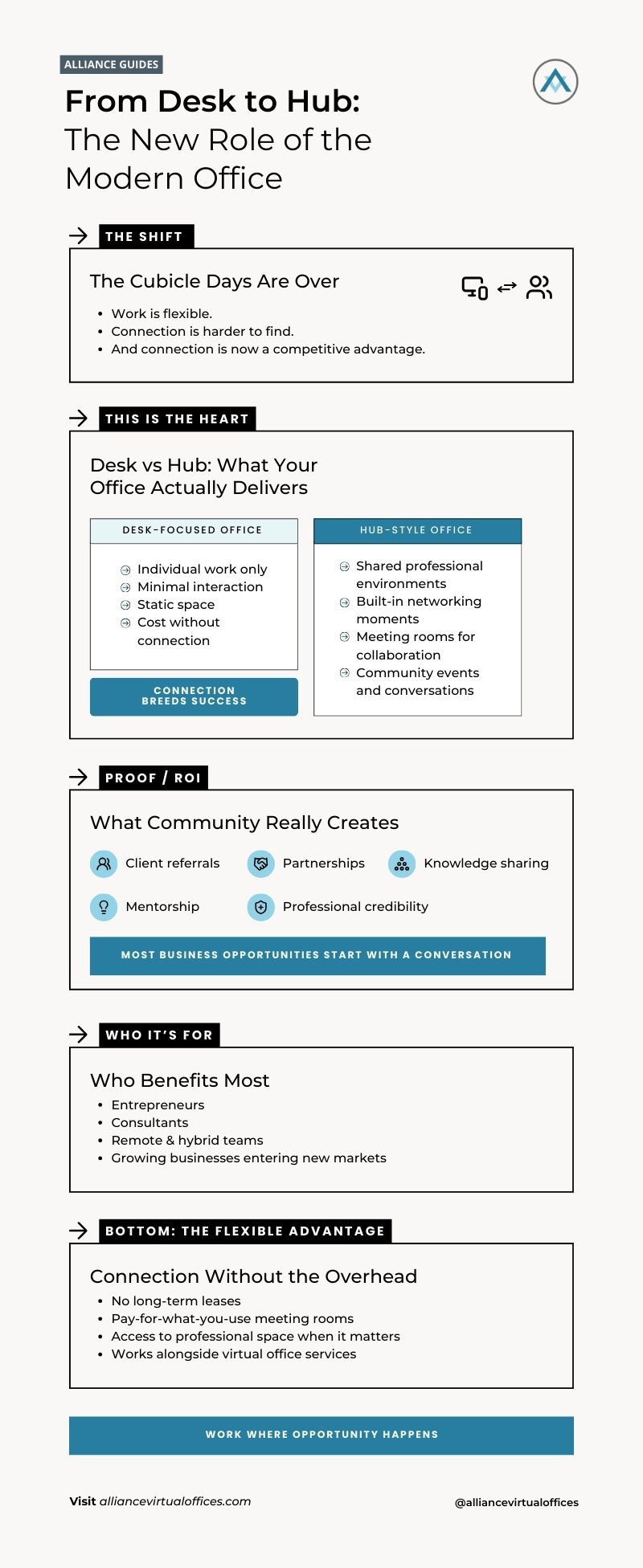
Not all offices create connection. Some simply replicate isolation in a different setting.
A hub-style office is intentionally designed to encourage interaction, without forcing it. The difference lies in how space is used and how people are brought together. These environments function as business networking offices, supporting growth beyond day-to-day work.
Unlock Our Current Virtual Office Offers
Enter your email below and we’ll send you the latest available promotions and monthly specials for Virtual Offices, Meeting Rooms, and Live Receptionists.
Shared Spaces That Invite Conversation
Traditional offices prioritize private rooms and individual desks. Hub-style offices balance privacy with shared environments that naturally bring people together.
Business lounges, shared reception areas, and open meeting spaces create low-pressure opportunities for interaction. These spaces make it easy to start conversations without the formality of scheduled meetings.
A shared environment signals that connection is welcome, not disruptive.
Meeting Rooms as Connection Catalysts
Meeting rooms are often viewed as purely functional. In reality, they are one of the most powerful tools for professional networking.
When designed and used intentionally, meeting rooms support:
- Client meetings that build trust
- Small group discussions and workshops
- Networking events and roundtables
- Collaborative working sessions
They provide structure without rigidity and professionalism without distance.
Access to professional meeting rooms allows individuals and teams to host meaningful interactions without maintaining a full-time office.
You can explore meeting room options here:
https://www.alliancevirtualoffices.com/meeting-room-locations
Events That Create Momentum
Community events transform an office from a workspace into a living ecosystem.
Workshops, industry meetups, lunch-and-learns, and informal mixers give professionals a reason to show up, stay engaged, and connect beyond their immediate tasks.
The most effective events focus on shared interests rather than hard selling. Education, skill-building, and conversation create value first. Relationships follow naturally.
Over time, these repeated interactions build familiarity and trust, which are the foundation of professional opportunity.
The Business Value of Community Events and Networking
Networking is often misunderstood as self-promotion. In reality, its value lies in creating visibility and trust over time.
Community-driven offices enable networking that feels organic rather than transactional.
Real Outcomes From Real Connections
Casual professional interactions frequently lead to tangible business results, including:
- Client referrals from trusted peers
- Strategic partnerships and collaborations
- Mentorship and advisory relationships
- New market insights and opportunities
- Increased credibility through association
These outcomes are rarely immediate. They compound over time as relationships deepen.
Harvard Business Review notes that “Social capital — the value gained when people work well together — is just as, if not more, important than human or financial capital.”
Professionals who participate in community-oriented offices are often top-of-mind when opportunities arise because they are visible, familiar, and trusted.
Visibility Without the Pitch
One of the biggest advantages of community events is that they reduce the need for aggressive selling.
When people see your expertise in action, hear your questions, or collaborate with you directly, your value becomes evident without a formal pitch.
This type of visibility builds confidence and credibility, especially for consultants and service providers whose work relies on trust.
A Stronger Professional Brand
Being associated with a professional, well-run office environment also enhances brand perception.
Clients and partners are influenced by where and how meetings take place. A polished setting signals stability, seriousness, and professionalism.
Community-centered offices help professionals show up as established and credible, even if their business is lean or remote-first.
Who Benefits Most From Community-Centered Offices
Community-driven offices support a wide range of professionals, but certain groups see outsized benefits.
Entrepreneurs and Startup Founders
Early-stage founders need more than a workspace. They need access to ideas, advice, and potential collaborators.
Being part of a professional community increases exposure to:
- Experienced operators
- Potential investors or advisors
- Service providers and specialists
- Peer support during growth challenges
Community interactions often surface insights that would otherwise take months or years to learn independently.
Consultants and Independent Professionals
Consultants rely on credibility and relationships. A community-enabled office provides both.
Meeting clients in professional environments reinforces trust. Networking events create opportunities to connect with complementary service providers and referral partners.
For consultants who work remotely, having access to physical spaces when it matters most creates a strong balance between flexibility and presence.
Learn more about the benefits of a professional business address here:
Remote and Hybrid Teams
Distributed teams often struggle to maintain connection beyond video calls.
Flexible office environments allow teams to:
- Host in-person strategy sessions
- Meet clients in key markets
- Strengthen team relationships periodically
These touchpoints improve collaboration and alignment without requiring a permanent office.
If you are navigating hybrid work models, this overview may help:
https://www.alliancevirtualoffices.com/virtual-office-blog/what-is-hybrid-work/
Businesses Expanding Into New Markets
Establishing a presence in a new city is easier when you can plug into an existing professional ecosystem.
Community-centered offices provide instant access to local networks, professional environments, and infrastructure, without the risk of long-term leases.
How Flexible Offices Support Networking Without Overhead
Traditional offices lock businesses into fixed costs, regardless of how often the space is used.
Flexible offices remove that burden while preserving access to connection.
Pay for What You Use
With flexible meeting room access, businesses only pay when they need space.
This model supports:
- Client meetings
- Networking events
- Workshops and presentations
- Team collaboration sessions
It eliminates the inefficiency of underused offices while maintaining professional presence.
Scalable Presence Across Locations
Flexible office providers offer access to multiple markets, allowing businesses to scale their footprint without scaling overhead.
This is especially valuable for:
- Consultants serving clients in different cities
- Remote teams with distributed members
- Growing businesses testing new regions
Built-In Professional Environments
Flexible offices are designed to support professional interaction.
From staffed receptions to business lounges and meeting rooms, these environments make it easier to connect, host, and collaborate without operational complexity.
Explore flexible office and virtual office options here:
https://www.alliancevirtualoffices.com/virtual-offices-locations
Why Alliance Virtual Offices Is Built for Connection
Alliance Virtual Offices approaches workspace differently. The goal is not to sell desks. It is to support how modern professionals actually work and connect.
Access to Professional Space Worldwide
With thousands of locations globally, Alliance Virtual Offices provides access to professional environments where and when they are needed.
Meeting rooms and shared spaces support:
- Client-facing interactions
- Networking and community events
- Collaboration and teamwork
This flexibility allows professionals to show up with confidence, regardless of where they are based.
Designed for Real Business Interaction
Alliance Virtual Offices locations are professionally staffed and designed to support meaningful interaction.
Business lounges and shared environments encourage conversation without sacrificing professionalism. Meeting rooms provide structure for deeper collaboration.
These spaces are not incidental. They are central to how connection happens.
A Natural Extension of Virtual Office Services
Virtual office users are not excluded from community benefits.
By pairing a virtual office with on-demand access to meeting rooms and shared spaces, professionals get the best of both worlds: flexibility and connection.
They can work remotely most days and still engage in face-to-face interactions when it matters most.
Work Where Opportunity Happens
Work has changed, but the need for connection has not.
In a world of remote tools and digital communication, in-person interaction has become more valuable, not less. Offices that function as hubs help professionals build relationships, gain visibility, and grow faster.
Community events, shared spaces, and professional environments turn workspaces into ecosystems of opportunity.
Choosing the right office is no longer about where you sit. It is about who you can connect with and what those connections make possible.
Explore Alliance Virtual Offices locations and meeting spaces to see how a hub-style workspace can support your next stage of growth.