
- Virtual Offices vs. PO Boxes: Which Works for You?
- HIPAA and Privacy Considerations for Therapy Practices
- How to Select and Implement a Privacy-Safe Address
Q: Can therapists and coaches use a professional business address without exposing their home address or compromising client confidentiality?
A: Yes. A virtual office provides a real, commercial street address that can be used for licensing, client communications, and public-facing materials, without ever disclosing where you actually live or work.
The Part of Private Practice Nobody Warns You About
You spent years building your skills, your credentials, and your confidence. You finally launched your practice or coaching business. And then someone asked for your business address, and you typed in your home address without thinking twice.
It feels harmless. Most people do it. But for therapists and coaches, that single decision quietly creates a set of problems that compound over time.
Consider this: one practitioner listed her home address on her Psychology Today profile when she launched her practice. Within a year, a client she had discharged showed up at her door. She had done everything right clinically. The address did the damage.
That is not a worst-case scenario. It is a pattern that mental health professionals encounter more often than the industry talks about.
A professional business address for therapists and coaches is not just about looking established. It is about creating a boundary between your professional life and your personal one, and doing it before you need to.
NEXT STEPS: Not sure what a virtual office includes? Start with what a virtual office is before going further.
The Risks of Using Your Home Address
Personal Safety Comes First
Therapists and coaches work with people navigating some of the most difficult periods of their lives. Most clients are wonderful. But the nature of the work means you occasionally encounter individuals whose behavior can become unpredictable or boundary-crossing.
When your home address appears on your website, your business registration, or a client intake form, you have removed an important layer of protection. A dissatisfied client, a person in crisis, or anyone who searches your name publicly can find out exactly where you live.
This is not a hypothetical concern. It is a documented safety issue in the mental health profession, and it is one of the most common reasons therapists seek out a professional business address separate from their residence.
Professional Credibility Matters More Than You Think
Beyond safety, a home address sends an unintended signal to prospective clients. A residential address on a Psychology Today profile, a coaching website, or a business card can create doubt before a client ever speaks with you. It raises the question of whether this is a serious practice or a side project.
A commercial address in a professional building answers that question immediately and in the right direction.
Licensing Requirements May Leave You No Choice
Many state licensing boards require mental health professionals to list a verifiable business address, not a residential one, for their public license record. Using a home address in these cases is not just a preference issue. It can create a compliance problem with your licensing board.
Before assuming your home address is acceptable, check your state board’s specific requirements. Many explicitly require a commercial address for the public-facing license record.
“Your home address is your most personal piece of information. A professional practice deserves its own front door.”
NEXT STEPS: Read should I use my home address for my business?
Virtual Offices vs. PO Boxes: Which Works for You?
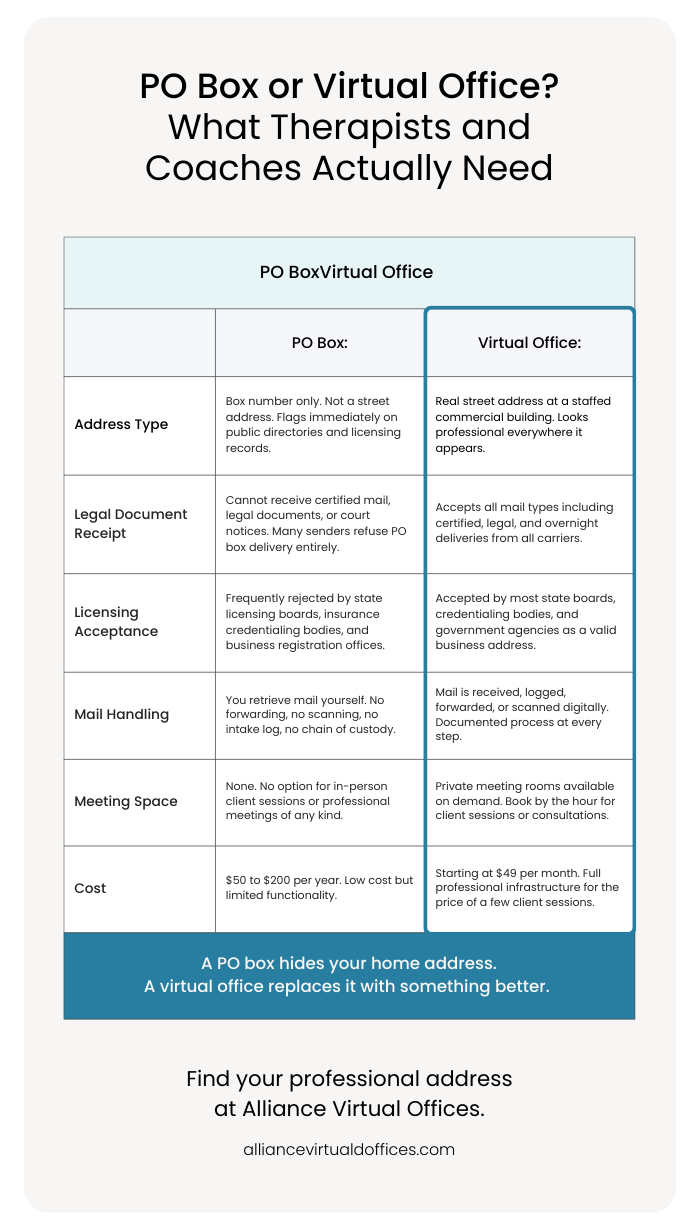
When therapists and coaches first consider separating their personal and professional addresses, a PO box often comes to mind as the simplest option. It is inexpensive and widely available. But it comes with real limitations that matter in a professional services context.
Here is how the two options compare:
| PO Box | Virtual Office | |
| Cost | $50 to $200/year | $49 to $150/month |
| Street Address | No (box number only) | Yes (real commercial address) |
| Receives Legal Documents | No | Yes |
| Receives Packages | Limited | Yes |
| Professional Signage | No | Available at many locations |
| Mail Forwarding | No | Yes |
| Mail Scanning | No | Yes |
| Meeting Rooms | No | Available on demand |
| Licensing Board Accepted | Often not accepted | Generally accepted |
| HIPAA Support | Minimal | Stronger chain of custody |
The core problem with a PO box is that it is not a street address. Many state licensing boards, insurance credentialing bodies, and legal documents require a physical street address and will not accept a PO box. A virtual office solves all of those gaps while still protecting your home address completely.
NEXT STEPS: Find out why a free virtual business address is not what it seems
HIPAA and Privacy Considerations for Therapy Practices
What HIPAA Actually Says About Addresses
HIPAA does not prescribe a specific type of business address for mental health professionals. What it does require is that protected health information (PHI) is handled, stored, and transmitted through secure, controlled processes. Your business address is part of that ecosystem.
When client correspondence, insurance documents, how they are received, stored, and accessed matters. A home mailbox with no documented intake process is a weak link. A virtual office with a professional mail handling workflow is a meaningful step toward a more controlled environment.
Most importantly, using a commercial address instead of a residential one reduces the risk of PHI inadvertently reaching the wrong environment, whether that is a shared household, an unsecured mailbox, or a location that does not have documented privacy procedures.
Confidential Mail Handling in Practice
A quality virtual office provider receives your mail, logs it, and either holds it securely for pickup, forwards it to a designated address, or scans it digitally for your review. Each step is documented, creating a chain of custody that a home mailbox simply cannot provide.
For therapists handling insurance correspondence, client billing, and licensing renewals, that documentation matters. It supports the kind of operational discipline that HIPAA-adjacent compliance requires.
HIPAA compliance is not a single checkbox. It is a set of operational habits. Your mailing address and how mail is handled at that address is one of those habits.
NEXT STEPS: Learn how Form 1583 authorizes secure mail handling.
How to Select and Implement a Privacy-Safe Address
Step 1: Choose a Staffed Commercial Location
Not all virtual office providers are equal. The address needs to be a real, staffed commercial building, not a mailbox storefront or unmanned kiosk. When a licensing board, insurance company, or client looks up your address, it should resolve to a professional building.
A staffed location also means someone is physically present to receive certified mail, packages, and time-sensitive documents on your behalf.
Step 2: Confirm Mail Handling Policies
Before signing up, ask specific questions. How is mail logged when it arrives? Who has access to it? How is it forwarded or scanned? Is there a documented intake process?
For therapists and coaches, the answers to these questions are not just operational details. They are part of your privacy infrastructure. A provider that cannot answer them clearly is not the right fit.
Step 3: Verify Licensing Board Acceptance
Check with your state licensing board before committing to a virtual office address. Most boards accept commercial virtual office addresses. Some have specific language about what qualifies. Confirming this upfront saves you from having to update your license record after the fact.
Step 4: Apply the Address Consistently
Once you have a professional business address, use it everywhere. Your website, your Psychology Today or coaching directory profile, your business registration, your email footer, your intake forms. Consistency is what makes the address work as a privacy barrier. If your home address appears in any one of those places, the protection is incomplete.
Step 5: Consider a Live Receptionist for Client-Facing Calls
A live receptionist answering calls under your practice name adds another layer of professional separation. Clients reach a real person, not a personal cell phone. Calls are routed or messaged according to your preferences. Your personal number stays private.
For solo practitioners especially, this is a low-cost way to create a meaningful professional buffer between your personal life and your practice.
“Privacy for a therapist or coach is not just about protecting yourself. It is about creating the conditions where clients feel safe too.”
NEXT STEPS: how to get a virtual office address and what to look for.
Built for Practices Like Yours
Therapists and coaches need infrastructure that respects the nature of their work. That means privacy by default, not as an afterthought.
Alliance Virtual Offices gives your practice a real commercial address in a staffed building, one that holds up under scrutiny from licensing boards, insurance credentialing bodies, and clients who Google you before their first session. It is the kind of address that says you take your practice seriously, because you do.
Mail arrives, gets logged, and is forwarded or scanned according to your preferences. Nothing sits in an unsecured mailbox. Nothing gets mixed in with your personal correspondence. The process is documented, which matters when your work involves sensitive client information.
When a session needs to happen in person, a private meeting room is available on demand. Quiet, professional, and completely separate from your home. Your clients walk into a space that reflects the care you bring to the work itself.
And when someone calls your practice number, a live receptionist answers under your name. Not voicemail. Not your personal cell. A real person who handles the first impression so you can stay focused on the work that matters.
Your practice deserves a foundation built on the same intention you bring to every client relationship.
NEXT STEPS: Explore Alliance Virtual Offices plans and find the right setup.
Your Practice Deserves a Professional Foundation
A professional business address for therapists and coaches is not a luxury. It is a baseline for operating safely, credibly, and in alignment with licensing requirements. Your home address was never meant to carry that weight.
A virtual office gives your practice its own front door, a real commercial address that protects your privacy, supports your compliance obligations, and sends the right signal to every client and referral source who looks you up.
The setup is simple. The protection it provides is lasting.
NEXT STEPS: Book a virtual office with Alliance Virtual Offices.
Recommended Reading :
- Should I Use My Home Address for My Business?
- How to Get a Virtual Office Address: Everything You Need to Know
- Choosing the Right Virtual Office Address for Your Business Niche
- Form 1583: Why It’s Important and How to Set It Up
- Free Virtual Business Address: What It Really Means
- Virtual Office Address and SEO
- HIPAA Privacy Rule Overview