
- Ethics and Bar Compliance: The Rules That Matter
- Compliance Checklist: How to Evaluate a Virtual Address Provider
- Setup Steps: Register, Advertise, and Operate Without Ethics Headaches
Q: Can a lawyer use a virtual business address for their law firm?
A: Yes, if the address is a real commercial street address with onsite staff, secure mail handling, and is represented truthfully in advertising and filings. A properly staffed virtual office address can satisfy bar registration requirements, protect client confidentiality, and maintain the professional image clients and courts expect.
Remote Practice Is Common. A Compliant Address Is Still Required.
Remote and hybrid practice has become standard for solo attorneys and small firms. But bar registration, court filings, client-facing materials, and state advertising rules all require a real, verifiable business address.
Whether you are launching a new practice or expanding into a second jurisdiction, the address you use carries real ethics implications.
This guide covers the ABA rules that matter most, the options that hold up to bar scrutiny and those that do not, a checklist for evaluating providers, and the setup steps to operate without ethics headaches.
Can Attorneys Use a Virtual Business Address? The Short Answer
Yes, with three conditions:
- The address must be a real commercial street address, not a mailbox number or P.O. box format.
- The location must be staffed during business hours for receipt of mail, deliveries, and service of process.
- The address must be represented truthfully in all advertising, filings, and client-facing materials. No “full-time office” language unless you are actually there full-time.
What to avoid: Mailbox-only services, unstaffed coworking desks, and retail mailbox-store addresses can create ethics and service-of-process risks. The distinction between a staffed commercial address and a mail-forwarding box matters significantly under most bar rules.
What makes a virtual office different from a basic mailbox service is not always obvious, and understanding it before you register protects you from inadvertent ethics violations.
Ethics and Bar Compliance: The Rules That Matter
Three ABA Model Rules create the practical compliance framework for attorneys using a virtual business address. Here is what each one means in plain terms.
ABA Model Rule 7.1: No Misleading Communications
Rule 7.1 prohibits lawyers from making false or misleading statements about their services. Applied to business addresses, this means you cannot imply you maintain a full-time physical office at a location if you do not.
The risk is not that virtual addresses are inherently misleading.
The risk is in how you describe them. Language like “offices in” or “located at” carries different weight than simply listing an address. Keep descriptions accurate and verifiable.
ABA Model Rule 7.2: Advertising Contact Information
Rule 7.2 governs lawyer advertising and requires that contact information be accurate and accessible. Your business address as it appears on your website, letterhead, court filings, and bar registration should be consistent. Inconsistent or unverifiable address listings can draw bar scrutiny even when no deceptive intent exists.
ABA Model Rule 1.6: Confidentiality and Mail Handling
This is the compliance rule most often overlooked when attorneys evaluate virtual address providers. Rule 1.6 requires lawyers to take reasonable measures to prevent unauthorized access to client information.
Applied to mail handling, this means:
- Who has access to your mail at the provider location?
- Is it stored securely?
- Are scans transmitted through secure channels?
- Does staff have documented protocols for legal deliveries?
A provider with no chain-of-custody documentation for mail handling is a Rule 1.6 risk.
ABA Formal Opinions 495 and 498
ABA Formal Opinion 495 confirmed that attorneys can practice in jurisdictions where they are not licensed, provided they do not imply local licensure.
ABA Formal Opinion 498 addressed virtual practice more broadly, affirming that lawyers working remotely can meet ethics obligations when appropriate safeguards are in place. Both opinions support virtual addressing when done correctly.
State Bar Variability
The ABA Model Rules are a baseline, not a uniform standard.
Florida’s bar rules use a “bona fide office” concept in advertising guidance that addresses when location claims require a verifiable physical presence.
New York has issued ethics opinions specifically addressing virtual law office addresses and the conditions under which they are acceptable. Before registering your address, confirm with your state bar’s advertising and ethics opinions.
Most state bars publish opinion summaries that cover virtual office and address issues directly.
“The risk is not that virtual addresses are inherently misleading. The risk is in how you describe them. Language like ‘offices in’ carries different weight than simply listing an address.”
Unlock Our Current Virtual Office Offers
Enter your email below and we’ll send you the latest available promotions and monthly specials for Virtual Offices, Meeting Rooms, and Live Receptionists.
Best Options Compared: What Works and What Usually Does Not
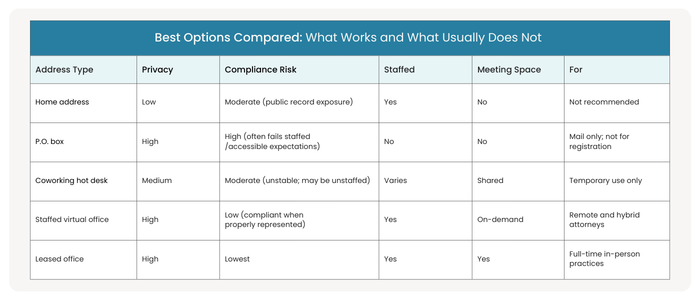
Home Address: Using your home address exposes it in public bar registrations, court filings, and online directories. Beyond the privacy and safety concerns, it can also undermine professional credibility with clients evaluating your firm against larger practices.
Why home addresses create problems goes well beyond perception.
P.O. Box: Most bars expect an address where official communications can be reliably received by a person, not a box. P.O. boxes frequently fail this standard, and some bars explicitly reject them for registration purposes.
They are also flagged by clients doing basic due diligence on a firm.
Coworking Hot Desk: Hot desks are typically not tied to a specific suite address, may not be staffed for mail receipt, and can change as membership terms change.
Using a coworking hot desk as your official address introduces instability and potential accuracy issues in your filings over time.
Staffed Virtual Office Address: A staffed virtual office at a recognized commercial building provides a consistent street address, onsite staff during business hours, secure mail handling, and typically on-demand access to meeting rooms for client consultations.
This is the strongest compliance option for remote and hybrid attorneys.
Virtual Address Only vs Full Virtual Office: A virtual business address plan typically provides the address and mail handling. A full virtual office adds phone answering, a dedicated business number, receptionist services, and meeting room access.
For attorneys who occasionally meet clients in person or need intake support, the full virtual office delivers better protection and a more complete client experience.
How virtual office space works covers both options in detail.
Compliance Checklist: How to Evaluate a Virtual Address Provider
Before selecting a provider, confirm each of the following:
- Real commercial street address with a verifiable building name and suite number
- On-site staff during business hours who can sign for deliveries and receive service of process
- Documented mail chain-of-custody: locked storage, restricted access, clear handling procedures
- Explicit policy for service of process and legal deliveries
- On-demand meeting rooms or day offices for client consultations
- Guidance on how to list the address in advertising materials without overstating physical presence
- Multi-location support if you are licensed or marketing in more than one jurisdiction
- Secure digital mail scanning with access controls if you use scan-and-email services
Provider Red Flags
- No visible onsite staff or building lobby presence
- Mailbox-store format or retail suite numbering
- No documented protocol for legal mail or sensitive deliveries
- No meeting room access or referral to a separate provider for in-person needs
- Vague or non-existent security documentation
Unlock Our Current Virtual Office Offers
Enter your email below and we’ll send you the latest available promotions and monthly specials for Virtual Offices, Meeting Rooms, and Live Receptionists.
Setup Steps: Register, Advertise, and Operate Without Ethics Headaches
- Choose your city and location strategically. Select a location based on your jurisdiction needs and client footprint. If you are admitted in multiple states or expanding into a new market, choose a provider with locations in those cities.
- A downtown address in a recognized business district adds credibility and supports local search visibility.
- Confirm how the address appears in all materials. Before filing anything, decide exactly how the address will appear on your bar registration, letterhead, website footer, court filings, email signature, and online directories. Consistency across all of these protects you from Rule 7.2 issues. Avoid any language that overstates your physical presence.
- Set your mail handling rules. Define whether mail will be forwarded, scanned, or held for pickup. Align these rules with your Rule 1.6 confidentiality obligations. If mail will be scanned, confirm that the process uses secure transmission and that access is restricted to authorized staff only.
- Confirm your registered agent needs separately. A virtual business address and a registered agent serve different purposes. Your virtual address receives general mail and supports your public-facing presence. A registered agent receives formal legal process and state correspondence for your entity.
- Most attorneys need both. Virtual address vs registered agent explains when each applies and how they work together.
- Plan for in-person client needs. Even remote attorneys occasionally need a professional space for consultations, depositions, mediations, or client reviews. Confirm that your provider offers on-demand meeting room booking and that rooms meet the privacy expectations appropriate for attorney-client conversations.
Starting a law firm the right way covers the full compliance setup from registration through advertising.
“A virtual business address can be fully compliant. What creates risk is the combination of the wrong provider, inconsistent listings, and language that overstates your physical presence.”
The Right Address Is a Compliance Foundation, Not a Shortcut
For solo attorneys and small firms operating remotely or across multiple jurisdictions, a staffed virtual business address is not a workaround. It is a well-established, bar-compatible solution when chosen and represented correctly.
The key is selecting a provider that can document its staffing, mail handling, and security protocols, and using the address in ways that are accurate and consistent across all public-facing materials.
NEXT STEPS: Virtual office options for attorneys | See Alliance Virtual Offices plans
Recommended Reading :
- Virtual law office basics
- Virtual office for lawyers
- Starting a law firm the right way
- Virtual address vs registered agent
- Why avoid using your home address
- Virtual law firms are the future
Ready to Set Up a Compliant Address for Your Practice?
Talk to our team to find the right virtual office plan for your jurisdiction and practice type.