
- Why Attorneys Are the Most Common Virtual Office Users
- Bar Registration and Your Virtual Office Address
- The Cost Comparison: Virtual Office vs. Traditional Office for a Law Practice
- Setting Up a Virtual Office for Your Practice
Q: Can attorneys run a credible, compliant law practice using a virtual office instead of a traditional leased office?
A: Yes. A virtual office gives attorneys a staffed commercial address that satisfies most bar registration requirements, protects their home address from public court filings, provides live call answering for client intake, and offers professional meeting space when needed—at a fraction of the cost of a traditional law office lease.
A virtual office gives attorneys a professional business address at a staffed office building, a dedicated phone number, live receptionist services, and on-demand meeting rooms, all without a traditional office lease. For solo practitioners and small firms, it solves the specific problems law practice creates: bar registration requirements, public court filings that expose your home address, clients who expect an office, and the cost of space you only use a few days a week.
Attorneys are one of the most common professional categories using virtual offices, and many keep them long-term because the model fits how law practices operate. This guide covers how attorneys use virtual offices, what the bar association and court filing requirements mean for your address, the real cost comparison, and how to set one up for your practice.
Why Attorneys Are the Most Common Virtual Office Users
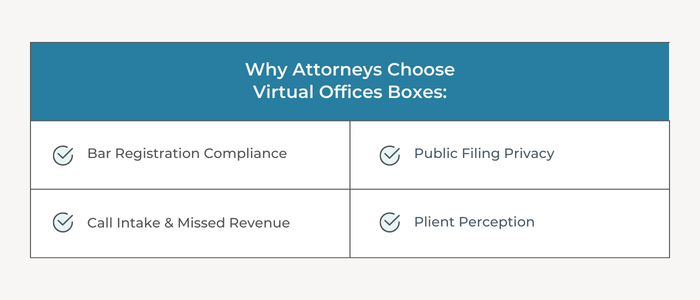
Law practice creates a specific set of address and communication problems that other professions do not face to the same degree:
- State bar registration requires a physical address. Most state bars require a physical street address for your registration. PO boxes are rejected. Retail mail store addresses with suite numbers can create additional scrutiny for bar compliance and credibility. A virtual office at a real, staffed office building typically aligns with these requirements more cleanly than a PO box or retail mail store address.
- Court filings put your address on the public record. Every brief, motion, and pleading you file includes your business address. If that address is your apartment, it is now on the public record for every case you handle. This is a real concern for many practices. Court filings and public case records can make your business address accessible depending on jurisdiction and case type. Opposing parties, their associates, and anyone with a PACER login or a trip to the courthouse can see it.
- Clients expect an office. When a prospective client is evaluating attorneys, they check the address. A home address creates doubt about the size and stability of the practice. A professional address at a recognized office building does not raise those questions.
- A missed call is a missed client. Potential clients who call a law firm and reach voicemail call the next attorney on their list. This is one of the few industries where a single unanswered phone call can cost thousands of dollars in fees. A live receptionist changes that equation entirely.
These are not theoretical benefits. They are the four specific reasons that solo attorneys and small firms choose virtual offices, often for these reasons.
Bar Registration and Your Virtual Office Address
The first question most attorneys ask is whether their state bar will accept a virtual office address. The answer is yes in the vast majority of states, with some nuance worth understanding.
What State Bars Require
Most state bars require a principal office address that is a physical street address (not a PO box). They want to know where you practice, and they want the address on file to be reachable for service of process and bar correspondence.
A virtual office at a staffed, physical office building meets this requirement. The address is a real commercial location with staff on-site during business hours. Mail and legal documents delivered there are received by real people and forwarded to you.
What State Bars Look at More Closely
Some state bars have begun scrutinizing certain types of addresses, particularly those associated with retail mail stores, UPS Store locations, and services that provide a suite number at a commercial storefront. The concern is that these addresses do not represent a real office and may indicate that the attorney is misrepresenting their practice location.
There is a real difference between a mailing address at a retail storefront and a professional office at a staffed commercial building. Every Alliance Virtual Offices location is the latter: a real workspace with conference rooms, on-site staff, and a professional lobby. When bar examiners or clients look up the address, they see an office building, not a strip mall.
Registered Agent vs. Office Address
Some attorneys confuse these two requirements. A registered agent address is where the state sends official legal documents for your business entity (your LLC or PC). Your office address is where you practice law and where the bar sends correspondence. They can be the same address, but they serve different functions.
A virtual office covers your office address. If you also need a registered agent in the same state, many virtual office providers (including Alliance) offer that service separately or as part of a package.
How Attorneys Use Virtual Office Services
Understanding the services in a law practice context helps clarify why attorneys get so much value from them. Here is how each component works for a legal professional:
Professional Business Address
Your address appears on your bar registration, business cards, website, letterhead, pleadings, client contracts, and engagement letters. It is the most visible element of your practice infrastructure. A virtual office gives you a professional address at a commercial office building that holds up to scrutiny from the bar, from clients, and from opposing counsel.
For solo practitioners, the address is also a privacy decision. Without a virtual office, your home address is the default, and it ends up on every court filing and public record associated with your cases.
Live Receptionist
This is the service that attorneys say makes the biggest difference to their practice. A live receptionist answers your calls with your firm name, screens callers, takes messages, and transfers calls based on the rules you set up.
Why this matters for law specifically:
- A potential client calls about a car accident case. If a real person answers and takes their information, you call back within the hour and have a consultation scheduled. If voicemail answers, they hang up and call the next firm. This pattern repeats dozens of times per month in active practices
- During court appearances, depositions, or client meetings, your phone still gets answered professionally. No calls go to voicemail during the hours that matter most
- The receptionist can perform basic intake: collect the caller’s name, case type, and contact information so you can prioritize callbacks
- Opposing counsel, court clerks, and other attorneys calling your firm get a professional experience. This matters more than you might think for your reputation in the legal community
Meeting Rooms for Client Consultations
Client meetings in law practice require privacy, professionalism, and sometimes a conference table that fits multiple parties. Depositions need a quiet, formal setting. Mediations require a neutral environment.
Virtual office meeting rooms at Alliance locations are professional conference rooms in commercial buildings. You book them by the hour when you need them: an initial client consultation on Tuesday, a deposition on Thursday, a mediation next week. Between those meetings, you work from wherever you are most productive.
The meeting room is at the same address on your business cards and pleadings. When a client arrives for their first consultation, the front desk greets them and directs them to the conference room. That experience reinforces every promise your marketing made about your firm.
Mail Handling
Legal mail requires careful handling. Court notices, client correspondence, checks, and legal documents need to arrive reliably and be processed promptly. Virtual office mail handling at a staffed location means your mail is received by real people, sorted, and forwarded or held per your instructions.
For attorneys handling cases in multiple jurisdictions, having mail arrive at a professional office rather than accumulating in a home mailbox (or being left on a doorstep) reduces risk and increases reliability.
The Cost Comparison: Virtual Office vs. Traditional Office for a Law Practice
The numbers for an attorney practice are stark. Here is a side-by-side comparison for a solo practitioner or small firm:
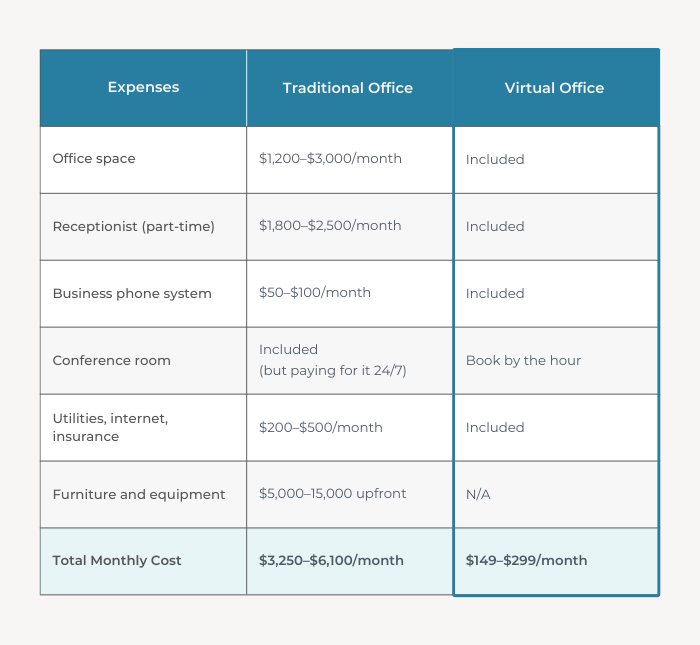
Annual difference: A solo attorney switching from a traditional office to a virtual office saves $37,000 to $70,000 per year. Even a solo practitioner who never had a physical office saves $4,000 to $5,000 annually compared to piecing together the same services individually (PO box, answering service, phone line, hourly meeting rooms).
Those are billable hours you are buying back. At $200 to $400 per hour, the annual savings from a virtual office represent the equivalent of 100 to 350 additional billable hours you can reinvest in client work, marketing, or your life outside the practice.
Practice Scenarios: How Three Types of Law Practices Use Virtual Offices
The New Solo Practitioner
You just passed the bar or left a firm to start your own practice. You need an address for bar registration, a phone number for your website, and a meeting room for your first client consultation. A lease would eat half your savings before you file your first case.
A virtual office at $149/month gives you the professional foundation to launch without the financial risk. You register with the bar using a commercial office address, put a professional phone number on your website, and book a conference room for client meetings as they come. As your caseload grows, you add live receptionist services to handle intake calls while you are in court or working on cases.
The Established Solo or Small Firm with a Lease
You have a physical office but find yourself working from home three or four days a week. The lease costs $2,000/month, and the conference room sits empty 90% of the time. Your receptionist costs another $2,500/month, and they spend half their day with nothing to do.
You transition to a virtual office at the same address (or a better one). Your phone still gets answered professionally. Clients still have a place to meet you. Your bar registration stays current. But your overhead drops by $4,000+ per month. That is $48,000 per year redirected from rent to revenue.
The Multi-Jurisdiction Practice
You handle cases in your home state and two neighboring states. Clients in each state want a local attorney. Bar associations in each state want a local address. You need an office address in all three states, but maintaining three physical offices rarely makes financial sense for a two-person firm.
Virtual offices in each state give you a local address for bar registration, a local phone number for client outreach, and meeting rooms for in-person consultations when you travel for hearings or client meetings. Alliance has locations in all 50 states, so you can add jurisdictions as your practice expands.
Setting Up a Virtual Office for Your Practice
The setup process for attorneys is straightforward but has a few law-specific considerations:
1. Choose your location carefully. Pick an address in a business district your clients will recognize as professional. If you practice in a specific court district, consider an address near the courthouse for convenience during hearing days. The address will appear on your bar registration, pleadings, and marketing, so choose one that supports the image you want.
2. Set up your live receptionist early. Work with the receptionist team to create a call script that fits your practice. Include how to handle new client inquiries (what information to collect), how to screen solicitation calls, how to handle calls from opposing counsel or courts, and when to transfer directly to you vs. take a message.
3. Configure your phone system. Set up call forwarding rules so your business line reaches you during work hours and goes to professional voicemail after hours. If you have a paralegal or associate, set up extensions so the receptionist can transfer calls to the right person.
4. Update your bar registration. Once your virtual office is active, update your address with the state bar. If you are registering for the first time, use the virtual office address from the start. Include the suite number if one is assigned.
5. Update all practice materials. Business cards, letterhead, website, email signature, engagement letter templates, pleading templates, and directory listings. Consistency matters for both credibility and local SEO. Use the same address format everywhere.
6. Set up directory listings. Alliance offers a Listing Management service that distributes your practice information across major directories, including legal-specific directories where potential clients search for attorneys. Ask your Alliance representative about setting this up when you activate your virtual office.
What to Look For in a Virtual Office Provider (Attorney-Specific)
Not every virtual office works well for a law practice. Here is what matters most for attorneys:
- Staffed office locations, not mail stores. This is the most important factor. Your bar, your clients, and opposing counsel will check the address. A retail mail store with a suite number is a risk to your professional reputation. A staffed commercial office building is not
- Professional meeting rooms. You will use these for client consultations, depositions, and mediations. They need to be private, quiet, and appropriately furnished. Visit or view photos before committing
- Live receptionist quality. The receptionist is representing your firm on every phone call. Ask about training, call volume capacity, and whether you can customize the script. A generic answering service is not the same as a professional receptionist who understands legal practice
- Mail handling reliability. Legal mail, court notices, and client checks require reliable, prompt handling. Ask about forwarding frequency, notification policies, and how they handle time-sensitive mail
- Multi-location network. If you practice in multiple jurisdictions or anticipate expanding, choose a provider with locations across the country. Alliance has 1,400+ locations in all 50 states
- Transparent pricing. No hidden fees for meeting room overages, mail forwarding, or receptionist minutes. Know the full cost before you commit
The Bottom Line for Attorneys
A virtual office is not a shortcut for attorneys. It is a strategic decision about how you allocate your practice resources. You spend $149 to $299 per month instead of $3,000 to $6,000 per month for a traditional office. Your bar registration has a professional address. Your phone gets answered by a real person while you are in court. Your clients meet you in a professional conference room at the address on your business card.
The attorneys who get the most from virtual offices are the ones who understand what it replaces: not the practice of law, but the overhead of maintaining a physical office you do not need five days a week. The address, the receptionist, the meeting rooms, the phone system: those are the infrastructure of a credible practice. The lease, the utilities, the furniture, the commute: those are the overhead you can eliminate.
Solo practitioners launching a new practice, established attorneys dropping an underused lease, and multi-jurisdiction firms expanding into new states all use virtual offices for the same reason: the math works, the professional standards are met, and the client experience is better than the alternatives.
Review available office locations in your jurisdiction and see which options align with your practice needs.
Frequently Asked Questions for Attorneys
Will my state bar accept a virtual office address?
In the vast majority of states, yes. A virtual office at a staffed, commercial office building is accepted for bar registration. The key is that the address is a real physical location, not a PO box or a retail mail store with a suite number. If you are concerned about your specific state, contact your state bar’s membership department before setting up your virtual office.
Can opposing counsel tell I have a virtual office?
They see a professional address at a commercial office building. In most cases, what others see is a professional commercial office address. The practical difference is how often you’re physically there—not the legitimacy of the location. When someone visits, staff are on-site, and the space looks like any other professional office. What opposing counsel will notice is whether you have a credible business presence, and a virtual office at a real workspace provides exactly that.
How does the live receptionist handle legal intake?
You customize the script. The receptionist answers with your firm name, and you set the instructions for what information to collect from new callers (name, case type, contact information, brief description of the matter). They send you the details by email or text immediately. You call back when you are ready. The receptionist screens out solicitors, handles basic inquiries, and transfers urgent calls directly to you if instructed.
What about client confidentiality?
Virtual office providers handle mail for many businesses and are accustomed to professional confidentiality standards. Your mail is received, sorted, and handled only by authorized staff. Meeting rooms are private professional spaces. Call handling and phone features vary by configuration, so discuss any heightened confidentiality needs and settings with your provider. Phone calls through your virtual phone line are not recorded or monitored. For attorneys with heightened confidentiality requirements, discuss specific needs with the provider before signing up.
Can I use a virtual office for my legal entity (LLC or PC)?
Yes. The virtual office address can serve as the principal office address for your LLC, PC, or PLLC. If you also need a registered agent in the same state, that is a separate service that many providers offer. Alliance provides registered agent services in most states.