


- Why Client-Facing Professionals Need Dedicated Meeting Space
- What a Good Meeting Room Includes
- Meeting Room Use Cases by Industry
- Meeting Rooms as Part of Your Virtual Office
Q: Do I really need a dedicated meeting space for client consultations, or can I just meet wherever is convenient?
A: If you’re an attorney, CPA, advisor, or other client-facing professional, on-demand meeting rooms give you a private, professional place to meet clients by the hour, without leasing full-time office space.
You get the credibility and confidentiality of a commercial office setting (front desk, conference room, WiFi, presentation tools) while paying only for the time you actually use.
On-demand meeting rooms give attorneys, CPAs, financial advisors, and other client-facing professionals a place to hold consultations, reviews, and presentations without leasing full-time office space. You book by the hour at a professional office building, use the space for your meeting, and leave. No lease, no furniture, no 12-month commitment.
For professionals who spend most of their time in client meetings, at court, or conducting fieldwork, maintaining a dedicated office creates unnecessary overhead. Yet meeting clients at a coffee shop undercuts your credibility. An on-demand conference room at a commercial office building solves the problem: clients see professionalism, and you pay only for the hours you use.
This guide explains how on-demand meeting rooms work, what they include, what they cost, and how they fit into a virtual office strategy for professional service firms.
Why Client-Facing Professionals Need a Dedicated Meeting Space
The location where you meet a client sends a signal. That signal shapes their perception of you before the conversation even starts.
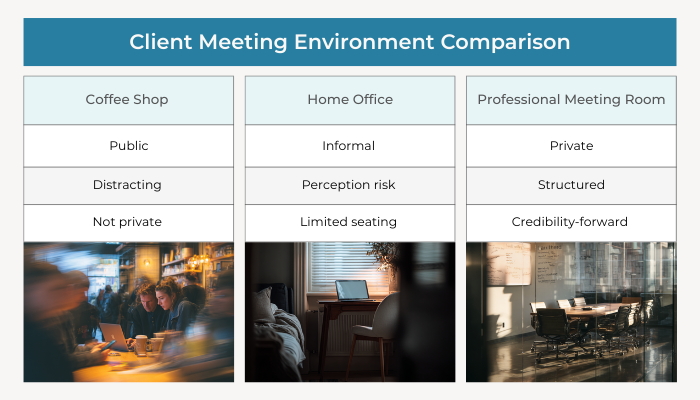
Coffee shops do not work for confidential conversations. Background noise, crowded tables, overhearing risk, and the casual environment make coffee shops suitable for quick informational meetings but inappropriate for discussing sensitive legal, financial, or personal matters. Clients are reluctant to share financial documents, case details, or estate planning concerns with a stranger at the next table.
Your home office sends the wrong signal for a first meeting. Working from home has become normalized for many professions, but when a client arrives for their first consultation, a residential setting raises questions.
Are you established? Do you have other staff? Is this a real business?
These doubts often form unconsciously, but they affect whether the client trusts you with a high-value matter.
A professional conference room at a commercial office building sets the right tone. When a client walks into a building with a lobby, a front desk, a directory, and professional offices, the environment reinforces credibility. For attorneys discussing cases, CPAs reviewing financials, advisors presenting portfolios, the setting matters. It says: I am a real business, I am here to stay, and I take this work seriously.
An on-demand meeting room gives you that setting without the cost of a full-time lease. You get the professional address, the furnished conference room, the front desk greeting, and the client impression all for a fraction of what a permanent office would cost.
How On-Demand Meeting Rooms Work
The mechanics are straightforward and designed for simplicity.
Step 1: Book online or through an app. You select your date, time, room size, and any special equipment (video conferencing, whiteboard, presentation setup). Booking takes two minutes. Most services allow reservations from a few hours to several weeks in advance.
Step 2: Arrive at the building. You show up at the scheduled time. The front desk greets you, confirms your reservation, and directs you to your conference room. Your client is guided to the room by the receptionist and meets you there.
Step 3: Use the space. The room is furnished with a professional conference table, comfortable chairs, WiFi, power outlets, a whiteboard or large display screen, and video conferencing equipment. Your client sees the same address that is on your business card. You conduct your meeting in a professional setting.
Step 4: Leave when you are done. No cleanup required. Many providers include short grace periods if your meeting runs slightly over, though policies vary by location. You walk out. The building handles setup for the next client.
From your client’s perspective, they are visiting your office. They see the professional address, are greeted by staff, and meet you in a professional conference room. From the client’s perspective, they are meeting you at your professional business location. The experience mirrors what clients expect from a traditional professional office environment.
The cost difference is substantial: you pay $25 to $75 per hour for the room you actually use instead of $3,000 to $5,000 per month for office space you maintain whether you use it or not.
Meeting Room Use Cases by Industry
Attorneys
Attorneys use on-demand meeting rooms for client consultations, depositions, mediations, settlement discussions, and case reviews. Privacy and professionalism are non-negotiable in legal work. Specialized deposition rooms with recording equipment access, video conferencing for remote witnesses, and soundproofing to contain confidential discussions are standard in most on-demand meeting spaces. Solo practitioners and small firms rely on these rooms because they cannot justify the cost of maintaining their own conference space.
CPAs and Accounting Firms
Tax planning sessions, quarterly financial reviews, audit kick-offs, and new client onboarding all require a secure environment where clients feel comfortable discussing their financial situation and providing sensitive documents. During tax season, an accounting firm’s phone volume and meeting frequency can triple. On-demand rooms allow firms to scale meeting capacity without carrying fixed overhead year-round.
Financial Advisors
Portfolio reviews, retirement planning meetings, and estate planning consultations all involve detailed financial discussion. Clients expect to meet an advisor in a professional office setting when discussing their money. The conference room becomes the backdrop that reinforces credibility and expertise.
Real Estate Agents
Listing presentations, buyer consultations, and closing walkthroughs benefit from a professional setting. First impressions matter for winning listings. Conducting listing consultations in a professional office setting reinforces an established and organized brand presence.
Consultants and Service Firms
Project kickoffs, strategy presentations, quarterly business reviews, and client pitches are where consultant firms sell their expertise.
A professional conference room helps win engagement from prospects and shows existing clients that your firm is well-organized and takes their work seriously.
What a Good Meeting Room Includes
Professional on-demand meeting spaces typically include:
- Furniture. Conference table that seats 4 to 12 people (depending on room size), comfortable ergonomic chairs, credenza or side table for materials
- Technology. WiFi, power outlets at every seat, large display screen or projection system for presentations, video conferencing equipment for hybrid meetings (client in room, other participants remote)
- Whiteboard or smart board. For visual collaboration, brainstorming, or sketching concepts during your meeting
- Quiet, professionally designed conference rooms with acoustic considerations to support confidential conversations.
- Professional setting. Clean, modern design, good lighting, temperature control, and a building address that matches your professional brand
- On-site staff. Front desk to greet your client, confirm reservations, direct people to the correct room, and handle any technical issues
- Optional upgrades. Catering, recording equipment, printing services, or reception area access, depending on the provider and your plan
The goal is simple: the client walks in and sees a professional office. You do not have to maintain it 24/7, and you did not spend six figures to set it up. You only pay for the hours you use it.
The Cost of On-Demand Meeting Rooms
On-demand meeting room pricing varies by city, building quality, and room size. Here is a typical breakdown:
| Duration | Typical Cost Range | What’s Included | Best For |
| Hourly | $25–$75 | Furnished room, WiFi, basic AV | One-off meetings, consultations |
| Half-day (4 hours) | $100–$250 | Room, WiFi, AV, some flexibility | Extended sessions, depositions |
| Full-day (8 hours) | $200–$500 | Room, tech, flexible check-in/out | Multi-meeting days, training, events |
| Monthly plan (included hours) | 2–8 hrs/month included with virtual office | Varies by plan tier | Regular meeting needs, budget-conscious |
Cost comparison: A traditional lease on a small office or suite might cost $1,500 to $3,000 per month. You pay for 24/7 access, furniture, utilities, and a 12-month commitment. An on-demand meeting room at $50 per hour means you need to hold only 30 to 60 hours of meetings per month to break even. Most professional service firms use far fewer meeting hours than that.
The math becomes clearer for solo practitioners and small firms: if you hold one client meeting per week (4 meetings per month) at one hour each, you spend roughly $200 to $300 per month. A permanent office would cost 5 to 10 times that. The meeting room option gives you professionalism without overhead.
Meeting Rooms as Part of Your Virtual Office
On-demand meeting rooms are most powerful when integrated with a virtual office plan. Here is why:
A virtual office with Alliance includes a professional business address, a dedicated phone number, mail handling, and a receptionist. Add meeting rooms at the same building, and every touchpoint your client has with your business is consistent.
Picture the experience from a prospective client’s perspective:
- They search for your business online and find your address at a professional commercial building
- They call your phone number, and a live receptionist answers with your company name
- They schedule a meeting and arrive at the same professional office address
- The front desk greets them by name and directs them to your conference room
- You meet them in a furnished, professional setting
Every touchpoint of that experience says the same thing: this is an established, credible business. That consistency is the real value. A client who calls your phone number, drives to your address, and meets you in a professional office has confidence in your business before they even sit down.
This is different from a patchwork approach where you use a mail forwarding service, hold meetings at a random coworking space across town, and answer calls from your cell phone. Each service is functional, but they do not create a cohesive professional image. With a virtual office and meeting rooms at the same address, the impression is unified.
Tips for Running a Great Client Meeting
You have booked the professional conference room. The setting is perfect. Here are practical tips to make the most of the meeting:
- Arrive 15 minutes early. Confirm the room is set up correctly, AV equipment is working, and you have what you need. Do not troubleshoot tech problems while your client is walking in.
- Test equipment before your client arrives. If you are presenting, project your slides before they get there. If you are using video conferencing for remote participants, call in early and confirm audio and video are working.
- Bring printed materials as backup. Technology fails sometimes. Have a printed agenda, contract, or proposal ready so you can hand it over if your presentation file does not open.
- Brief the front desk on your client’s name. A simple ‘I am expecting John Smith at 2 PM, please send him to Conference Room B’ makes the check-in smooth and reinforces the professional impression.
- Follow up within 24 hours. The meeting is the beginning of the relationship, not the end. A follow-up email thanking them for their time, summarizing what you discussed, and outlining next steps keeps momentum.
Meeting Rooms vs. Coworking Space
On-demand meeting rooms and coworking space serve different needs. Here is how they compare:
Coworking space provides full daily access to an office, shared desk, kitchen, lounge, networking events, and a community of other freelancers and small businesses. Cost typically runs $150 to $500 per month. If you work from multiple locations or need a dedicated desk, coworking makes sense.
On-demand meeting rooms provide access to a professional conference space by the hour without a desk, lounge access, or daily office. Cost is $25 to $75 per hour. If you spend most of your time at home or client sites and only need a professional space for occasional meetings, on-demand rooms are more economical and flexible.
Many solo practitioners use a combination: a virtual office for the professional address and mail handling, on-demand meeting rooms for client meetings, and either a home office or occasional coworking space for focused work. This hybrid approach gives you the professional image without overhead.
The Bottom Line
Professional meeting rooms are one of the highest-value services for client-facing professionals. The cost is low (typically $25 to $75 per hour), the return is high (first impressions matter), and the flexibility is significant (you pay only for what you use).
Attorneys, CPAs, financial advisors, consultants, and other professionals who build their business on client relationships should have a professional space to meet clients. An on-demand meeting room at a commercial office building provides that without leasing your own office.
The most effective strategy pairs on-demand meeting rooms with a virtual office at the same address. When your client calls your phone, drives to your address, and meets you in a professional conference room, they see a consistent, credible business. That consistency is how you win engagement from prospects and deepen relationships with existing clients.
Explore available meeting room locations in your city and see current hourly availability and pricing.
Frequently Asked Questions
Can I book a meeting room without a virtual office plan?
Yes. On-demand meeting rooms can be booked as standalone services at most office buildings. However, pairing them with a virtual office plan is more economical because many virtual office packages include a set number of meeting room hours per month at no extra charge.
How far in advance do I need to book?
Most services allow same-day booking if rooms are available. For important meetings, book at least one week ahead. If you hold meetings regularly, many providers offer standing monthly reservations or monthly packages that reserve a block of hours for your use.
What if my meeting runs over?
Most on-demand meeting services include a grace period (10 to 15 minutes) at no extra charge. If your meeting will run significantly over, notify the front desk before the scheduled end time so you can extend your reservation. Some providers charge a prorated hourly rate for overages; others may charge the full next hour, depending on your plan.
Are meeting rooms private and soundproofed?
Yes. Professional on-demand meeting spaces have interior conference rooms with acoustic to contain sound. The space is designed to support confidential discussions. This is especially important for attorneys, CPAs, and advisors who discuss sensitive information with clients.
Can I book meeting rooms in different cities?
If the service or your virtual office plan operates in multiple locations, yes. This is useful for firms with clients in different cities or for traveling professionals who need a professional space wherever they are. Check with your provider about access in other markets and any price differences.
Do I need to provide credit card information for every booking?
Once your account is set up, most services allow you to book through a mobile app or web portal using saved payment information. Billing is automatic. Some providers require advance payment for reservations; others bill monthly for standing plans.


