
Q: What is the average cost of a virtual office?
A: Most businesses pay between $49 and $300 per month, depending on whether they need only a professional business address or a full-service package with phone answering and meeting room access.
A virtual office costs between $49 and $300 per month, depending on location, provider, and which services are included. A basic plan with just a business address starts around $49 per month. A full plan with address, phone, live receptionist, and meeting room hours runs $150 to $300 per month.
For small business owners, startups, and professionals who work remotely, a virtual office solves the core problem: you need a professional business address and phone presence without the cost and commitment of a physical office lease. The actual price depends on what you need. For many businesses, the cost isn’t just about price. Instead, it’s about protecting your home address, presenting a credible business location, and avoiding long-term lease commitments.
This guide breaks down virtual office pricing by tier, explains what affects the cost, shows what you get at each price point, and helps you avoid hidden fees.
Virtual Office Pricing Tiers
Virtual office services stack into three main pricing categories. Here is what you get at each level:
| Tier | Basic | Standard | Full |
|---|---|---|---|
| Monthly cost | $49–$75 | $100–$150 | $150–$300 |
| Business address | ✓ | ✓ | ✓ |
| Basic mail handling | ✓ | ✓ | ✓ |
| Phone number | ✗ | ✓ | ✓ |
| Voicemail + call forwarding | ✗ | ✓ | ✓ |
| Live receptionist | ✗ | ✗ | ✓ |
| Meeting room hours | ✗ | Optional add-on | Included (2–5 hrs/mo) |
| Coworking access | ✗ | Optional add-on | Optional add-on |
The table above shows the most common configuration. Many providers let you customize by adding or removing services. For example, you could choose the Basic address plan but add a phone number separately or get Standard services without meeting room access.
What Affects Virtual Office Pricing
Geographic Location
Location is the single biggest driver of price. A virtual office address in New York City, San Francisco, or Chicago costs significantly more than one in Omaha, Phoenix, or Portland. This reflects real commercial real estate costs. Prime office addresses in tier-one cities command higher rent, which providers pass on to customers. A basic NYC address might cost $150 per month, while the same service in a secondary market costs $49.
Services Included
A business address alone is the cheapest option. Add a phone number, and the price goes up. Add live receptionist answering, and you are in a different price band entirely. Each service adds real labor and infrastructure cost. Live receptionists are the biggest cost driver because they require trained staff available during business hours.
Provider Quality
Not all virtual office providers are equal. Some operate out of retail mail stores (like UPS Store franchises). Others run staffed commercial offices with professional receptionists, lobby amenities, and conference rooms. A $20 per month address at a mail store is not the same as a $100 per month address at a staffed office. You are paying for professionalism, presence, and trained staff who represent your business appropriately when a client calls.
Meeting Room Hours
Included meeting room hours start at zero for basic plans and go up to 5 or more hours per month on full plans. Each hour of included access increases the service cost. Beyond included hours, you typically pay $30 to $100 per hour to book additional rooms. The more hours included in your plan, the higher the base price.
Contract Length and Commitment
Longer commitments help stabilize your business address over time and allow providers to offer discounted pricing. If you commit for a year, providers give you a discount. A service might charge $100 per month for month-to-month, but $80 per month if you pay 12 months upfront. This is standard pricing and exists because providers want certainty about revenue.
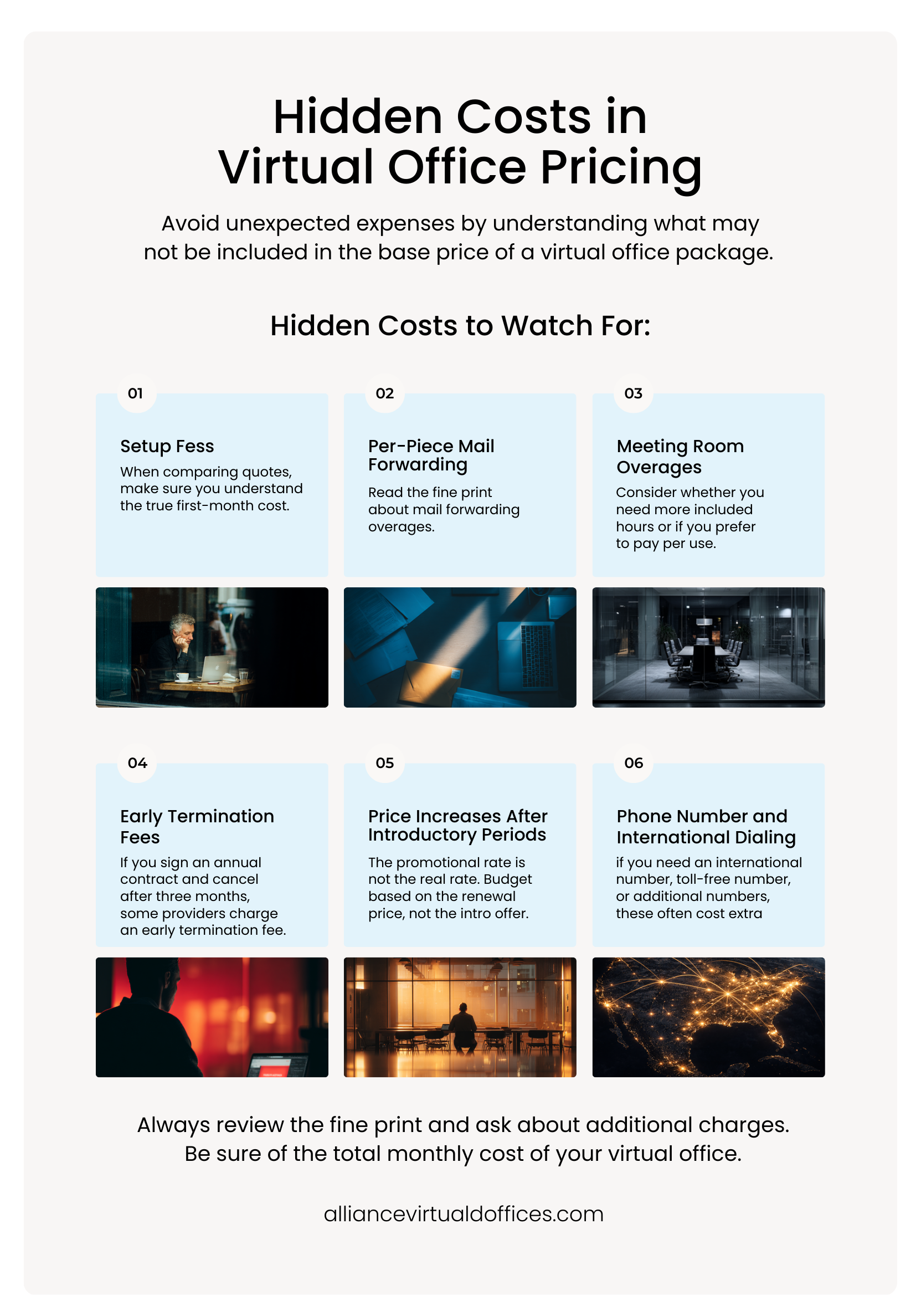
Hidden Costs to Watch For
Setup Fees
Some providers charge setup or activation fees ($50 to $200) to get your account running. Alliance Virtual Offices does not charge setup fees. When comparing quotes, make sure you understand the true first-month cost.
Per-Piece Mail Forwarding
Basic mail handling is included in most plans (once per month or once per quarter). But some providers charge per item to forward mail outside of your plan limits. If you get lots of mail, these per-piece charges ($1 to $3 per item) add up fast. Read the fine print about mail forwarding overages.
Meeting Room Overages
Your plan includes 2 hours of meeting room time per month. Book a third meeting? You might pay $50 to $100 for that extra hour. For heavy meeting room users, this can double your monthly bill. Consider whether you need more included hours or if you prefer to pay per use.
Early Termination Fees
If you sign an annual contract and cancel after three months, some providers charge an early termination fee (often equal to the remaining months at your plan rate). Always ask about exit terms before signing.
Price Increases After Introductory Periods
Some providers offer $39 per month for the first three months, then jump to $89 per month after. The promotional rate is not the real rate. Budget based on the renewal price, not the intro offer.
Phone Number and International Dialing
A local phone number is included in most standard and full plans. But if you need an international number, toll-free number, or additional numbers, these often cost extra ($10 to $20 per number per month).
What You Get at Each Price Point
$49–$75 Per Month: Basic Address
At this price, you get a professional business address at a staffed commercial office, typically one mail handling per month, and the ability to use the address on your website, business cards, and license applications. You do not get a phone number, meeting room access, or receptionist service. This tier is ideal for solopreneurs who just need a credible address and have phone calls handled separately (through a Google Voice number or dedicated phone service).
$100–$150 Per Month: Standard Bundle
This is the sweet spot for most small business owners. You get the address, a dedicated business phone number with voicemail, call forwarding to your cell, and mail handling (usually monthly). Some providers include one or two hours of meeting room time. This covers the core needs: location, phone presence, and basic call handling. You manage calls yourself rather than through a receptionist.
$150–$200 Per Month: Full Service (Without Heavy Meeting Room Use)
Add a live receptionist, and you move into this range. The receptionist answers calls with your company name, takes messages, screens callers, and can handle basic intake. You also get 3 to 5 hours of meeting room time included. This tier is designed for professionals like attorneys, consultants, and service providers who get regular call volume and need a professional presence.
$200–$300 Per Month: Full Service (Premium)
This is the top tier: address, phone, live receptionist, 5+ hours of monthly meeting room time, possible coworking access, and sometimes bilingual receptionist capability. You are paying for a comprehensive presence and the ability to meet clients in professional spaces without maintaining a physical office lease.
The Real Cost Comparison
Virtual office pricing only makes sense if you understand the cost of doing the same thing independently. Here is what you would pay for each piece:
| Service | Typical Cost | Term | Notes |
|---|---|---|---|
| Private office lease | $500–$2,000+ | 1–3 years | Plus utilities, parking, furniture |
| PO box | $20–$50/mo | Month-to-month | Not a business address; banks may reject |
| Business phone line | $25–$50/mo | Month-to-month | Voicemail included; no answering service |
| Answering service | $100–$300/mo | Month-to-month | Live receptionist; minimum call volume may apply |
| Conference room rental (hourly) | $50–$150/hr | Per use | Must book in advance; limited availability |
| TOTAL: Address + Phone + Answering + Rooms (5 hrs/mo) | $695–$2,550+ | Month-to-month | All services combined |
| Virtual office (full plan) | $150–$300/mo | Month-to-month | All services in one package |
The comparison is straightforward: a full virtual office plan consolidates services that would otherwise cost significantly more when purchased separately. Even compared to mid-range independent services ($695/month), a virtual office saves 70% or more. And compared to a physical office lease, the savings are massive.
Is the Cheapest Virtual Office Worth It?
You will see virtual office services advertised for $15 to $30 per month online. In most cases, these are operated from retail mail stores, not staffed commercial offices. This matters more than price.
The key difference: A mail store address uses the mail store’s business address or a mailbox number, not a full commercial office address. Banks, government agencies, and some clients will reject these addresses or flag them as not credible. A staffed office address looks like a real office because it is a real office.
A $49 per month address at a staffed commercial office building is not the same as a $15 per month address at a UPS Store. You are paying for what you actually get: a professional office location, proper business address formatting, and a real receptionist who can answer the phone professionally.
The cheapest option works if your only need is a forwarding address for mail and you have phone calls handled elsewhere. But if client perception matters (and it does for most professional services), the cheapest option may not support the level of credibility many professional businesses require. If your business address appears on public filings, contracts, state registrations, or court documents, the quality and credibility of that address matters. A staffed commercial office address protects both perception and privacy in ways a retail mailbox cannot. The $49 to $75 tier is usually the true floor for legitimate value.
How to Get the Best Value
Start with What You Actually Need
Do not buy a full package if you only need an address. Many businesses start with the Basic tier ($49–$75) and upgrade only when their needs change. You can always add services later. Starting lean saves money upfront.
Match Your Call Volume to Your Plan
If you get two calls per month, a basic phone plan with voicemail is enough. If you get 20 calls per month, a live receptionist is worth the upgrade. Do not pay for receptionist service you do not need, and do not try to save money by going without one if your phone is ringing constantly.
Use Meeting Rooms on Demand, Not Just for Included Hours
If your plan includes five hours of meeting room time but you only use two hours per month, you are overpaying for unused space. Some providers let you downgrade to a lower tier and pay per use instead. The math might work out better.
Choose the Right Contract Length
If you are sure about staying for a year, an annual contract usually saves 15% to 25% per month compared to month-to-month. But if you are uncertain or testing the service, start month-to-month. The slightly higher cost is worth the flexibility.
Look for Bundled Pricing
Some providers offer better pricing if you stack services. For example, address + phone + receptionist together might cost $200, but buying them separately might cost $240. Always ask about bundle pricing.
Is a Virtual Office Tax Deductible?
Yes. Virtual office expenses are generally deductible as a business expense. This includes:
- Monthly service fees for the address, phone, and receptionist service
- Mail handling and forwarding charges
- Meeting room rental and hourly usage fees
- Any setup fees or one-time costs
Keep receipts for all virtual office charges. These deductions reduce your taxable income for the year. Consult your accountant about how to categorize these expenses for your specific business type (sole proprietor, LLC, corporation, etc.). The IRS publication 535 covers business expenses in detail.
Frequently Asked Questions
What is the cheapest virtual office?
The cheapest virtual offices start at $20 to $40 per month, but these are usually mail-only services at retail stores, not staffed offices. A legitimate business address at a staffed commercial office starts at around $49 to $75 per month.
Are there free virtual office options?
Not really. Some services, like Google Voice, offer free phone numbers, and you can use your home address on business licenses in many states. But these do not give you a professional business address or receptionist service. A virtual office involves real overhead (office rent, staff), so it cannot be free.
Why do some virtual offices require a 6-month or 12-month commitment?
Longer commitments help providers forecast revenue and reduce their acquisition costs. In exchange, they offer a discount. If you want month-to-month flexibility, you pay a higher rate. It is the same model as cell phone plans or internet service.
Can I upgrade or downgrade my plan?
Yes, most providers let you change plans or add services whenever you need to. If you start with Basic and realize you need a phone number, you can upgrade to Standard. You might pay a prorated amount for the upgrade or downgrade, depending on the provider’s policy.
How does virtual office pricing compare to coworking?
A coworking membership typically costs $200 to $500+ per month and includes desk space, WiFi, and sometimes meeting room access. A virtual office is $49 to $300 per month and does not include desk space or WiFi. If you need a place to work every day, coworking is better. If you just need a professional address and phone presence, a virtual office is cheaper.
Do I need a virtual office in my home state?
Not necessarily. Many businesses get a virtual office address in a major city (like New York or San Francisco) even though they operate in a different state. This can enhance credibility. However, if you need to physically meet clients, choose a location where you actually do business or where clients expect to find you.
Further reading:
- What is a Virtual Office and How Does it Work?
- Transform Your Legal Practice: The Benefits of Virtual Offices for Lawyers
- What Is a Virtual Office Space? Benefits, Features & How It Works (2026 Guide)
The Bottom Line
Virtual office pricing is transparent, scalable, and a fraction of the cost of a real office. A basic plan costs less than lunch for your team per month. A full plan with receptionist and meeting rooms costs less than one hour of conference room rental at a hotel.
The right virtual office for your business depends on what you actually need. Ask yourself:
- Do I need just an address, or do I need a phone presence too?
- Do I get enough calls to justify a live receptionist service?
- How often do I need to meet clients in person?
- Can I commit to a year, or do I need flexibility?
Answer those questions and you will find the right price point. Most small business owners start with the Standard tier ($100–$150) and either downgrade to save money or upgrade for additional services. The flexibility to change is part of the value.
Compare Virtual Office Pricing in Your City
Pricing varies by location and service level. The most accurate way to determine your monthly cost is to review available plans in your market and compare what’s included.