
- Virtual Office Costs for Consultants: What You Will Really Pay
- Client Perception: What Clients Notice (and What They Do Not)
- The Worth It Scorecard (Plus 3 ROI Scenarios)
Q: Is a virtual office worth it for consultants?
A: It is usually worth it when your work depends on trust, and you need a professional address, privacy, and a client-ready meeting space without committing to a full lease. For most independent consultants, one closed deal or one retained client covers a year or more of the monthly cost.
Why Your Setup Signals More Than You Think
As an independent consultant, you are the product. Clients are not just evaluating your expertise; they are assessing whether you are someone they can trust with sensitive projects, confidential information, and real budget. Your business address is part of that evaluation, whether it appears on your website, your proposal, a vendor registration form, or a quick Google search.
A virtual office for consultants can solve three problems at once: credibility, privacy, and occasional need for a professional meeting space, without the overhead of a lease. This post breaks down the real costs, the measurable benefits, and a simple scorecard so you can decide whether it makes sense for your practice.
What Consultants Actually Use a Virtual Office For
Virtual offices are not one-size-fits-all tools, and consultants use them differently depending on their business model. Here are three common profiles.
The Independent Advisor. A solo strategy, HR, or IT consultant who works remotely and needs a commercial address for proposals, client contracts, and vendor registration forms. A home address on a master services agreement can raise questions before the conversation even starts. A recognized downtown address does not.
The Boutique Firm. A two- to five-person consultancy that is remote-first but client-facing. They need a consistent address across their website, Google Business Profile, and LinkedIn, plus access to a conference room for client kickoffs, quarterly business reviews, and occasional workshops.
The Multi-City Consultant. A consultant expanding into a new market who wants local credibility before committing to a hire or a lease. A virtual office address in the target city builds search visibility and signals to regional prospects that you have a presence there.
Across all three profiles, the core use cases are the same: a commercial address on client-facing documents, a home address kept off public records, reliable mail handling while traveling, a professional space available on-demand, and the ability to establish presence in a new geography.
Virtual Office Costs for Consultants: What You Will Really Pay
Most virtual office plans fall into three tiers based on features and city.
| Plan Tier | Monthly Range | Best For | What’s Included |
| Address Only | $49 – $99 | Solo consultants needing a credible address | Business address, mail receipt, lobby directory listing |
| Address + Mail Services | $100 – $150 | Consultants with regular mail or packages | All above + mail forwarding or scanning, local phone number |
| Full-Service | $150 – $300+ | Boutique firms or high-touch client practices | All above + live receptionist, meeting room hours, call answering |
Hidden costs to watch for:
- Setup or activation fees (typically a one-time charge of $25 to $75)
- Per-piece mail forwarding or scanning fees above your plan’s included volume
- Hourly meeting room rates when you exceed included hours
- Postage charges for physical mail forwarding
For comparison: a coworking desk in a mid-size metro runs $250 to $500 per month, and a traditional office lease can easily exceed $1,500 monthly once utilities and setup are included. See the full 2026 virtual office costs breakdown for city-by-city pricing and plan comparisons.
Benefits That Actually Move the Needle for Consultants
Credibility signals. A recognized business district address on your proposals, email signature, and LinkedIn profile communicates stability before you ever speak to a prospect. Clients completing vendor due diligence or running background checks see a staffed commercial address, not an apartment building or a retail mailbox store.
Faster onboarding. Many enterprise clients require a verified business address on vendor registration forms. A virtual office address satisfies that requirement without adding complexity to your business registration.
Privacy and risk reduction. When your home address is listed on public business records, it can appear in client background checks, online directories, and court filings. A commercial address separates your personal life from your professional identity.
Operational leverage. Mail handling, call answering, and appointment scheduling services free you from admin work that pulls you away from billable hours. For consultants who travel frequently, a virtual office also delivers business continuity: your mail is handled, your calls are answered, and nothing falls through the cracks while you are on-site with a client.
Geographic flexibility. Testing a new market before committing to a hire or a physical space is one of the clearest ROI cases for a virtual office. A local address supports local search rankings via Google Business Profile and signals to regional prospects that you have a real presence there.
“For consultants, the question is not whether a professional address matters. It is whether you can afford to let it work against you.”
Client Perception: What Clients Notice (and What They Do Not)
There are three moments when clients evaluate your professional setup.
- First impression. Your website, email signature, LinkedIn profile, and proposal header. A commercial address signals a real business. A home address or P.O. box can raise questions before the conversation even starts.
- Contracting and onboarding. Vendor forms, MSAs, and background checks often require a business address. A virtual office address holds up to that scrutiny in a way a residential address does not.
- First in-person meeting. If clients come to you, the physical space matters. A well-designed conference room at a recognized business center is a very different experience from a coffee shop or a shared kitchen table.
What clients rarely care about: whether you sit at that address every day. What they do care about: that the address is real, that someone is reachable, and that you can meet them professionally when it counts.
Credibility Setup Checklist for Consultants
- Business address consistent across your website footer, Google Business Profile, LinkedIn, and all proposals
- Email signature includes address and a direct phone number
- Google Business Profile verified and active with accurate hours
- Contact page lists your address rather than showing a “remote only” note
- Proposal and invoice templates updated before you announce the new address
One thing to avoid: using different addresses on different channels. Inconsistent NAP data (name, address, phone) across your online presence undermines both SEO and client trust. Read more about how address consistency builds credibility.
Unlock Our Current Virtual Office Offers
Enter your email below and we’ll send you the latest available promotions and monthly specials for Virtual Offices, Meeting Rooms, and Live Receptionists.
Virtual Office vs Alternatives
The right setup depends on your business model. Here is how the main options compare for independent consultants and boutique firms.
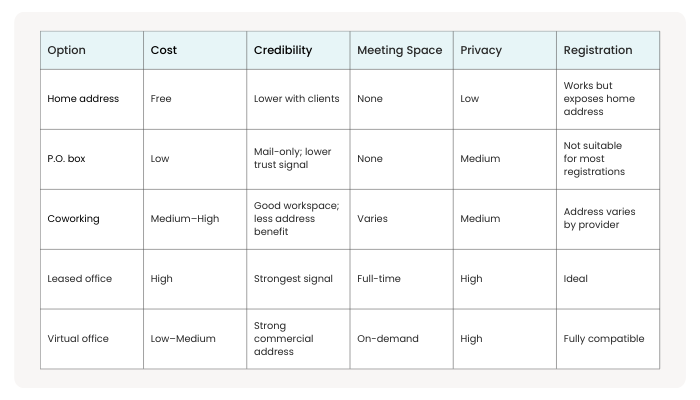
For most independent consultants and boutique firms, the winning combination is a virtual office paired with on-demand meeting room access. You get a credible commercial address every day, and a professional space on the days that matter. Compare home vs. virtual business address and virtual office vs. coworking for a deeper look at each trade-off.
The Worth It Scorecard (Plus 3 ROI Scenarios)
Score yourself one point for each “yes”:
- Do you sell high-trust, high-ticket services?
- Do clients ask for a business address on vendor or onboarding forms?
- Do you meet clients in person one to four times per month?
- Do you want to keep your home address off public business records?
- Do you target clients in a specific metro market?
- Do you receive critical mail (contracts, checks, legal correspondence)?
- Do you miss calls or need scheduling support?
- Do you need to project a larger, more established presence?
- Are you expanding into a new city or market?
- Do you currently use a P.O. box or home address on client-facing documents?
How to read your score:
- 7 or above: A virtual office is very likely worth it. Start with a full-service plan.
- 4 to 6: Probably worth it. An address-only or address-plus-mail plan covers your core needs.
- 3 or below: You may not need one yet, though it is worth revisiting as your client base grows.
Three ROI Scenarios
Scenario 1: Solo Consultant (Address and Mail Only). A marketing consultant pays $79/month for a virtual office on a recognized downtown street. She lists the address on her proposals and LinkedIn. One prospect who was on the fence signs a $9,500 engagement. That deal covers more than nine years of her virtual office cost.
Scenario 2: Boutique Firm (Address, Receptionist, and Occasional Rooms). A three-person operations consultancy adds a live receptionist and meeting room access to their plan at $195/month. They retain a client who nearly walked because the previous setup felt informal. That retention is worth $48,000 annually.
Scenario 3: Multi-City Consultant (Address in Client Market). A consultant based in Austin adds a virtual office address in Chicago for $99/month to support a push into Midwest enterprise clients. Within four months, two new clients attribute their outreach to the local presence they saw on Google. See meeting room locations to explore on-demand space in key markets.
How to Set Up a Virtual Office Without Hurting Credibility
- Choose a location clients recognize, or one near your key client clusters. A known business district carries more weight than a generic commercial address.
- Confirm the provider operates a staffed office center. A building with a lobby, staff, and available meeting rooms is different from a mailbox service. Understand the difference at CMRA compliance explained.
- Set your mail handling rules upfront. Decide whether you want mail scanned and emailed, physically forwarded, or held for pickup. Know who is authorized to receive packages.
- Update every brand touchpoint before announcing: website footer, email signature, proposal and invoice templates, Google Business Profile, LinkedIn, and your CRM.
- Add meeting room access for key moments: client kickoffs, quarterly business reviews, discovery calls that benefit from a boardroom setting, and workshops.
- Consider a live receptionist if you close business by phone. A missed call at the wrong moment can end a deal before it starts.
Compliance note: Most virtual office providers are registered as Commercial Mail Receiving Agencies (CMRAs) and will ask you to complete USPS Form 1583 along with a government-issued ID. This is standard and required by law. Plan for a 24 to 48 hour activation window while the form is processed.
“Update every brand touchpoint before you announce the new address. Inconsistency across channels is the credibility risk, not the virtual office itself.”
Choose the Right Plan and Book Your First Meeting Room
A virtual office is worth it for consultants when a professional address, privacy, and a client-ready meeting space create real leverage in your business. That combination closes deals faster, strengthens client retention, and protects your personal information, all at a fraction of what a traditional lease costs.
Next step: compare virtual office plans to find the right tier for your consulting practice, then book a meeting room for your next client kickoff, quarterly review, or discovery session.
Recommended Reading :
- What is a virtual office?
- 2026 virtual office costs
- Home vs. virtual business address
- Virtual office vs. coworking
- CMRA compliance explained