
- How Much Does a Virtual Office Cost?
- What a Good Budget Plan Includes
- Affordable Virtual Office Providers Compared
Q: How much does a virtual office cost?
A: Most virtual offices run between $49 and $300 a month. Basic address-only plans sit at the low end, while plans that add mail handling, a phone number, or meeting room credits climb higher. Prices advertised below $30 usually come from retail mail stores rather than staffed commercial buildings.
Finding an affordable virtual office is less about chasing the lowest sticker price and more about knowing what that price actually buys. A cheap monthly rate can hide limited mail handling, a low-quality address, or fees that appear only after you sign up. For a new business watching every dollar, those surprises undo the savings.
The demand for these services is real. The U.S. Census Bureau recorded roughly 5.62 million business applications in 2025, up about 8.2% from the year before, and many of those founders are shopping for a professional business address without the cost of a lease.
That volume has pulled in a crowded field of providers, and the pricing runs from a few dollars a month to a few hundred. A “cheap virtual office” listing and a well-rounded affordable plan can look identical in a search result, yet deliver very different value once you read the details.
This guide breaks down what a virtual office really costs in 2026, what drives the price, what a solid budget plan should include, and how to judge address quality when you are spending carefully. The goal is to help you find an affordable virtual office that holds up, not just a cheap one.
How Much Does a Virtual Office Cost?
A virtual office typically costs between $49 and $300 per month, and the range is wide because plans bundle very different things. At the low end you are paying for a business address and basic mail service. At the high end you are paying for a full plan with call handling, meeting room time, and coworking access.
The advertised price and the real monthly cost are often not the same number.
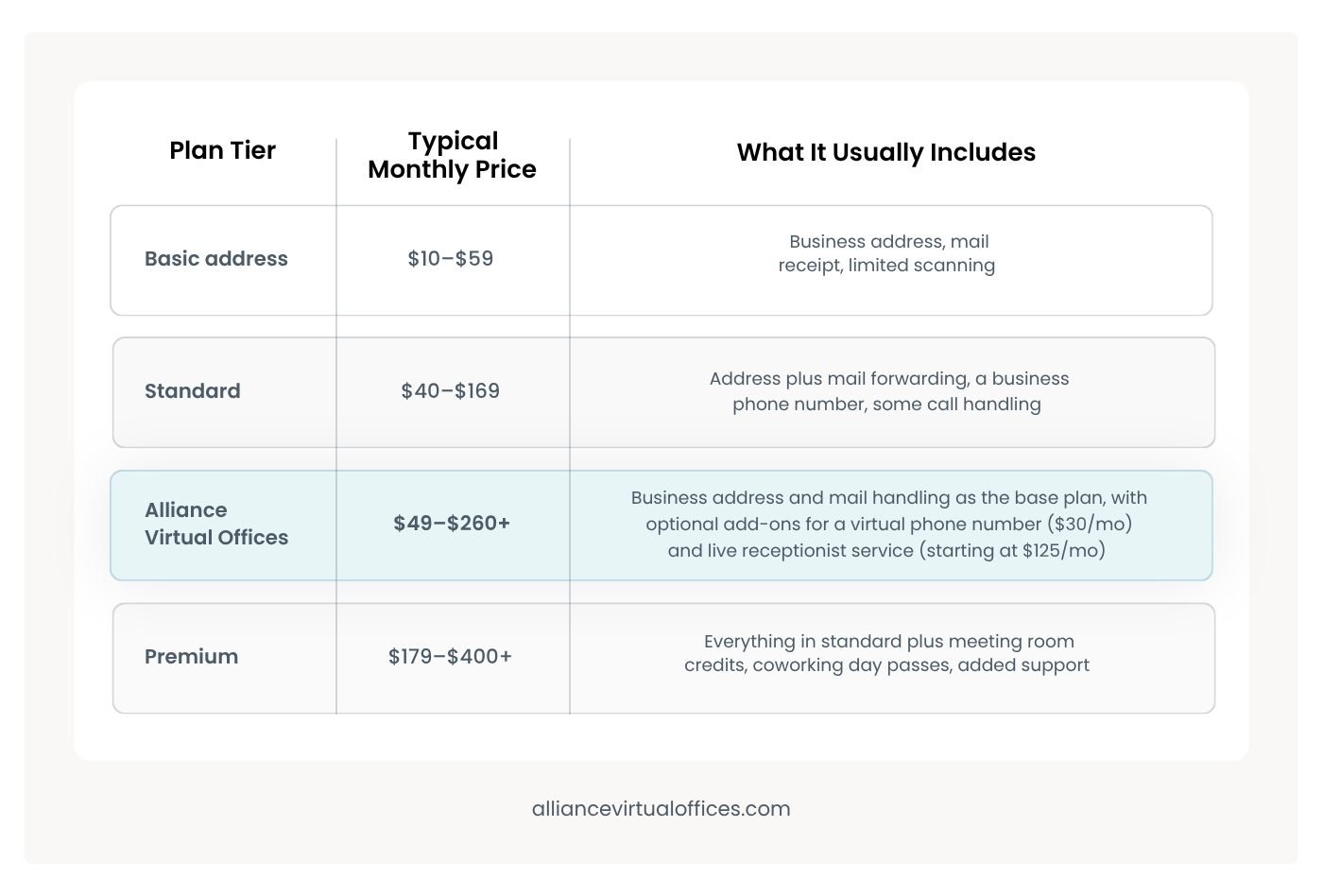
Understanding the tiers helps you read a price list without getting caught off guard.
Location moves these numbers too. A virtual office in New York City often starts around $150 a month for basic service, while secondary cities like Austin, Denver, or Phoenix commonly run $75 to $100. A prestige address costs more because the building and location carry more weight with clients and institutions.
A cheap virtual office at the very bottom of the market, often $9.99 to $30 a month, usually strips the plan down to mail receipt at a shared counter. That can be enough if all you need is somewhere to receive occasional mail. It rarely includes the scanning, forwarding, or credible address that a growing business relies on.
Treat the base rate as a starting point, then add the services you will actually use to see the real monthly figure. For a neutral breakdown of how providers stack up, Alliance’s guide to comparing virtual office providers walks through the tiers in more depth.
What You Get at Each Price Tier
The tiers are less about status and more about how much of your back office the plan handles. Knowing what each level typically covers keeps you from overbuying or underbuying.
A basic address plan is built for founders who need a credible place to receive mail and register a business. It covers the address and mail receipt, with scanning often limited or billed per item. This tier suits pre-revenue or very early businesses that keep costs lean.
A standard plan adds communication and logistics. Expect mail forwarding, a business phone number, and some call handling, which fits a business that is starting to field client contact and wants a single professional identity. This is the tier most growing small businesses settle on.
A premium plan layers on space and support: meeting room credits, coworking day passes, and more hands-on service. It makes sense once you meet clients in person or need occasional professional space, and it can still beat a lease on cost.
What Drives Virtual Office Pricing
Virtual office pricing comes down to a handful of factors, and knowing them lets you tell the difference between a plan that is genuinely affordable and one that is simply cheap. The biggest driver is the quality of the address itself.
An address attached to a staffed commercial building costs more to operate than a slot at a retail mail store, and that shows up in the price. When you see virtual office service advertised at $15 to $30 a month, it is often a CMRA, a Commercial Mail Receiving Agency, rather than a real office with a front desk. The address may still work for mail, but it may not carry the same credibility.
Mail handling is the next level. Plans differ on how many pieces of mail they include, whether scanning is free or metered, and what mail forwarding costs. A rock-bottom plan can look affordable until you add the forwarding and scanning you actually need.
Then there are the features layered on top. A business phone number, call answering, and meeting room credits each add cost. If call answering is on your list.
The virtual office market is growing quickly, valued at roughly $39.59 billion in 2026 by Kings Research and projected to more than double by 2033, which means more providers and more plan variety to sort through.
Commitment length is a quieter driver. Providers often advertise their lowest rate only on an annual plan, so the month-to-month price can be noticeably higher. If flexibility matters to you, factor the true monthly cost of a short-term plan into the comparison rather than the headline annual rate.
Add-ons are where budgets quietly balloon. A base plan might look affordable, then a phone number, extra mail scans, and a few meeting room hours push the real total well past a mid-tier plan that already bundles those features. Stacking cheap components can cost more than one well-chosen plan.
Unlock Our Current Virtual Office Offers
Enter your email below and we’ll send you the latest available promotions and monthly specials for Virtual Offices, Meeting Rooms, and Live Receptionists.
What a Good Budget Plan Includes, and the Hidden-Fee Traps
An affordable virtual office should cover the essentials without nickel-and-diming you for them. Before you compare providers on price, get clear on what a good budget plan needs to include, because that is the real basis for comparison.
At minimum, a solid budget plan should give you a real business address, reliable mail receipt, and a reasonable amount of mail scanning or forwarding. Many founders also want a business phone number and occasional access to a meeting room, though those can be added later as the business grows.
Reliability matters as much as the feature list. A plan that includes scanning but processes it slowly, or one that caps included mail at a handful of pieces, can frustrate a business that receives regular correspondence. Look for clear limits and turnaround times, not just a checkmark next to each feature.
The traps tend to hide in the fees, not the base rate.
Watch for these common ones:
- Metered scanning: a low base price that charges per scanned page or per envelope.
- Forwarding markups: mail forwarding billed at a premium over actual postage.
- Setup and identity fees: one-time charges, including the USPS Form 1583 notarization required to receive mail on your behalf.
- Plan caps: limits on how many mail items you can receive before overage fees kick in.
- Cancellation and renewal terms: long lock-ins or auto-renewals that make leaving expensive.
Read More: The Virtual Office Buyer’s Guide
The USPS Form 1583 requirement deserves a note of its own. To receive mail on your behalf, a provider must have this form completed and notarized, and some charge for the notarization while others include it. It is a normal part of setup, so the question is simply whether the cost is disclosed up front.
A plan that is transparent about these costs is often more affordable in practice than one with a lower advertised rate and a long list of add-ons. Read the fee schedule before the price tag, and if a provider makes its full pricing hard to find, treat that as information in itself.
Judging Address Quality on a Budget
Not every cheap address is a good address, and this is where budget shopping most often goes wrong. The address is the entire point of a virtual office, so it deserves the closest look even when you are watching costs.
Start with the building. A staffed commercial building signals to clients, banks, and partners that there is a real operation behind the name, while a retail mail counter or a residential-looking address does not carry the same weight. This distinction matters most for businesses that appear on public records, contracts, or directories.
Banks and government agencies add another consideration. A real street address from a staffed commercial location is generally accepted for business banking and registration, but requirements vary by institution, so confirm with your bank and check your state’s rules before you rely on it.
The same caution applies to using the address for an LLC or with the IRS: a genuine street address usually works, while PO Boxes often do not, and specifics differ by state and agency.
Privacy is a benefit that budget shoppers often overlook. Using a real business address keeps your home address off public filings, client-facing materials, and online directories, which matters for anyone running a business from home. A cheap plan that lists a residential-style address does little to protect that separation.
There is a simple way to check quality before you pay. Search the address online to confirm it is a genuine commercial building, look for a suite or floor rather than a unit number that reads like a mailbox, and see whether the provider describes a staffed front desk.
If you want to see how addresses differ by market and building, you can browse virtual office locations and compare what each address actually offers before deciding whether the savings are worth the trade-off.
An affordable address should still be a real one. Paying slightly more for a staffed commercial building often protects the credibility that a virtual office is supposed to provide. A credible address is the one asset in this decision you cannot easily fix after the fact, so it is the place to spend rather than skimp.
Affordable Virtual Office Providers Compared
The virtual office market includes national providers, mail-focused services, and full-service operators, and they compete on very different strengths. A neutral comparison helps you match a provider to your budget and your needs rather than to a marketing claim.
Broadly, the options fall into three camps. Mail-forwarding services and CMRAs compete hardest on price and suit businesses that mainly need an address and mail. Coworking and office brands bundle a virtual office with physical space and tend to cost more. Full-service virtual office providers sit in between, pairing a real address with mail handling, phone options, and meeting rooms.
Matching the camp to your situation is most of the work. A freelancer who needs an occasional professional address and light mail can be well served by a low-cost mail service.
A client-facing consultant or a business that expects to meet people in person usually benefits from a full-service provider whose address sits in a staffed commercial building. A company that already wants regular physical space may find a coworking brand’s bundle worth the higher price.
Switching costs are worth weighing before you chase the lowest rate. Changing your business address later means updating bank records, state filings, directories, and marketing materials, which takes time and can briefly unsettle clients.
Picking a credible address you can stay with is often cheaper over a year than saving a few dollars a month and moving twice. Checking a provider’s reviews and cancellation terms up front is a small step that prevents that expense.
The table below frames the trade-offs to weigh, not a ranking.
Where does a value-focused, full-service option fit? Alliance Virtual Offices is one provider in this category, offering business addresses in staffed commercial buildings with mail handling and optional add-ons, and it was named the top pick for 2026 by the third-party review site FitSmallBusiness.
Weigh it against other providers on the metrics that matter to you: the real monthly cost, the quality of the address, mail limits, and contract terms.
NEXT STEPS: Compare Alliance virtual office plans and locations
Whichever direction you lean, run the same test on every provider. Add up the true monthly cost for the services you will use, check the address against a staffed commercial building, and read the cancellation terms before you sign.
Finding an Affordable Virtual Office That Actually Delivers
Choosing an affordable virtual office is really a value decision, not a price decision. The cheapest plan on paper can cost more once you add the scanning, forwarding, and features you need, while a slightly higher plan with a real address and clear fees often delivers more for the money.
Keep the process simple. Define the services you actually need, compare the total monthly cost rather than the headline rate, insist on a real address in a staffed building, and read the fee and cancellation terms in full.
Alliance Virtual Offices, starting at $49 a month, is one option built around exactly this kind of transparent, tier-based pricing. Do that, and you will separate the genuinely affordable virtual office plans from the ones that only look cheap.
The pace of new business formation shows no sign of slowing. The Census Bureau logged 473,679 applications in August 2025 alone, and market analysts at Market Research Future project the virtual office sector to roughly double over the next decade. More demand means more providers competing on price, which is good for buyers who know how to compare.
With more than 5 million new businesses forming each year, the market has plenty of options at every price point. The right one for you is simply the plan that gives you a credible address and the services you actually need at a cost you can predict.
Frequently Asked Questions
How much does a virtual office cost?
Will banks accept a virtual office address?
Does the IRS accept a virtual address?
Can you get a virtual office address for an LLC?
What is the difference between a cheap and an affordable virtual office?
Further Reading