
- Virtual Office Cost vs. Traditional Lease by Industry
- How to Calculate Your Virtual Office ROI
- The Hidden Value Beyond Virtual Office Cost Savings
Q: How much does a virtual office cost compared to a traditional office lease?
A: A virtual office typically costs $50 to $150 per month, while traditional office leases for professional services often run $1,500 to $8,000 per month depending on industry and location. For many firms, that can mean savings of 90% or more on address and presence costs.
Most articles about virtual offices answer the cost question, but the more useful question driving decisions is in fact: how much will I save? The answer depends heavily on your industry and what you would otherwise spend on physical space.
Virtual office cost in 2026 typically ranges from $50 to $150 per month for a professional business address, mail handling, and varying levels of meeting room access. But that number means almost nothing in isolation.
This guide breaks down virtual office cost and ROI by industry, comparing what attorneys, certified public accountants, consultants, healthcare practitioners, and e-commerce sellers typically spend on physical space versus what they would pay for virtual office solutions.
What a Virtual Office Actually Costs in 2026
Understanding what a virtual office includes helps you match the right plan to your actual needs.
A virtual office bundles several services under one monthly subscription. The core offering is a professional business address at a real, recognized commercial location that’s typically available for Limited Liability Company (LLC) registration, business licensing, Internal Revenue Service (IRS) correspondence, and client-facing use.
Mail handling (receiving, forwarding, or scanning) is also included in many virtual office plans. Meanwhile, a live receptionist service is often available as a separate add-on. This service provides phone answering in your business name with a real, trained professional on the line.
Beyond the address, virtual office plans vary by what else is bundled. This may include:
In 2024, the virtual office market was valued at $15.1 billion, and by 2032, is projected to reach almost double, at $30.1 billion, with a Compound Annual Growth Rate (CAGR) of 13.5% during this period.
This growth shows that the market has increased enough that there are options widely available at every price point. Competitors in the virtual office market range from approximately $40 to $300+ per month depending on location, features, and brand.
When you’re shopping around, looking at what a virtual office doesn’t include is worth noting as well. These includes: no utilities, no buildout costs, no furniture, no long-term lease obligation, and no maintenance responsibilities. These excluded costs represent a significant portion of the true cost of traditional office space that most lease comparisons undercount.
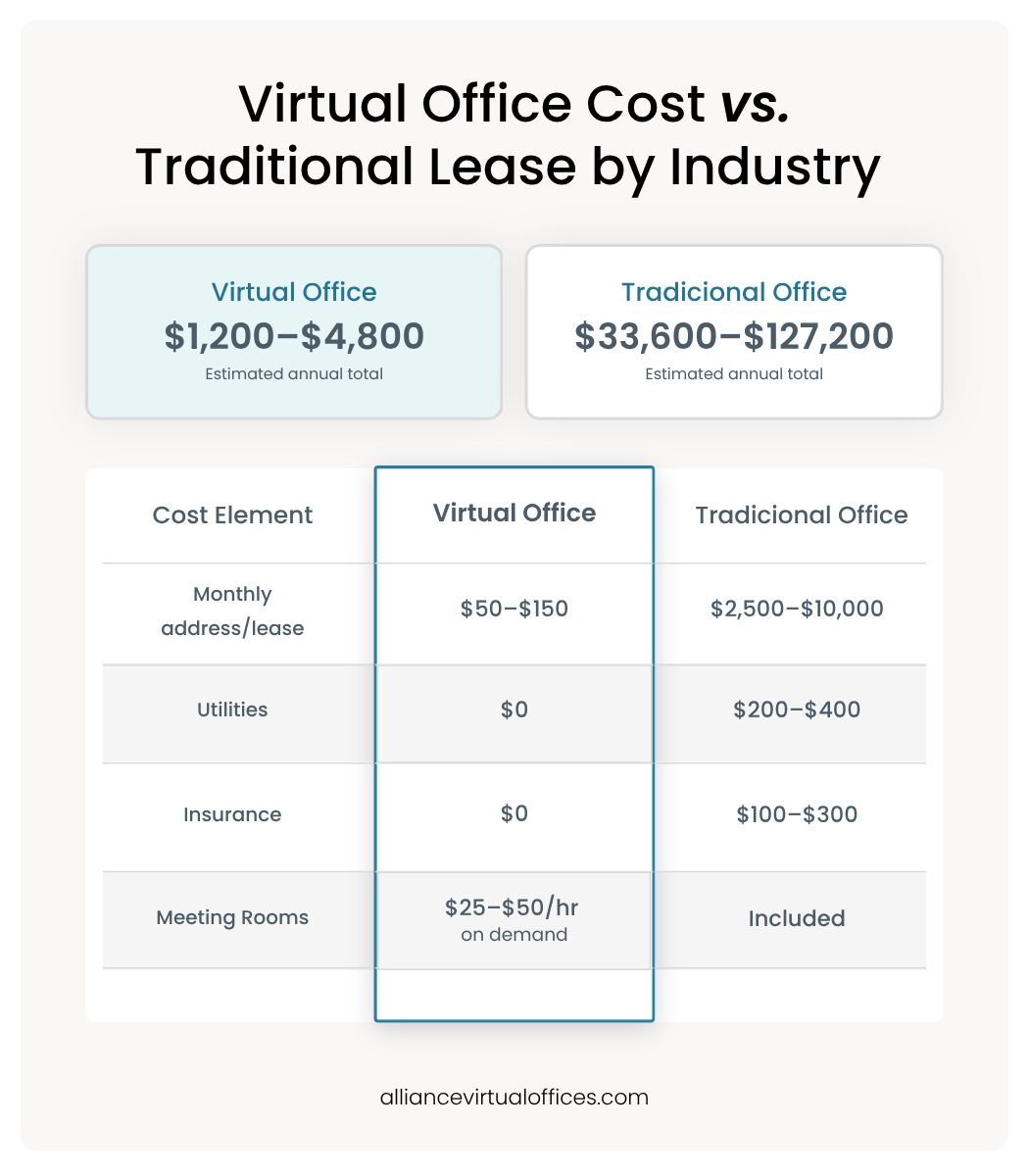
Virtual Office Cost vs. Traditional Lease by Industry
The savings calculation is most meaningful when grounded in what businesses in specific professions spend on physical space. The figures below represent typical ranges; your specific market and building class will determine where in the range your numbers fall.
Attorneys and Law Firms
A referral checks your law firm before calling, and your business address shows up before your reputation does. For solo attorneys, the question is whether a professional presence requires a $3,000-per-month lease to deliver it.
Solo attorneys and small law firms in mid-size cities typically pay $2,500 to $5,000 per month for office space. In major metros, $5,000 to $10,000 or more is common. Add utilities ($200–$400/mo), insurance ($100–$300/mo), and maintenance, and the true monthly cost of a traditional law office often runs $3,000 to $6,000+.
A virtual office alternative for a solo attorney costs significantly less; sometimes $50–$150 per month for a business address and mail handling, plus on-demand meeting rooms at an additional $25–$50 per hour for client consultations. In most months, that brings your costs under $300. Here’s a cost breakdown to consider:
This makes the annual savings estimate for a solo attorney typically between $28,000 and $58,000+, depending on market. Many state bars accept virtual office addresses for law practice registration. Before making the switch, confirm your state’s specific rules.
A solo practitioner transitioning from a firm partnership to independent practice faces this decision at exactly the moment when preserving cash flow matters most. A professional business address in a recognized commercial building, available from day one, supports client communication and bar registration without requiring a lease commitment while the practice builds its client base.
Read More: Start a Law Firm the Smart Way
CPAs and Accounting Firms
Tax season hits and you need to meet with 15 clients in two weeks. But the office you pay for year-round sits mostly empty the other forty weeks.
A small Certified Public Accountant (CPA) firm or solo accounting practice typically leases 400–600 square feet, at monthly rents ranging from $2,000 to $4,000 in most markets. Tax season creates concentrated meeting demand, but throughout the rest of the year, office use may be minimal.
A virtual office solution allows CPAs to maintain a professional business address year-round and book meeting rooms on demand during the busy season. That’s far more cost effective than maintaining a full lease for 12 months to support 3 months of intensive client traffic.
The annual savings estimate is typically $22,000 to $46,000, depending on how much meeting room time is needed during peak periods. A virtual office for CPA practices is increasingly common, particularly for practitioners transitioning from a larger firm to a more independent practice.
Consultants and Professional Services
You fly into a client city for a high-stakes engagement, but the only thing on your business card that hasn’t kept pace is your business address. For many consultants, physical office space is more about professional credibility than operational necessity.
Independent consultants in management, HR, marketing, and finance typically meet clients at the client’s office or on video. A consultant who leases office space primarily for the address and occasional client calls typically pays $1,500 to $3,000 per month for access they use infrequently.
A virtual office costs as little as $50–$100 per month, but it delivers the same address credibility as a traditional lease without the overhead. The annual savings estimate is typically around $16,000 to $35,000.
Consultants who occasionally need in-person client access can book equipped meeting rooms on demand rather than maintaining a full lease. The room is ready, the whiteboard clean, and the front desk knows your name.
For consultants, the virtual office cost ROI calculation often involves a secondary consideration beyond savings, as a professional address signals an established practice operating from a recognized business location. This professionalism matters for proposals, contract negotiations, and engagements where the client’s procurement team reviews the vendor’s business profile before approving payment.
Healthcare and Therapy Practices
Medical and therapy practices present a different calculation. Clinical space, such as examination rooms and treatment areas, requires a physical presence that a virtual office cannot replace.
However, the administrative overhead of running a practice is often a separate cost. A practice that maintains a separate administrative office for billing, credentialing, and administrative staff can typically shift those functions to a virtual office address, while leasing only the clinical space needed for patient care.
Annual savings on administrative overhead are typically between $12,000 and $30,000. This calculation applies most directly to multi-location practices, therapy practices that operate primarily by telehealth, and medical practitioners who are building an administrative address that’s distinct from their clinical location.
E-Commerce and Online Businesses
You registered your LLC with your home address, and now it appears on every public filing. For e-commerce sellers and digital-first businesses, this is usually the moment the virtual office search begins.
Most online sellers don’t have a lease to replace. Instead, they work from home and need a business address that isn’t their personal residence. The value is about privacy, professionalism, and compliance rather than lease elimination.
Using a home address for LLC registration, IRS filings, and business correspondence means that address becomes public record. But the annual virtual office cost is $600 to $1,800 per year. For the privacy, compliance, and professional credibility gained, most online business owners find the office lease vs virtual office comparison favors a virtual office solution.
How to Calculate Your Virtual Office ROI
When you’re evaluating virtual office costs, the ROI framework is simple. Run through these steps with your own numbers:
Step 1: Calculate your current or projected total office cost
Monthly lease cost + utilities + insurance + maintenance + parking (if applicable) = Total Monthly Office Cost
Step 2: Estimate your virtual office monthly cost
Select the plan tier that fits your meeting and mail needs. Add the estimated monthly cost of any on-demand meeting room bookings.
Step 3: Subtract to find monthly savings
Total Monthly Office Cost – Virtual Office Monthly Cost = Monthly Savings
Monthly Savings × 12 = Annual Savings
Step 4: Factor in the flexibility premium
A traditional office lease typically requires a 1–5 year commitment with early termination penalties. Meanwhile, a virtual office membership typically runs month-to-month.
The true benefit is flexibility value, which refers to the ability to scale up, scale down, or relocate without lease penalties.
Step 5: Consider the opportunity cost of time
Managing a physical office consumes time that a business owner or practice manager could deploy elsewhere, such as lease negotiations, utilities, vendor relationships, and maintenance coordination.
A conservative estimate for the hours spent on physical office administration each month, multiplied by the owner’s effective hourly rate, adds a real but often invisible cost to the traditional lease model.
Worked Example: Solo Attorney in Austin, TX
The virtual office cost savings in the worked example above land high, illustrating that results vary by market and practice type. Run the numbers with your own figures rather than relying on any single benchmark.
Read More: Virtual Office Costs
The Hidden Value Beyond Virtual Office Cost Savings
The monthly savings figure is the most straightforward part of the ROI calculation. However, several additional factors carry real value but resist easy quantification. These include:
- Flexibility. A virtual office is typically month-to-month, with no 3–5 year lease commitment. You can scale up, add locations, or change markets without penalty. This means that a startup signing a 3-year lease in month six of operations is betting on sustained growth and a stable market, which could be expensive to unwind. Virtual office arrangements can remove much of that risk, and it’s why 80% of US startups choose virtual office spaces.
- Geographic presence. A virtual office allows you to establish a professional business address in a new market without physically relocating. This makes sense for consultants, attorneys, or financial advisors expanding to a new region.
- Time savings. Eliminating a daily commute and reducing overhead management tasks, such as lease negotiations, maintenance coordination, and utility accounts, returns hours per week to the business owner.
- Professional image. A commercial address in a recognized business center carries weight with clients, lenders, and licensing boards. A home address on a professional services website or business card can reduce perceived credibility before a conversation begins.
- Tax implications. Virtual office costs are typically deductible as an ordinary and necessary business expense. Consult a tax professional for guidance specific to your situation, since deductibility depends on how and where the address is used.
Which Alliance Virtual Offices Plan Fits Your Industry
The right virtual office plan depends on how much physical meeting access you need, not on the maximum you might ever use. Paying for 16 hours of monthly meeting room access when you need two hours isn’t cost effective.
Here are some of the virtual office plans offered by Alliance Virtual Offices:
All virtual office plans include a professional business address at real business centers nationwide. Additional meeting room hours beyond the included allocation are bookable on demand.
Unlock Our Current Virtual Office Offers
Enter your email below and we’ll send you the latest available promotions and monthly specials for Virtual Offices, Meeting Rooms, and Live Receptionists.
Understanding Virtual Office Cost Helps You Make a Confident Decision
Virtual office costs typically range from $50 to $150 per month, but that number only becomes meaningful when you set it against what you would otherwise spend. For attorneys and CPAs, the annual savings are often in the tens of thousands.
Savings can be significant for consultants, and the flexibility premium adds further value. For e-commerce sellers and online businesses, ROI is measured in privacy, compliance, and professional credibility rather than lease elimination.
The ROI framework is straightforward: calculate your total monthly office overhead, subtract the cost of the virtual office plan that fits your needs, and multiply by 12. Then add the flexibility value of operating without a long-term lease.
If you’re comparing your options, explore Alliance Virtual Office plans and locations to see what’s available in your market and calculate your potential savings.
Frequently Asked Questions
How much does a virtual office cost?
Is a virtual office worth it?
How much can you save with a virtual office vs. an office lease?
Can I use a virtual address for my LLC?
Does the IRS accept a virtual office address?
What does a virtual office cost per month?
Is a virtual office worth it for a law firm?
Further Reading