
- Is a Pressure Washing Business Worth It? Costs, Earnings & Margins
- Set Up Your Pressure Washing Business the Right Way
- Land Your First Pressure Washing Jobs
Q: How do you start a pressure washing business?
A: Launching a pressure washing business can happen in a few weeks. Register as an LLC, get an EIN, secure a business address and license, add liability insurance, buy or rent a pressure washer, then win first jobs through local marketing and referrals.
Learning how to start a pressure washing business is appealing for a simple reason, because the barrier to entry is low and the margins are strong. Demand for exterior cleaning keeps growing as homeowners and property managers outsource the work that they used to do themselves.
The catch isn’t the work itself, as most new pressure washing business owners learn how to clean a driveway within a week. Where people stumble is the business layer underneath the work, which involves choosing a business structure, getting registered, establishing a professional business address, keeping a professional presence, and setting up insurance before your first check clears.
This guide walks through what it costs and what you can earn when you set up a pressure washing business. It also covers how to set up a business the right way, what equipment you need, how to price your services, and landing your first paying clients.
Is a Pressure Washing Business Worth It? Costs, Earnings & Margins
For a hands-on pressure washing business owner who’s willing to do the work, the numbers are attractive. When you compare the startup costs for pressure washing business ideas against most other trades, it’s a low entry price with a quick path to making profit. But there are three numbers that matter most: startup costs, earnings, and margins.
Startup costs for a pressure washing business typically run between $2,000 and $6,000 for a solo setup, according to Jobber. The low end covers a solid residential machine, hoses, nozzles, and detergents, plus basic registration and business insurance.
The high end adds commercial-grade equipment, a surface cleaner, and branding. If you need to buy a vehicle to haul your rig, you’ll need to budget separately for that.
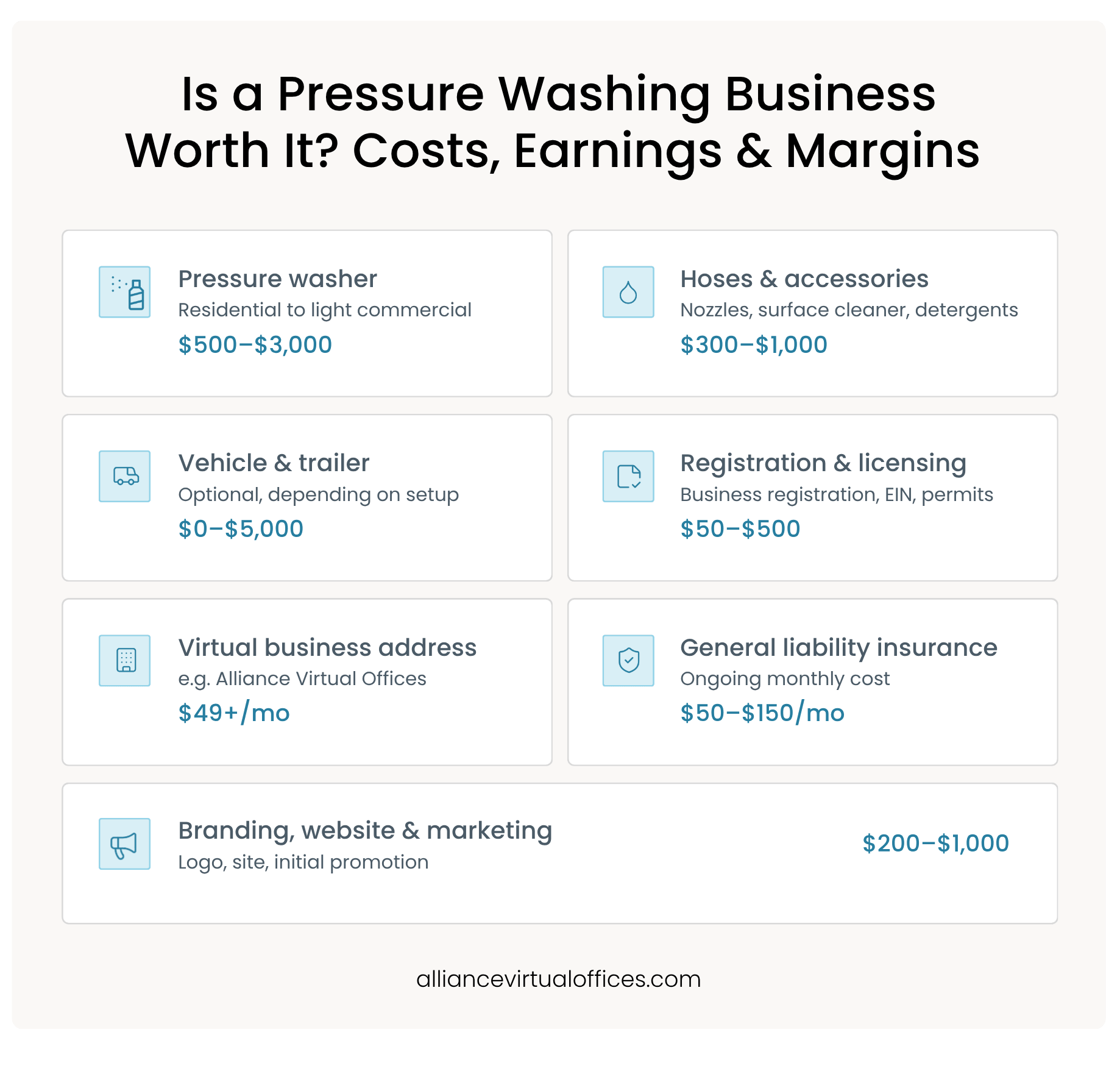
It helps to see where the money goes. So, here’s a realistic breakdown of the startup costs for a pressure washing business at a solo level:
Notice how little of that cost is fixed overhead. Unlike a storefront, a pressure washing business carries almost no rent, which is a big part of why the margins hold up. You don’t even need a physical office. You can get a virtual office address from Alliance Virtual Offices that maintains a business presence at a fraction of the cost.
Once your gear is paid off, most of what you charge is profit minus fuel, water, and detergent. If you complete two residential jobs a day at an average ticket of a few hundred dollars, a full week of work adds up quickly.
As you build your reputation, you’ll get repeat customers plus seasonal contracts that will smooth out the slow stretches. That is how a solo operator moves from part-time side income toward a full-time living within a season or two.
Earnings scale with effort and repeat work. Established solo operators report earnings of between $50,000 and $100,000 or more per year, per figures cited by UpFlip. A single operator running two or three jobs a day can generate meaningful daily revenue once you generate a steady client base.
Margins are the reason the model works. Gross margins on pressure washing jobs are commonly cited between 40% and 70%, because fuel, water, detergent, and equipment upkeep are part of your main ongoing costs. Keep your scheduling tight and your travel efficient, and a large share of each job stays in your pocket.
There’s a downside to running this kind of business, because it demands physical work. You’ll spend long days on your feet, your equipment will need regular maintenance, weather can wipe out a workday, and local markets can get competitive. None of that is a dealbreaker, but you should plan for it rather than be surprised by it.
Read More: How to Start a Remote Cleaning Business
Set Up Your Pressure Washing Business the Right Way
When you’re starting a pressure washing business, getting the foundation right is essentially your first step, as everything after it should get easier, from opening a bank account to signing commercial clients.
Start with your business structure. Many pressure washing operators form a Limited Liability Company, or LLC, rather than run as a sole proprietor. While a sole proprietorship is simpler and cheaper to start, it offers no liability separation between your personal and business assets. An LLC business structure also looks more established to clients.
Your next step is getting an Employment Identification Number (EIN): a free, federal tax ID from the Internal Revenue Service (IRS) that enables you to open a business bank account, hire team members, and keep your Social Security number off your paperwork. It takes minutes to apply online.
Then you can decide on your professional business address, which is even more necessary when you form an LLC. Many business owners don’t realize this, but if you start your business using your home address, and then list it on your website, Google Business listing, and state filings, it puts your family’s home on permanent public record.
Meanwhile, a professional business address from Alliance Virtual Offices keeps your home address private and reads as more credible to clients deciding whether to hire your services.
Finally, handle business licensing. Requirements vary by state and city, but most pressure washing businesses need a general business license, with some areas requiring contractor registration or water-runoff permits because of wastewater rules.
Check your state’s Secretary of State portal and your city clerk for support. The Small Business Administration (SBA) also keeps a helpful overview of federal and state requirements.
NEXT STEPS: Explore a Professional Business Address from Alliance
Insurance and Protecting Your Business
Pressure washing business insurance isn’t optional once you start spraying high-pressure water near windows, siding, cars, and landscaping. One cracked window or damaged surface or vehicle can cost you much more than a season of premiums. Treat your insurance coverage as a cost of doing business rather than an afterthought.
General liability insurance is the core coverage. It protects you if you damage a client’s property or someone is injured because of your work. For a property-facing service like pressure washing, this is the policy that lets you take on real jobs with confidence.
Pressure washing business insurance for a solo operator commonly costs in the range of $50 to $150 per month for general liability, depending on your coverage limits, location, and claims history. To put it in perspective, that’s a small price to pay against the potential cost of a single accident on a client’s property. It’s also far cheaper than most business owners expect before they get a quote.
Beyond general liability insurance, consider a few add-ons to your business structure as you grow. A surety bond reassures larger clients that you’ll complete work as agreed. Commercial auto coverage matters once you’re driving a dedicated work vehicle. And if you hire staff, workers’ compensation is usually required.
Many commercial clients and property managers will ask for proof of insurance before they hire you, so having it in place opens doors rather than just covering risk.
Get Your FREE Guide Today!
How to Start a Business in a Recession

Equipment and Supplies You Actually Need
When you’re starting a pressure washing business, you don’t need to buy all your equipment and supplies at once. Start by getting the core kit that lets you do quality residential work, then reinvest profits into gear that expands what you can offer.
The heart of your setup is the pressure washer itself, and the two numbers that matter are pounds per square inch (PSI) and gallons per minute (GPM):
- PSI measures the force and stripping power of the water stream, essentially the cleaning pressure.
- GPM measures water flow, which controls how fast you can rinse a surface.
For most residential power washing work, a machine in the 3,000 to 4,000 PSI range with solid GPM handles driveways, siding, and decks. Gas units generally outperform electric for professional use, since they deliver more consistent pressure and aren’t tethered to an outlet.
Power washing and pressure washing are often used interchangeably, though power washing technically uses heated water. In practice, most residential jobs are handled with a standard cold-water pressure washer, and you can market yourself using whichever term your local customers search for.
Around the machine, you’ll want a few essentials, including the following:
- A surface cleaner attachment for fast, streak-free work on flat concrete
- Quality hoses, quick-connect fittings, and a range of spray nozzles
- Detergents suited to different surfaces, from concrete to wood
- Safety gear, including boots, eye protection, and gloves
As your reputation in pressure washing grows, consider adding a soft washing setup to broaden your services, as this uses low pressure and cleaning solutions to safely clean roofs, painted surfaces, and delicate siding that high pressure would damage. Offering both pressure washer equipment and soft washing opens the door to more jobs and commands higher profits.
As you scale your pressure washing business, think about purchasing a reliable work vehicle and trailer, a water tank for sites without easy access, and backup equipment so a breakdown doesn’t cancel a day of jobs. Buy for the work you have, not the work you imagine.
Maintenance is the unglamorous habit that protects your income. A commercial pressure washer is a workhorse, but it needs regular care. This involves checking the oil, flushing the pump, storing it away from freezing temperatures, and keeping spare fittings and nozzles in your truck. Ten minutes of upkeep at the end of a job prevents the kind of mid-week breakdown that cancels appointments and dents your reputation.
Write a Simple Pressure Washing Business Plan
A pressure washing business plan doesn’t need to be a fifty-page document, but it does need to answer a few practical questions clearly, so you know how you’ll make money and who you serve.
Start with pricing. Operators typically charge by the square foot, by the job, or by the hour, and rates vary by region and surface. Research what local competitors charge, then price to reflect your quality and reliability rather than racing to the bottom. Bundling services, like a driveway plus house wash, raises your average ticket.
Next, define your services and your target customers. You might focus on residential cleaning services such as driveways, patios, and house washing, or pursue commercial and fleet work with recurring contracts. Residential work is easier to start and market locally. Commercial work is harder to win but delivers steadier, repeat revenue.
Then map your simple economics. Estimate your cost per job, your target number of jobs per week, and the revenue that gets you to your income goal. Because pressure washing carries strong profit margins, even a modest weekly job count can add up to a solid full-time income once you’re booked.
Finally, note your growth plan. Decide when you’ll add soft washing, hire your first helper, or invest in a second machine. Writing it down keeps you focused when the busy season hits and it is tempting to just chase every call.
Seasonality deserves a line in your plan, too. In much of the country, exterior cleaning peaks in spring and summer and slows in winter. Smart operators smooth that curve by lining up recurring commercial contracts, offering gutter and holiday-light-prep services in the off-season, and pre-booking spring work while the phone is quieter.
A pressure washing business plan that anticipates the slow months keeps your income steadier than one built only around peak demand.
Land Your First Pressure Washing Jobs
Marketing a mobile service business is largely local, and the good news is that a few basics go a long way. You don’t need a big ad budget to fill your first weeks, but here’s a step by step to help land your first pressure washing jobs:
- Start with a Google Business Profile. It puts you on the map for local searches, collects reviews, and is free to set up. Add before-and-after photos of your work, since visible results sell pressure washing better than any slogan. Ask every satisfied customer for a review and a referral, because word of mouth is the top driver for local service businesses.
- Layer in neighborhood tactics. Post in local community groups, hand out door hangers in neighborhoods where you just finished a job, and partner with real estate agents and property managers who need reliable cleaning on a schedule. Consistency beats intensity here, so show up regularly rather than in bursts.
- Referrals deserve a system, not just hope. After every job, ask the customer directly whether they know a neighbor who could use the same service, and consider a small discount for referrals that turn into booked work. Because pressure washing results are visible from the street, one clean driveway often sells the next three on the block. A tidy follow-up text with before-and-after photos turns a one-time customer into a repeat client and a source of word-of-mouth leads.
One operational detail can cost new operators money, and that’s missed calls. When you’re up a ladder or running a loud machine, you can’t always hear or see your phone ringing. When you don’t answer the phone, a prospect who reaches voicemail often just calls the next company.
However, a dedicated business line with live answering service from Alliance Virtual Offices solves this problem. It provides live coverage from someone who, while you’re busy working, can capture a lead and take them to the next step. Use our live receptionist calculator to see what answering support would cost.
Read More: Virtual Receptionist for Contractors
Starting Your Pressure Washing Business with Confidence
Knowing how to start a pressure washing business comes down to sequencing two things well: the cleaning work (which is easy to learn), and the business setup. The latter is where lasting operations are built.
Here’s the recap to starting your pressure washing business:
- Budget $2,000 to $6,000 to start, and expect strong margins once you start getting booked by clients.
- Form your entity, whether that’s an LLC or sole proprietorship.
- Get an Employment Identification Number.
- Keep your home address private with a professional business address.
- Secure your business license and carry general liability insurance.
- Buy the core equipment first, and consider more technical equipment and a vehicle later on.
- Add soft washing services as you expand, price for quality, and win your first jobs through a Google Business Profile, reviews, and referrals.
Get your business foundations right and you’ll look legitimate and established from your very first job. This is exactly what turns a one-time cleaning into a repeat customer. A professional business address, a dedicated business line, and a plan for capturing every lead give a solo operator the presence of a much larger company.
Get a professional business address for your business with Alliance Virtual Offices, starting at just $49 per month.
Frequently Asked Questions
How much does it cost to start a pressure washing business?
Do you need a license to start a pressure washing business?
Is a pressure washing business profitable?
What equipment do you need to start a pressure washing business?
Do I need insurance for a pressure washing business?
Further Reading