
- What you need to register a wellness business
- Can you register a wellness business without an office?
- Why PO boxes and UPS boxes usually do not work
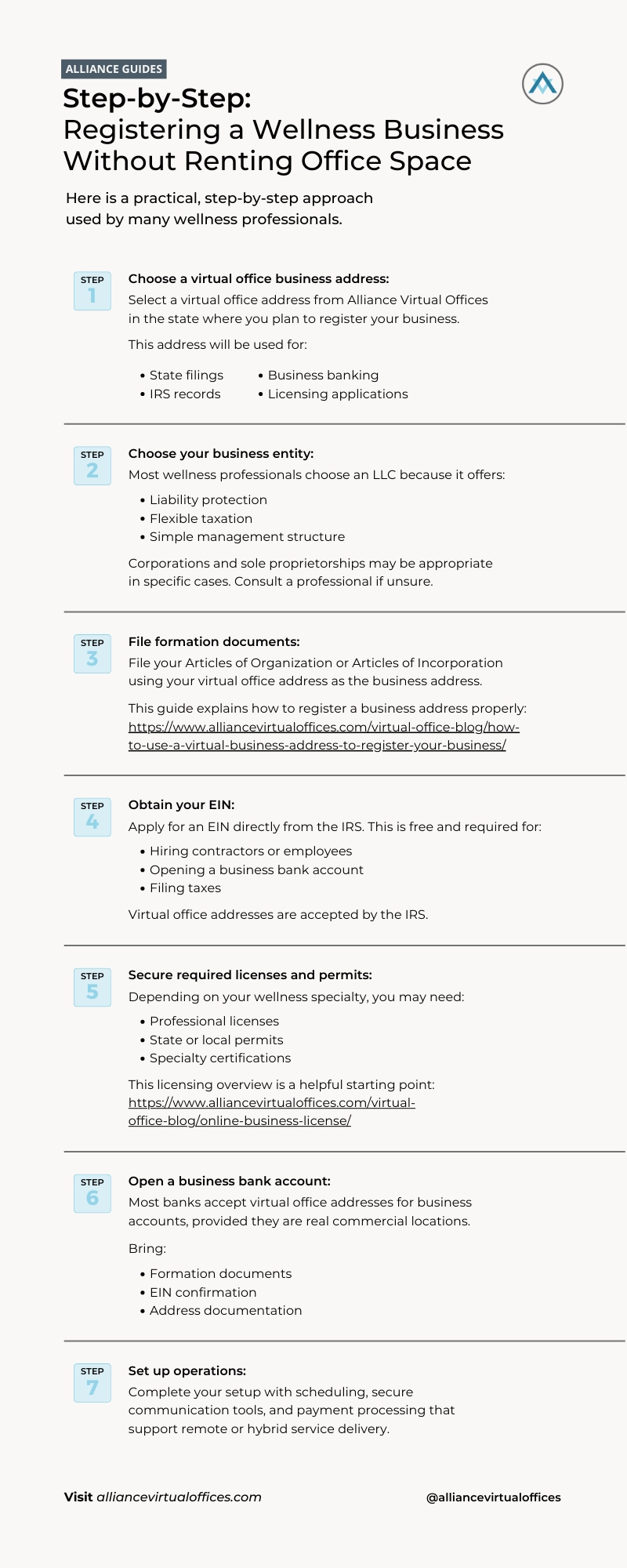
- Step-by-step: Registering a wellness business without renting office space
Q: Can you register a wellness business without renting a physical office?
A: Short answer-Yes.
A wellness business can be legally registered without renting office space by using a compliant virtual office business address. A virtual office provides a real commercial street address that meets state registration requirements, protects personal privacy, and allows wellness professionals to operate remotely or hybrid without the cost or commitment of a traditional office lease.
Modern wellness businesses are evolving quickly. Therapists, coaches, nutritionists, massage therapists, and holistic practitioners are no longer tied to traditional office settings. Many now work remotely, see clients virtually, travel to client locations, or operate hybrid practices that blend online services with occasional in-person sessions. This shift has made it easier than ever to launch and grow a wellness business without the overhead of a permanent office.
Here’s the challenge.
Even if you do not need a full-time workspace, you still need a legally valid, professional business address to register your company, open a business bank account, apply for licenses, receive official mail, and protect your personal privacy. State filings, the IRS, banks, and licensing agencies all require a real business address. Using the wrong type of address can slow down registration, create rework, or expose your home address on public records.
Renting commercial office space just to satisfy paperwork requirements is expensive, unnecessary, and often misaligned with how wellness professionals actually work today. Home addresses raise privacy and zoning concerns, while PO boxes and UPS store boxes are frequently rejected for business registration. That leaves many wellness entrepreneurs stuck between options that either cost too much or fail to meet legal requirements. This is why understanding how to get a business address that works for registration is critical.
The good news is that you can register a business without an office.
By using a professional virtual office address, wellness practitioners can establish a legitimate commercial presence without committing to a lease. A virtual office provides a real street address that can be used for state filings, licensing, banking, and mail handling, while allowing you to operate remotely or on the go.
This guide walks you through exactly how to register a wellness business without renting office space, explains which address options work and which ones do not, and shows how a virtual office from Alliance Virtual Offices supports credibility, privacy protection, and long-term flexibility. Along the way, you’ll see how a professional virtual office address from Alliance Virtual Offices fits the way modern wellness businesses actually operate.

What You Need to Register a Wellness Business
Most wellness entrepreneurs run into trouble during business registration for one reason: the business address requirement.
Regardless of whether you are forming an LLC, corporation, or operating as a sole proprietor, states generally require several core elements.
Core business registration requirements
- A legal business name
- A chosen entity type (LLC, corporation, or sole proprietorship)
- A registered agent (requirements vary by state)
- A legal business address
- Required licenses or certifications for your discipline
- An EIN for tax purposes
For wellness practitioners, licensing requirements may apply to massage therapy, counseling, mental health services, nutrition services, bodywork, or health-adjacent coaching. These requirements vary by state and profession, so always verify with your state licensing board and consider the best state to register your business before filing.
The business address is often the biggest sticking point.
Many wellness professionals do not want to:
- Rent an office they rarely use
- Put their home address on public records
- Risk using an address option that gets rejected later
Understanding which address types are acceptable makes the entire process simpler.
Can You Register a Wellness Business Without Renting an Office?
Short answer? Yes.
You can register a wellness business without renting office space, as long as you use a compliant commercial business address that meets state and federal requirements. What matters is not whether you physically occupy an office every day, but whether your business is tied to a legitimate address that can be used for legal, tax, and licensing purposes.
This distinction is critical. States do not require wellness professionals to lease an office in order to form an LLC or corporation. Instead, they require a valid business address where official correspondence can be sent, legal documents can be delivered, and the business can be formally associated. The address must be real, commercial, and acceptable for state filings. It does not need to be a space you work from full time.
This is especially relevant for modern wellness businesses, which are increasingly remote-first by design.
Perfect Setup for Telehealth and Virtual Coaching
Telehealth and virtual coaching are now standard across many disciplines, allowing practitioners to serve clients without a physical office. Mobile massage therapists, bodyworkers, and wellness consultants often travel directly to client locations. Hybrid practitioners may work from home most days while using professional space only occasionally for assessments, workshops, or client sessions.
For these business models, a traditional office lease adds cost without adding value. Monthly rent, long-term commitments, and unused space do not align with how most wellness professionals operate today.
However, a professional business address is still essential. It is required for business registration, banking, licensing, and mail handling. It also plays a key role in protecting personal privacy and presenting a credible, established presence to clients and institutions. A virtual office address that meets industry standards bridges this gap, giving wellness entrepreneurs the legal foundation they need without forcing them into an office they do not need.
Why You Should Not Use Your Home Address
Using your home address might seem like the simplest option, but for many wellness professionals, it creates avoidable long-term problems.
Privacy risks
When you register a business, your address becomes public record. That means your home address can appear in multiple places, often permanently.
Common examples include:
- State business registration databases
- Licensing board directories
- Online business listings and aggregators
- Legal and regulatory filings
For wellness professionals, this is more than an inconvenience. Client discretion, personal safety, and clear professional boundaries matter. Once a home address is public, it is difficult to fully remove.
Professional perception
A residential address can also raise questions during key moments of growth.
It may be flagged or scrutinized by:
- Potential clients evaluating your credibility
- Banks during business account setup
- Insurance providers or credentialing partners
In contrast, a professional business address signals that your practice is established, legitimate, and structured to operate responsibly. Even for fully remote or mobile wellness businesses, this perception plays an important role in trust and verification.
For practitioners who plan to grow, work with third parties, or maintain strict personal boundaries, relying on a home address often becomes a limiting choice rather than a convenient one.
Zoning and regulatory issues
Many cities and municipalities place restrictions on business activity conducted from residential addresses. These rules vary widely, but they often apply even if you are not seeing clients in person or operating a storefront.
Common issues include:
- Local zoning laws that limit commercial use in residential areas
- Home occupation rules that require special permits
- HOA or building restrictions that prohibit registered businesses
Even fully online or virtual wellness businesses can run into problems. Simply listing a home address on state filings, licensing applications, or public directories can be enough to trigger zoning reviews or compliance notices.
In some cases, practitioners are forced to update their business address after registration, refile documents, or explain their setup to local authorities. This creates unnecessary friction and administrative work.
Using a professional commercial business address helps avoid these conflicts entirely. It separates your personal residence from your business on paper, reduces regulatory exposure, and allows you to register and operate without worrying about local zoning or HOA limitations that were never designed for modern, remote-first businesses.
Credentialing and insurance challenges
Certain health-adjacent services may face additional scrutiny during insurance credentialing or third-party verification processes. A residential address can complicate these reviews.
If you are planning to operate long-term, a home address is rarely the best choice.
For a deeper look at operating remotely, see this guide on how to start a business from home
Why PO Boxes and UPS Store Boxes Usually Do Not Work
Many wellness entrepreneurs consider PO boxes or private mailbox services because they seem cheap, simple, and “good enough.” Unfortunately, these options often fail business registration requirements, especially when you’re forming an LLC or corporation and need an address that agencies can verify as a real business location.
PO boxes
Most states prohibit PO boxes for LLC or corporation registration because:
- They are not physical commercial addresses
- They cannot be used for service of process or official delivery requirements
- Many state filing systems automatically reject them
Even if a filing slips through, a PO box can create problems later when you try to:
- Open a business bank account
- Apply for a professional license
- Receive state notices or legal documents reliably
UPS Store and private mailbox services
UPS Store boxes and other private mailbox services look like street addresses, but they are still classified as mailboxes. That classification is what creates risk.
Common issues include:
- State rejection during business formation or amendments
- Licensing agencies refusing the address during review
- Banks declining the address for business account setup or verification
In other words, it may look compliant, but it often doesn’t behave compliantly when a state agency, bank, or licensing board runs validation checks.
This comparison breaks down the differences clearly
If your goal is to register a business without physical office space, PO boxes and mailbox services can lead to delays, re-filings, and avoidable back-and-forth. A compliant commercial business address removes that uncertainty from the start.
How a Virtual Office Solves the Problem
A virtual office provides a compliant, professional business address without requiring you to rent office space.
Why virtual offices work for business registration
A properly structured virtual office address is designed to meet business formation and verification requirements, not just mail delivery needs. This is what separates virtual offices from PO boxes and private mailboxes.
A compliant virtual office address:
- Is a real commercial street address located in a staffed business center
- Can receive official mail from the state, IRS, banks, and other institutions
- Meets requirements for LLC and corporation filings in most jurisdictions
- Protects your home address and personal privacy by keeping personal and business records separate
Because the address is tied to real workspace and onsite staff, it is recognized as a legitimate place of business for registration and ongoing operations.
For wellness professionals, a business address tied to workspace creates flexibility without sacrificing legitimacy. You get the legal foundation required to register, verify, and grow your business without being locked into space you do not use every day.
Professional presence without daily office use
A virtual office allows you to maintain a professional footprint while working in the way that makes sense for your practice.
With a virtual office, you can:
- Register your business legally using a compliant commercial address
- Present an established, professional image to clients, banks, and licensing agencies
- Operate remotely, travel to client locations, or run a hybrid practice
- Access professional meeting rooms or offices only when in-person space is actually needed
This approach aligns with how modern wellness businesses operate. You pay for legitimacy, flexibility, and access, not unused square footage.
Alliance Virtual Offices provides compliant business addresses across a national network of staffed business centers. You get a real location tied to professional workspace, not a mailbox.
Learn more about virtual office locations here
Additional Tools Wellness Professionals Often Need
Beyond a business address, many wellness businesses benefit from additional services.
Live receptionist services
A live receptionist can:
- Answer calls professionally
- Screen inquiries
- Schedule appointments
Learn more here
Meeting rooms for client sessions
Even remote wellness businesses occasionally need professional space for:
- In-person consultations
- Workshops
- Client assessments
Alliance Virtual Offices offers on-demand meeting rooms without long-term commitments.
Mail handling and scanning
Mail services allow you to:
- Receive official correspondence
- View mail remotely
- Maintain consistent records
These tools support fully remote operation while maintaining professionalism.
Best States to Register a Wellness Business
The best state depends on where you operate and where your clients are located.
Common choices
- Florida: Popular for wellness and service businesses
- Texas: Business-friendly environment
- California: Strict licensing but large wellness market
- New York: Professional credibility in health-adjacent fields
Wyoming or Delaware: Often used for asset protection strategies
If you are licensed to practice in a specific state, registering there is usually the simplest approach.
Why Alliance Virtual Offices is Ideal for Wellness Professionals
Alliance Virtual Offices is designed for professionals who want legitimacy without unnecessary overhead.
Key advantages include:
- Real commercial addresses suitable for state filings
- National coverage across major markets
- Optional meeting rooms for client-facing work
- Live receptionist services
- Flexible plans that scale with your practice
Rather than forcing wellness professionals into office leases, Alliance supports modern, flexible business models built around how you actually work.
Ready to register your wellness business the right way?
If you want a compliant business address without renting office space, Alliance Virtual Offices can help you get set up quickly and correctly. Our team can walk you through address options, answer registration questions, and help you choose a solution that fits how your wellness business actually operates.
Contact our sales team to explore available locations and get started with a professional business address today.