
- Compliance and Legal Standards for CPA Virtual Offices
- How Virtual Offices Strengthen Client Trust
- Streamlining Tax-Season Workflow
- Case Studies
Q: Are virtual offices compliant and trustworthy for CPA firms in 2026, and why do accountants choose them?
A: Yes. Virtual offices that provide staffed, verifiable business addresses are fully compliant for CPA firms under IRS, state board, and industry guidelines. CPAs choose them because they protect client confidentiality, support licensing and tax documentation requirements, and offer a professional business presence without the cost of a traditional lease. They also streamline tax-season workflows with secure mail handling, live receptionist support, and access to private meeting rooms for client consultations.
Why Virtual Offices Are Vital for Modern CPA Firms
The accounting world has changed quickly. Remote teams, cloud-based tax software, digital client portals, and flexible work schedules have pushed CPA practices far beyond traditional office models. Many firms now serve clients across the country while maintaining smaller, hybrid teams.
More often than not, accounting firms operate in hybrid or fully remote formats. This shift gives firms flexibility, but it also raises new questions about compliance, privacy, and professional image. Virtual offices solve these challenges by offering secure, compliant business addresses and professional client-facing environments without the cost of a full lease.
Virtual offices help CPA firms stay credible, meet regulatory requirements, and work efficiently during busy seasons. They also support remote firms that want a presence in multiple markets.
If you’re comparing options for your practice, this guide breaks down everything you need to know.
Compliance & Legal Considerations for Virtual CPA Offices
Meeting regulatory standards is the foundation of any CPA practice. Whether you prepare tax returns or provide advisory services, your business address, document handling, and client communication workflows all have regulatory implications.
Virtual offices can support board compliance, but not all providers meet the standards accountants need. Here’s what matters most.
IRS and State Board Requirements
The IRS and state boards of accountancy typically require:
- A verifiable, staffed business address
- A physical location where mail can be delivered securely
- Compliance with IRS Publication 4557 (Safeguarding Taxpayer Data)
- Support for licensing, renewals, and correspondence
Home addresses and P.O. Boxes often don’t meet these standards. Many state boards reject them for registrations, license renewals, and client records.

Alliance Virtual Offices provides staffed, professional business addresses designed to meet these expectations. Locations are operated by trained teams who handle secure mail delivery and client-facing correspondence.
For more guidance, see our resource on using a virtual office for business registration.
Why CPA Firms Need a Physical Business Address
A compliant business address is required for:
- Firm registration
- IRS correspondence
- EIN applications
- Client document delivery
- Bank and lender communication
- KYC and AML verification
Virtual offices give firms a permanent address that works for licensing and regulatory needs while supporting hybrid workflows. Accountants need remote CPA office solutions that remain compliant.
KYC/AML Documentation and Secure Mail Handling
CPA firms often deal with KYC documents, tax returns, and financial records that must be handled with care. Alliance Virtual Offices uses trained onsite teams to receive, secure, and store mail until it’s forwarded or picked up.
These services reduce the risks associated with using a home mailbox or a coworking space with unstaffed reception.
Bottom Line: Virtual offices are fully compliant for CPA firms when the address is staffed, verified, and secured.
NEXT STEPS: Finding the Best Cities for Financial Advisors and CPAs
Building Client Trust Through Professional Presence
Trust is everything in accounting. Clients hand over their financial records, tax history, and sensitive personal data. They want clarity, consistency, and reassurance that they’re working with a firm that takes their privacy seriously. A polished, professional business address helps deliver that reassurance before the first meeting even begins.
For many firms, a virtual office becomes the foundation of that professional presence. It provides the visible stability and legitimacy clients expect while giving you the flexibility to operate remotely or in a hybrid model.
The Psychology of Trust in Financial Services
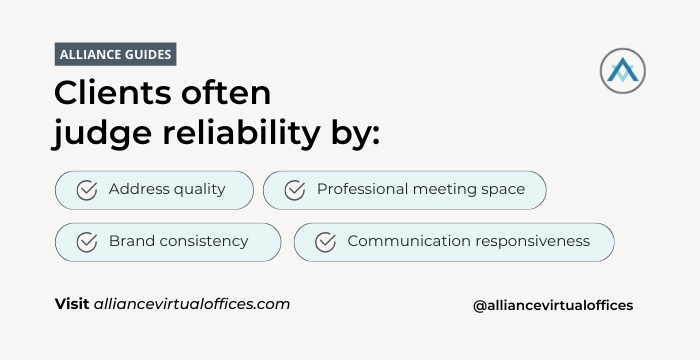
Most clients judge the reliability of an accounting firm long before you prepare a return or analyze a balance sheet. Subtle cues shape their perception, including:
- Address quality
- Communication responsiveness
- Availability of private meeting space
- Brand consistency across touchpoints
When a CPA lists a home address or a mailbox, clients may question whether the firm is established, secure, or properly licensed. Financial services depend heavily on perceived stability. Even small details can influence whether a client chooses to share sensitive documents or sign a long-term engagement letter.
How Virtual Offices Improve First Impressions
A virtual office gives you the kind of public-facing infrastructure that clients expect from a professional accounting practice. Alliance Virtual Offices provides:
- Professional business addresses that work for licensing, IRS correspondence, and client trust
- Private meeting rooms you can book anytime for secure, in-person consultations
- Live receptionists who answer calls using your firm’s name and direct inquiries professionally
- Fast, secure mail handling for IRS notices, client documents, and financial statements
Together, these services help clients feel confident that they’re working with a firm that’s organized, established, and serious about data security. The moment a client sees your business address, calls your receptionist, or arrives at a meeting room, they understand they’re partnering with a legitimate accounting practice.
“I started using a virtual office for my practice last year. Clients feel more confident meeting me in a dedicated space rather than a coffee shop. It changed the way I’m perceived as a firm.”
— Emily R., CPA
Clients Prefer Professional Spaces Over Home Offices
Studies show that clients feel more secure when an accountant has a dedicated business address and private meeting space. Virtual offices provide exactly that without a long-term lease.
Virtual offices give you all these professional advantages without taking on a commercial lease. You get the look and feel of an established, well-run practice, but with the flexibility to work remotely or operate a hybrid firm. Whether you’re onboarding a new client, discussing sensitive documents, or reviewing tax results, a private meeting room reinforces that you take confidentiality and professionalism seriously.
Clients trust firms that present themselves consistently and professionally. A virtual office helps you deliver that impression every time, no matter where you’re physically working.
Bottom Line: Virtual offices reinforce trust by creating a professional, consistent client-facing experience.
Streamlining Tax-Season Workflow with Virtual Office Tools
Tax season is the busiest and most stressful time for firms. Most bottlenecks come from communication issues, document overload, and missed calls.
Virtual offices support workflow efficiency through integrated services.
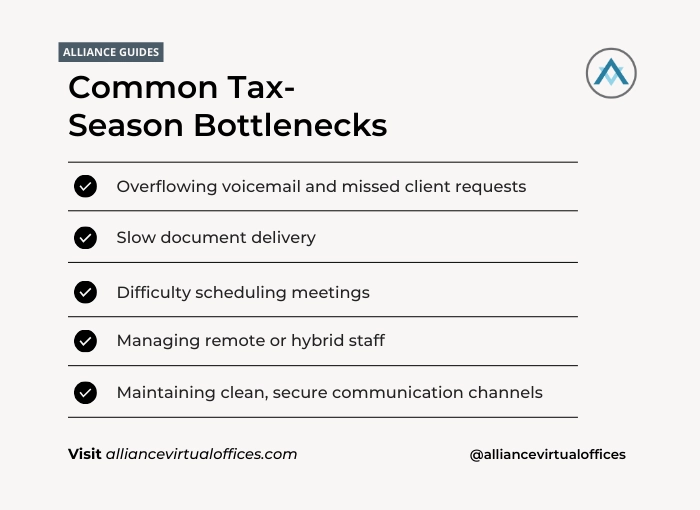
Virtual offices solve these by centralizing communication and document handling.
Tools That Keep CPA Firms Moving
Tax season isn’t just busy. It’s chaotic. Calls spike, documents pour in, deadlines overlap, and clients expect immediate answers. Virtual office tools give CPA firms the structure and support they need to stay responsive and organized without expanding overhead.
Live receptionist services
Live receptionists answer incoming calls using your firm’s name, route inquiries, screen out spam, and schedule appointments on your behalf. This creates a polished first impression and keeps your phone lines from overwhelming your team. During peak filing periods, receptionists can also relay urgent messages, protect your focus time, and ensure every client gets a timely response.
See how live support compares to voicemail in our article on virtual receptionist services.
Digital mail handling
CPA firms deal with IRS notices, client files, W-2s, checks, and bank statements—documents that can’t be lost or delayed. Digital mail handling keeps your communication flow clean and efficient. Trained onsite staff receive your mail, scan it, notify you instantly, and forward items securely to the correct team member. You never risk documents sitting in an unattended mailbox or arriving late during tax season.
On-demand meeting rooms
Whether you’re preparing an audit, onboarding a new client, or resolving a tax issue, private meeting rooms provide a secure and professional place to work. You can reserve rooms whenever you need them, in any city where you’re serving clients, and only pay for the time you use. These rooms give you the privacy and structure that clients expect for conversations involving sensitive data.
Workflow tips for tax season
Virtual office tools become even more powerful when combined with a smart workflow. A few best practices include:
- Set digital inbox rules for incoming client documents
- Use receptionist teams to triage phone calls and reduce interruptions
- Schedule client meetings in batches to protect deep-work time
- Centralize document drop-offs at your virtual office address
- Standardize client submission deadlines for smoother intake
These small shifts help your team stay ahead of deadlines instead of reacting to them.
Hybrid team support
If you’re managing a remote or hybrid firm, the right systems matter. Virtual offices help centralize communication, coordinate client appointments, and create a shared hub for document intake, even when your staff isn’t in the same city.
Virtual offices streamline communication, meetings, document handling, and team coordination during your busiest seasons, giving your firm the capacity and professionalism it needs to perform at its best.
If you’re managing a remote or hybrid staff, see our guide to managing remote teams for more structure and support.
Bottom Line: Virtual offices streamline communication, meetings, and document flow during the busiest parts of your year.
Data Security & Confidentiality in Remote Accounting Environments
Security is the top concern for CPA firms using virtual offices.
Alliance Virtual Offices provides spaces and processes designed to protect sensitive information.
Secure Mail Handling and Document Delivery
All mail is received by trained staff and stored securely. Only authorized individuals can pick up or have mail forwarded.
This helps you stay within the legal boundaries with:
- IRS Publication 4557
- State privacy rules
- Client confidentiality standards
Use our guide on the secure virtual office address to learn more.
NDA-Protected Meeting Rooms and Workspaces
Private rooms let you:
- Review tax returns
- Conduct audit prep
- Discuss financial data
- Meet with clients securely
Coworking spaces often lack controlled access, making them less ideal for accounting work.
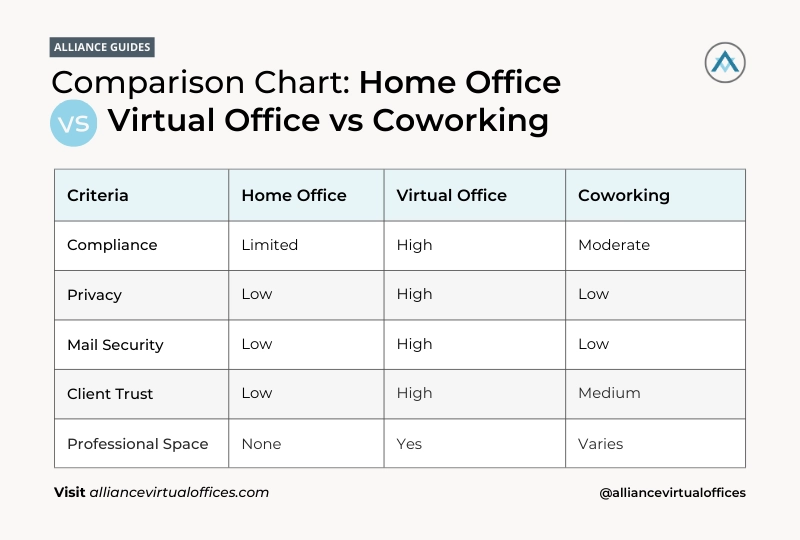
Bottom Line: Virtual offices offer the best balance of privacy, meeting regulatory standards, and professionalism for CPA firms.
Case Studies: How Top CPA Firms Thrive with Virtual Offices
Here are examples of how real-world CPA practices (fictionalized for illustration) use virtual offices to scale.
Case Study 1: Small Firm Scaling Regionally
A two-partner tax practice based in Colorado wanted to expand into neighboring states but didn’t want the cost or administrative burden of opening physical offices. Using virtual office addresses for licensing and IRS correspondence, they registered in three additional states in under 60 days.
With consistent business addresses, professional meeting rooms, and reliable mail handling, the firm began attracting regional clients almost immediately. Client acquisition increased by 40 percent in the first six months, and they completely eliminated a $3,200 monthly lease they’d previously maintained for a traditional office.
“We added two new states to our practice without signing a single lease. The virtual office setup made expansion simple.”
— Daniel M., CPA
Case Study 2: Remote Firm Boosting Client Trust
A fully remote accounting firm serving startups and freelancers needed a professional way to meet clients during onboarding, audits, and year-end reviews. While all of their day-to-day operations were digital, many clients still wanted a private, secure space for sensitive discussions.
By using virtual office meeting rooms in their primary markets, the firm created a polished, consistent in-person experience when needed. During tax season, they hosted dozens of client consultations in professional spaces instead of cafés or coworking lounges.
As a result, their client satisfaction scores climbed significantly. Clients cited “professional meeting space” and “secure document review environment” as key improvements in feedback surveys.
Case Study 3: Mid-Sized Firm Streamlining Operations
A 15-person hybrid accounting firm faced growing pains during tax season. Calls were backing up, voicemail messages were getting lost, and mailed documents often arrived late because no one was consistently in the office.
They adopted virtual office services with live receptionists and digital mail handling. Receptionists answered calls using the firm’s name, scheduled appointments, and filtered non-essential inquiries. Meanwhile, digital mail allowed them to receive IRS notices and client documents immediately, even when staff worked from home.
Within one season:
- Missed inquiries dropped by 70 percent
- Response times improved dramatically
- Staff reported less stress and fewer interruptions
- Client wait times during peak months shortened
The firm delivered faster, more reliable service without hiring additional admin staff.
Bottom Line: Virtual offices help CPA firms expand into new states, strengthen client trust, improve communication, and streamline operations during the busiest parts of the year. Whether you’re a solo practitioner or a mid-sized hybrid team, the right virtual office setup becomes a strategic advantage for growth and reliability.
Why Choose Alliance Virtual Offices for Accounting Firms
Alliance Virtual Offices offers a suite of services designed for industries that depend on privacy, accuracy, and regulatory adherence. CPA firms, tax professionals, auditors, and financial advisors benefit from a business infrastructure that supports both day-to-day operations and long-term growth.
Verified Business Addresses
More than 1,200 staffed, compliant locations across the United States give CPAs a reliable foundation for licensing, IRS correspondence, and professional client interactions. These addresses meet the strict requirements many state boards expect for firm registration and documentation.
Tailored Live Receptionist Services
Live receptionists help manage call volume during high-pressure periods like tax season and quarterly filings. Calls are answered using your firm’s name, routed appropriately, and screened to protect your time. This keeps your workflow organized while maintaining a polished front-facing experience for clients.
Meeting Rooms Near Financial Hubs
Whether you need to host an audit prep meeting, deliver tax results, or perform onboarding for a new client, you’ll have access to private, professional meeting rooms in major business markets. Locations in cities like New York, Dallas, Chicago, Atlanta, and dozens more make it easy to meet securely, even if your team works remotely.
Integration With Accounting Tools
Digital mail services integrate smoothly into existing firm workflows, especially during tax season when client documents arrive daily. You can centralize document intake, receive digital scans immediately, and forward items to the right team member without delays.
Privacy, Professionalism, and Trusted Operations
Financial professionals work with sensitive data every day. Alliance Virtual Offices provides private workspace options, trained onsite staff, secure mail handling, and a professional business presence that supports confidentiality, regulatory alignment, and consistent experiences for your clients.
Explore virtual office plans for CPA firms today.
Bottom Line: Alliance Virtual Offices gives CPA firms the reliable business addresses, communication tools, secure mail handling, and nationwide presence they need to operate confidently in a modern, hybrid accounting environment.
It’s a complete business infrastructure built to support trust, stability, and efficient client service, especially when the workload peaks.
The Future of CPA Practice Management
Virtual offices have become strategic assets for modern CPA firms. They offer professionalism, efficiency, security, and flexibility that traditional offices can’t match at the same cost.
If you want a secure, trusted virtual office address that supports the way accounting firms work today, the next step is simple.
Book your virtual office for accountants with Alliance Virtual Offices.