
- The 2026 Financial Reality New Entrepreneurs Must Plan For
- Why Virtual Offices Are a Financial Advantage in 2026
- Budgeting, Forecasting, and Cash Flow Control in 2026
- How Virtual Offices Reduce CAPEX and OPEX
Q: How should new entrepreneurs approach financial planning in 2026 while keeping startup costs low and building a credible, scalable business?
A: New entrepreneurs in 2026 should focus on lean financial planning that prioritizes cash flow, flexibility, and capital efficiency.
By reducing fixed overhead, using digital-first systems, and leveraging virtual offices instead of traditional office leases, founders can lower startup costs, improve cash runway, maintain professional credibility, and allocate more resources toward growth-driving activities like marketing, hiring, and product development.
Starting a business in 2026 looks very different than it did even five years ago.
Operating costs are higher. Competition is global. Customers expect professionalism from day one. And for new entrepreneurs, every dollar spent too early or in the wrong place can slow growth before momentum ever builds.
That’s why financial planning for entrepreneurs in 2026 is less about cutting corners and more about allocating capital intelligently.
One of the biggest shifts shaping modern startup budgeting is the move away from traditional office space and toward virtual offices. Founders are choosing lean, digital-first business infrastructure that protects cash flow while still supporting credibility, compliance in registration or licensing in your industry, and long-term growth.
This guide breaks down how new entrepreneurs can structure their finances in 2026, reduce startup costs, and build a scalable foundation using virtual offices as a strategic financial tool.
If you’re serious about building a business that lasts, this is where smart financial planning begins.
For cost-efficient ways to establish your business presence, explore professional virtual office services designed for modern entrepreneurs.
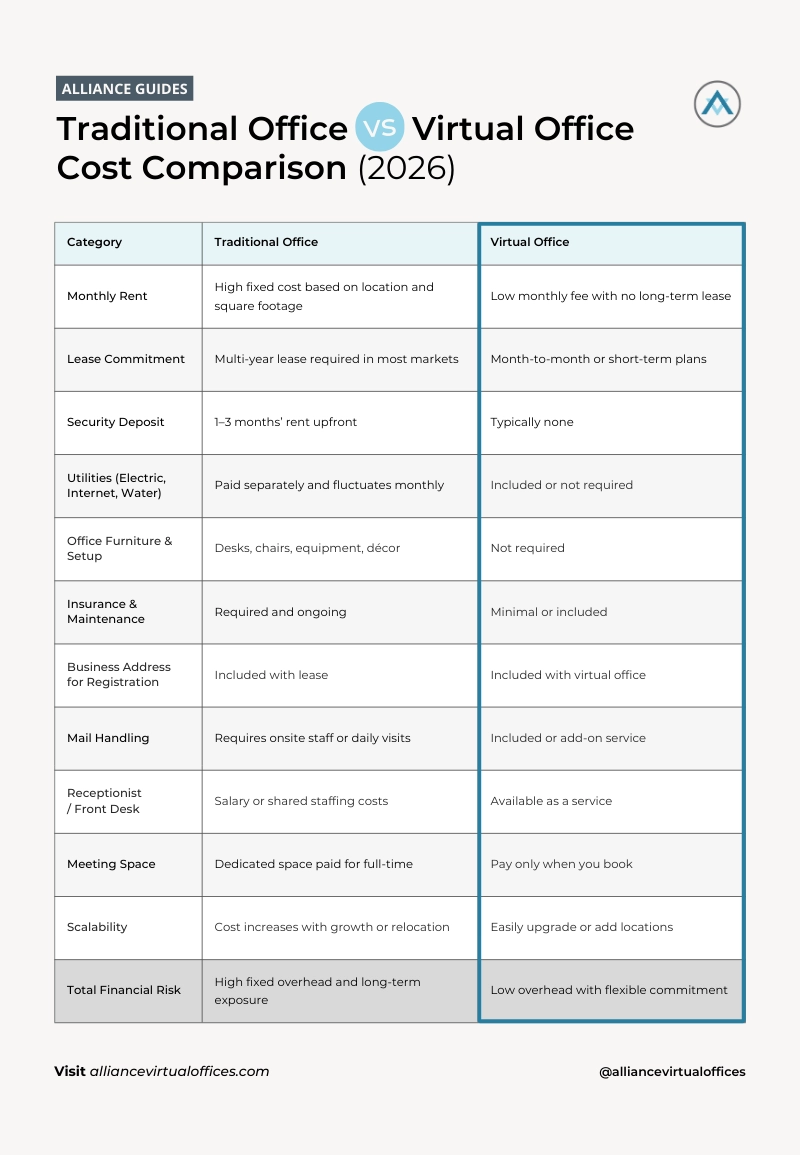
What this comparison means for financial planning in 2026
Traditional office space locks entrepreneurs into fixed costs that don’t adjust when revenue fluctuates.
Virtual offices convert many of those fixed expenses into flexible operating costs, allowing founders to:
• Preserve early-stage capital
• Extend cash runway
• Invest more in marketing, hiring, or product development
• Scale without renegotiating leases
For entrepreneurs focused on startup budgeting in 2026, this shift can materially improve cash flow and long-term financial resilience.
Industry benchmarks from CBRE and Forbes Small Business show that a traditional office can require $10,000–$50,000+ in upfront costs when accounting for security deposits, furniture, basic equipment, and first-month rent in mid-sized U.S. markets. In major metros, that number can be significantly higher.
The 2026 Financial Reality New Entrepreneurs Must Plan For
The financial landscape for startups has shifted. Understanding these forces is the first step in building a resilient financial plan.
Rising costs across core business expenses
Commercial real estate costs remain a significant financial burden for new businesses in 2026.
In many major U.S. metro areas, average office rents are still 20–35% higher than pre-2020 levels, according to market outlooks from CBRE and JLL. For small businesses, rent alone can consume up to 30% of monthly operating expenses, before utilities, insurance, maintenance, and shared building costs are added (SBA small business cost guidance).
Beyond rent, long-term leases introduce financial rigidity. Security deposits, multi-year commitments, and annual rent escalations lock founders into fixed costs that do not adjust when revenue fluctuates. The SBA consistently cites high fixed overhead as one of the most common contributors to early-stage cash-flow stress.
For founders operating remotely or serving clients online, physical office space often becomes an underutilized expense rather than a growth driver.
Workforce utilization studies from Gartner and McKinsey show that many small and mid-sized businesses now use office space fewer than three days per week while continuing to pay for full-time access.
In contrast, virtual offices allow entrepreneurs to maintain a professional presence while reallocating capital toward revenue-generating activities such as marketing, hiring, or product development.
Remote-first business models are now the default
Remote and hybrid work are no longer fringe strategies. By 2026, an estimated 60–70% of knowledge-based businesses operate with distributed or hybrid teams, according to workforce trend data from McKinsey and Gartner. Consulting firms, SaaS startups, eCommerce brands, creative agencies, and professional service providers increasingly prioritize flexibility over centralized office space.
This shift has permanently changed how entrepreneurs approach overhead and staffing. Instead of hiring locally to justify office leases, founders now recruit globally. Instead of budgeting for desks and square footage, they invest in digital tools, cloud infrastructure, and client-facing systems. The U.S. Bureau of Labor Statistics reports continued growth in remote-eligible roles, reinforcing that this operating model is no longer temporary.
As a result, physical offices are no longer a prerequisite for legitimacy. What matters more is whether a business can operate reliably, communicate professionally, and meet regulatory and client expectations. Virtual offices fit naturally into this model by providing a stable business address and administrative support without anchoring the company to a single physical footprint.
Capital efficiency matters more than ever
Capital efficiency has become a defining metric for business viability, not just venture-backed startups. Rising interest rates, tighter lending standards, and cautious investor sentiment mean entrepreneurs must demonstrate disciplined financial management. Deloitte and Harvard Business Review research consistently shows that businesses with lower fixed overhead have longer cash runways and higher survival rates during periods of economic volatility.
Founders who avoid large upfront investments are better positioned to absorb demand shifts, delayed payments, or seasonal fluctuations. This applies equally to bootstrapped businesses and funded startups. PitchBook data indicates that investors increasingly favor companies with lean cost structures and predictable operating expenses.
Virtual offices align directly with this environment by supporting lean operations without sacrificing legitimacy. They convert traditional capital expenditures into manageable operating costs, giving entrepreneurs greater flexibility to adapt their financial strategy as the business evolves.
Credibility challenges for new businesses
Despite the rise of digital-first operations, new entrepreneurs still face very real credibility requirements. Business registration, banking verification, payment processing, licensing, and vendor onboarding all require a legitimate business address, as outlined in SBA and IRS business formation guidance.
Using a home address or PO box can create friction at multiple points. Banks and payment processors may flag applications, state filings may be delayed, and clients may question professionalism. Small business onboarding data and major U.S. bank guidelines indicate that address verification issues remain a common cause of account slowdowns for newly formed businesses.
A professional business address helps resolve these challenges while reinforcing financial discipline. It establishes a clear separation between personal and business finances, supports compliant registration, and presents a credible presence from day one. For entrepreneurs focused on long-term financial planning, credibility is not cosmetic — it directly impacts how quickly a business can open accounts, accept payments, and operate without interruption.
Why Virtual Offices Are a Financial Advantage in 2026
Virtual offices are not just convenient. They’re a financial planning strategy.
Here’s why they matter for entrepreneurs focused on reducing startup costs and improving cash flow.
Immediate overhead reduction
Traditional office space comes with layered expenses:
• Rent and long-term leases
• Utilities and maintenance
• Office furniture and equipment
• Insurance and security
• Cleaning and shared services
A virtual office removes most of these costs while still providing a real commercial business address and administrative support.
Professional credibility without long-term risk
A virtual office gives entrepreneurs a legitimate business presence that works for:
• LLC or corporation formation
• Business banking and payment processors
• Licensing and vendor applications
• Client-facing credibility
This matters financially because delays in banking, compliance issues, or credibility gaps can stall revenue generation.
When discussing business legitimacy, linking to a dedicated virtual office address page helps readers understand how location and professionalism intersect with financial planning.
Flexibility to scale without relocation costs
Virtual offices allow founders to operate nationally or globally without re-establishing infrastructure every time the business grows.
Meeting rooms, mail handling, and receptionist services are available on demand instead of locked into long-term commitments.
For founders watching burn rate, flexibility is financial protection.
Financial Foundations Every New Entrepreneur Needs in Place
Strong financial planning for entrepreneurs starts with structure, not spreadsheets.
Setting financial goals by growth phase
Instead of vague revenue targets, break goals into stages:
Year 1: Stability
• Cover operating costs
• Establish predictable cash flow
• Avoid unnecessary debt
This first year is about survival and visibility. The goal is not aggressive growth, but understanding your true monthly expenses, validating demand, and making sure revenue can consistently support day-to-day operations without relying on personal savings or high-risk financing.
Year 2: Optimization
• Improve margins
• Invest in marketing or systems
• Reduce founder workload
With the business functioning, Year 2 focuses on efficiency. This is when founders refine pricing, eliminate waste, and reinvest profits into tools or channels that drive sustainable growth. Systems and automation begin replacing manual effort.
Year 3: Scale
• Expand offerings or markets
• Hire selectively
• Strengthen forecasting accuracy
By Year 3, the business should be operating from a position of stability. Expansion decisions are now data-driven, supported by stronger financial forecasting, clearer cash-flow patterns, and confidence in what the business can afford to grow without destabilizing operations.
Virtual offices support each stage by keeping fixed costs low while access to professional infrastructure remains available.
Determining true startup capital needs
Startup capital is the amount of money a business needs to operate until it can reliably support itself through revenue. For many new entrepreneurs, this number is often inflated because traditional office space is assumed to be a non-negotiable requirement.
When founders include office rent, deposits, furniture, utilities, and long-term lease commitments in their startup budget, initial capital needs can increase dramatically. In major U.S. markets, securing even a modest office may require tens of thousands of dollars upfront when factoring in deposits and build-out costs.
Removing office rent from startup budgeting often reduces initial capital requirements significantly. For example, a consultant or digital service provider operating with a virtual office can launch with only core expenses such as software, marketing, insurance, and professional services. This allows founders to launch sooner, self-fund longer, and avoid early dilution or high-interest debt.
In practice, determining true startup capital means identifying which expenses are essential for generating revenue and which can be deferred or replaced with flexible alternatives. Virtual offices help founders separate “nice to have” costs from “need to have” infrastructure.
Understanding fixed vs variable costs
Fixed costs are expenses that remain constant regardless of how much revenue a business generates. Examples include office leases, long-term contracts, salaried staff, and certain insurance policies. These costs must be paid even during slow months.
Variable costs, on the other hand, fluctuate based on business activity. Examples include marketing spend, contractor labor, transaction fees, software usage tiers, and on-demand workspace. Variable costs rise and fall with revenue, making them easier to manage during periods of uncertainty.
Smart small business financial planning in 2026 prioritizes variable costs over fixed commitments. Fixed costs lock you in and reduce flexibility. Variable costs adapt with revenue and protect cash flow.
Virtual offices convert what used to be fixed expenses into flexible operating costs. Instead of committing to a multi-year lease, founders pay a predictable monthly fee and add services like meeting rooms or receptionist support only when needed. This shift improves financial resilience and gives entrepreneurs more control over their burn rate.
Building a recession-resistant plan
Uncertainty is a permanent feature of entrepreneurship. Economic slowdowns, seasonal demand changes, delayed client payments, or unexpected expenses can disrupt even well-run businesses.
A recession-resistant plan focuses on maintaining flexibility. Lean infrastructure gives founders more runway during slow periods and reduces the risk of being forced into reactive decisions like layoffs, emergency loans, or downsizing.
For example, a business with a traditional office lease may be required to cover rent regardless of revenue fluctuations. A business using a virtual office can maintain its professional presence while scaling expenses up or down as conditions change.
This is one reason virtual offices for startups are increasingly viewed as a risk-management tool, not just a convenience. They allow entrepreneurs to preserve cash, respond quickly to market changes, and continue operating professionally even during economic uncertainty.
Budgeting, Forecasting, and Cash Flow Control in 2026
Strong financial forecasting separates businesses that survive from those that scale.
Creating a 12-month cash flow projection
Every new entrepreneur should maintain a rolling 12-month forecast that tracks:
• Monthly revenue expectations
• Recurring expenses
• One-time investments
• Cash reserves
Virtual offices help keep forecasts predictable because overhead remains stable and low.
Managing burn rate intentionally
Burn rate isn’t just for venture-backed startups.
Solo founders and service businesses still need to understand how quickly they’re spending relative to income.
Reducing fixed overhead through virtual offices extends runway without cutting growth initiatives.
Forecasting revenue realistically
Different models require different assumptions:
• Consulting and services rely on utilization rates
• Subscription businesses focus on churn and lifetime value
• eCommerce depends on margins and inventory cycles
Financial forecasting for entrepreneurs works best when expenses are predictable and scalable, not tied to long-term leases.
If your current budget feels tight, reassessing office expenses is often the fastest way to free up cash flow without sacrificing professionalism.
How Virtual Offices Reduce CAPEX and OPEX
Understanding the difference between capital expenditures and operating expenses is critical for startup budgeting in 2026.
Reducing capital expenditures
Traditional offices require upfront spending on:
• Furniture
• Build-outs
• Deposits
• Equipment
Virtual offices eliminate most of these capital investments, preserving cash for growth.
Lower ongoing operating expenses
With virtual offices, operating costs are typically limited to:
• Monthly service fees
• Optional mail handling
• Pay-as-you-go meeting rooms
Meeting room access without leasing full space is a major cost advantage. Entrepreneurs only pay for professional space when needed.
Operational efficiency through digital services
Digital mail forwarding and centralized communication reduce administrative overhead while keeping records organized.
For example, business mail forwarding improves responsiveness without requiring daily office visits.
Live receptionist services also reduce staffing costs while maintaining a professional front line.
Tax Planning and Legitimate Expense Deductions
Tax planning is a core component of small business financial planning in 2026.
When virtual office services are deductible
In many cases, virtual office expenses qualify as legitimate business deductions when they are:
• Ordinary and necessary
• Used exclusively for business purposes
• Properly documented
This may include address services, mail handling, and receptionist support. Entrepreneurs should always consult a tax professional for specifics.
Meeting legal requirements benefits with a real business address
Using a commercial address that meets formal requirements simplifies interactions with:
• State registration offices
• Banks and lenders
• Licensing authorities
This reduces administrative friction that can delay operations or revenue.
Clean record-keeping supports financial clarity
Virtual offices centralize mail and documentation, making bookkeeping easier and audits less stressful.
Building a Digital-First Business Infrastructure That Scales
A virtual office functions as the physical anchor for a digital business.
Essential systems for modern entrepreneurs
A scalable infrastructure typically includes:
• Virtual office as headquarters
• Cloud accounting software
• Digital phone systems
• Secure document storage
• Cybersecurity protocols
Virtual offices integrate naturally into this stack without forcing physical overhead.
Example use case:
A remote consultant uses a virtual office address to register their LLC, open a business bank account, receive official mail, and book meeting rooms only when client meetings require a professional setting.
For a deeper explanation of how virtual offices function as a legitimate business foundation, learn more here
Supporting remote teams and contractors
As businesses grow, remote staffing becomes more common.
Virtual offices provide a consistent business presence even as teams operate from different locations.
For entrepreneurs setting up remote operations, learn more here
Financial Scenarios: How Entrepreneurs Use Virtual Offices Strategically
Solo consultant launching a professional practice
A consultant avoids leasing office space, saving thousands annually. Funds are redirected toward marketing and client acquisition. Meeting rooms are booked only when client meetings require a physical space.
Early-stage eCommerce brand
An online brand uses a virtual office address for registration, banking, and vendor relationships. Mail handling supports returns and supplier documents without warehouse overhead.
Remote-first SaaS startup
Founders maintain a professional address for credibility while keeping payroll and infrastructure lean. Cash reserves are preserved for product development and customer support.
In each case, virtual offices support financial efficiency while maintaining legitimacy.
How Alliance Virtual Offices Supports Financially Smart Growth
Alliance Virtual Offices is designed to support entrepreneurs who value efficiency, credibility, and flexibility.
Services include:
• Professional virtual business address
• Mail handling and forwarding
• Live receptionist services
• On-demand meeting room access
• Business phone solutions
These services help founders reduce financial risk, improve cash flow, and present a credible business presence without unnecessary overhead.
Learn more about available virtual office solutions here
If you’re building a business for 2026 and beyond, choosing the right infrastructure partner can significantly impact your financial trajectory.
Building a Financially Stable Business Starts With Lean Decisions
Financial success in 2026 is driven by intentional planning, disciplined spending, and smart allocation of resources.
Virtual offices give entrepreneurs the ability to operate professionally while staying flexible and cost-efficient. They reduce overhead, support compliance, and allow founders to invest where it matters most.
For new entrepreneurs navigating today’s economic realities, virtual offices are not a shortcut. They are a strategic financial decision.
Build a credible, cost-efficient business foundation for 2026 and beyond by contacting Alliance Virtual Offices to get started.