
- What Is a Freight Broker and What Do They Do?
- The 6 Steps to Get Your Freight Broker License
- How Much Do Freight Brokers Make?
Q: How do you become a freight broker?
A: Form a legal business entity, apply for FMCSA broker authority using the OP-1 application to get your MC number, file the $75,000 BMC-84 surety bond, designate process agents through a BOC-3 filing, then set up a professional business address and phone line to work with carriers and shippers.
Freight brokerage is one of the few logistics businesses you can start without a truck, a warehouse, or a large amount of capital. If you want to know how to become a freight broker, the path is well defined, though it runs through a specific set of federal requirements rather than a single license exam.
A freight broker connects shippers who have goods to move with motor carriers who have trucks to move them. The work is relationship driven and detail heavy, and the barrier to entry is regulatory rather than financial.
You do not need years of experience or a logistics degree to start, but you do need to clear the Federal Motor Carrier Safety Administration (FMCSA) registration process, post a sizable bond, and set up the basics of a legitimate business presence before you start working with carriers.
This guide walks through what a broker actually does, what the role pays, the six steps to get licensed, the real startup costs, and how to break in with no prior experience.
What Is a Freight Broker and What Do They Do?
A freight broker is the intermediary between a shipper and a motor carrier. The broker arranges transportation for a fee but does not own trucks, employ drivers, or take possession of the freight.
According to the FMCSA, a broker is the “middle person” who arranges the transportation of property without operating the vehicles or assuming responsibility for the cargo. That single distinction shapes the entire business, because it separates brokers from forwarders and carriers in the eyes of federal law.
Day to day, a broker sources freight from shippers, finds qualified carriers to haul it, negotiates rates on both sides, and manages the paperwork that keeps a load moving. Much of the sourcing happens on a load board, an online marketplace where available freight and available trucks are matched.
The value a broker adds is coordination and trust. Shippers do not want to vet dozens of carriers for every load, and small carriers do not have the sales teams to keep their trucks full, so the broker bridges that gap and earns a fee for doing it reliably.
In a fragmented trucking market with hundreds of thousands of small carriers, that matchmaking role stays in steady demand.
Because so much of a broker’s credibility comes down to trust, the basics of how you present your business matter from day one. A professional business address from Alliance Virtual Offices is one of the first things that signals to shippers and carriers that they’re dealing with an established operation, not a side hustle.
Freight Broker vs. Dispatcher vs. Forwarder
These three roles are often confused, but the legal and practical differences are significant. Here is how they compare.
A dispatcher works on behalf of a carrier to find and book loads, so they represent one side rather than sitting in the middle. A freight forwarder, by contrast, takes possession of the goods, consolidates shipments, and assumes responsibility for transportation, which is why forwarders carry far more liability than brokers.
How Freight Brokers Get Paid
Brokers earn a margin, sometimes called the spread. They charge the shipper one rate to move a load and pay the carrier a lower rate, keeping the difference as their commission.
Margins vary by lane, freight type, and market conditions, but a common range is 10% to 20% per load. Because income scales with the number of loads a broker moves, experienced brokers with strong carrier relationships can build meaningful volume over time.
The mechanics behind each paid load are straightforward once you see them. A broker finds available freight on a load board, contacts a qualified motor carrier, and locks the terms in a broker-carrier agreement that spells out the rate, the pickup and delivery windows, and who is responsible if something goes wrong.
That agreement is the backbone of the transaction. Accurate paperwork matters as much as sales skill. Brokers who track loads closely, pay carriers promptly, and communicate clearly with shippers earn repeat business and steady income.
How Much Do Freight Brokers Make?
A realistic freight broker salary depends heavily on whether you work as an employee agent or run your own brokerage. The two paths produce very different income profiles, so it helps to look at them separately rather than quoting a single number.
The U.S. Bureau of Labor Statistics groups freight brokers and agents under Cargo and Freight Agents, and BLS wage data placed the average annual wage for that group at roughly $52,500 in 2023. That figure reflects salaried and hourly employees rather than independent business owners.
Employee Agent vs. Independent Broker
An employee or agent typically earns a base salary, a commission split, or both, working under an established brokerage that already holds the authority and bond. This is the lower-risk entry point, and it maps closely to the BLS figure above.
An independent broker keeps the full margin on every load but also carries all the overhead: the bond, insurance, software, and the cost of finding freight. Income here is uncapped in principle but variable in practice, and early months are often lean while business develops.
Read More: Best Cities for Transportation Companies
The 6 Steps to Get Your Freight Broker License
Becoming a licensed freight broker follows a clear sequence. Each step builds on the last, and skipping one will usually stall your FMCSA activation.
Step 1: Learn the Business
Before filing anything, understand how freight moves and how brokers earn. Formal training is optional rather than required, so weigh the cost against your budget and learning style.
Many new brokers start with a short freight broker training course covering load boards, rate negotiation, and the broker-carrier agreement that governs each transaction. These courses range from free online material to paid programs that run several hundred dollars, and none of them is a legal requirement to operate.
Others learn on the job as an agent first, which is covered in the no-experience section below. Either way, the goal at this stage is to understand freight flows, seasonality, and how carriers evaluate the brokers they choose to haul for.
Step 2: Form Your Business Entity
Register a legal business entity, typically an LLC, before you apply for authority. An LLC separates your personal assets from business liability and gives you a clean structure for banking, contracts, and taxes.
This is also the stage to sort out your business address, since the address you use on your FMCSA filing should match your entity registration and banking records. For guidance on choosing one, see how to choose the right business address for your LLC.
Step 3: Apply for FMCSA Broker Authority
File the OP-1 application through the FMCSA to obtain broker operating authority and your MC number. The filing fee is $300 per authority type, as confirmed by the FMCSA.
The MC number itself is issued at no additional cost once your application clears. FMCSA typically estimates several weeks of processing before a new applicant shows as active, so file early in your timeline.
This step is what most people mean when they talk about getting a freight broker license, even though there is no exam or classroom certificate involved. Your broker authority and MC number are the federal credential that legally lets you arrange freight for compensation, and your registration must stay active through annual obligations such as Unified Carrier Registration.
Step 4: File the $75,000 BMC-84 Surety Bond
Federal law requires every freight broker to maintain a $75,000 financial guarantee, most commonly satisfied through a BMC-84 surety bond. This freight broker bond protects carriers and shippers if a broker fails to pay what it owes.
You do not pay $75,000 out of pocket. You pay an annual premium, which is a percentage of the bond amount based mainly on your personal credit. According to industry data from surety bond providers, applicants with strong credit typically pay between 1% and 3% of the bond, or roughly $750–$2,250 per year, while average credit often runs 3% to 10%.
Note that FMCSA’s updated broker financial responsibility rule took full effect on January 16, 2026. This reshaped the trust-fund alternative to the bond. Most new brokers choose the BMC-84 bond for simplicity.
Step 5: Get Insurance and Designate Process Agents
File a BOC-3 form to designate a process agent in every state where you operate. A process agent is a local representative who can receive legal documents on your behalf, and the filing is usually handled through a service for a small one-time fee.
Many brokers also carry contingent cargo and general liability insurance. It is not always federally mandated for brokers the way it is for carriers, but shippers increasingly require it before awarding freight.
Contingent cargo coverage steps in if a carrier’s own insurance fails to pay a valid claim, which protects your relationship with the shipper. Treat insurance as a sales asset as much as a safeguard, because a well-covered broker is easier for cautious shippers to trust.
Step 6: Set Up a Professional Address and Phone Line
Carriers and shippers vet who they work with, and a professional business presence supports that first impression. A commercial business address and a dedicated business phone line help your brokerage look established rather than run from a personal cell and a home address.
A virtual office from Alliance provides a real business address at a commercial building. You can use it on your FMCSA filing, your entity registration, and your carrier agreements. Pairing it with a dedicated business line keeps your personal number private while giving carriers a consistent point of contact.
NEXT STEPS: Explore Alliance Virtual Office locations
What Does It Cost to Become a Freight Broker?
Startup costs for a freight brokerage are modest compared with asset-based logistics businesses, but they are not trivial. Here is a realistic breakdown of the main line items.
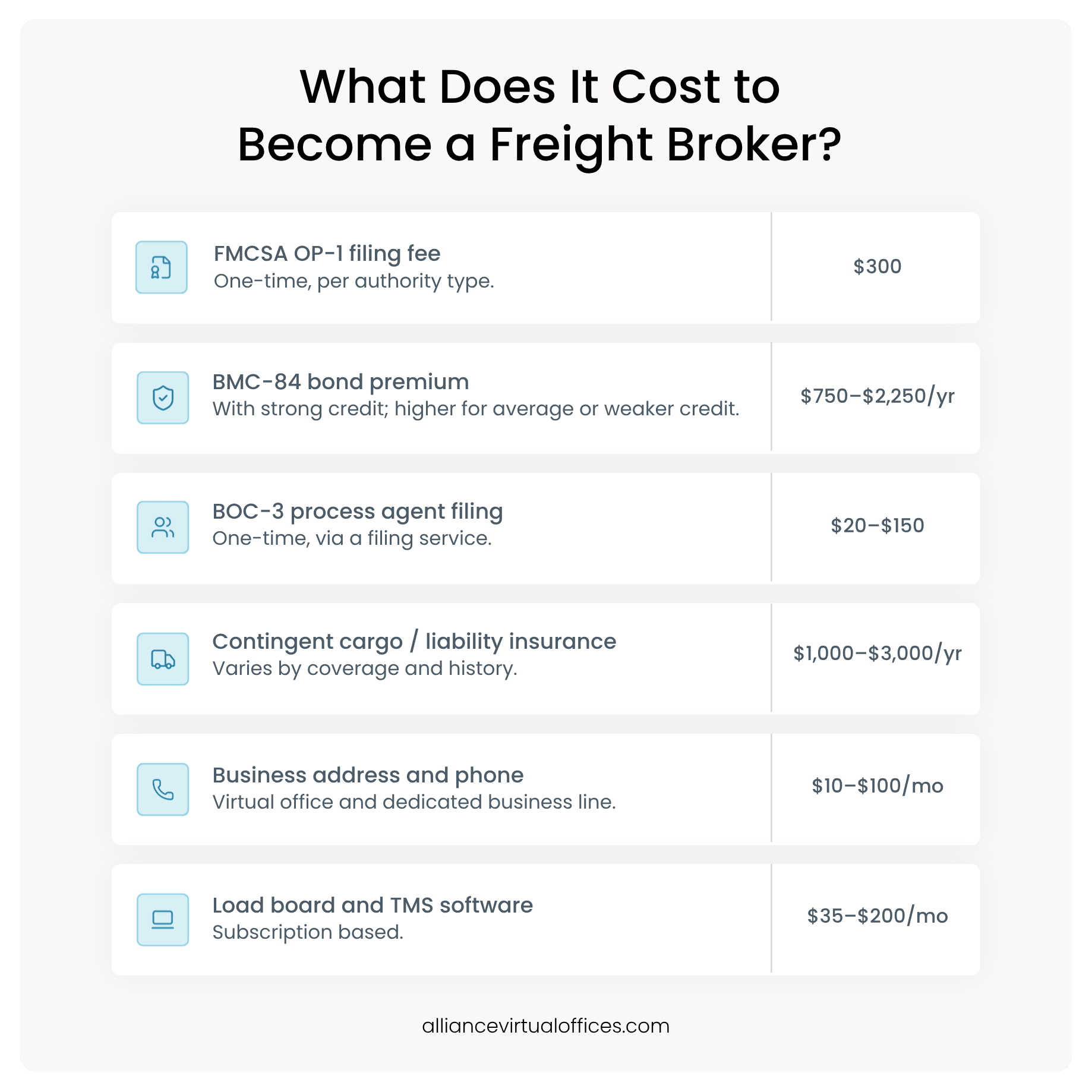
For most new brokers with good credit, the realistic first-year outlay lands in the low thousands of dollars, driven mainly by the bond premium and insurance. That keeps freight brokerages accessible relative to businesses that require vehicles or facilities.
Budget for working capital on top of these setup costs. Brokers often pay carriers before the shipper pays them, so a cash cushion or a factoring arrangement helps you cover that gap in the early months before invoices start clearing on a predictable cycle.
Get Your FREE Guide Today!
How to Start a Business in a Recession
How to Become a Freight Broker With No Experience
You do not need prior logistics experience to enter the field. The most common no-experience path is to start as a freight agent under an established brokerage.
As an agent, you work under the brokerage’s authority and bond, so you skip the upfront licensing costs while you build carrier and shipper relationships. You earn a commission split on the freight you move, and you learn the operational rhythm of the business on someone else’s infrastructure.
“The agent model lowers the risk of learning how to become a freight broker because your income is tied to performance rather than a large upfront bet. You focus on selling and servicing freight while the brokerage handles compliance, factoring, and back-office work.”
Once you have a book of business and a working knowledge of rates, lanes, and carrier vetting, many agents transition to their own authority. At that point the six steps above apply in full, and the relationships you built as an agent become the foundation of your independent brokerage.
There is no fixed timeline for that jump. Some agents stay for a year to build volume, while others move faster once they are confident they can source freight and manage carriers without a parent brokerage behind them.
NEXT STEPS: Set up a dedicated business line with Alliance Virtual Phone
Starting Your Freight Brokerage the Right Way
Learning how to become a freight broker comes down to clearing a defined regulatory path and then building the relationships that generate freight. Form your entity, secure FMCSA broker authority and your MC number, post the $75,000 BMC-84 bond, file your BOC-3, and set up the professional presence that carriers and shippers expect.
The licensing is the easy part to plan for because the requirements are fixed and public. The harder work is the sales and service that follow, which is why starting as an agent appeals to many newcomers before they take on their own authority.
Whichever path you choose, a stable business address and a dedicated phone line give your brokerage a credible footing from day one. Alliance Virtual Offices makes both easy to set up: a commercial business address starts at $49 a month, and a dedicated Alliance Virtual Phone line can be added for a small additional cost.
Together they let you register your entity, file your FMCSA paperwork, and meet carriers and shippers with a professional presence, without the overhead of a physical office.
Frequently Asked Questions
How do you become a freight broker?
How much does it cost to become a freight broker?
Do you need a license to be a freight broker?
How much do freight brokers make?
Can you become a freight broker with no experience?
Further Reading
- Best Cities for Transportation Companies
- How to Choose the Right Business Address for Your LLC
- Virtual Business Address for an LLC
- Freight Broker vs. Freight Forwarder vs. Dispatcher vs. 3PL