


- How We Chose These Cities (Methodology)
- The Top Cities & What They Unlock
- Compliance Snapshot: Virtual Office + DOT / FMCSA / IRP – What’s Allowed?
Q: Which U.S. cities give transport companies the most ROI for a virtual office-and why (port/air/rail data)?
A: The best U.S. cities for transport companies to set up a virtual office in 2025 are Chicago, Dallas-Fort Worth, Atlanta, Houston, Los Angeles/Long Beach, New York/New Jersey, Savannah, Memphis, Louisville, Cincinnati (CVG), Laredo, and Miami.
These hubs offer the highest ROI thanks to their port volume, air cargo capacity, rail connectivity, and cross-border trade strength, giving carriers, brokers, and 3PLs prime access to shippers and supply-chain partners without the cost of a physical lease.
In 2025, freight lanes are shifting faster than ever. Tariffs, port congestion, nearshoring, and e-commerce peaks all demand that logistics firms show presence where deals get done without locking in long lease commitments. A virtual office offers a lean, flexible way to project local credibility near shippers, brokers, ports, and hubs. When it comes to regulated motor carriers, however, misuse of virtual addresses can trigger DOT/FMCSA compliance risks.
This guide helps owners and ops leaders at trucking carriers, freight brokers, 3PLs, last-mile couriers, and import/export firms evaluate which U.S. cities make ideal virtual office locations. You’ll get data-backed reasoning, compliance caveats for motor carriers, and a decision matrix plus set-up checklist to act quickly.
How We Chose These Cities (Methodology)
The logistics landscape in 2025 looks nothing like it did five years ago. Trade realignment, e-commerce surges, and manufacturing nearshoring are reshaping freight flows across the U.S.
That means the “best cities for transport companies” aren’t just about population or cost anymore. They’re about connectivity, throughput, and access to decision-makers. These shifts prove that logistics firms need agile infrastructure, something covered in our guide on future-ready freight operations.
Our team analyzed more than 40 U.S. markets using five core metrics to identify where a virtual office for logistics companies delivers the greatest ROI:
1. Port & Container Throughput (TEUs)
Container activity is one of the best barometers of regional freight strength. We reviewed 2024–2025 TEU figures from major ports:
- Port Houston: 4.14M TEUs in 2024 (+8% YoY) – record highs across petrochemical exports and imports.
- Port of NY/NJ: The East Coast’s top container port, handling roughly 20% of U.S. import volume.
- Port of Savannah: Fastest-growing U.S. port for East/Gulf Coast lanes.
These hubs influence inland rail, drayage, and warehousing ecosystems hundreds of miles beyond their docks.
Data sources: Port Houston, panynj.gov, Georgia Ports Authority, and U.S. Trade Numbers.
2. Air Cargo Landed Weight & Express Hub Activity
Freight that moves by air relies on efficiency, reliability, and proximity. We prioritized metros hosting top-tier air cargo airports:
- Memphis (FedEx World Hub) – consistently the #1 or #2 U.S. cargo airport.
- Louisville (UPS Worldport) – largest express air hub by package volume.
- CVG (DHL + Amazon Air) – fastest-growing e-commerce gateway in North America.
- DFW, ATL, and MIA – major global cargo gateways with multimodal expansion.
Source: Bureau of Transportation Statistics, 2024 Top 25 Cargo Airports.
3. Intermodal & Rail Access
Cities like Chicago, Dallas, and Atlanta dominate intermodal freight. Chicago alone sees 25% of all U.S. freight trains and 50% of intermodal trains pass through its rail network (Chicago Metropolitan Agency for Planning).
These hubs connect ports, air cargo, and road carriers, allowing logistics companies to coordinate domestic and international shipments with ease.
4. Cross-Border & Nearshoring Corridors
Cross-border trade is booming:
- Laredo, TX, remains the #1 U.S. port by trade value ($339B in 2024).
- New customs plazas, drayage parks, and cold chain facilities have made Laredo and its twin city of Nuevo Laredo the epicenter of U.S.–Mexico freight.
- Houston and Dallas are also capturing rerouted nearshoring capacity.
Source: laredoedc.org, Laredo Morning Times.
5. Market Momentum & Business Density
We factored in 3PL clustering, fulfillment space growth, and accessibility for meetings-because virtual offices thrive where in-person connections still matter.
Cities like Atlanta, Dallas, and Savannah are seeing record logistics facility absorption rates and robust transportation tech ecosystems.
Finally, we filtered for Alliance Virtual Offices coverage, ensuring that each recommended market offers professional-grade virtual office options with:
- Real commercial business addresses
- Mail handling & forwarding
- On-demand meeting rooms near ports or airports
- Optional live receptionist and virtual phone services
That means every location on this list is not only strategically sound but operationally ready for you to activate within a week.
The Top Cities & What They Unlock
Each logistics hub below offers a distinct mix of freight advantages: ports, air cargo capacity, intermodal connectivity, or cross-border trade.
Whether you’re a freight broker, 3PL, courier, or trucking company, a virtual office in these markets helps you stay close to your customers and project instant credibility without the overhead of a physical lease.
Below are 12 U.S. cities (and metro nodes) where a virtual office can deliver outsized value for transport, logistics, and freight firms.
Chicago, IL
Often called the crossroads of North America, Chicago remains the country’s premier rail and intermodal hub. Roughly 25% of all U.S. freight trains and half of the nation’s intermodal trains pass through this region (Chicago Metropolitan Agency for Planning).
A virtual office in Chicago puts logistics firms in the middle of the action – connecting Great Lakes ports, Midwestern manufacturing, and national distribution networks.
For carriers, IMCs, or 3PLs managing both import drayage and inland rail moves, it’s a cost-effective base for sales meetings, driver onboarding, and regional marketing.
Next step: Browse Chicago virtual offices
Why it works:
- The U.S. intermodal nerve center: roughly 25% of all freight trains pass through the region, while 50% of intermodal trains route through it.
- Deep rail/terminal networks (BNSF, UP, NS, CP) plus access to Midwest shippers.
- Central time zone helps bridge East–West deals.
- Ideal first inland hub for carriers, brokers, and 3PLs targeting mid-America.
For whom: Carriers with mixed lanes (ocean + inland), 3PLs seeking Midwest footprint, brokers courting Chicago-based industrial shippers.
What to push: Use the address for shipper meetings, driver recruiting outreach, local and online directory listings, and phone presence. Keep operations/records separate.
Alliance Virtual Offices tie-in: Leverage Alliance locations near O’Hare or downtown to host face-to-face meetings.
Dallas–Fort Worth, TX
DFW’s strategic location at the intersection of I-35, I-20, and I-45 makes it one of the best cities for logistics companies expanding nationally.
The metro’s central time zone, abundant fulfillment centers, and growing inland port ecosystem position it as a perfect second hub to pair with either coast.
A virtual address for trucking companies in Dallas signals reliability to shippers spanning both the Midwest and Gulf markets. With easy access to DFW International Airport and regional warehousing, logistics operators can host client meetings or manage calls from anywhere.
Next step: Explore Dallas virtual offices.
Why it works:
- Strategic center of gravity in the U.S. road network (I-35, I-20, I-45).
- Strong e-commerce fulfillment density with DFW as a logistics backbone.
- Growing inland port and warehouse development.
- Good East/West balancing point when paired with a coastal node.
For whom: Carriers that run east-west + north-south lanes, 3PLs needing central presence, courier networks expanding regionally.
Atlanta, GA
The Southeast’s distribution powerhouse, Atlanta anchors the intersection of I-75, I-85, and I-20, giving access to virtually every major Southern market.
Home to one of the nation’s busiest airports and a massive logistics labor pool, it’s ideal for 3PLs, carriers, and brokers seeking fast access to regional retail and manufacturing corridors.
A virtual office in Atlanta keeps your brand visible in a city synonymous with freight, fulfillment, and connectivity.
Next step: View Atlanta locations.
Why it works:
- Prime Southeast distribution nexus, anchored at the crossroads of I-75, I-85, and I-20.
- Access to growing Southeast industrial parks and fulfillment clusters.
- Large talent pool in logistics, operations, and tech.
- Good insertion point for brokers targeting distribution-rich states (GA, AL, SC, FL, TN).
Houston, TX
Houston combines energy exports, petrochemical manufacturing, and one of the country’s fastest-growing container ports. Port Houston handled over 4.14 million TEUs in 2024, up 8% year-over-year.
That strength extends inland through strong road, barge, and rail links, making Houston indispensable for importers, exporters, and freight brokers working the Gulf corridor.
A virtual office for logistics firms in Houston offers instant credibility near the port and access to a massive shipper base, with on-demand meeting rooms for client consultations.
Next step: See Houston virtual offices.
Why it works:
- Port Houston hit a record 4,139,991 TEUs in 2024, an ~8% increase year-over-year, driven by strong import and export growth. app.eesea.com+3Container News+3WorldCargo News+3
- The port supports massive tonnage volumes, chemical exports, energy cargo, and container trade. Port Houston+2Port Houston+2
- Deep Gulf Atlantic trade corridor, Midwestern reach via barge/rail/road.
- Ideal for brokers, drayage-based 3PLs, and carriers handling imports/exports.
For whom: Importers/exporters, ocean carrier partners, freight brokers dealing in Gulf routes, 3PLs in cross-border logistics.
Los Angeles / Long Beach, CA
Together, these twin ports handle more than 30% of U.S. containerized imports, making LA/LB the undisputed gateway for trans-Pacific trade. The area’s concentration of drayage providers, 3PLs, and freight forwarders offers unmatched networking potential.
Setting up a virtual office in Los Angeles places your brand right where global freight decisions begin – without the burden of Southern California lease rates.
Next step: Browse LA virtual offices.
Why it works:
- The premier West Coast gateway for trans-Pacific imports.
- Proximity to export manufacturing clusters and West Coast shippers.
- Drayage + port services cluster (3PLs, depots, forwarding).
- Strong brand credibility having a LA/LB presence for brokers and carriers.
New York / New Jersey (Newark / Jersey City, NJ)
The Port of New York and New Jersey is the East Coast’s largest container port and the nation’s top gateway for imported consumer goods.
With direct access to Northeast retailers and dense shipper clusters, it’s a natural base for freight brokers and import-focused carriers.
A virtual office in NJ or NYC gives your firm a credible coastal presence, ideal for connecting with buyers, customs brokers, and importers.
Next step: Explore NY/NJ offices.
Why it works:
- East Coast container hub: the NY/NJ port complex is among the top U.S. foreign container ports. Bureau of Transportation Statistics+3Wikipedia+3Wikipedia+3
- High density of retailers, importers, consumer goods distribution in the Northeast.
- Great for brokers needing proximity to NYC / tri-state industrial clients.
- Connects Atlantic trade lanes, East Coast rail corridors, and road networks.
Savannah, GA
Savannah continues to outpace peers as the fastest-growing U.S. container port, driven by new on-dock rail and inland connectivity. Logistics developers are racing to build warehouse space near the terminals, creating fertile ground for brokers and freight tech startups.
A virtual office in Savannah puts your brand near booming East Coast import flows – without paying coastal premiums.
Next step: Find Savannah virtual offices.
Why it works:
- The fastest-growing container gateway on the East/Gulf coasts, with on-dock rail and inland connectivity.
- Increasing warehouse/port-adjacent development sprawl.
- Strong surge in container volumes due to congestion at competing ports.
- Excellent for 3PLs targeting Southeastern import flows, especially apparel, retail, and consumer goods.
Memphis, TN
Known as “America’s Distribution Center,” Memphis houses the FedEx World Hub, one of the world’s most advanced air cargo networks. It’s ideal for parcel, expedited, and e-commerce logistics companies that thrive on speed.
With a virtual office in Memphis, you align your brand with FedEx reliability while keeping your operations lean.
Next step: See Memphis offices.
Why it works:
- Home to FedEx World Hub, one of the most critical air cargo nodes globally.
- Late-flight cutoffs and express service reach.
- Great for time-definite, parcel-forwarding, and air + ground fusion operations.
- Ideal for couriers, parcel integrators, and high-value air-forward firms.
Louisville, KY
Louisville’s proximity to UPS Worldport, the world’s largest automated package-handling facility, makes it essential for time-critical and last-mile providers.
Establishing a virtual office in Louisville allows small carriers and couriers to participate in a global express network while minimizing fixed overhead.
Next step: View Louisville locations.
Why it works:
- Adjacent to UPS Worldport in Louisville, critical for time-sensitive ground-air shipments.
- Strong appeal to carriers, courier networks, and 3PLs focused on parcel, e-commerce, and expedited lanes.
- Leverage the brand signal of being near UPS’s central hub.
Cincinnati / Northern Kentucky (CVG), KY
CVG is emerging as a dual-hub powerhouse, hosting both DHL’s North American SuperHub and Amazon Air’s main base. That combination fuels explosive e-commerce and parcel activity.
A virtual office near CVG lets your team connect with air cargo networks and last-mile providers while maintaining a professional U.S. headquarters.
Next step: Explore CVG virtual offices.
Why it works:
- Dual cargo hubs: DHL hub + Amazon Air presence.
- Rapid e-commerce growth and capacity expansion in the region.
- Strategically central for east-west / north-south coverage.
- Brokers and 3PLs catering to parcel, fulfillment, and regional routes benefit strongly.
Laredo, TX
Sitting on the U.S.–Mexico border, Laredo is now the #1 U.S. port by trade value, surpassing even Los Angeles. Billions in goods cross here annually, driven by nearshoring and manufacturing in Mexico.
For freight brokers, customs consultants, and cross-border carriers, a virtual office in Laredo signals local expertise and compliance awareness in the North American trade corridor.
Next step: See Laredo offices.
Why it works:
- #1 U.S. port by trade value in 2024; major U.S.–Mexico corridor.
- Gateway for nearshoring, maquiladora flows, and cross-border brokerage.
- Excellent for freight brokers, cross-dock providers, and carriers specializing in Mexico–U.S. lanes.
- Less competition for virtual presence in border zones; high differentiation.
Miami, FL
Miami anchors U.S.–Latin America logistics. It’s a natural launchpad for import/export, perishables, and pharma freight thanks to its multilingual workforce and air cargo leadership.
A virtual office in Miami gives global brokers and forwarders a foothold in the Americas’ southernmost hub – without committing to high downtown rent.
Next step: Browse Miami locations.
Why it works:
- Latin America & Caribbean gateway, especially for perishables, pharma, high-value air cargo.
- Multilingual workforce and trade links to Central and South America.
- Great for 3PLs or broker operations serving hemispheric import/export flows.
- Strong for firms working tropical, refrigerated, or cross-border trade with Latin America.
Compliance Snapshot: Virtual Office + DOT / FMCSA / IRP – What’s Allowed?
A virtual office can enhance brand credibility, improve communication, and streamline mail handling for brokers, couriers, and logistics SaaS firms.
But if your company holds DOT or FMCSA operating authority, you must understand exactly where a virtual office fits in your compliance structure.
The Rules in Plain English
FMCSA requires every motor carrier to designate a “principal place of business” (PPOB). This is not a mailing address or shared mailbox. It’s a location where the company “exercises direction and control” over its operations.
According to FMCSA and 49 CFR §390.29:
- A P.O. Box, UPS store, or unrelated “mail drop” is not acceptable as your principal place of business.
- FMCSA officials must be able to visit your PPOB for compliance reviews, safety audits, or record inspections.
- Required records (driver files, vehicle maintenance, insurance, tax, and compliance) must be accessible at or through that address.
- Your OP-1 or MCS-150 form cannot list a P.O. Box as your main business address.
- IRP (International Registration Plan) adds another layer: most jurisdictions require an “established place of business” to issue apportioned plates, defined as a physical location with personnel and business records tied to the carrier’s operations.
- Virtual offices typically don’t meet that threshold, unless staff are physically present and working under your control at that address.
Learn more about compliance-friendly address solutions in our full guide on virtual offices for logistics and transport companies.
Source references: FMCSA | 49 CFR §390.29 | IRP/YMAWS Guidelines.
So When Can You Use a Virtual Office?
- For Mail, Sales, and Branding:
Perfectly acceptable for correspondence, billing, marketing, and professional representation near shippers or brokers. - For Non-Carrier Entities:
Freight brokers, 3PLs, and logistics software providers can generally use virtual offices as their primary address without issue. - For Carriers:
Use the virtual office for visibility and contact purposes, but maintain DOT safety and operational records at a physical site (yard, terminal, or controlled office). - For Multi-State Carriers:
Virtual offices can provide compliance – use them for regional communication and sales, while designating your true PPOB for audits.
Staying Audit-Ready
Here’s how to remain compliant while using a virtual office:
- Keep all DOT records at an auditable location (owned/leased by your company).
- List that same location on MCS-150, IRP, and insurance filings.
- Use your virtual office for correspondence and marketing, not regulatory documents.
- Digitize your records so they can be provided remotely if inspectors request them.
- Train staff or receptionists to redirect FMCSA inquiries to your compliance lead.
This approach lets you maintain cost-effective credibility while keeping your operation fully audit-proof.
Choosing Between Two Great Cities (Decision Matrix)
When two or more cities make sense – say, Chicago vs. Dallas or Savannah vs. Houston – a structured comparison ensures your virtual office expansion aligns with your business goals.
Consider these key variables:
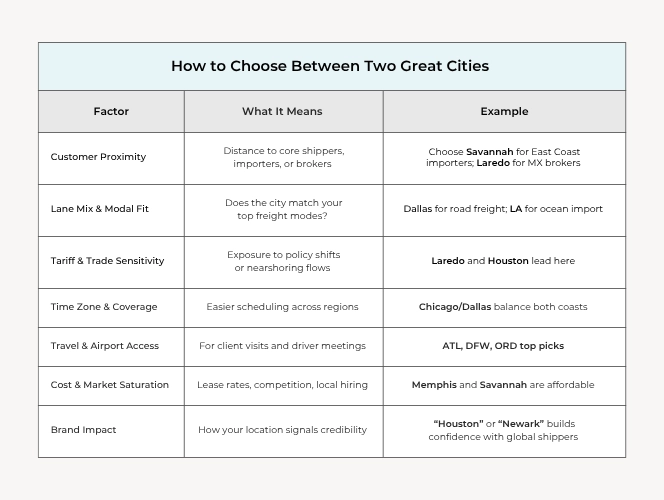
Pro Tip: Use a hub-and-spoke model. Choose an anchor city (e.g., Chicago or Dallas) for national credibility, pair it with a coastal hub (LA/LB or NY/NJ), and add one specialty node (Laredo, CVG, or Savannah). This tri-city footprint gives 90% shipper coverage with minimal overhead.
How to pair cities:
- Choose an inland anchor (Chicago or Dallas)
- Add a coastal gateway (LA/LB or NY/NJ)
- Add a specialty node (Laredo for cross-border, CVG / Louisville for parcel, Savannah for import growth)
For example: Chicago + NY/NJ + Laredo or Dallas + LA + CVG make strong three-city combos for national coverage.
Set-Up Checklist for Transport Teams
- Address validation & registration
Ensure the virtual address can receive business-class mail and be legally formatted in DOT / state registrations.
- Mail handling + digital scanning
Use scanned mail forwarding, scanning, and secure shred/archive.
- Live receptionist & local phone setup
Route calls, transfer to your operations team, and appear local to prospects.
- Meeting rooms near airport / port
Reserve on-demand space to meet shipper / broker contacts.
- Local and online listings
Use city-level profiles with logistics categories and optimized content.
- Routing & forwarding of mail / packages
Forward to your operations address (warehouse, yard, terminal).
- Compliance firewall
Do not list virtual office as ROW address for regulatory records.
- Promote your “hub city presence”
In proposals, marketing, and email footers, mention your virtual office city to gain credibility.
- Annual audit & record keeping plan
Periodically check mail logs, forwarding, meeting room usage reports.
You can spin up operations within 7–10 days once mail & address are set. Then layer in phone, receptionist, and meeting rooms.
Before registering, confirm your provider meets business compliance standards – our step-by-step guide on how to get a virtual office address walks you through it.
Want to budget your setup? Here’s what to expect for virtual office costs.
Why Choose Alliance Virtual Offices
- 1,400+ locations across U.S. & internationally, enabling easy hub expansion
- Online booking and scalable plans (mail + phone + receptionist + meeting rooms)
- Integration with logistics workflows: forwarding, scanning, meeting reservations
- Service bundles optimized for transport & logistics clients
- Easy to replicate across multiple cities without long leases or build-outs
For logistics and transport professionals, speed and flexibility aren’t optional – they’re the backbone of your business. Alliance Virtual Offices was built with that same mindset.
With over 1,400 locations across the U.S. and worldwide, Alliance makes it easy to expand your presence into key freight hubs without a single lease or long-term commitment.
Whether you’re establishing your first virtual office for a trucking company or scaling a multi-city brokerage footprint, every location is fully equipped to support your operational goals.
See how a real logistics provider scaled faster using Alliance’s platform in our shipping and logistics case study.
You can book and manage everything online, choosing from scalable plans that include professional mail handling, local business phone numbers, live receptionists, and on-demand meeting rooms.
Each service integrates seamlessly with how transport companies actually work, coordinating shipments, scheduling driver interviews, or meeting clients near airports, ports, and warehouses.
Alliance’s virtual office solutions for logistics firms are purpose-built for the industry.
You get reliable mail forwarding, document scanning, and meeting reservations without the administrative friction of maintaining multiple leases. Plus, you can replicate your setup across cities as your freight network grows, ensuring consistent branding, customer service, and compliance across every hub.
In short, Alliance Virtual Offices gives you the infrastructure to look established everywhere you do business, while keeping your operations lean, mobile, and ready for the next opportunity.
Further Reading:
Choose Your Hub, Add a Spoke, and Go Live This Week
In 2025, the smart transport networks will run virtual hubs, not expensive leases.
Choose one anchor city (Chicago or Dallas), add a coastal gateway (LA/LB or NY/NJ), and layer in a specialty node (Laredo, CVG, Savannah) to cover import, export, air, and cross-border flows.
Start small, prove ROI, then scale your virtual address footprint as sales and operations demand. When you’re ready, browse Alliance Virtual Offices locations, get a quote, and begin projecting presence in America’s freight centers.
Next step: filter Alliance Virtual Offices locations in your preferred cities, compare mail + meeting + receptionist bundles, and pick your first hub this week. Browse U.S. virtual offices or explore international options to expand globally.


