
- What a virtual office in Washington DC includes and costs
- The Legalities of a virtual address in Washington DC for your Business
- The Best Washington DC business districts and how to get set up
Q: How much does a virtual office cost per month in Washington DC?
A: Most virtual office plans in Washington DC run somewhere between roughly $50 and $200 per month, depending on the address, neighborhood, and whether it includes mail forwarding or meeting room access. That’s a fraction of what leasing physical space would cost.
If you’re searching for a virtual office address in Washington DC, you’re almost certainly looking for a business address inside the nation’s capital (rather than in Washington State on the other side of the country).
Plenty of founders want a credible presence in the district without the commitment or cost of signing a traditional office lease, from LLC owners registering a company to a consultant meeting clients several times a quarter.
A virtual office is built for exactly these situations. This guide walks through what a Washington DC virtual office is and costs, whether the address holds up for your LLC and banking, and which DC districts carry the most professional weight.
What a Virtual Office in Washington DC Includes and Costs
A virtual office address gives you a real commercial street address in Washington DC, plus a set of services making that address usable for business.
You’re not renting a desk you never sit at; you’re buying the right to use a professional address, along with the support and services that come with it.
The core of any virtual office plan is the business address itself. From there, virtual office providers often layer on services depending on the tier you choose. For example, here’s a typical virtual office plan from Alliance Virtual Offices in Washington DC:
- A commercial street address in a recognized Washington DC building, usable on your website, business cards, and filings. It can replace the visibility of your home address on public record.
- Mail receipt with optional forwarding, so anything sent to the business address reaches you wherever you are.
- On-demand meeting room or day-office access, depending on plan tier.
- Optional call answering with live receptionist services, so a real person can greet callers in your company name and route them back to you.
What you pay for a virtual office in Washington DC
Virtual office pricing scales with the address and the services attached. Entry-level plans covering an address and basic mail handling sit at the lower end of the range, while plans bundling mail forwarding, phone answering services, and meeting time cost more.
A few things drive the difference in price. The prestige of the building and district matters, since a K Street address in Washington DC commands more than a suburban one. Mail volume and forwarding frequency factor in, and so does whether you want call handling with a live receptionist plan or on-demand meeting space attached.
Match the plan tier to what you’ll use, rather than paying for services you won’t touch. If call handling is on your list, run the numbers with our live receptionist calculator before you commit to a tier.
Now put that next to physical space. Prime office rents in DC crossed $100 per square foot per year in 2026, with 12.5% year-over-year growth, according to CBRE. By contrast, a virtual office gives you a comparable business address for a set monthly fee, without paying for the square footage, buildout, or multi-year commitment.
Read More: How much does a virtual office cost?
The Legalities of a Virtual Office in Washington DC for Your Business
A virtual office address is a real commercial address, and you can generally use it as your business address for your website, marketing, mail, and filings. The nuance is in what a virtual address does and doesn’t replace.
The Internal Revenue Service, or IRS, wants to see a business address where you can reliably receive mail. In most situations, a commercial virtual office address that receives and forwards mail meets that need.
Likewise, many banks accept a commercial street address when you open a business account. But, as banks follow customer-identification rules, some ask for additional documentation, and policies vary by institution, so confirm with your bank before you apply.
Where a registered agent still comes in
Many people conflate a virtual office address with a registered agent, but they serve different purposes. If you form a Limited Liability Company (LLC) in Washington DC, you’re required to maintain a registered agent with a physical DC address that’s available to receive legal documents during business hours.
Your virtual office address doesn’t automatically satisfy that requirement; however, some providers offer a separate registered agent service. Remember that a virtual office plan alone isn’t a substitute. Treat them as two boxes to check, not one.
The DC licensing layer: Basic Business License and Clean Hands Certificate
Operating a business or LLC in Washington DC usually means dealing with the Department of Licensing and Consumer Protection, or DLCP.
Many businesses need a Basic Business License, and before DLCP issues one, you generally need a Clean Hands Certificate confirming you don’t owe the District more than a set amount in taxes or fees.
A virtual office address supports this process by giving you a consistent business address in Washington DC for your records and correspondence. It doesn’t exempt you from licensing. For the current rules, fees, and which license category applies to you, go straight to DLCP rather than relying on second-hand summaries.
Read More: What’s a Virtual Office?
The Best Washington DC Business Districts and How to Get Set Up
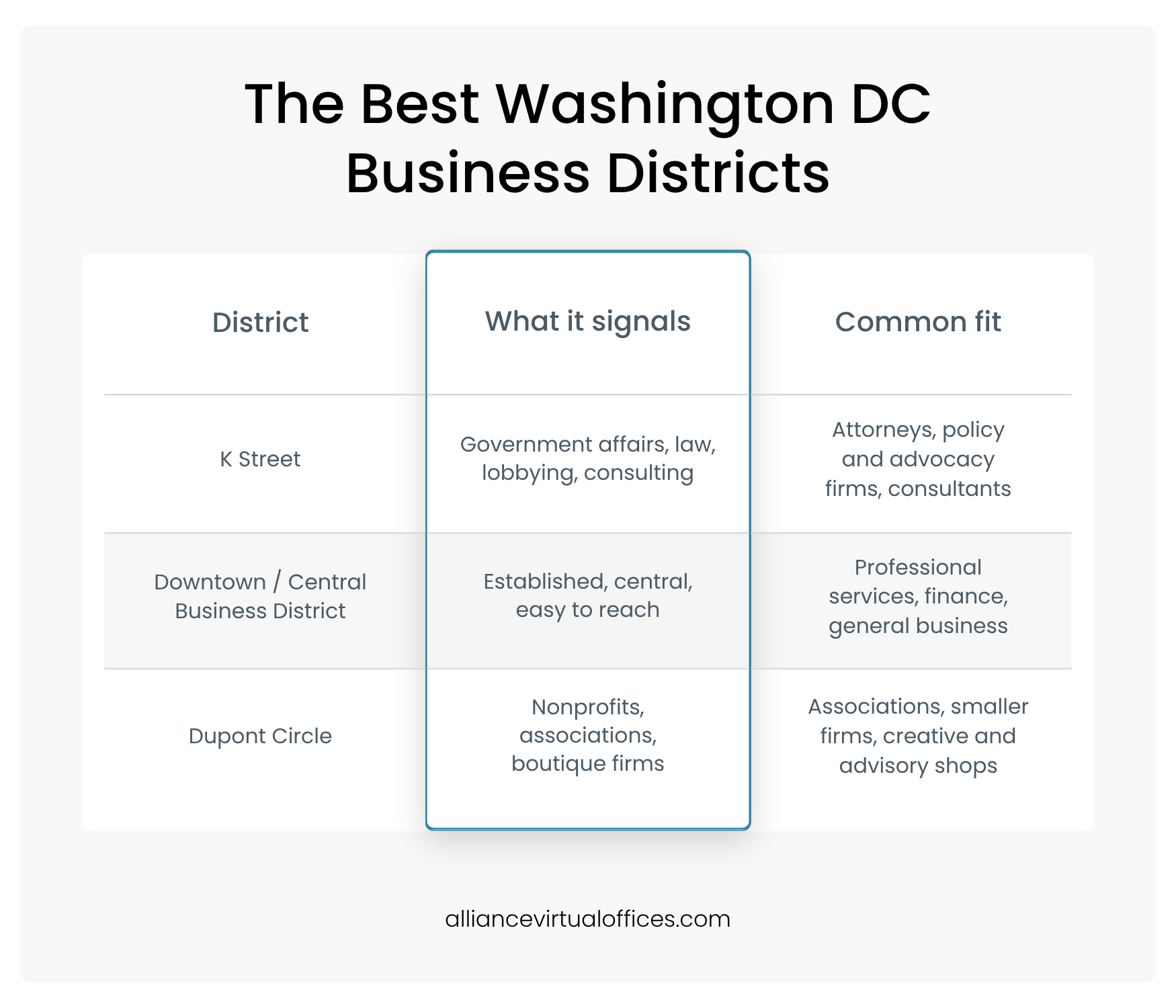
Not every business address in Washington DC carries the same signal. The neighborhood on your letterhead tells clients and partners something about your business, so it’s worth choosing deliberately.
Three districts tend to anchor the strongest professional presence. These are:
Why the timing works in your favor
There’s a market backdrop worth knowing. DC office vacancy has hovered between 21.3% and 24.2% through 2026, according to Colliers, as federal footprints shrank and older buildings emptied out. Prime, high-quality space is filling again, but a lot of professional buildings still have room.
For you, that means there’s plenty of access to well-located addresses in respected buildings without competing for scarce space.
Unlock Our Current Virtual Office Offers
Enter your email below and we’ll send you the latest available promotions and monthly specials for Virtual Offices, Meeting Rooms, and Live Receptionists.
How to get a Washington DC virtual office, step by step
Setting up a virtual office in Washington DC is simple. To get started, work through the following steps in order:
- Choose your address. Pick the DC district that fits how you want your business to read and confirm the specific building.
- Verify what’s included. Check whether your chosen virtual office plan covers services such as mail forwarding, meeting room access, and call handling, or whether those are add-ons.
- Complete USPS Form 1583. Federal rules require this notarized form before a provider can receive mail on your behalf. You’ll submit two forms of ID with it.
- Put the address to work. Use it for your filings, your business bank account, your website, and your mail once everything is verified.
NEXT STEPS: Explore Washington DC Virtual Offices
Supporting services worth adding
Two add-ons tend to earn their keep. A call answering service greets callers in your company name, which matters when a downtown address sets an expectation of a staffed office. Meeting room access in the same building gives you a professional place to sit down with clients when you need one.
Why a Virtual Office in Washington DC Is a Smart Move for Growing Businesses
A virtual office in Washington DC gives you a credible capital-city address for a monthly fee that stays far below the cost of leasing physical space.
Keep three things in mind when setting up a virtual office in Washington DC. First, the address supports your filings, banking, and mail, but you still need a separate registered agent for a DC LLC, and you still handle DLCP licensing on your own.
Second, the district you choose shapes how your business reads, so pick it with intent. Third, a soft office market means good addresses are available now without a scramble.
Alliance Virtual Offices offers Washington DC addresses in recognized buildings starting at $49 per month, with mail forwarding, on-demand meeting rooms, and a Live Receptionist service available as you grow. It’s a practical way to plant a professional flag in the capital.
Browse Washington DC virtual office plans to get started.
Frequently Asked Questions
Does the IRS accept a virtual address for business?
Will banks accept a Washington DC virtual address?
Is a virtual mailbox better than a PO Box for a DC business?
Do I still need a registered agent if I have a DC virtual address?
Further Reading