
- The 2027 Financial Reality New Entrepreneurs Must Plan For
- Why a Virtual Office Is a Financial Advantage in 2027
- Budgeting, Forecasting, and Cash Flow Control in 2027
Q: How should new entrepreneurs approach financial planning in 2027?
A: Focus on cash flow and keep fixed overhead low by using digital-first systems and a virtual office instead of a traditional lease. That leaves more of your starting capital for growth work like marketing and hiring.
Starting a business in 2027 looks very different than it did five years ago. Operating costs are higher, competition is global, and customers expect professionalism from day one.
That’s why financial planning for entrepreneurs in 2027 comes down to putting every early dollar where it drives growth. For many founders starting a work-from-home business, that means choosing a virtual office over a traditional lease.
A virtual office turns several fixed office costs into one predictable monthly fee. It also keeps the credibility you need to open accounts, sign clients, and grow.
The 2027 Financial Reality New Entrepreneurs Must Plan For
Higher costs, remote work, tighter capital, and credibility checks all shape how much money a new business needs on day one. Each one affects how you build your plan.
Rising costs across core business expenses
Office space is getting more expensive again. Average U.S. office asking rent rose 3.1% year over year to $37.95 per square foot in the third quarter of 2026, the fastest growth since 2016, according to CBRE’s Q3 2026 U.S. Office Market Report.
Rent is also a fixed cost, so it doesn’t drop when revenue does. The SBA’s startup cost guidance lists office space among the common startup costs and counts rental lease payments as a fixed cost, alongside insurance and salaries.
Long-term leases add rigidity on top of that. Security deposits, multi-year commitments, and annual rent escalations lock founders into payments that stay the same in a slow month.
Founders who work remotely or serve clients online often pay for office space they rarely use. Even at larger companies, employees average 2.9 days a week in the office, according to CBRE’s 2026 Americas Office Occupier Sentiment Survey.
A virtual office lets those founders keep a professional presence and move that money to marketing, hiring, or product development.
Hybrid work has become the norm
Remote and hybrid work aren’t fringe strategies anymore. As of May 2026, 52% of U.S. employees with remote-capable jobs work hybrid and 26% work exclusively remote, according to Gallup’s hybrid work indicator.
Across all jobs, 22.6% of U.S. workers teleworked in March 2026, according to the Bureau of Labor Statistics. The rate is much higher in professional and business services, where 41.8% of workers teleworked in June 2026, according to BLS industry data.
Consulting firms, SaaS startups, eCommerce brands, creative agencies, and professional service providers increasingly choose flexibility over a central office. Instead of hiring locally to justify a lease, founders recruit wherever the talent is and budget for digital tools, cloud infrastructure, and client-facing systems.
Physical offices aren’t a prerequisite for legitimacy anymore. What matters is whether a business operates reliably, communicates professionally, and meets regulatory and client expectations.
A virtual office fits this model. It provides a stable business address and administrative support without tying the company to one physical location.
Capital efficiency matters more than ever
Capital efficiency has become a test of viability for bootstrapped businesses as much as venture-backed ones. Borrowing isn’t getting cheaper, either, with the Federal Reserve holding its target range at 3.75% to 4.00% in October 2026 after a September increase, according to Admiral Markets’ FOMC recap.
Cash reserves are thin for most small businesses. The median small business across 25 U.S. metro areas held 17.6 cash buffer days in 2025, or fewer than three weeks of outflows if revenue stopped, according to JPMorgan Chase Institute research.
Founders who avoid large upfront investments are in a better position to absorb demand shifts, late payments, or seasonal dips. Money that isn’t locked into a lease adds to that buffer.
Virtual offices support lean operations because they turn capital expenditures into manageable operating costs. That gives you room to adjust your financial strategy as the business changes.
Credibility challenges for new businesses
New businesses still have to clear credibility checks. Registering with the state, opening a business bank account, setting up payment processing, and onboarding with vendors typically ask for a business address.
Even the IRS application for an EIN asks for a mailing address and, if different, a street address that can’t be a PO box, according to the IRS instructions for Form SS-4.
Using a home address or PO box can create friction. Banks and payment processors may flag applications, state filings can be delayed, and clients may question professionalism.
A professional business address helps with these checks and keeps your personal and business finances separate.
Credibility affects how quickly a business can open accounts and accept payments, so it belongs in your financial plan.
Address eligibility for filing, licensing, and banking varies by state, business type, and institution. Confirm requirements with the relevant authority before you submit.
Why a Virtual Office Is a Financial Advantage in 2027
A virtual office replaces most of the layered costs of a traditional lease with one monthly fee. An Alliance Virtual Office includes a professional business address, mail handling, and on-demand Meeting Room bookings.
Traditional office vs. virtual office costs
The biggest differences are how much you pay upfront and how long you’re committed.
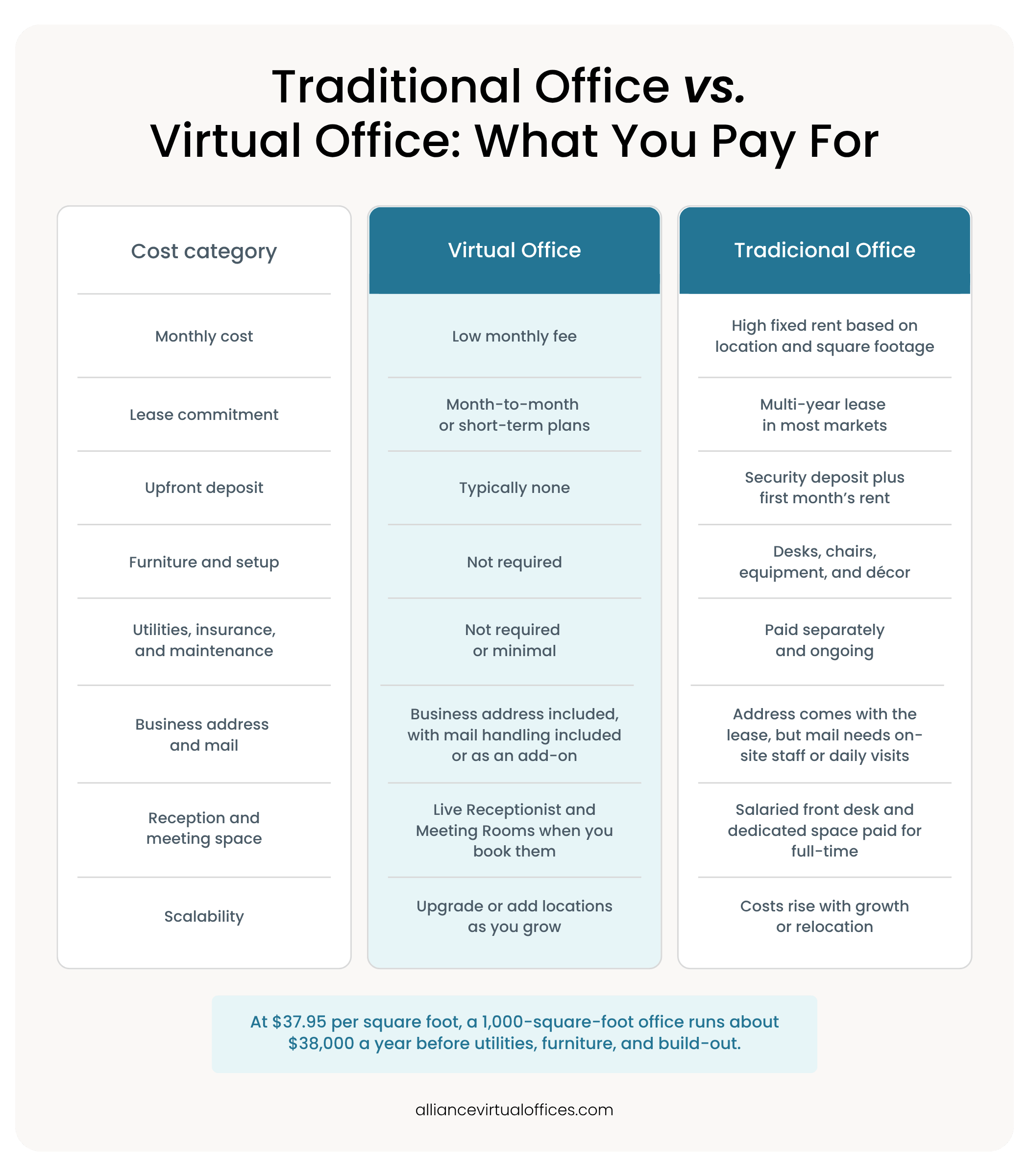
At CBRE’s national average asking rent of $37.95 per square foot, a 1,000-square-foot office runs about $38,000 a year before utilities, furniture, and build-out. In major metros, that number can be much higher.
What this comparison means for your plan
A traditional office locks you into fixed costs that don’t move when revenue does. A virtual office turns many of those into flexible operating costs, which helps you preserve early capital, extend your cash runway, and scale without renegotiating a lease.
For entrepreneurs focused on startup budgeting in 2027, that shift can improve cash flow and long-term resilience.
Lower capital and operating expenses
Capital expenditures are the large purchases a business makes upfront, and operating expenses are the ongoing costs of running it. Traditional offices are heavy on both, with furniture, build-outs, deposits, and equipment before you open, then rent, utilities, maintenance, insurance, and cleaning every month.
A virtual office removes most of that while keeping a professional business address and administrative support. Ongoing costs are usually limited to a monthly service fee, optional mail handling, and the hours you book a Meeting Room for client meetings.
Digital mail forwarding cuts administrative time and keeps records organized, since nobody has to visit an office daily to collect mail. A Live Receptionist service answers your calls without the cost of a salaried front desk, and our live receptionist calculator shows what you could save.
Read More: Mail Forwarding for Business Optimizes Your Time and Money
Flexibility to scale without relocation costs
A virtual office lets you operate nationally or globally without rebuilding infrastructure every time the business grows. Meeting Rooms, mail handling, and Live Receptionist support are available on demand instead of locked into long-term commitments.
NEXT STEPS: Find a Virtual Office location near you
Financial Foundations Every New Entrepreneur Needs in Place
Strong financial planning for entrepreneurs starts with structure, not spreadsheets.
Setting financial goals by growth phase
Vague revenue targets are hard to plan around. Break your goals into stages instead.
Year 1: Stability
- Cover operating costs
- Establish predictable cash flow
- Avoid unnecessary debt
The first year is about survival and visibility. Learn your true monthly expenses, validate demand, and make sure revenue can cover day-to-day operations without leaning on personal savings or high-risk financing.
Year 2: Optimization
- Improve margins
- Invest in marketing or systems
- Reduce founder workload
Once the business is running, Year 2 is about efficiency. Founders refine pricing, cut waste, and reinvest profits into tools or channels that drive sustainable growth, while automation starts replacing manual work.
Year 3: Scale
- Expand offerings or markets
- Hire selectively
- Strengthen forecasting accuracy
By Year 3, the business should be operating from stability. Expansion decisions can rest on stronger forecasts, clearer cash-flow patterns, and a realistic view of what the business can afford.
A virtual office supports each stage by keeping fixed costs low while professional infrastructure stays available.
Determining true startup capital needs
Startup capital is the money a business needs to operate until revenue can reliably support it. Many founders inflate this number because they assume traditional office space is non-negotiable.
Office rent, deposits, furniture, utilities, and lease commitments push initial capital needs up quickly. Even a modest office can mean a five-figure annual rent commitment before deposits and build-out costs.
Removing office rent from your startup budget often cuts initial capital requirements. A consultant or digital service provider with a virtual office can launch with core expenses only (software, marketing, insurance, and professional services).
That lets founders launch sooner, self-fund longer, and avoid early dilution or high-interest debt. In practice, finding your true startup capital means separating the expenses that generate revenue from the ones you can defer or replace with flexible options.
Understanding fixed vs. variable costs
Fixed costs stay the same regardless of revenue, including office leases, long-term contracts, salaried staff, and some insurance policies. You pay them even in slow months.
Variable costs move with business activity, including marketing spend, contractor labor, transaction fees, software usage tiers, and on-demand workspace. Because they rise and fall with revenue, they’re easier to manage when things are uncertain.
Small business financial planning in 2027 should favor variable costs over fixed commitments wherever possible. A virtual office replaces a multi-year lease with a predictable monthly fee, and you add Meeting Rooms or Live Receptionist support only when you need them.
Building a recession-resistant plan
Economic slowdowns, seasonal swings, late client payments, and surprise expenses can disrupt even well-run businesses. A recession-resistant plan keeps you flexible, so you have more runway in slow periods and less pressure to make reactive decisions like layoffs, emergency loans, or downsizing.
“A business with a traditional lease owes rent no matter what revenue does. A business with a virtual office keeps its professional presence while scaling other expenses up or down, which is why more founders treat virtual offices for startups as a risk-management tool.”
Get Your FREE Guide Today!
How to Start a Business in a Recession
Budgeting, Forecasting, and Cash Flow Control in 2027
Strong financial forecasting separates businesses that survive from those that scale. These habits keep your numbers honest month to month.
Creating a 12-month cash flow projection
New entrepreneurs should keep a rolling 12-month forecast that tracks monthly revenue expectations, recurring expenses, one-time investments, and cash reserves. A virtual office makes that forecast easier to manage because overhead stays low and predictable.
Managing burn rate intentionally
Solo founders and service businesses need to track burn rate as closely as venture-backed startups do. Cutting fixed overhead with a virtual office extends your runway without cutting growth initiatives.
Forecasting revenue realistically
Different business models need different assumptions. Consulting and service firms rely on utilization rates, subscription businesses on churn and lifetime value, and eCommerce brands on margins and inventory cycles.
Financial forecasting for entrepreneurs works best when expenses are predictable and scalable. If your budget feels tight, reassessing office costs is often the fastest way to free up cash.
Tax planning and deductible expenses
Tax planning belongs in your budget from the start. Virtual office expenses can qualify as business deductions when they’re ordinary and necessary, used exclusively for business, and properly documented, which may include address services, mail handling, and Live Receptionist support.
Centralized mail and documents also make bookkeeping easier and audits less stressful. Tax forms may distinguish mailing, principal, and physical-location addresses, so confirm deductions and the correct address field with a tax professional or the applicable tax authority.
Building a Digital-First Business Infrastructure That Scales
A virtual office gives a digital business a physical anchor.
Most scalable setups pair it with cloud accounting software, a business phone system, secure document storage, and cybersecurity protocols.
How entrepreneurs use virtual offices
A solo consultant who skips an office lease keeps that rent money for marketing and client acquisition. They use the virtual office address to open a business bank account and receive official mail, and they book Meeting Rooms only when a client meeting calls for a professional setting.
An early-stage eCommerce brand uses a virtual office address for registration, banking, and vendor relationships. Mail handling keeps supplier invoices and official documents in one place, separate from the founder’s home.
A remote-first SaaS startup keeps a professional address for credibility while running lean on payroll and infrastructure. Its cash reserves go to product development and customer support.
Supporting remote teams and contractors
Remote staffing becomes more common as businesses grow. A virtual office gives the company one consistent business presence while the team works from different locations.
Financial Planning for Entrepreneurs Starts With Lean Decisions
Financial success in 2027 comes from disciplined spending and putting capital where it earns a return. A virtual office lets you operate professionally while keeping overhead low and flexible.
Get Your FREE Guide Today!
How to Start a Business in a Recession
Alliance Virtual Offices gives you a professional business address with mail handling, and you can add Live Receptionist, Meeting Room, and Virtual Phone services as you grow. Virtual Office plans start at $49 a month, so you can build a credible presence without a lease.
Contact Alliance Virtual Offices to choose a location and set up your business address for 2027.
Frequently Asked Questions
How can a virtual office help new entrepreneurs save money in 2027?
Are virtual office expenses tax-deductible?
What financial tools should new entrepreneurs use in 2027?
How does a virtual office support business credibility?
Can a virtual office replace a physical office entirely?
Further Reading