
- Which Is the Best Answering Service for Property Management?
- How to Triage a Tenant Call
- How Much Does a Property Management Answering Service Cost?
Q: What is a property management answering service?
A: It handles tenant and prospect calls on behalf of a landlord or management company, triaging maintenance emergencies, dispatching vendors, capturing leasing inquiries, and taking routine messages. Many operate 24/7 and route urgent calls to an on-call manager while holding everything else until business hours.
By the Alliance Virtual Offices editorial team. Reviewed by Alliance’s Live Receptionist product group, which supports call answering for property managers and landlords across the United States.
It’s 2am and a unit is flooding. The call goes to a personal cell phone or to voicemail, and either way somebody’s awake for the next three hours.
Every property manager past a certain door count has lived some version of that night, and a property management answering service is the usual answer to it. If you’re new to the category, start with the difference between a live receptionist and an answering service.
The U.S. Census Bureau counted 46,827,000 renter-occupied housing units in the second quarter of 2026, 31.3% of total housing inventory. The Bureau of Labor Statistics counts 460,400 property, real estate, and community association manager jobs, and IBISWorld sizes the industry at $136.9 billion across roughly 335,000 businesses with about 997,000 employees.
The managers who get the most from an answering service run 50 to 400 doors and currently take the after-hours phone themselves, which works until it doesn’t. Independent landlords with 5 to 30 units who can’t justify a full-time hire, and are tired of missing leasing calls, need an answering service for landlords sized for their portfolio.
Which Is the Best Answering Service for Property Management? Seven Options Compared
A residential property management answering service and a property management call answering service describe the same product in most vendor catalogs. What matters is whether the service can triage a maintenance emergency, not what it calls itself.
How We Evaluated These Services
Every provider was assessed against the same six criteria, weighted by what goes wrong most often in property management call handling. Misclassified emergencies cause more damage than unanswered phones.
Emergency triage carries the heaviest weight because it’s the criterion with a property-damage cost attached. A service that takes a perfect message about a burst pipe and files it for Monday morning has failed in a way that a service that misspells a prospect’s name hasn’t.
Alliance’s Live Receptionist was assessed on the same six criteria as every other provider, including the ones where it doesn’t fit. Call quality wasn’t independently audited, and no provider’s overnight performance was tested under load.
Only a trial can show you either one, which is why the 2am test call matters more than any table.
Seven Options on Identical Fields
Six named providers and a group of AI entrants are compared on the same fields. Coverage claims come from each provider’s published documentation as of September 2026, and a provider with no published pricing is listed as quote only.
AnswerNet is stronger than Alliance on PMS integration and documented triage, and Ambs is stronger on published operational process. An operator who ranks those criteria first should shortlist them.
Alliance’s Live Receptionist suits the 5-to-400-door operator who wants real people answering during business hours, evenings, and Saturdays without adding payroll.
Read More: Best AI Answering Services for Small Business in 2026 (Honest Review: What AI Can and Can’t Do)
How to Triage a Tenant Call: Emergency, Urgent, or Routine
Triage is the whole product. Everything else an answering service for property management companies does is message-taking, and at 2am you’re paying for more than a message.
Tenant maintenance emergency call handling is also the criterion buyers evaluate last and regret first. It’s easy to compare monthly prices and hard to compare judgment, so many operators shop on price and discover the difference during their first real incident.
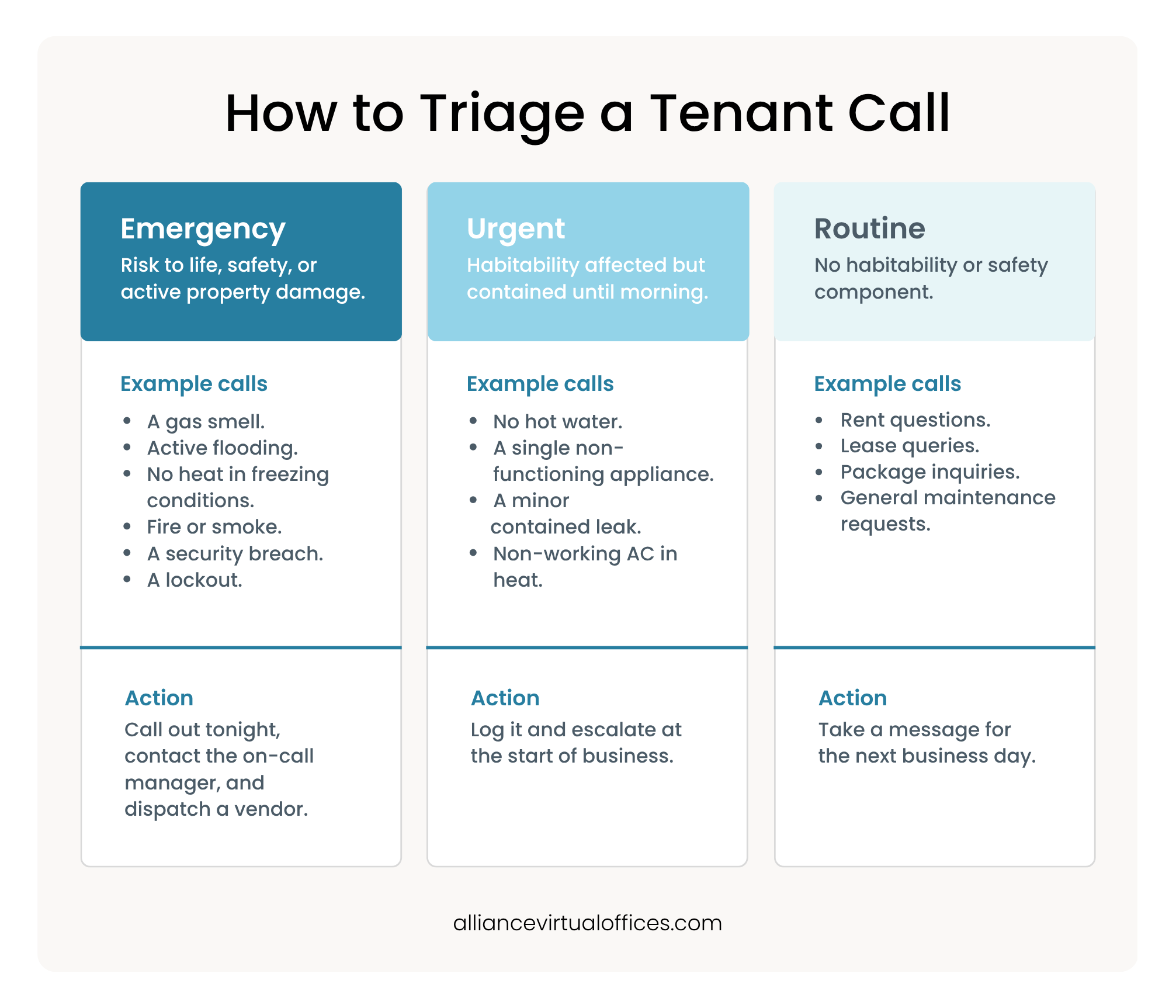
A workable protocol sorts every inbound tenant call into three tiers before anything else happens. Use these tiers as a starting framework, then write down your own thresholds and hand them to the service before it takes a single call.
Emergencies That Need a Call-Out Tonight
AnswerNet’s agents are trained to treat anything adjacent to “fire, flood, or blood” as urgent, a three-word heuristic worth borrowing. It errs toward over-escalation, and that’s the right direction to err in.
Gas smell, active flooding, no heat in freezing conditions, fire or smoke, a security breach, and a lockout all belong here. A lockout is the one operators most often argue about.
A tenant locked out at midnight will solve the problem themselves, usually with a locksmith who bills you more than your preferred vendor would have.
Urgent, But It Can Wait Until Morning
No hot water, a single non-functioning appliance, and a minor contained leak all affect habitability without threatening it. These calls need a timestamp, a clear log entry, and a message that reaches the right person before 9am, and nobody needs to roll a truck overnight.
Here the risk runs the other way, toward under-escalation. A “minor contained leak” that’s been running for six hours is no longer minor, so the script needs a duration question.
Routine, Message Only
Rent questions, lease queries, package inquiries, and general maintenance requests are the bulk of the volume, and none of it needs a human at 3am. AI answering handles this tier competently.
Building Your Escalation List So the Service Can Act
A triage protocol without an escalation list is a classification exercise. Before the service can act on a call, it needs these in writing.
- An on-call rotation, with names, numbers, and the hours each person covers
- A preferred vendor list with after-hours rates already agreed, covering plumbing, electrical, HVAC, locksmith, and restoration
- A spend authorization ceiling, so an agent can approve a $400 emergency call-out without waking you for permission
- A list of units with known issues, so a third call about the same radiator isn’t treated as a new emergency
The vendor dispatch piece is where the value compounds. If your service can reach a plumber directly at 2am from a list you supplied, a flooded unit stays a contained incident.
For the contractor side of that dispatch relationship, which helps when you’re negotiating after-hours rates, see virtual receptionist for contractors.
Read More: Answering Service for Plumbers, HVAC & Contractors
AI vs Live Answering for Property Management: Where Each One Holds Up
An AI answering service for property management is a reasonable purchase for many operators, especially those whose overnight calls are mostly routine.
Where AI Answering Is Adequate
Routine rent and lease questions are scripted, repetitive, and low-consequence, which is the profile AI handles reliably. Office-hours overflow fits too, since an AI agent answering in two rings beats a caller waiting on hold.
Appointment scheduling works well, particularly for showings, because the task is structured and the worst case is a rescheduled calendar entry. After-hours message capture on non-urgent calls is also well within reach.
Together, those four categories make up a large share of a typical portfolio’s call volume. An operator whose overnight calls are overwhelmingly routine isn’t making a mistake by buying AI.
Where a Live Human Is Still the Defensible Choice
Ambiguous emergencies are the clearest case. A caller who says “there’s water coming from somewhere” needs someone who can ask three unscripted follow-up questions and decide.
Distressed callers need a person too. A tenant whose ceiling has collapsed isn’t in a state to navigate a classification prompt, and how that call is handled affects whether they renew.
So do judgment calls on spend authorization. Approving a $600 after-hours call-out against a $500 ceiling because the alternative is water damage takes a decision no script covers.
The underrated case is any call where misclassification carries a property-damage or liability cost. That’s where the price difference between AI and live answering stops being the relevant number.
What to Ask an AI Vendor Before You Sign
Insist on specifics for each of these questions.
- What’s the escalation path to a human, and does one exist at 3am?
- How does the system handle a call it misclassifies, and who finds out?
- What’s the vendor’s position on liability when a missed emergency causes damage?
- Does the demo reflect real overnight performance, or a curated call set?
None of those questions are hostile, and a good AI vendor answers them directly. One that deflects has told you something.
For a fuller side-by-side, see AI receptionist vs live receptionist.
How to Get A FREE Live Receptionist
Request Your Code Below and Get a FREE
Live Receptionist for 1 Month!

How Much Does a Property Management Answering Service Cost?
Human answering services for property management generally run $175 to $470 per month, plus $1.30 to $1.49 per minute above the included allowance. Per-minute pricing sits around $0.90 to $1.25, per-call pricing around $1.25 to $2.75, and property-specific AI voice agents with PMS integration typically run $400 to $800 per month.
Treat these as rough market ranges, since rates shift often, and many providers quote privately.
The cost of property management answering service plans is hard to compare because the billing units differ, and several providers publish no rates at all. The right billing model depends on the shape of your call volume more than on your budget.
Per-Minute vs Per-Call vs Flat Plans, and How to Estimate Your Volume
Per-minute billing suits low and unpredictable volume, but ask about rounding. Thirty-second increments are common, and a 40-second call billed as a full minute changes the math at volume.
Per-call billing suits steady, short calls. Ask what counts as a call, because wrong numbers, hang-ups, and callbacks from the same tenant are all billable at some providers.
Flat monthly plans suit predictable volume and are the easiest to budget. Overage rates are where the margin sits, so get them in writing before you sign.
To estimate volume, take your last three months of after-hours calls, multiply by average handle time, and add 20%. Many operators underestimate, because they remember the emergencies and forget the rent questions.
Alliance’s breakdown of answering service pricing works through that calculation in more detail.
In-House vs Outsourced: The Actual Comparison
The in-house alternative isn’t free, and a government figure makes the comparison easy to check. The BLS puts the median annual wage for property, real estate, and community association managers at $69,990 as of May 2025, with 4% employment growth projected from 2025 to 2035 and about 36,900 openings per year.
Even hiring below that median for a phone-only role, and before payroll taxes, benefits, or cover for nights and weekends, a single hire costs an order of magnitude more than a $200 monthly service.
Alliance publishes its Live Receptionist plans openly, starting at $125 a month for 50 minutes, so the arithmetic is easier to run than with quote-only providers. You can also run your own numbers with the live receptionist calculator.
For scale, apartment operations alone contributed $175.2 billion a year to the national economy, according to a 2019 study by Hoyt Advisory Services for NMHC and the National Apartment Association. The study is from 2019, so treat that figure as background.
After-Hours Coverage and PMS Integration: What to Test Before You Sign
Most buyers want an after-hours answering service property management teams can trust overnight, and coverage claims in this category need checking. Overnight and weekend hours are the expensive hours to staff, so providers have a commercial incentive to describe partial coverage in language that sounds total.
Reading those claims carefully is the highest-return twenty minutes of the evaluation, and integration claims deserve the same scrutiny.
What Real 24/7 Coverage Looks Like
Real 24/7 coverage means a trained person answers at 3am on a Sunday, with access to your escalation list and authority to act on it. Anything less is voicemail with extra steps.
Common versions include an overnight queue where calls are answered but nothing happens until morning, offshore coverage with no vendor dispatch authority, and an automated attendant that pages an on-call manager who is, in practice, you.
Test it during the trial. Call the service at 2am, describe a burst pipe, and time how long it takes before your phone rings.
A 24/7 answering service property management operators can rely on should reach you within minutes.
Run the same test on a Saturday afternoon and again on a public holiday. Holiday coverage is the gap that most often goes unnoticed at signing, because it’s rarely mentioned in the contract and seldom raised in the demo.
Weekend Leasing Calls Bring In Revenue
Weekend coverage is usually sold as a cost, but it also protects revenue. The Census Bureau’s national rental vacancy rate stood at 7.3% in the second quarter of 2026, and the median asking rent for vacant for-rent units was $1,531.
That puts a price on a missed weekend showing inquiry. A unit that sits vacant an extra month because a Saturday prospect went to voicemail costs roughly $1,531 in forgone rent, against a service costing a fraction of that.
Leasing inquiry capture is the criterion many operators underweight when they shop, and after-hours virtual receptionist covers how that coverage is usually structured.
Alliance’s Live Receptionists answer Saturdays from 9am to 7pm ET, along with weekdays from 8am to 9pm ET.
NEXT STEPS: Explore Alliance Live Receptionist plans
PMS Integration: AppFolio, Buildium, Yardi, Propertyware, and Entrata
Buyers ask about property management software integration constantly, and few providers in this category explain it clearly. Part of the reason is that “integration” describes at least three different things.
The weakest version is a shared rent roll, where you send the service a daily-updated tenant list and agents work from that file. It’s unglamorous and it works, and for a portfolio under a few hundred doors it’s often enough.
The middle version is read-only access to your PMS, so agents can confirm a tenant’s unit, lease dates, or balance during the call without asking you. This is where most competent providers sit.
The strongest version is full write-back, where a maintenance request logged by the answering service appears as a work order in AppFolio, Buildium, Yardi, Propertyware, or Entrata without anyone re-keying it. Not every provider that claims it can deliver it.
Verify it in the demo. Ask the vendor to log a test maintenance request while you watch your own PMS screen, and note how long it takes to appear and which fields arrive populated.
If a provider has no integration, the shared rent roll is a reasonable fallback, but price it accordingly, because someone on your team is doing the re-keying.
Confirm who updates the shared file and how often. A rent roll refreshed weekly will have an agent telling a tenant their balance is wrong, which is worse than the agent having no balance information at all.
Daily is the minimum that works, and AnswerNet is the one provider in this comparison that makes daily refresh an explicit part of its process.
Integration depth often decides whether the best answering service for property management in general is the best one for you. A 60-unit landlord loses nothing by working from a shared rent roll, while a 1,500-door operator loses hours a week to it.
Operators building a portfolio from scratch may find how to start a real estate investment business useful for the wider setup, and Live Receptionist for real estate agents covers the brokerage side of call handling.
Choosing the Right Property Management Answering Service for Your Portfolio
Start by matching coverage to when your calls actually arrive, which means pulling three months of call logs before you shop.
Then verify the triage protocol before you look at pricing. A cheaper service that misclassifies a gas smell costs more than an expensive one that doesn’t, and this is the criterion most worth paying for.
Confirm the escalation list can be acted on. A service that can reach your plumber at 2am on your authority is doing a different job from one that sends you a text.
Last, pick the pricing model that matches your volume shape. Predictable volume favors flat plans, spiky volume favors per-minute, and short high-frequency calls favor per-call.
For operators who want real people answering tenant calls without adding a hire, Alliance’s Live Receptionists answer weekdays from 8am to 9pm ET and Saturdays from 9am to 7pm ET, with published plans from $125 a month and no setup fee. How to set up your Live Receptionist service walks through configuring the escalation rules.
Frequently Asked Questions
How much does a property management answering service cost?
What is the difference between an answering service and a call center for property management?
Can an answering service dispatch maintenance vendors?
How does an answering service tell an emergency from a routine tenant call?
Does an answering service integrate with AppFolio, Buildium, Yardi, or Propertyware?
Further Reading