
- What’s an After Hours Virtual Receptionist?
- How After Hours Call Answering Works
- Which Businesses Need After Hours Call Answering Most
Q: What’s an after hours virtual receptionist?
A: An after hours virtual receptionist is a live call answering service that handles business calls outside standard office hours, including evenings, weekends, and holidays. Instead of voicemail, trained receptionists answer in your company’s name, take messages, screen leads, and route urgent calls.
Many service businesses receive calls outside the standard 9-5 working hours, with 40-50% of inbound calls taking place during these times, according to CrowdAnswers market research. If no one answers those calls, you’re not just missing messages, but potentially handing business over to your competitors.
An after hours virtual receptionist fills that gap, using live, trained call handlers who answer in your name. This article explains what an after hours call answering service involves and how to evaluate what you are buying before you sign up for an after hours virtual receptionist.
The Real Cost of Missed Calls After Business Hours
What the Numbers Show
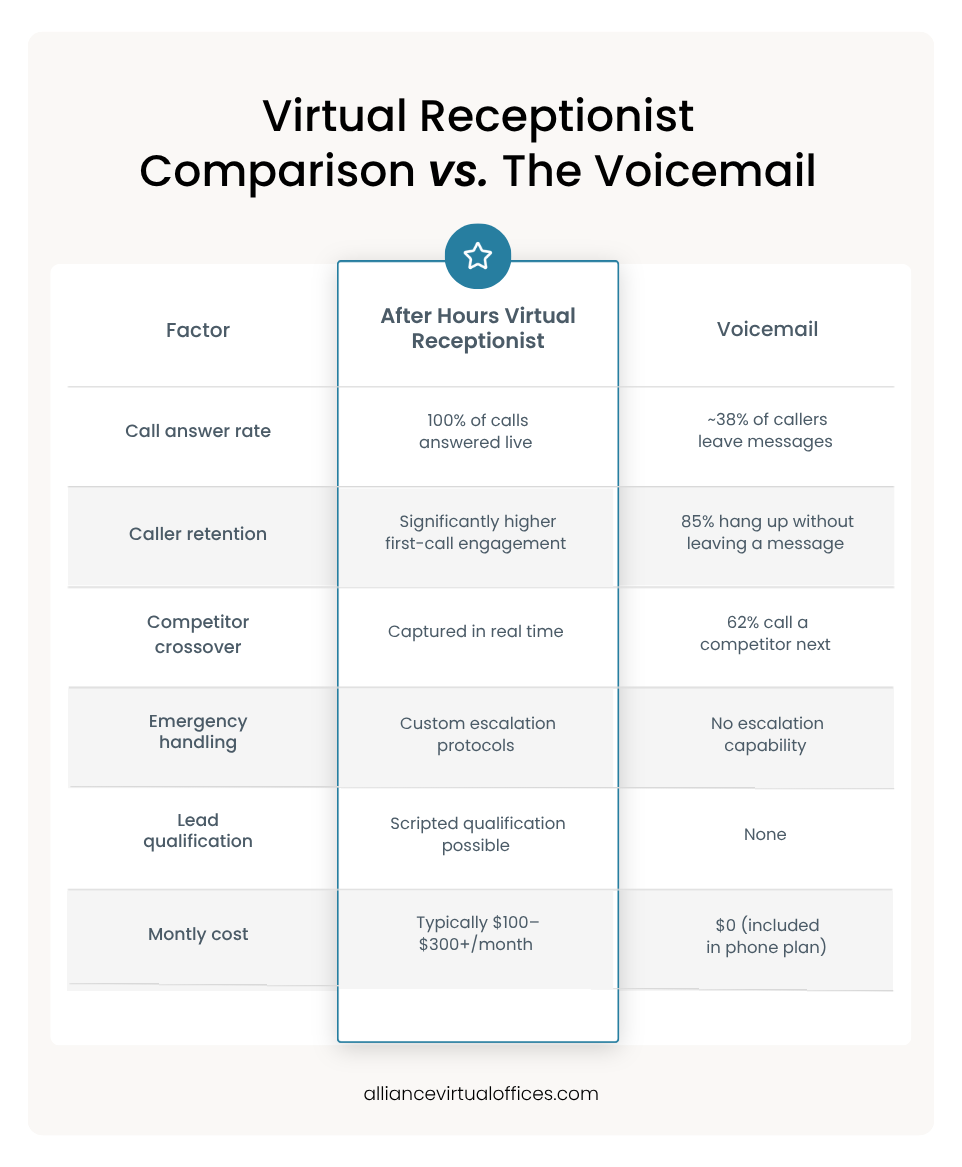
The data on missed calls is consistent, with 85% of callers who reach voicemail hanging up without leaving a message. Of those who don’t reach a person, 62% will contact a competitor immediately. Businesses compound the problem by answering fewer calls than they likely realize. The revenue loss is measurable. Small businesses lose an average of $126,000 per year to missed calls.
Why Voicemail Fails Service Businesses
The 85% hang-up rate on voicemail isn’t irrational caller behavior. It reflects a reasonable expectation that a voicemail in a service business context means receiving a slow response or none at all. After-hours callers often experience urgent situations, such as a leaking pipe, jammed locks, or a looming legal deadline. They need a fast resolution, not a callback promise without a timeline.
Voicemail also doesn’t screen or prioritize callers to distinguish a genuine emergency that needs immediate escalation from a routine inquiry that can be handled first thing in the morning. An after hours virtual receptionist can triage calls. That distinction makes the difference between retaining a long-term client and losing them to whoever picks up the phone first.
What’s an After Hours Virtual Receptionist?
How It Differs from a Standard Answering Service
An answering service typically takes messages and relays them, which is a more passive function. But a virtual receptionist is trained to represent your business more fully: greeting callers in your company’s name, using customized scripts, making routing decisions, and in some cases, booking appointments or handling frequently asked questions.
An after hours virtual receptionist extends these capabilities beyond standard hours. Some providers offer true 24/7/365 coverage including holidays, while others only cover evenings and weekends. Before choosing a provider, know exactly what coverage window you’re purchasing.
Live Humans vs. AI Bots
Growing as a category, AI-powered receptionists are chatbots that handle inbound calls using natural language processing. They’re cost-effective for simple, highly structured interactions, but struggle with complex, high-stakes, or emotionally charged calls.
Scenarios may include a homeowner with a water flooded basement, a patient in pain who is trying to reach an after-hours medical line, or a potential legal client assessing whether to retain counsel. For service businesses where after-hours calls tend to be high-stake and emotional interactions, a live receptionist service generally outperforms automated systems on conversion and caller satisfaction.
If your after-hours callers are primarily existing clients with simple requests, an AI system may be sufficient for your business. But if your callers are new leads evaluating whether to hire you, having a real person at the end of the line is a meaningful differentiator.
Read more: What Is a Live Receptionist? How It Works
How After Hours Call Answering Works
What Happens to Your Calls After 5 PM
The operational mechanics of an after hours virtual receptionist are straightforward. You configure call forwarding on your business phone to route calls to the virtual receptionist service. When a call comes in, a live receptionist answers.
The receptionist then follows your custom call handling protocol: taking a message and sending it to you via text or email, screening the lead and passing qualifying information, routing the call to an on-call staff member for emergencies, or booking an appointment in your calendar system. After every call, you receive a notification, typically in real time via SMS or app.
Setup, Customization, and Call Routing
Setup typically takes one to two business days. You provide the service with a call script: your company name and greeting, FAQs, escalation rules (what counts as an emergency and who to notify), and message delivery preferences. Good providers walk you through scripting during onboarding.
For businesses with multiple staff or service areas, routing rules can be more complex, with different on-call contacts for various service types, escalation tiers, or bilingual handling. Before signing, confirm whether their platform supports the routing complexity your business requires.
How to Get A FREE Live Receptionist
Request Your Code Below and Get a FREE
Live Receptionist for 1 Month!

Which Businesses Need After Hours Call Answering Most
Home Services and Emergency Trades
For Heating, Ventilation, and Air Conditioning (HVAC) contractors, plumbers, locksmiths, and electricians, after-hours call volume is the norm. Tradespeople often see a huge number of calls arriving outside standard business hours.
A plumbing company with no after-hours coverage is effectively a part-time plumbing company in a market where competitors answer around the clock.
The missed-call cost in these industries compounds quickly because service tickets are high-value. A single missed emergency HVAC call in summer could represent a $3,000–$8,000 repair or replacement job. Covering after-hours calls isn’t a luxury service upgrade; for trades and home services, it’s a basic requirement to remain competitive.
Professional Services: Legal, Medical, Real Estate
Attorneys, healthcare practices, and real estate professionals each have specific after-hours call patterns. Prospective legal clients often call in the evening after researching their options during the workday, while medical patients needing after-hours care or guidance are frequently in time-sensitive situations where speaking to someone in real-time matters.
Real estate leads are also highly time-sensitive; a buyer who plans to call three agents one evening will sign with whoever responds to their inquiry first.
For regulated industries, like medical and legal, after-hours call handling has compliance dimensions. Medical practices need Health Insurance Portability and Accountability Act (HIPAA)-compliant message handling, and law firms must work with call handlers who understand the basics of confidentiality. Confirm that the provider you’re considering has the appropriate training and protocols suited to your industry.
Small Businesses That Can’t Afford to Miss a Lead
The $126,000/year missed-call cost reflects a broader category of small businesses where phone calls are still a primary lead generator, and after-hours calls represent real revenue opportunities.
Consultants, insurance agents, tutoring businesses, fitness studios, and many retail operations fall into this category. For these businesses, after-hours call answering service is a cost-justified form of business insurance. As a live receptionist service can cost between $100–$300/month, it’s a small fraction of your annual revenue at risk from unanswered calls.
Read more: Auto-Attendant Phone Systems: Setup Guide and Scripts
What to Look for in an After Hours Answering Service
The Voicemail vs. Virtual Receptionist Comparison
The comparison isn’t voicemail vs. live answering in isolation; it signifies the revenue cost of missed calls against service costs. For any business where a single missed call represents $300 or more in potential revenue, the math favors a live receptionist service.
Coverage Hours, Training, and Call Handling Protocols
“After hours” can mean evenings only, evenings and weekends, or true 24/7/365, including federal holidays. If your business receives emergency calls on Thanksgiving or New Year’s Day, verify that your chosen provider’s coverage hours include holiday coverage explicitly before contracting an after hours virtual receptionist.
Training quality also matters more than it appears in marketing materials. Ask providers whether their receptionists receive industry-specific training, what their quality assurance process looks like, and whether bilingual (such as English/Spanish) coverage is available. High call volume and quality aren’t always compatible, so make sure to ask about average wait times during peak hours.
Cost vs. Value: Breaking Down the Math
After-hours answering service pricing typically ranges from $100 to $300+ per month, depending on call volume and coverage scope. Most providers structure pricing per minute or per call. Use the live receptionist calculator to estimate costs for your call volume.
The return on investment benchmark is instructive. CrowdAnswers research found that service businesses capturing after-hours calls see 25–40% more booked appointments. Depending on average job value and close rates, even a modest increase in captured leads can translate into thousands of dollars in additional monthly revenue, which often far exceeds the cost of an after-hours coverage service.
After Hours Virtual Receptionist Services: Making the Right Call for Your Business
The core value proposition of an after hours call answering service is simple: your callers want to speak to a person, not a voice message, and the callers contacting your business after 5 PM are often the most motivated and most likely to hire you.
But they’re also most likely to walk away if they don’t receive the response they expected. With an 85% hang-up rate on voicemail, and 62% calling competitors next, service businesses without live coverage are potentially leaving six figures in annual revenue on the table.
For small businesses that use their phone as a lead generator, having after-hours virtual receptionist coverage is a practical, cost-justified solution.
Alliance Virtual Offices offers a live receptionist service with US-based receptionists who answer in your company’s name, handle messages and lead screening, and route urgent calls according to your custom protocols, including after-hours and weekend coverage.
If you’re evaluating your options, start with your average call value and current after-hours answer rate. If there’s a meaningful gap, the return on investment case for live answering makes itself.
To get started, see how a Live Receptionist service from Alliance Virtual Offices handles after-hours calls.
Frequently Asked Questions
How much does an after hours answering service cost?
Is a virtual receptionist better than voicemail after hours?
Which industries benefit most from after hours call answering?
Can an after hours virtual receptionist handle emergency calls?
Further Reading