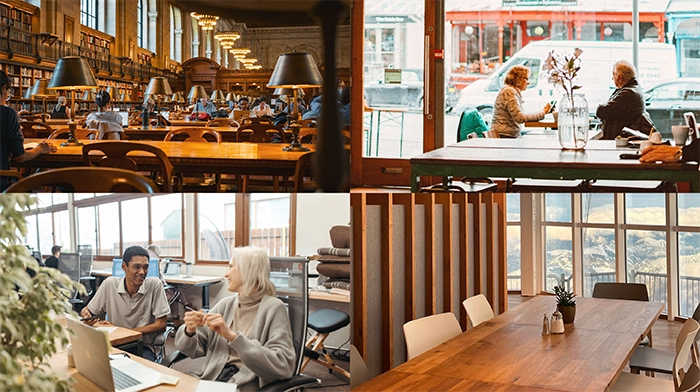
- The Scorecard: All 11 Options Compared
- Which Place to Work Remotely for Which Job
- Staying Safe on Public Wi-Fi
Q: Where are the best places to work remotely besides home?
A: Libraries and coffee shops suit free, low-stakes work. A coworking day pass suits a full focused day, and a private day office or hourly meeting room gives you a door for calls and client meetings.
The home office stops working on a Tuesday afternoon. A leaf blower starts up next door just as your client call begins.
If you’re hunting for the best places to work remotely, the data says you’re not alone. In 2025, 35% of employed people did some or all of their work at home on days they worked, and many hybrid teams now book on-demand meeting rooms for the days they meet in person.
Still, only 24% of hybrid workers would choose to be home all the time if the choice were theirs. Sociologists call the spaces between home and the office a third place, and the real question is which one fits the task.
We rated 11 options on cost, Wi-Fi, quiet, call privacy, and client-readiness, using 2026 prices wherever they exist.
The Scorecard: How the Best Places to Work Remotely Compare
Cost per day is what you’d typically spend, Wi-Fi is how dependable the connection tends to be, and quiet is the usual noise level.
Call privacy is whether you can talk at normal volume without being overheard, and client-ready is whether you could host a visitor without apology. These are good places to work remotely in different ways, so the right pick depends on the job.
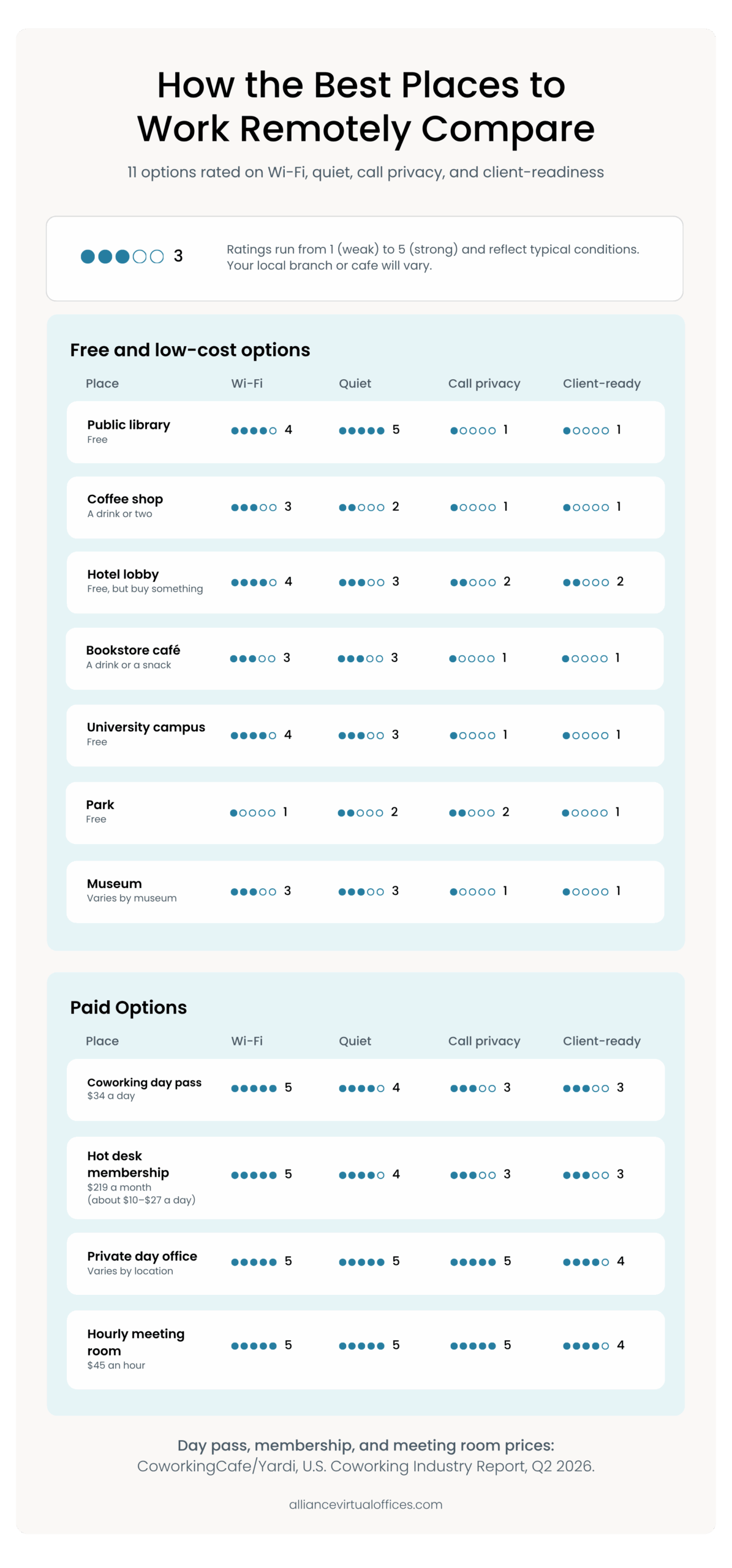
Ratings run from 1 (weak) to 5 (strong) and reflect typical conditions, so your local library branch or café will vary. Day pass, membership, and meeting room figures are CoworkingCafe data for Q2 2026.
Free Places to Work Remotely (and Where Each One Breaks Down)
Free options are the right answer for many tasks. They win on cost but tend to break down on calls and client visits.
Free spaces rarely require a membership, so you can try a few in a single week at no cost.
Public libraries
Libraries cost nothing, and many offer a bookable library study room, which makes them one of the quiet places to work, as long as you book the room. They suit deep focus if you find a quiet floor or a study room, and they break down on calls because the open areas are shared.
Wi-Fi is usually dependable, and a reserved study room gives you a table nobody else can take.
Hours vary by branch, and outlets near good tables fill early. For a longer free list, see Alliance’s guide to free coworking spaces.
Coffee shops
A coffee shop costs the price of a drink or two. It suits an hour or two of email and light admin, and it breaks down on noise and outlets, and on etiquette once you’ve camped past your first drink.
Noise level is the biggest variable, since a mid-morning weekday is calmer than a weekend lunch hour.
Client meetings rarely work there, and shared Wi-Fi brings security risks of its own. For the full comparison, read coworking vs. coffee shop.
Read More: Meeting Rooms vs. Coffee Shops
Hotel lobbies
Business hotels often have comfortable seating and solid Wi-Fi, and the lobby is typically free to sit in. It suits a change of scene for a few hours.
Arrive early afternoon, after checkout traffic has thinned and before the check-in rush.
It breaks down on etiquette and consistency. Buy something from the bar or café, keep calls short and quiet, and leave if staff ask, because a hotel lobby is a courtesy space and quality swings from one property to the next.
Bookstore cafés
Bookstore cafés tend to be quieter than coffee shops, with a similar cost of a drink or a snack. They suit reading-heavy work and light writing.
They break down on seating and outlets. Tables are limited, and most customers are there to browse.
A table near the back and a midweek visit give you the best odds of a calm hour.
University campuses
Many campus libraries and student centers admit the public at no cost. They suit long focus sessions, with dependable Wi-Fi and plenty of outlets.
Access rules vary by school, and exam weeks can leave every table taken. Student centers are usually the easiest way in, since libraries sometimes limit access to ID holders.
Confirm the visitor policy online first.
Parks and outdoor spaces
Parks are free and restorative, and they work for reading, planning, and calls on earbuds. They break down on screen glare, battery life, weather, and laptop security, since you can’t leave your table for a minute.
Bring a phone hotspot for the connection. Shade, a seat with a back, and a full battery make a two-hour session workable.
Museums
Museum cafés and member lounges cost a coffee or, for some lounges, a membership. They suit creative work and a half day of thinking time.
They aren’t a full-day option. Seating is limited, and calls aren’t welcome in galleries.
A member lounge, where one exists, is usually quieter than the public café.
Get Your FREE Guide Today!
How to Start a Business in a Recession
Paid Remote Work Spaces Worth the Money
Paid remote work spaces earn their cost on full days of focus and on any call or meeting where a closed door matters. Each one is a tool for a specific job.
Prices are national medians from CoworkingCafe’s Q2 2026 coworking report. The same report counted 9,384 U.S. coworking spaces, about 77% of them run by regional or independent operators, so one is usually close by.
Coworking day pass
The national median day pass costs $34. You get dependable Wi-Fi and a proper desk, which suits a full day of mixed tasks.
It breaks down when you need real privacy, since call booths vary by location. Arrive early for the best choice of desk, and ask whether the pass includes a call booth.
Our guide to the coworking day pass explains how booking works.
Hot desk membership
A coworking hot desk usually comes as a monthly membership, and the national median membership is $219 a month. Divide $219 by the $34 day pass, and the break-even lands at about six or seven days a month.
It suits people who work outside the home most weeks, and it breaks down if your schedule is unpredictable. Run the math on your own calendar before you commit.
Ask whether the membership works across multiple locations if you travel.
See coworking membership cost for typical price ranges.
Private day office
A private day office gives you a closed door and a professional backdrop for video calls. It suits a full day of client calls or confidential work, and pricing varies by location, so check the listing.
Ask what hours the office is yours and whether a printer, whiteboard, or screen is included.
It breaks down on cost if you only need an hour. You can book a private office by the day, or read about the day office as an alternative to a long-term lease.
Hourly meeting room
The national median meeting room costs $45 an hour. It’s the answer for an in-person client meeting or an interview, where the room itself carries the impression.
Room sizes vary, so book for the number of people you expect.
Networks like Alliance let you book a Meeting Room by the hour, with listed rates starting around $10 an hour at some locations. For typical rates and uses, see meeting room rental rates and meeting rooms for client consultations.
Where Prices Run Low and High
City choice changes what each option costs, and CoworkingCafe’s Q2 2026 data shows the spread. Median day passes are cheapest in Cleveland–Akron and Sacramento at $25 and highest in Miami at $45.
Meeting rooms follow a similar pattern, from $30 an hour in Sacramento and Salt Lake City to $73 in Manhattan. Prices shift each quarter, so treat these figures as a starting point and check a local listing before you go.
For a city-by-city view, see the top coworking spaces in the U.S., and if you move often, read how to work from anywhere as a digital nomad.
Which Place to Work Remotely for Which Job
Match the place to the task, not to your mood. Free spaces handle low-stakes work well, and the paid options earn their place when privacy or a client is involved.
- Deep focus: a library or a coworking day pass.
- Quick email and admin: a coffee shop.
- A client call: a space with a door, such as a private day office or a call booth.
- A client meeting: an hourly meeting room.
- A full day of mixed tasks: a coworking day pass, or a hot desk if you go more than six or seven days a month.
When you’re deciding where to work remotely on a call-heavy week, pay for the door. If a visitor will judge the room, book one.
A search for “places to work remotely near me” returns a long list, so add the task. Try “quiet places to work near me” for focus and “remote work spaces near me” for desks and rooms.
Alliance’s network includes Coworking, private day offices, and hourly Meeting Rooms, which covers calls, client meetings, and full days of mixed work.
NEXT STEPS: Find a coworking space near you
Staying Safe on Public Wi-Fi
Public Wi-Fi is fine for reading and most email, and it gets riskier when you handle banking or client files. Public places to work rarely control who else is on the network, and that’s the main public Wi-Fi security risk.
Prefer sites that load over HTTPS, and skip any network that asks you to install software to connect.
In a 2023 Forbes Advisor survey of 1,000 U.S. travelers who use public Wi-Fi, 41% said their information had been compromised, and 52% of them said it happened at a café or restaurant. And 34% said they don’t use a VPN.
- Use a VPN on any network you don’t control.
- Confirm the exact network name with staff before you connect.
- Switch to your phone hotspot for banking or client files.
- Turn off file sharing, and lock your screen when you step away.
Choosing the Best Places to Work Remotely Based on the Job in Front of You
Free spaces cover low-stakes work, and a paid door covers calls and clients. Libraries, cafés, and campuses cover focus and admin at little or no cost.
A day pass covers a full day, and a hot desk fits a regular weekly pattern.
Alliance’s network includes Coworking, private day offices, and hourly Meeting Rooms in cities across the U.S. and abroad. Listed Meeting Room rates start around $10 an hour at some locations, compared with the $45 national median.
Pick the cheapest option that fits the task, and step up only when a call or a client requires it.
Frequently Asked Questions
What are good places to work remotely besides home?
How much does a coworking day pass cost?
Can I work from a hotel lobby without staying there?
Is it rude to work in a coffee shop all day?
Where can I take a private Zoom call away from home?
Further Reading