
Q: What is the difference between a live receptionist and an answering service?
A: A live receptionist acts as a professional extension of your team, answering in your company name, screening calls, qualifying leads, and often scheduling appointments. An answering service focuses on basic call coverage and message capture. Both ensure calls get answered, but the caller experience and business value differ significantly.
A missed call costs more than an inconvenience. When your phone rings and no one answers, or connects to a robotic automated system, you lose trust. Potential clients hang up and call a competitor. Leads evaporate before they ever reach your team. Existing customers feel undervalued.
For small business owners, solo professionals, and startup founders, the question of how to handle incoming calls is not trivial. You need reliable coverage, but you also need a solution that reflects your brand, captures leads, and makes your callers feel heard. The two most common approaches are live receptionist services and answering services. On the surface, they sound similar. Both handle phone calls. But the difference is substantial, and choosing the wrong one can undermine your growth.
This guide breaks down what each option does, compares them side-by-side, and helps you decide which fits your business stage, budget, and priorities.
What a Live Receptionist Does
More Than a Call-Taker
A live receptionist is a professional extension of your team who works on your behalf. Here is what they typically provide:
- Answers in your company name: Callers reach a real person who greets them professionally using your business name and tone.
- Screens and forwards calls: They assess the reason for the call and route it to the right person or department.
- Takes detailed messages: They capture not just what was said, but context, urgency, and caller intent.
- Qualifies leads: They ask discovery questions to identify serious prospects and gather initial information.
- Schedules appointments: Many can book meetings, callbacks, or consultations directly into your calendar.
- Manages after-hours coverage: They extend your availability beyond standard business hours.
The key difference is personalization. A live receptionist understands your business, your tone, and your process. They are trained to represent your brand. When a caller needs to reschedule, a live receptionist can think on their feet. When a prospect asks a specific question, they take notes and flag it as high-priority.
This is why live receptionist services work best for businesses where the first call is critical. The initial human interaction often sets the tone for the entire relationship.
NEXT STEPS: Learn more about live receptionist services
What an Answering Service Does
An answering service is a more streamlined, transactional solution. It focuses on reliable coverage and basic intake rather than full business support.
Typical Capabilities
- Basic call coverage: Answers phones during specified hours, often after-hours, weekends, or holidays.
- Message capture: Records caller name, number, and reason for call, then delivers a message to you.
- Overflow handling: Picks up calls when your team is busy or unavailable.
- Urgent call routing: Can escalate critical calls, such as emergencies or VIP clients, to your personal phone.
- Simple scripts: Uses standardized intake protocols rather than customized business logic.
An answering service excels when your primary need is coverage and availability. You are not looking for lead qualification or appointment booking. You just need a safety net so calls do not go to voicemail. Most operate on a simple model: the call comes in, they take a message, they send it to you, you follow up. It is predictable and cost-effective for businesses that have the bandwidth to handle callbacks themselves.
Side-by-Side Comparison
| Factor | Live Receptionist | Answering Service |
|---|---|---|
| Scope of Service | Full business support: calls, messages, scheduling, lead qualification | Basic message-taking and coverage |
| Personalization | High — trained on your business, tone, and processes | Low — standardized scripts and intake |
| Appointment Scheduling | Yes, integrated with your calendar | Rarely. They take messages only |
| Lead Qualification | Yes, asks discovery questions and flags priorities | No. Basic message capture only |
| Call Routing | Intelligent routing based on your business logic | Simple forwarding or escalation rules |
| First Impression | Polished, professional, brand-aligned | Professional but generic |
| After-Hours Availability | Yes, typically 24/7 or customized hours | Often yes — frequently the primary use case |
| CRM Integration | Often yes, can sync appointments and notes | Rarely |
| Callback Management | Proactive follow-up coordination | You manage all callbacks |
| Customization | High — scripts, call flows, business rules | Limited to message format |
| Caller Experience | Premium — callers feel heard and valued | Adequate — calls do not go unanswered |
| Price Range | $300–$1,500+/month typical | $100–$500/month typical |
| Best For | Lead generation, sales, professional services | Overflow, after-hours, budget-conscious needs |
Key Takeaway: A live receptionist is a strategic investment in customer experience and business operations. An answering service is a tactical tool for coverage gaps.
Which Option Is Best for Different Business Types
Your business model shapes which solution makes sense.
Solo Professionals and Consultants
If you are a solo founder juggling calls, client work, and admin, a receptionist service for small business is often worth the investment. They can schedule your time, qualify prospects, and reduce the mental load of missed calls during meetings.
Example: A freelance consultant who receives 20 calls per week. An answering service works for after-hours overflow, but during business hours a live receptionist ensures every prospect gets vetted and scheduled without the consultant dropping the ball.
Law Firms and Professional Services
Live receptionists are the stronger choice here. Callers have a specific legal issue, need quick routing to the right attorney, and expect professionalism. Lead quality matters enormously because a misdirected call is lost revenue.
Example: A personal injury law firm receives calls from accident victims, insurance adjusters, and existing clients. A live receptionist asks qualifying questions, flags urgent cases, and ensures the right attorney gets the call immediately.
Contractors and Field Services
A hybrid approach often works best: live receptionist during business hours, answering service for after-hours emergency routing. You need real-time appointment scheduling and lead qualification, since not every inquiry is a qualified job.
Example: A plumbing company that receives 30 or more calls daily during peak season. A live receptionist books jobs and confirms technician availability. An answering service handles emergency calls after 6 PM.
Healthcare-Related Practices
A live receptionist is essential. Callers need to reach the right specialist, book appointments, and feel heard about their concern. Compliance and professionalism are non-negotiable.
Example: A therapy practice needs receptionists who can empathetically handle intake, ask about insurance, and book appointment slots without sounding corporate.
E-commerce and Online Businesses
If most of your revenue comes through online channels, an answering service may be enough. Calls are often support-related (shipping, returns, questions) rather than high-stakes lead opportunities. If you offer phone sales or consultations, a live receptionist for business hours makes sense.
NEXT STEPS: See how a Live Receptionist fits your business type
How to Choose Based on Your Growth Stage
When an Answering Service Is Enough
- You have fewer than 20 calls per week
- You mainly need overflow or after-hours coverage, not business-hours support
- Calls are straightforward: tech support, customer service, or inquiry intake
- You have bandwidth to follow up on all callbacks yourself
- Your budget is in the $100 to $300 per month range
- Lead quality is less critical than simple availability
An answering service gives you peace of mind and reliability without eating into your budget. You will handle callbacks yourself, but at least they are captured.
When a Live Receptionist Becomes Essential
- You receive 30 or more calls per week during business hours
- Lead quality and conversion directly impact revenue
- You need appointment scheduling to reduce back-and-forth
- You want brand consistency across every caller interaction
- You are time-poor and need callbacks handled before they go cold
- You operate in a competitive vertical where first impression matters
- You are scaling and need a solution that grows with you
A live receptionist service becomes ROI-positive when the time and leads it captures outweigh the cost. For many businesses, that threshold arrives earlier than expected.
Growth Stage Framework
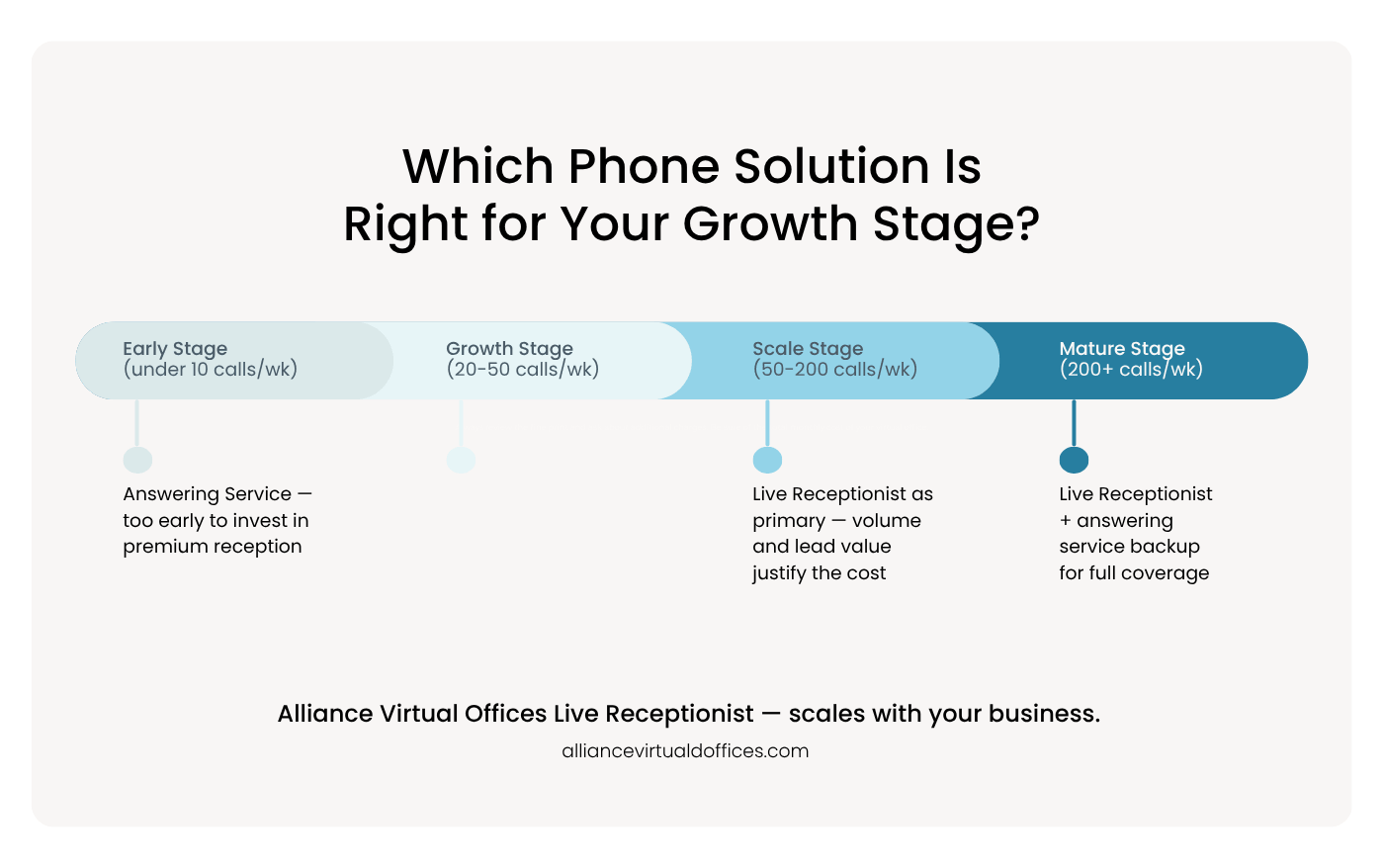
Early Stage (fewer than 10 calls per week): Use nothing yet, or a basic answering service. It is too early to invest in premium reception while you are still learning what your call volume looks like.
Growth Stage (20 to 50 calls per week): Use an answering service plus a live receptionist trial. You need coverage, and you should test whether lead quality improves with a live person answering.
Scale Stage (50 to 200 calls per week): A live receptionist should be your primary solution. Volume and lead value justify the cost, and you need systematized handling.
Mature Stage (200 or more calls per week): Live receptionist combined with an internal reception team, or outsourced live reception with an answering service as backup, depending on call complexity and strategic priorities.
NEXT STEPS: Compare plans and get started with a Live Receptionist
The Right Call Starts With the Right Service
Which option is better for your business? The answer depends on what you are optimizing for.
If your priority is coverage and cost-efficiency, an answering service works. You will have a safety net. Calls will not go unanswered. You will get messages. Do not expect proactive lead qualification, appointment booking, or a premium caller experience from this option, but for many early-stage businesses it is the right starting point.
If your priority is trust, lead conversion, scheduling efficiency, and a polished customer experience, a live receptionist is the stronger investment. You will typically see ROI through improved lead quality, reduced no-shows, and the brand confidence that comes from every call being handled professionally.
For most growing businesses, the question is not whether to choose one over the other. It is when to upgrade from one to the other. Start with a clear picture of your call volume, lead value, and bandwidth. If you are turning away prospects or losing confidence in how calls are handled, that is a signal worth acting on.
Ready to See the Difference a Live Receptionist Makes?
Alliance Virtual Offices’ Live Receptionist service is built for growing businesses that are ready to stop compromising on first impressions. Professional, personalized, and scalable.
Explore Live Receptionist plans
Further Reading