
- Where a Registered Agent Address Works and Where It Doesn’t
- The Public-Filing Privacy Trap, State by State
- Your Three Real Options for a Business Address
Q: Can I use my registered agent as my business address?
A: Usually no. A registered agent address exists to accept legal papers, so it fails bank verification and the IRS EIN application’s physical-address fields, unless you’re your own agent at your own address.
You’ve paid for a registered agent, and now a bank application, an IRS form, and a state filing all want a business address. Using the agent’s address looks like the easy answer.
So can you use your registered agent as your business address? Usually not, and there’s a second problem underneath the first: many owners hire a registered agent to keep a home address off the public record, and then a separate state filing publishes it anyway.
The fix starts with knowing which form needs which address.
What a Registered Agent Address Legally Is
A registered agent, also called a statutory agent or agent for service of process, is the person or company appointed to accept legal papers for a business. Lawsuits, subpoenas, and state correspondence arrive there and get forwarded to you.
The core address rules are consistent across states. It must be a physical street address in the state of formation or registration, not a P.O. box, and the agent must be available there during business hours.
That’s its whole legal job. A registered agent address is a service-of-process endpoint, not an operating address.
A registered agent address is a service-of-process endpoint, not an operating address.
Some states add their own wrinkles. In Texas, for example, the registered office can’t be a commercial mail service box unless that business is itself the registered agent.
Contracts matter too. Not every registered agent service lets clients use its address for anything beyond legal papers, so read your agreement before you list it anywhere else.
Alliance Virtual Offices covers the groundwork in its guide to principal office vs. registered agent address, including which states require the two to be separate.
Read More: Can I Be My Own Registered Agent?
Registered Agent Address vs. Business Address: What’s the Difference?
In the registered agent vs. business address question, the difference is function. A registered agent address is where the state and the courts reach your business with legal papers. A business address is where your business operates and receives its own mail, banking correspondence, and client communication.
There are two different questions here. The registered agent address answers where someone can serve your business, and the business address answers where your business works.
The two can be the same address, especially for a business that leases its own space. The confusion comes from cost: the registered agent address arrives bundled with a service you’ve already paid for, so it looks free.
Can a registered agent address be the same as a business address? Sometimes, but it satisfies one requirement and fails several others.
Where a Registered Agent Address Works and Where It Doesn’t
Can I use my registered agent as my business address? The answer changes with the form in front of you.
Can It Go on State Formation Filings? Sometimes
Your agent’s name and address go on the articles of organization because the state requires them. Whether that address can also serve as your principal office is a separate question, and the answer depends on the state.
Some states permit listing the registered agent address as the principal office and others don’t. Alliance’s own research counts seven states that require the two to be separate: Connecticut, Illinois, Massachusetts, Michigan, Minnesota, New York, and Rhode Island.
Rules change, so confirm against your state’s current filing instructions. The one clean yes: if you serve as your own registered agent at your own business address, the two addresses are the same by definition.
Does It Work for the IRS EIN Application? Not in Practice
You may have read that the IRS explicitly prohibits using a registered agent’s address. The SS-4 instructions don’t say that.
Per the IRS instructions for Form SS-4, lines 4a and 4b ask for the entity’s mailing address. Lines 5a and 5b ask for its street address if different, with the instruction “Don’t enter a P.O. box number here,” and line 6 asks for the county and state of the principal business.
The form asks where the business physically is. A registered agent’s office isn’t that, so the address doesn’t fit those fields.
Can You Open a Business Bank Account With It? No
There’s a specific federal rule behind this one.
Under FinCEN’s Customer Identification Program, a bank must obtain an address before opening an account, and for “a person other than an individual (such as a corporation, partnership, or trust),” that address must be “a principal place of business, local office, or other physical location” (31 CFR 1020.220).
A registered agent’s office is none of those things for your entity. It’s the agent’s location, not yours, so a bank may ask for more documentation or decline the address.
Banks also apply their own address and verification standards on top of that rule, and approval is the bank’s call. For more, see how your LLC’s business address affects banking and taxes.
Will It Handle Your General Mail? No
Registered agent services are built for legal and state mail. Some limit or charge for forwarding regular business mail, so check your service agreement.
The agent may not be equipped for regular business mail, and mixing the two risks missed communications. That’s a compliance risk, because the item lost in a pile of marketing mail could be a legal notice with a deadline.
Ask your agent how it handles general mail before you list its address anywhere public. If you’d rather keep all business mail in one place, you’ll need a separate business address.
Receiving business mail at a Commercial Mail Receiving Agency (CMRA) requires a signed authorization on PS Form 1583. The USPS sets that requirement, and it applies to every CMRA.
Everything You Need to Grow Your Business

That’s what you get with a custom
Virtual Office Plan from Alliance
Select:
- Virtual Office
- Live Receptionist
- Virtual Phone
- Meeting Rooms
- Coworking
- Full Time Office
The Public-Filing Privacy Trap, State by State
Many owners hire a registered agent to keep a home address off the public record. Then a separate annual filing publishes it anyway.
The Texas Public Information Report
Every corporation, LLC, limited partnership, professional association or financial institution organized in Texas, or with nexus there, files Form 05-102, the Texas Franchise Tax Public Information Report, each year.
According to the Texas Comptroller, officer and director information from the most recently processed reports appears in the public Taxable Entity Search. The report is due even when no tax is owed, and failing to file can cost the entity its right to transact business.
Entities outside those categories file a separate Ownership Information Report instead. That report is confidential.
California, Florida, and Nevada
Three more states run recurring filings that put names and addresses on the public record. Requirements change, so confirm specifics on each state’s Secretary of State page.
California, Statement of Information. It’s a public record listing the names and addresses of managers or members, plus the registered agent.
Florida, Annual Report via Sunbiz. The Division of Corporations states that this information becomes public record on its website, including officer and manager names and addresses.
Nevada, Annual List of Managers or Members. It lists the names, titles and addresses of managers or members, updated every year, and searchable online.
A registered agent address protects the formation document. Annual reporting in many states can re-expose the people behind the entity, which is why the registered agent address alone doesn’t solve the privacy problem.
Keep Your Home Address Off the Annual Report
Start with the annual report itself. Where the form lets you give a business address for each officer, manager or member, use that address instead of your home.
Check your state’s instructions first and confirm whether the form requires a residential address. Look up your state’s Secretary of State requirements to see what yours asks for.
Then make the change at your next filing. In Texas, the public search shows information from the most recently processed reports, so your next report is your next chance to change what’s displayed.
Your Three Real Options for a Business Address
There are three addresses you can realistically put on a business form. Each one comes with a tradeoff.
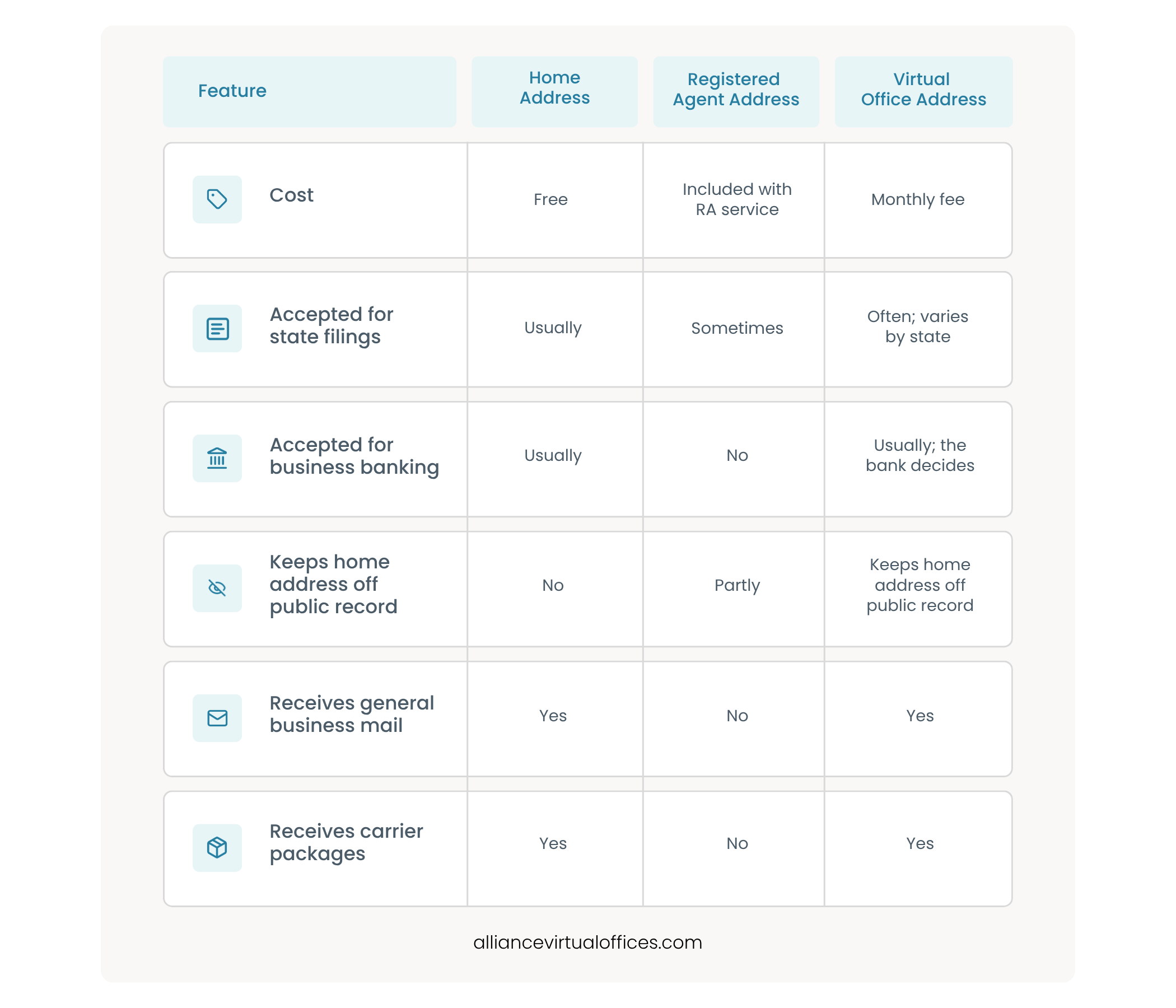
Filing requirements vary by state and entity type, and banks apply their own address and verification standards. Oregon, for example, currently bars a Virtual Office or commercial mail receiving agency address from serving as a principal or registered office.
Home address. It’s free and accepted almost everywhere, but it goes on the public record. It suits owners who don’t mind that and don’t meet clients at the business address.
Registered agent address. It’s already paid for, which is its whole appeal, but it fails three of the four uses above. Keep it for service of process.
Virtual Office address. It’s a real street address that receives your own mail, for a monthly fee. It suits owners who need one address for state filings, bank applications, and deliveries, subject to each one’s rules.
How an Alliance Virtual Office Fits
An Alliance Virtual Office includes a business address at a staffed Coworking Center, a real workplace rather than a mailbox store.
Onsite staff receive and sign for your mail, which you can pick up locally or have forwarded daily, weekly, biweekly, or monthly. Meeting rooms and private offices are available by the hour when you need to meet a client in person.
Mail setup means completing PS Form 1583, and Alliance includes a free online notary for it. Alliance also issues an Address Certification Letter confirming your business is authorized to use the address, which clients commonly use for business registration and banking.
Alliance isn’t a registered agent, so you’ll still need one for service of process. A Virtual Office address and a registered agent do different jobs.
For a setup walkthrough, see a virtual business address for your LLC.
NEXT STEPS: Browse Virtual Office locations
Can I Use My Registered Agent as My Business Address? Match the Address to the Form
Usually not. A registered agent address exists to accept legal papers, and that’s the only job it’s measured against.
Match the address to the form. Service of process goes to your registered agent.
The bank and the IRS get a physical location your business occupies or rents. Then look past the formation document, since many states publish the addresses on your annual report.
If you need that physical location without a lease, an Alliance Virtual Office includes a business address at a staffed Coworking Center with mail handling and on-demand meeting rooms. Plans start at $49 per month, and you can browse Virtual Office locations to find one in your state.
This article is informational only and isn’t legal or tax advice. Requirements vary by state, entity type and agency, and they change, so confirm with the relevant Secretary of State, your bank, or a qualified professional before filing. Start with the 50-state Secretary of State directory.
Frequently Asked Questions
Can I use my registered agent address as my business address?
Can I use a registered agent address with the IRS?
What’s the difference between a registered agent address and a business address?
What if I don’t have a business address for my LLC?
Can I open a business bank account with a registered agent address?
Further Reading
- Principal Office or RA Address? Everything You Need to Know
- What Is a Statutory Agent and Do You Need One?
- Why Your LLC’s Business Address Can Affect Banking, Taxes, and Legal Standing
- Virtual Address vs. Registered Agent: What Lawyers Need to Know
- What to Do After Forming an LLC: Your 10-Step Post-Formation Checklist