
- Who actually answers the phone at 2 a.m.
- The best veterinary answering services, compared
- What a veterinary answering service costs per after-hours call
Q: What is a veterinary answering service?
A: A veterinary answering service handles calls a clinic cannot take: overnight, weekends, and holidays. Staff take a history, apply the practice’s triage protocol, and either schedule the caller, direct them to an emergency hospital, or page the on-call veterinarian. Services are staffed by credentialed vet techs, general operators, or AI.
You already know what the 2 a.m. call costs you. The question in front of you now is who should be taking it.
Choosing a veterinary answering service is harder than it should be, because every vendor page in the category says the same four things. Twenty-four-seven coverage, trained operators, emergency dispatch, seamless handoff.
None of them tells you who is literally on the line at 2 a.m., or what happens when the on-call veterinarian does not pick up. This article compares seven named services on the criteria that actually differ between them, and prices the decision out per overnight call.
What a Veterinary Answering Service Actually Does, and Where the Category Splits
An answering service for veterinarians is sold as a bundle of features. Strip away the marketing and the job is narrow.
Someone answers a call your practice cannot take, collects enough history to understand what is happening, applies your protocol, and routes the caller somewhere.
The routing is the whole product. Schedule them for Monday, send them to an emergency hospital tonight, or wake the on-call veterinarian.
The volume behind that routing decision is larger than it feels at 2 a.m. The American Veterinary Medical Association’s 2025 Pet Ownership and Demographics Sourcebook puts dogs in 42.6% of U.S. households, roughly 87.3 million animals, with dog-owning households spending an average of $598 a year on veterinary care.
IBISWorld sizes the U.S. emergency veterinary services market at $49.5 billion in 2025, up 2.4% year over year. A meaningful share of that spend begins with a phone call somebody had to route correctly.
The market does not split by price or by feature list. It splits by who is on the other end of the line. Disclaimer: Alliance Virtual Offices publishes this guide and also sells a live receptionist service, which appears below judged on the same criteria as the rest.
Credentialed veterinary technicians
Some services staff after-hours lines with credentialed veterinary technicians. These are people who have worked in clinics, seen the presentations, and can ask a second and third question when the first answer does not add up.
AI-first services
Others answer with conversational AI, often trained on veterinary-specific protocols. These handle high-volume, low-ambiguity calls efficiently and at a flat monthly rate.
General call-center operators
The largest group staffs veterinary accounts with the same trained generalist operators who handle plumbing, legal, and property management accounts. They follow your written script accurately. They are not making clinical judgments, and the better ones do not pretend to.
The label veterinary telephone answering service covers all three staffing models, which is a large part of why the category is so hard to compare.
This is a fit question, not a quality ranking. The right answer depends on whether your overnight volume is mostly clinical judgment calls or mostly scheduling.
Read More: Live Receptionist vs. Answering Service
Who Actually Answers the Phone at 2 a.m.
This is the question no vendor page answers directly, and it is the one that should decide your shortlist for a veterinary after hours answering service. Grade it before you look at a single price.
What a credentialed veterinary technician can do that an operator cannot
A credentialed veterinary technician (CVT) can distinguish a dog that ate a sock from a deep-chested dog that is bloating, because the follow-up questions are different and they know which ones to ask. A generalist operator working from a script can only capture what the caller volunteers.
The economics here are worth understanding, because they explain why this option exists at all. The U.S. Bureau of Labor Statistics reports a median annual wage of $47,380 for veterinary technologists and technicians as of May 2025, against $130,100 for veterinarians.
That gap is the actual case for outsourcing after-hours triage to credentialed techs rather than buying more DVM on-call time. You are not replacing clinical judgment. You are putting a cheaper, credentialed filter in front of it so the on-call veterinarian is woken for the calls that warrant it.
The supply picture supports the argument. BLS counts 131,400 veterinary technologist and technician jobs, projected to grow 9% from 2025 to 2035 against a 3% all-occupation average, with roughly 13,400 openings a year.
On the veterinarian side, BLS counts 91,100 jobs growing at the same 9% rate, which works out to about 3,100 openings a year. Tech openings outnumber veterinarian openings roughly four to one.
That imbalance is why credentialed-tech triage is available to buy at all, and why DVM on-call coverage keeps getting harder and more expensive to staff internally.
What AI handles well, and where it stops
AI answering is genuinely good at a defined set of calls. Appointment confirmations, clinic hours, directions, refill requests, and routine rescheduling are pattern-matching tasks, and AI does them at a fraction of per-call human cost.
Overnight triage is a different task. Deciding whether facial swelling at 2 a.m. is a Monday appointment or an emergency referral is a judgment call about red-flag symptoms, not a scheduling task.
Be fair about this in both directions. If your after-hours volume is overwhelmingly confirmations and scheduling, an AI service is probably the better economic answer, and the savings are real.
If you are shopping for the best AI answering service for veterinary clinics, judge the shortlist on where that boundary sits rather than on the length of the feature list.
Read More: Best AI Answering Services
Scope of practice: what a non-veterinarian may and may not tell a caller
A person who is not a licensed veterinarian is limited in what guidance they can give a caller about a specific animal.
That limit does not disappear because the person works for a vendor rather than for you. Nothing here is legal advice, and your own counsel should weigh in.
What you can do is put the question to every vendor in writing. Ask what their staff are permitted to say, who wrote that policy, and how it is enforced at 2 a.m. when a caller is frightened and pushing for an answer.
How to Get A FREE Live Receptionist
Request Your Code Below and Get a FREE
Live Receptionist for 1 Month!

How to Evaluate a Veterinary Answering Service: Six Criteria
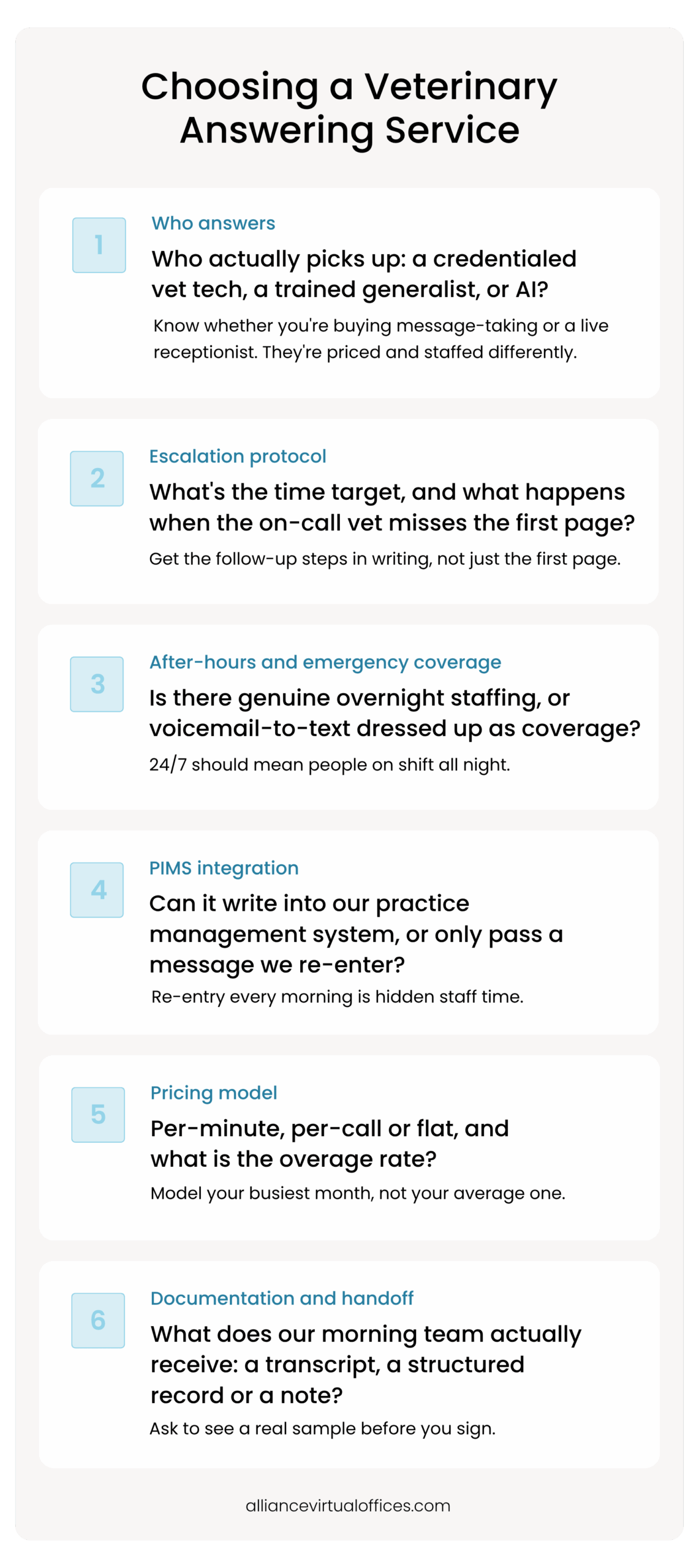
Settle these six before you compare prices. Most of them are answerable from a vendor’s own published pages, and the ones that are not tell you something by their absence.
- Who answers. A credentialed veterinary technician, a trained generalist operator, or AI. If you are unclear on the distinction between a message-taking service and what a live receptionist does, settle that first, because the two are priced and staffed differently.
- Escalation protocol. Ask for the time target, and specifically what happens when the on-call veterinarian does not answer the first page.
- After-hours and emergency coverage. A 24/7 veterinary answering service should mean genuine overnight staffing, not voicemail-to-text dressed up as coverage.
- PIMS integration. Whether the service can write into your practice information management system, or only pass a message your team re-enters in the morning.
- Pricing model. Per-minute, per-call, or flat, and what the overage rate is.
- Documentation and handoff. What your morning team actually receives: a transcript, a structured record, or a note.
Two of these six are answerable in five minutes on a vendor’s own website. The other four require a direct question, and how a vendor handles being asked is itself a data point.
The Best Veterinary Answering Services, Compared
Every figure below is what the vendor publishes on its own pages, checked in September 2026. None of it is independently audited, and it is presented as vendor-published rather than as market fact.
Note that vendors marketing a veterinary emergency answering service and those marketing general coverage frequently run the same operation behind the positioning. Compare the published specifics instead.
GuardianVets
GuardianVets has the strongest credentialing story in the category. The company states its service is staffed by US-based credentialed veterinary technicians with three to five years of clinical experience, and its chief medical officer is a former AVMA president.
Pricing is gated behind a demo request, with no figures published. GuardianVets states it has triaged more than 2.5 million cases, though its own homepage shows different case-volume figures in different blocks, so treat that number as vendor-reported and internally inconsistent.
GuardianVets says onboarding can take as little as seven days, starting with a call audit and a workflow analysis before the PIMS connection is built.
PupPilot
PupPilot is AI-first, and its published triage and escalation content is the most detailed of any vendor here, which is worth reading even if you do not shortlist them.
PupPilot states a 4.3% opt-out rate across roughly 2,000 interactions and more than 130 PIMS integrations. Both figures are self-published, single-clinic, and unaudited.
Centratel
Centratel staffs with general operators and publishes a starting price of $150 per month with a 30-day free trial. It is explicitly anti-AI in its positioning.
Its most useful contribution is honesty about billing. Centratel explains the difference between transaction-unit and per-minute billing and warns buyers about 28-day billing cycles, which is more candor than most of the field offers.
Centratel’s veterinary page walks through four steps: phone response, screening and prioritizing, a text alert or callback, and notification to management. It reports one customer-reported error for every 7,342 message transactions between April and June 2026, a figure it measures itself and that no outside party has audited.
Specialty Answering Service
Specialty Answering Service publishes the most explicit pricing in the set: from $44 per month, per-minute billing, month-to-month terms, and a two-week free trial.
Its veterinary page describes emergency dispatch and call screening but states no veterinary credential for the operators anywhere. That is worth knowing plainly, and it is not a criticism if your need is overflow rather than triage.
The $44 figure is a base rather than a total. Specialty’s published Economy plan adds $1.54 for every minute, and its next two tiers are $159 for 100 minutes and $269 for 220 minutes. Its trial runs two weeks or 200 minutes, whichever ends first, with no setup fee, so a practice can price a real month of overnight calls before it commits.
AnswerMTI
AnswerMTI maintains a dedicated veterinary vertical page and staffs with general call-center operators. It publishes neither pricing nor escalation specifics, so both have to be established during a sales conversation.
Its veterinary page describes 24/7 coverage, message delivery, and dispatch to your on-call. No veterinary credential is stated for the answering staff.
Endicott
Endicott also runs a veterinary vertical page staffed by general operators, with no published pricing and no published escalation detail.
Both AnswerMTI and Endicott are credible candidates when the requirement is straightforward message taking and dispatch against a written script. Neither should be shortlisted on an assumption of clinical triage, because neither claims it.
Alliance Live Receptionist
Disclosure: Alliance Virtual Offices publishes this article, and Alliance Live Receptionist is one of the services compared here.
Alliance Live Receptionist is built for the calls that fill a clinic’s working day. US-based live receptionists answer in your practice’s name, schedule appointments, take new-client details, and catch the lunch-hour and out-sick gaps that send callers to voicemail.
Plans are published from $125 a month for 50 minutes, and every plan includes a dedicated business number and virtual phone system, so there is no separate phone bill stacked on top. Coverage runs Monday to Friday 8 a.m. to 9 p.m. Eastern and Saturday 9 a.m. to 7 p.m. Eastern, which reaches well past a typical clinic’s closing time.
Where it stops is clinical triage. The receptionists do not carry a veterinary credential, and the service does not integrate with veterinary PIMS platforms. A practice whose central problem is 2 a.m. medical triage should shortlist a vet-tech-staffed specialist.
A practice whose central problem is 2 a.m. medical triage should shortlist a vet-tech-staffed specialist.
What a Veterinary Answering Service Costs Per After-Hours Call
Published floors in this category run from $44 to $150 a month, but a floor is not a bill: Specialty adds $1.54 a minute to its $44 base, and Centratel charges per transaction rather than per minute. Those numbers are not comparable.
So build the comparison the vendors decline to build. Price it per overnight call, using your own volume.
If a live receptionist is on your shortlist for daytime coverage, our live receptionist calculator prices that side of the decision against your own call volume.
The three billing models, normalized
Take a practice fielding 30 overnight calls a month at an average of four minutes each, which is 120 billable minutes.
The pattern matters more than any single figure. Per-minute pricing punishes long, complex calls, which is exactly what overnight triage produces. Per-call pricing punishes volume. Flat AI pricing rewards both and buys you no clinical judgment.
If your overnight calls are short and frequent, per-call billing typically wins. If they are few and long, per-minute usually does. For more on how these structures behave in practice, see how answering service pricing works.
The costs that do not appear on the pricing page
Setup fees, 28-day billing cycles that produce 13 invoices a year rather than 12, per-minute rounding, overage rates, and minimum commitments. Ask for all five in writing before you sign anything.
The 28-day cycle is the one most buyers miss. It quietly adds roughly 8% to the annual figure you thought you agreed to.
Per-minute rounding is the second. A service that rounds every call up to the next full minute turns a run of 90-second calls into billed two-minute calls, inflating a short-call practice’s invoice by about a third.
Overage rates deserve a direct question rather than a glance at the rate card. Ask what happens in a month when volume doubles, because a holiday weekend or a nearby emergency hospital closing will eventually produce one.
Questions to Ask Before You Sign
The escalation gap is your leverage. These are the five questions no vendor page answers, which means asking them tells you more than any comparison table can.
- What credential does the person answering my overnight calls hold?
- What is your escalation time target, and what happens if my on-call does not answer?
- What is your red-flag symptom list, and who wrote it?
- What does my morning team receive: a transcript, a structured record, or a PIMS entry?
- Can I hear a recording of a real after-hours triage call?
A vendor that answers all five in writing has earned a place on your shortlist. One that will not answer the first has told you something useful.
NEXT STEPS: Explore Alliance Live Receptionist plans
Choosing a Veterinary Answering Service That Fits Your Practice
The decision comes down to what your overnight volume actually consists of, and most practices have never broken it down.
If the calls are predominantly clinical judgment, shortlist a service staffed by credentialed veterinary technicians and settle the credentialing question before you compare a single price. The wage gap between techs and veterinarians is what makes that model affordable.
If the problem is daytime overflow, lunch-hour gaps, scheduling, and new-client intake, a general live receptionist service is the better economic fit. Alliance Live Receptionist sits in that second category, starting at $125 a month, and it is a reasonable choice there.
If your calls are overwhelmingly confirmations and routine questions, an AI service will likely cost less and serve you fine. Spend the difference somewhere it matters more.
Whichever direction you go, get the escalation protocol in writing before the contract is signed. It is the term that is hardest to renegotiate after a bad night, and the one nearly every vendor in this category leaves vague by default.
Settle who answers first. Price follows from that, and not the other way around.
Frequently Asked Questions
How much does a veterinary answering service cost per call?
Who actually answers the phone, a vet tech, a general operator, or AI?
Can an answering service triage a veterinary emergency?
What happens if the on-call veterinarian does not answer?
Can a veterinary answering service book appointments in our PIMS?
Further Reading