
- What’s a Medical Answering Service?
- HIPAA Compliance and Medical Answering Services
- How to Choose a Medical Answering Service
Q: What’s a medical office answering service?
A: A medical office answering service is a professional call handling solution that manages incoming patient calls on behalf of a healthcare practice, covering call routing, appointment scheduling, after-hours coverage, and urgent message triage, handled by live agents or AI.
Patient calls rarely arrive at convenient moments. They come during a packed clinic schedule, over lunch, after closing, and all at once when the front desk is already stretched. The numbers reflect the strain; the average medical practice misses 23% of incoming calls, and 41% of patients have switched providers, at least partly because they struggled to reach their previous practice by phone.
A medical office answering service exists to close that gap. It’s a professional call handling solution that answers patient calls for your practice, routes urgent matters appropriately, schedules or reschedules appointments, and captures messages when your staff can’t pick up. The service can run during business hours as overflow support, after hours, or around the clock.
This guide walks through what these services do, comparing a medical office answering service to the service provided by a live receptionist solution.
This article is for informational purposes only and does not constitute legal advice. Consult a qualified attorney or your state bar for guidance specific to your situation.
What’s a Medical Office Answering Service?
A medical office answering service is a professional call handling solution that manages incoming patient calls on behalf of a healthcare practice, providing call routing, appointment scheduling, after-hours coverage, and urgent message triage. The work is performed by trained live agents, automated AI systems, or a hybrid of the two.
Industry research suggests that 23% of incoming calls go unanswered, reach voicemail, get abandoned on hold, or simply drop out. Many patients won’t wait and, more generally, 62% of callers hang up without leaving a message. Each missed caller is a potential appointment, follow-up, or referral that is lost entirely.
How a Medical Answering Service Works
The workflow for a medical office answering service is straightforward. A call comes to your practice line and is forwarded to the answering service when your team doesn’t pick up within a set number of rings or outside set hours. The live agent or system answers in your practice’s name, follows your script, and handles the call.
There are two broad service models. Overflow answering catches the calls your in-house staff cannot get to during busy periods, while full-service answering handles the entire call flow during defined windows such as evenings, weekends, or the full 24 hours a day.
Types of Medical Answering Services
The right model for a medical office answering service depends on your call volume, specialty or niche, and how much judgment a typical call requires. The three common options differ mainly in who, or what, is on the line:
Live agents handle nuance well. They can hear distress in a caller’s voice, respond with empathy, and decide when something needs immediate escalation.
By contrast, AI systems answer calls instantly at any hour and scale without staffing, but they follow fixed decision trees and don’t improvise. Hybrid setups try to capture both, using automation for routine intake, routing sensitive or urgent calls to a live agent for handling.
Read More: What is a Live Receptionist
HIPAA Compliance and Medical Answering Services
Any third party that handles protected health information (PHI) on behalf of your medical practice falls under the Health Insurance Portability and Accountability Act (HIPAA). A medical office answering service that takes patient names, their reasons for calling, or appointment details is handling PHI, making HIPAA compliance a baseline requirement of any answering service, rather than a perk or premium feature.
What HIPAA Requires for Call Handling
In plain terms, the HIPAA Privacy and Security Rules govern how PHI may be used, disclosed, and protected. When you outsource call handling to an external vendor, that vendor becomes your business associate. The law expects specific safeguards to be in place, with the U.S. Department of Health and Human Services publishing the underlying requirements through its Office for Civil Rights.
What to Look for in a HIPAA-Compliant Service
A HIPAA-compliant medical answering service should be able to show you the following without hesitation. If a provider cannot speak to these points clearly, treat that as a signal it’s not the best suited provider for your medical practice:
- A signed Business Associate Agreement (BAA), which is required and should be offered upfront.
- Staff trained on PHI handling, minimum necessary disclosure, and breach notification.
- Secure transmission and storage of call data and messages.
- An available audit trail showing who accessed what, and when.
Live Receptionist vs. AI: HIPAA Risk Comparison
Not every answering tool is built for the healthcare industry. In fact, some AI services exclude healthcare use in their terms or don’t offer a BAA at all, which leaves the practice without the required compliance documentation.
But established answering service providers, who employ trained professionals to handle calls, are more likely to have the compliance infrastructure. This includes signed BAAs that a covered entity needs for a medical practice. AI can be compliant, but that compliance must be verified rather than assumed.
After-Hours Call Coverage for Medical Practices
Patients don’t stop needing medical help at 5 p.m. A parent with a feverish child, a patient unsure about a medication, or someone trying to book the first available slot will call whenever the concern arises. The urgency of these scenarios indicates that, if no one answers at the practice, a patient will seek help elsewhere.
Why After-Hours Calls Matter
Being placed on hold runs peoples’ patience thin. After hours, an unanswered line usually means a voicemail no one hears until the morning, by which point the appointment may be booked at another practice across town. Reliable after-hours coverage protects continuity of care and your medical practice’s schedule and reputation.
Overflow vs. After-Hours vs. 24/7 Service Models
Coverage is not one size fits all. Most practices choose a call plan based on when their phones go unanswered and how time-sensitive their calls tend to be. This might look like the following:
- Overflow coverage answers calls when in-house staff cannot answer them, mainly during busy daytime stretches.
- After-hours coverage handles evenings and weekends, a common fit for solo practitioners.
- 24/7 coverage answers around the clock, which suits urgent care, OB/GYN, and other specialties with time-sensitive calls.
Read More: Automated Phone System for Small Business
How Much Does a Medical Answering Service Cost?
Pricing for a medical office answering service usually follows one of a few models. The right plan for your practice depends on how predictable your call volume is, and you can use our live receptionist calculator to estimate your own numbers. The table below shows the cost ranges medical practices typically encounter:
Typical Pricing Models
Per-minute billing is the most common call structure for traditional medical answering. This plan charges only for the time agents spend on your calls. Meanwhile, per-call pricing works well when your call count is steady and easy to forecast, while a monthly flat rate trades some flexibility for a predictable line item.
What Affects the Price
Several factors move the cost number up or down. Higher call volume, broader coverage hours, and higher-acuity specialties, such as providing urgent care, tend to raise costs, as do language translation support, custom call scripts, and integration with your Electronic Health Record (EHR) or scheduling system.
How to Choose a Medical Answering Service
With the basics covered, the decision comes down to fit. The goal is a HIPAA-compliant medical answering service that matches your patient population, your specialty, and your budget. There are some key features to look out for when deciding on a medical office answering service provider.
Key Features to Look For
Use this checklist when comparing a physician answering service or any healthcare answering service:
- HIPAA compliance with a signed BAA, non-negotiable for any service touching PHI
- Coverage hours that match your patient population, whether that is after-hours or full 24/7
- Custom call scripts aligned to your practice’s protocols
- Agents with demonstrated experience in your specialty
- Integration with your EHR or scheduling system
- Transparent per-minute or per-call pricing with clear overage terms
Questions to Ask Before Signing Up
A short call with an answering service provider should clarify most of what you need to know before choosing a medical office answering service provider. Here are a few questions you should consider asking:
- Do you offer a signed Business Associate Agreement?
- Are your agents trained in HIPAA-compliant call handling?
- What is your average answer speed and abandonment rate?
- Can I customize the call script for my practice?
- What happens when my primary provider is unavailable, and who handles escalations?
Red Flags to Avoid
Some answers should give you pause. Be cautious with any provider that refuses to sign a BAA, cannot explain how call recordings are stored and destroyed, has agents who cannot describe their HIPAA training, or markets an AI-only service that cannot articulate a clear compliance path.
How to Get A FREE Live Receptionist
Request Your Code Below and Get a FREE
Live Receptionist for 1 Month!

Live Receptionist vs. AI Medical Answering: A Comparison
Both live receptionist services and AI answering have a real place, and the better choice depends on the kinds of calls your practice fields. The comparison below lays out some of the trade-offs:
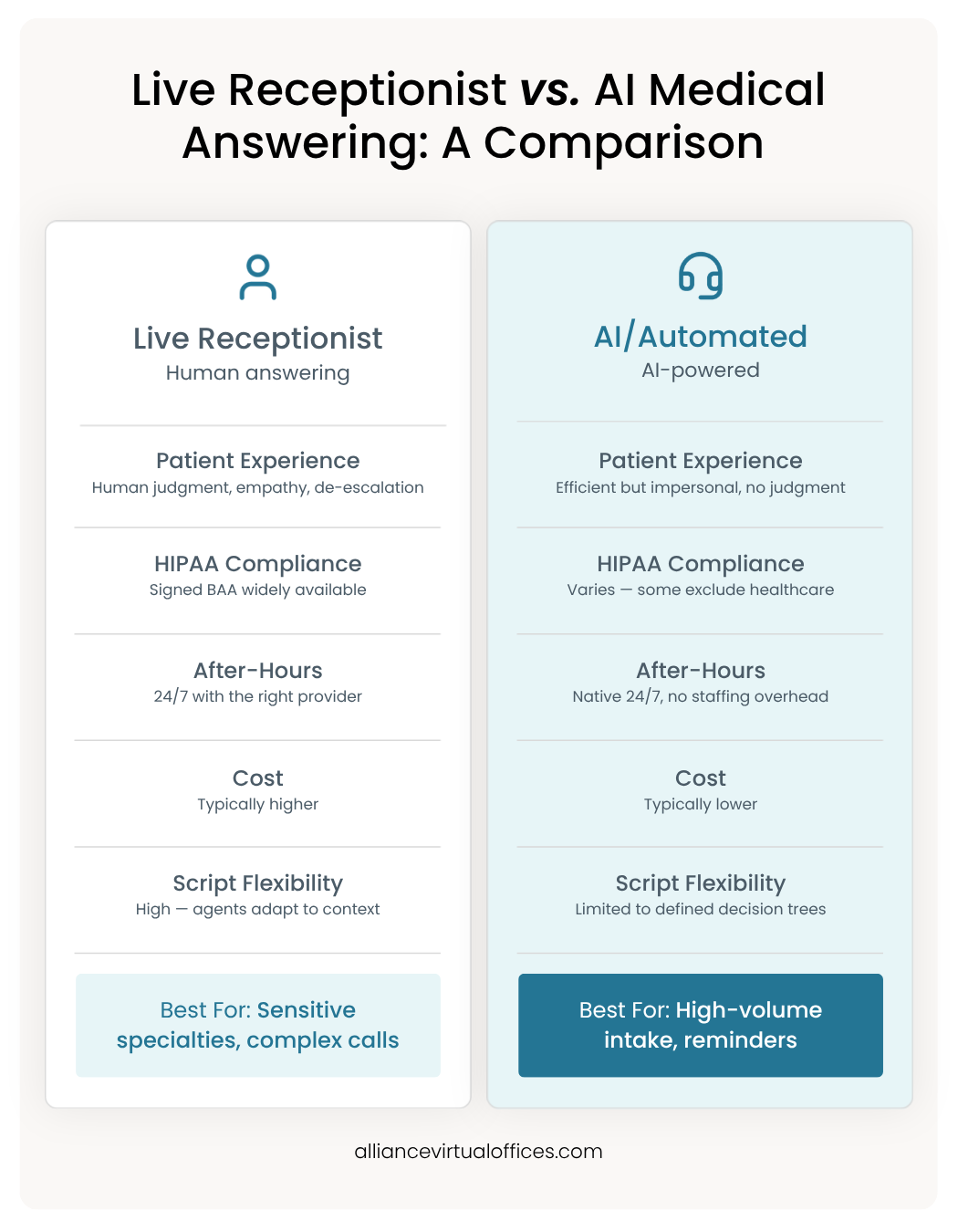
Deploying an AI answering service makes sense when your call volume is high or when you have simple and repeatable tasks that it can take over. This includes handling appointment reminders or basic non-urgent routing. It’s also much cheaper but that might come as a compromise.
That’s why live agent services tend to be preferable in medical specialties, including behavioral health, reproductive health, oncology, and pediatrics. In these cases, patient trust drives retention and calls often require judgment.
For practices that prioritize patient experience and HIPAA-verified call handling, a live receptionist service from a provider such as Alliance Virtual Offices is a defensible choice, particularly for practices where callers will discuss sensitive health information.
Finding the Right Medical Office Answering Service for Your Practice
Choosing a medical office answering service comes down to three decisions. First, confirm whether your chosen medical office answering service is HIPAA-compliant, because a signed BAA is non-negotiable. Then match the service model to your specialty, choosing a live receptionist, AI, or hybrid based on how much judgment your calls require. Finally, weigh the cost structure against your call volume.
For independent and small practices, a Live Receptionist service from Alliance Virtual Offices provides trained human agents and HIPAA-compliant call handling with no long-term contracts, starting at $125 per month. Paired with a virtual office address, the full service gives remote and hybrid healthcare professionals a business presence and reliable call coverage in one plan.
Explore Alliance’s Live Receptionist plans to get started.
This article is for informational purposes only and does not constitute legal advice. Consult a qualified attorney or your state bar for guidance specific to your situation.
Frequently Asked Questions
Is a medical answering service HIPAA compliant?
How much does a medical answering service cost per month?
What’s the difference between a live receptionist and an AI answering service?
Do medical answering services handle after-hours calls?
Further Reading