
- How a Virtual Address Works for Nonprofits
- Donor Credibility and a Nonprofit Professional Address
- Cost Savings for Lean Nonprofits
Q: Does a nonprofit need a physical office address?
A: No. The IRS requires a valid mailing address for correspondence and Form 990 filing, but this doesn’t need to be a leased office. However, all states require a physical street address (not a P.O. Box) for the registered agent or principal office.
There are 1.9 million registered nonprofits and philanthropic organizations in the U.S., according to a National Survey of Nonprofit Trends by Independent Sector. Yet, nonprofit finances can be tight, with 81% of nonprofits struggling to raise enough funds to cover all costs in 2025.
For organizations already stretched thin, the idea of paying for a physical office to maintain a legitimate address can be seen as a large overhead that could be eliminated. Instead, organizations can think about establishing a virtual address for nonprofits, providing a professional, compliant street address without a huge lease or commitment.
This guide covers what the Internal Revenue Service (IRS) requires for U.S. nonprofit addresses, how address choice affects donor trust and grant applications, and what the real cost savings look like.
This article is for informational purposes only and does not constitute legal advice. Consult a qualified attorney or your state bar for guidance specific to your situation.
Do Nonprofits Need a Physical Address? (IRS and State Requirements)
The answer depends on which requirement you’re discussing. The IRS and individual states have distinct rules, and conflating the two creates unnecessary confusion for nonprofit leaders.
What the IRS Actually Requires
The IRS requires every nonprofit organization to maintain a valid U.S. mailing address for three purposes: Form 990 filing (nonprofits’ public financial disclosure report), official correspondence from the IRS, and public disclosure in solicitation materials.
But it doesn’t require a leased or owned physical office. A professional mailing address, even one provided by a virtual office service, satisfies all three requirements.
One important detail, however, is that the address you provide on Form 990 becomes part of the public record through the IRS Tax Exempt Organization Search database. This means that any donor, foundation, or journalist can look up your organization’s registered address.
So, while a P.O. Box is technically acceptable for IRS purposes, many institutional funders view it unfavorably. As nonprofits are generally required to include their business address in solicitation materials, a professional street address is preferable to a P.O. Box for credibility.
State Registration and Registered Agent Rules
A registered agent is a legally designated person or company that receives official government and legal documents on behalf of a business. Every state requires a physical street address for the registered agent and, in most states, for the principal office filing. The registered agent must be available at that address during normal business hours to receive service of process.
This means that a mailbox rental at a shipping store (like a UPS Store) typically doesn’t qualify as a registered agent address because there’s no staff available to receive legal documents on behalf of the organization. Meanwhile, a staffed virtual office during business hours meets this requirement in most states.
The principal office vs. registered agent address distinction matters here, because the registered agent address and the principal office address can be registered at the same location. Many nonprofits use their virtual office address for both to simplify compliance filings across all states during registration.
How a Virtual Address Works for Nonprofits
Understanding the practical mechanics of a virtual office address helps nonprofit leaders implement it correctly from the start.
Mail Handling for Distributed Organizations
Most nonprofits, particularly volunteer-run organizations, don’t have staff present at a central location every day. The executive director may work from home, while the treasurer or board members may be in a different city or distributed across multiple states. A virtual office address solves the physical address requirement without requiring anyone to be present at that location.
The address appears on your website and donation pages, grant applications, state nonprofit registrations, charity solicitation registrations, registered agent filings, and Form 990. Using a virtual office with mail scanning services receives, scans, and forwards incoming mail, including IRS correspondence, state agency notices, and donor checks.
That operational flexibility is particularly valuable for distributed leadership structures common in volunteer-run organizations.
When evaluating a virtual office provider, look for a virtual business address that offers a real street address, on-site staff during business hours, and mail scanning included in the service tier.
When Virtual Addresses Don’t Qualify and What to Watch For
Not all address services meet state standards required for nonprofit compliance. P.O. Boxes, for example, don’t satisfy state registered agent requirements; mailbox rental addresses are often flagged by banks and state agencies as mailbox-service addresses rather than genuine office locations.
Multi-state organizations should review each state’s charity registration and solicitation rules to confirm compliance. Organizations operating in multiple jurisdictions should consult counsel for state-specific guidance.
Read more: What Is a Virtual Office? The Complete Guide
Donor Credibility and a Nonprofit Professional Address
Choosing your business address isn’t purely a compliance question. It has measurable implications for donor trust, grant eligibility, and banking access.
What Donors and Funders Look For
Institutional funders, including foundations, government agencies, and corporate donors, routinely look up Form 990 data in the IRS Tax Exempt Organization Search before making or renewing grants. The address on file is visible to anyone.
This makes a residential address signal a startup or volunteer operation which, although isn’t inherently disqualifying, invites additional scrutiny that a professional nonprofit professional address avoids.
The goal isn’t to misrepresent the organization’s scale, but to present the organization at the level of its mission, which typically warrants infrastructure that reflects organizational stability. A professional street address at a recognized business location communicates that stability, without requiring a single square foot of leased space.
Bank Accounts and Grant Applications
Most banks require a physical street address, rather than a P.O. Box, to open a nonprofit checking account. Some banks also research whether the address appears residential in public records, triggering additional scrutiny or documentation requirements during account opening. A virtual office at a genuine business street address avoids that friction.
Foundation and government agency grant applications frequently require a verified physical address. But consistent use of the same professional address across IRS filings, state registrations, bank records, and grant applications also reduces compliance red flags, which are discrepancies between addresses on file with different agencies. These can trigger delays in charity registration renewals and create unnecessary administrative work.
Everything You Need to Grow Your Business

That’s what you get with a custom
Virtual Office Plan from Alliance
Select:
- Virtual Office
- Live Receptionist
- Virtual Phone
- Meeting Rooms
- Coworking
- Full Time Office
Cost Savings for Lean Nonprofits
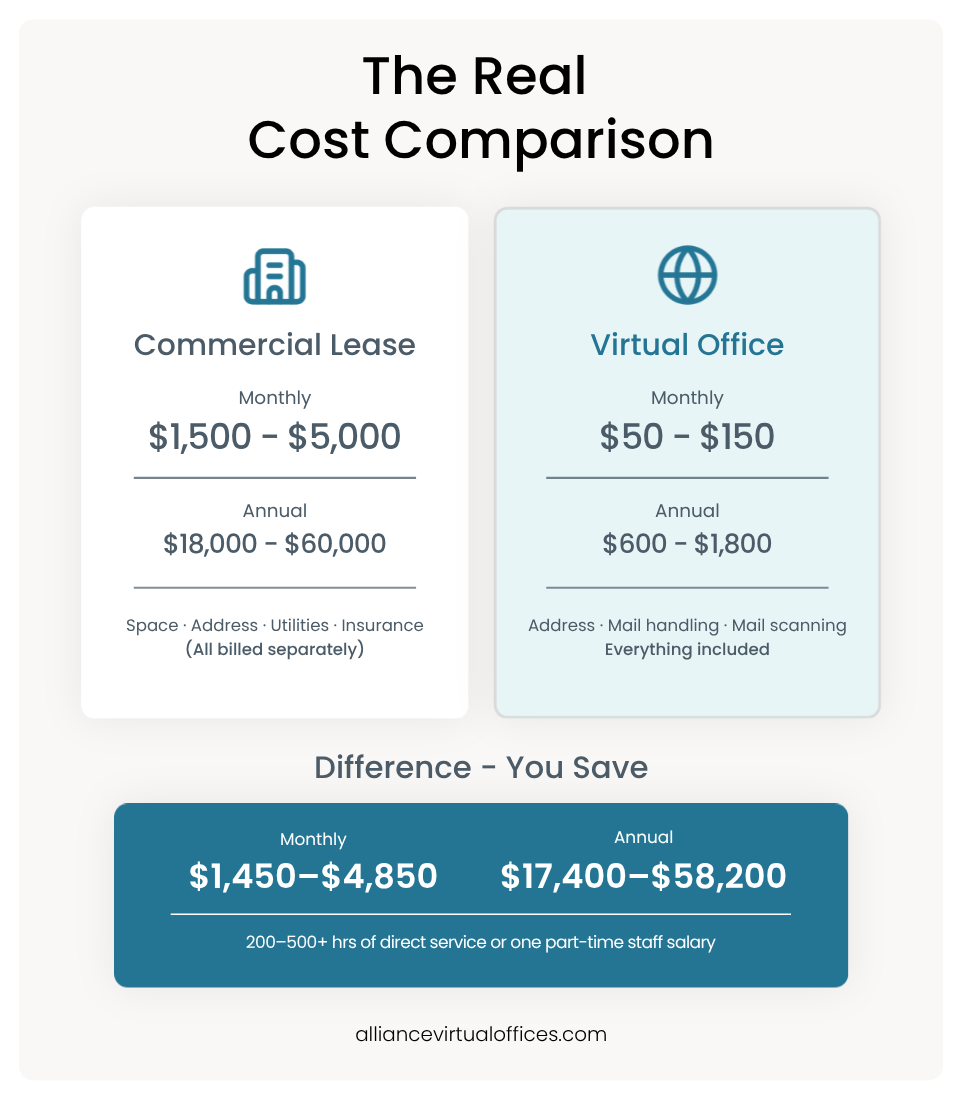
The question isn’t whether a nonprofit can afford a virtual office; it’s whether a physical office lease is a justifiable use of mission resources. Here’s a breakdown of what office overheads really look like:
The Real Cost Comparison
With 36% of nonprofits ending their most recent fiscal year with an operating deficit, according to the Health of the U.S. Nonprofit Sector Report by Independent Sector, an organization redirecting $17,000–$58,000 annually from overhead to program delivery is a meaningful operational decision, not a cosmetic one.
Equally, the same source reported that 68% of nonprofits expect demand for their services to increase in 2026, but only 31% say they are expanding capacity. That capacity gap underscores why eliminating unnecessary overhead is a strategic priority.
What the Savings Enable
The lease savings from switching to a virtual address have concrete programmatic equivalents. These include:
- Program funding: $17,400–$58,200 in annual lease savings can fund 200–500+ hours of direct service delivery, depending on program type and labor costs.
- Staffing: one year of commercial lease savings in most U.S. markets equals one part-time staff salary; a material addition for a lean organization.
- Reserve building: with 36% of nonprofits operating with deficits, redirecting overhead to reserves provides a financial buffer that protects program continuity during fundraising shortfalls.
Read more: How Much Does a Virtual Office Cost? A Complete Pricing Breakdown
State-Specific Compliance and Setup Considerations
To prevent address discrepancies that lead to compliance issues, it’s important for nonprofits to set up their office address correctly from the start.
New York Solicitation Disclosure Rules
New York’s charitable solicitation rules are governed by the Executive Law and Arts & Cultural Affairs Law. These have specific requirements for nonprofits soliciting contributions in the state.
Nonprofits that use a New York virtual address in solicitation materials (without having a physical presence in New York) may be required to disclose that the address is a mail drop under state charitable solicitation law. This doesn’t prohibit using a virtual address in New York, but it requires transparent disclosure.
Consistent Addresses Across Filings
Make sure to use the same address consistently across all filings, including Form 1023 (initial exemption application), Form 990 (annual return), state nonprofit registrations, charity solicitation registrations in each state where you fundraise, registered agent filings, and bank accounts.
Address discrepancies across agencies are a common trigger for charity registration renewal delays and can prompt information requests from state attorneys general offices.
When switching from a home address to a virtual office address, file Form 8822-B with the IRS to update your address of record, update each state’s nonprofit registry, and update your registered agent filings, before the next filing cycle, not after.
A Virtual Address for Nonprofit Organizations: The Practical Case
A virtual address for nonprofits is a standard, compliant solution that, when used correctly with a staffed provider, satisfies IRS mailing requirements, meets state registered agent rules, projects donor credibility, and eliminates commercial lease overhead.
With 1.9 million nonprofits in operation across the U.S., organizations that serve communities, employ staff, and steward donor funds, deserve business infrastructure that reflects their mission and uses their resources efficiently.
Alliance Virtual Offices provides professional business addresses at real staffed locations across the U.S., with mail handling and mail scanning services. Having a real street address, on-site staff during business hours, and mail services satisfy state registered agent requirements and maintains a credible nonprofit professional address without signing a lease.
Alliance Virtual Offices serves nonprofits across 1,400+ locations. Explore plans and pricing to find your virtual office address.
This article is for informational purposes only and does not constitute legal advice. Consult a qualified attorney or your state bar for guidance specific to your situation.
Frequently Asked Questions
Can a nonprofit use a virtual address for its IRS mailing address?
Does a virtual office address satisfy state registered agent requirements for nonprofits?
Will donors trust a nonprofit that uses a virtual office address?
Can I open a nonprofit bank account with a virtual office address?
Is a home address acceptable as a nonprofit’s registered address?
Further Reading