
- Licensing and Credentialing Address Requirements
- HIPAA, Patient Privacy, and Address Separation
- Professional Perception and Patient Trust
Q: Do I need a separate business address for my therapy or healthcare practice if I work from home?
A: Yes. Most state licensing boards and insurance credentialing processes require a business address separate from your home address. A virtual office provides this separation without the cost and commitment of a commercial lease, supporting licensing compliance, patient privacy, and professional credibility simultaneously.
Healthcare has changed over the past few years. What began as a pandemic-driven move to telehealth continues for many practices, with therapists, counselors, clinical social workers, and telehealth providers still operating across three models: fully remote, hybrid (some in-person, some virtual), or office-based with flexible scheduling.
This flexibility not only benefits clients. Healthcare professionals need a professional address existing independently of their home, without leasing a full-time clinical space. A virtual office for healthcare professionals addresses this directly, providing a business address, on-demand meeting room access, and all the infrastructure your practice requires, without the expensive overhead.
This guide helps you understand how a virtual office for healthcare professionals works in practice.
Licensing and Credentialing Address Requirements
State licensing boards don’t mind whether you see clients in-person or remotely, but they do care whether your business address is verifiable.
State Board Requirements Across Professions
Therapists, clinical social workers, counselors, and psychologists all face similar credentialing mandates. Your state’s licensing board typically requires:
- A business address separate from your home address.
- Physical address verification (P.O. Boxes typically don’t meet this requirement).
- Address stability for the duration of your license.
- An address associated with your practice, not your residence.
Each state handles this differently. Some boards explicitly accept virtual office addresses, while others accept any legitimate business address. A few require in-person office space. Your virtual office address works in the vast majority of jurisdictions, but verify your state rules before applying or renewing.
Multi-Credential, Multi-Location Practices
If you hold licenses in multiple states or plan to expand your practice geographically, this process becomes more complex. Some practitioners maintain one address in their home state and separate addresses in states where they’re expanding telehealth services.
A virtual office enables this without multiplying lease obligations. You’re paying only for address access, not physical occupancy in each state.
Insurance credentialing networks (UnitedHealthcare, Aetna, Cigna, and others) also require verifiable business addresses. They’re not assessing whether you have an office, rather that it’s a legitimate, established provider. A professional business address, whether it’s a virtual office or commercial space, satisfies these requirements.
Licensing Requirements Reference Table
Here’s how to satisfy each requirement type:
| Requirement Type | Details | Virtual Office Solution |
|---|---|---|
| Separate Business Address | Required by most states; must be verifiable, physical | ✓ Provided as an official business address |
| P.O. Box Prohibition | Most boards reject P.O. boxes | ✓ Real physical address eliminates this barrier |
| Address Stability | Address must remain consistent during license period | ✓ Guaranteed consistency with established provider |
| Multi-State Addresses | Need separate addresses for different states | ✓ Can maintain multiple addresses under one account |
| Insurance Network Credentialing | Expects business address verification | ✓ Meets verification requirements across networks |
| Mail Handling Verification | May require proof of address usage | ✓ Mail service provides documentation |
Read more: Learn what a Virtual Office is.
HIPAA, Patient Privacy, and Address Separation
This is where address separation matters most. Your home address is private information that belongs to you and your family. Your patients don’t need it.
Why Address Separation Protects Both You and Your Clients
When you list your home address on licensing documentation or professional directories, it becomes discoverable, as it’s published by insurance companies, third-party credentialing organizations, and online platforms. Over time, your home address becomes associated with your professional identity.
This creates two risks. Patient privacy is compromised if they can identify where you live, and your personal privacy is compromised. Having a separate business address eliminates both risks.
A virtual office for healthcare professionals is specifically designed to support this separation without requiring you to lease expensive physical space. For a detailed breakdown of how address choices affect privacy, see our guide on professional business address privacy for therapists and coaches.
HIPAA and Business Address Practices
HIPAA doesn’t mandate address separation, however, a HIPAA-compliant practice should minimize unnecessary personal information exposure. Rather than using your home address, a business address for clinical documentation, insurance submissions, and licensing records aligns with this principle, representing best practice.
If you need to send documentation to patients, such as test results, session notes, or discharge summaries, using a business address as the return address maintains professional boundaries and privacy. It’s a subtle but important advantage of having a virtual office for healthcare professionals.
Address Verification and Compliance
Your virtual office provider should allow mail handling and address verification. This matters when licensing boards or credentialing networks request proof that the address is legitimate and actively used. A mailbox service at a business center or virtual office location can provide this verification, whereas a P.O. Box can’t.
Professional Perception and Patient Trust
Patients make quick assessments about your credibility. Your business address signals stability and professionalism, but having your home address visible on online directories or credentialing platforms undermines that perception, even if you deliver excellent clinical work.
How Patient Trust Connects to Your Address
Consider what a prospective patient sees when they search online or call your insurance provider for in-network therapists. If they see a home address, they might question privacy, boundaries, and professionalism.
This matters for referral patterns. Many therapists receive patient referrals from physicians, psychiatrists, and other providers who use online directories to search for professionals. They’ll also notice whether you’re listed at a legitimate business address or a residential address.
A professional business address increases confidence in your practice, and a virtual office for healthcare professionals ensures that your business presence reflects the professional standards your practice deserves.
Building Credibility Across Multiple States
If you provide telehealth services across state lines, a business address in key markets (or a national virtual office address) reinforces that you’re an established, legitimate provider operating across multiple regions. This is particularly important for practitioners building their practice or expanding into new states.
Potential patients, or referring providers, view professional business addresses in multiple states as a sign of sophistication and reach. It’s an often-overlooked competitive advantage of a virtual office for healthcare professionals.
Meeting Rooms for In-Person Sessions
Not every therapist works fully remotely. Many operate hybrid practices, including telehealth for most clients, but occasional in-person sessions for new intakes, crisis situations, or clients who prefer face-to-face interactions.
For occasional in-person sessions, renting an entire office doesn’t make sense. But a virtual office with meeting room access gives you a professional address for credentialing and licensing, plus real space when you need it.
How Meeting Room Access Works
When you choose a virtual office plan with meeting room access, you can book professional therapy rooms by the hour. These are typically private, quiet spaces designed for professional client work, rather than open plan coworking areas.
Schedule a room for a few hours per week, or just a handful of hours monthly. You pay for the time you use it. If you shift toward more in-person work as your practice grows, you can increase your room bookings without committing to a lease.
Setting Up Your Practice Space
When you book a meeting room, clients arrive to a professional clinical environment. The space is confidential, soundproof (or sound-resistant), and equipped with comfortable seating. You don’t need to worry about home distractions, family interruptions, or the appearance of your personal space.
This also supports your licensing and insurance credentialing. Listing your virtual office address as your practice address, mentioning that in-person sessions are conducted in professional clinical spaces, satisfies regulators and patients.
Multi-State Practice Without Multiple Leases
Telehealth has made multi-state practice possible. A therapist licensed in New York can see a client in Colorado. A counselor licensed in Texas can provide services to someone in Massachusetts. This flexibility expands your potential client base and builds practice resilience.
But state licensing and credentialing can create complexity. Some states require a business address within the state, while others allow a single, national address. Some insurance networks demand state-specific addresses for credentialing purposes.
Navigating State Requirements
You likely can’t maintain one virtual office address nationwide and satisfy all state requirements. Instead, you’ll select a virtual office address in your primary state and possibly additional addresses in other states where you hold licenses or plan to expand significantly.
With some virtual office providers, you can maintain multiple addresses across different states, all under one account. This gives you one central management point for mail, calls, and administrative tasks, but separate professional addresses for each state where you’re licensed.
The cost remains far lower than leasing office space in multiple states. You’re paying for address access, not physical occupancy.
Managing Credentialing Across States
When credentialing with insurance networks in multiple states, each credentialing body requires a business address within that state (or at least accepts one). Maintaining multiple virtual office addresses, each legitimate, verified, and with mail handling capabilities, satisfies these requirements efficiently.
This approach future-proofs your practice. If you want to expand to another state later on, you can simply add a virtual office address, without lease negotiations, 12-month commitments, or setup fees.
Unlock Our Current Virtual Office Offers
Enter your email below and we’ll send you the latest available promotions and monthly specials for Virtual Offices, Meeting Rooms, and Live Receptionists.
Cost Comparison: Clinical Lease vs. Virtual Office
Numbers matter when you’re running a practice. Let’s compare the real economics of having a clinical lease vs. virtual office:
Traditional Commercial Office Lease
A dedicated therapy office space typically costs:
- Monthly rent: $1,500 to $3,000 (varies by market)
- Furniture and setup: $2,000 to $5,000
- Insurance and utilities: $200 to $500 monthly
- Long-term commitment: typically 12 months, sometimes 24
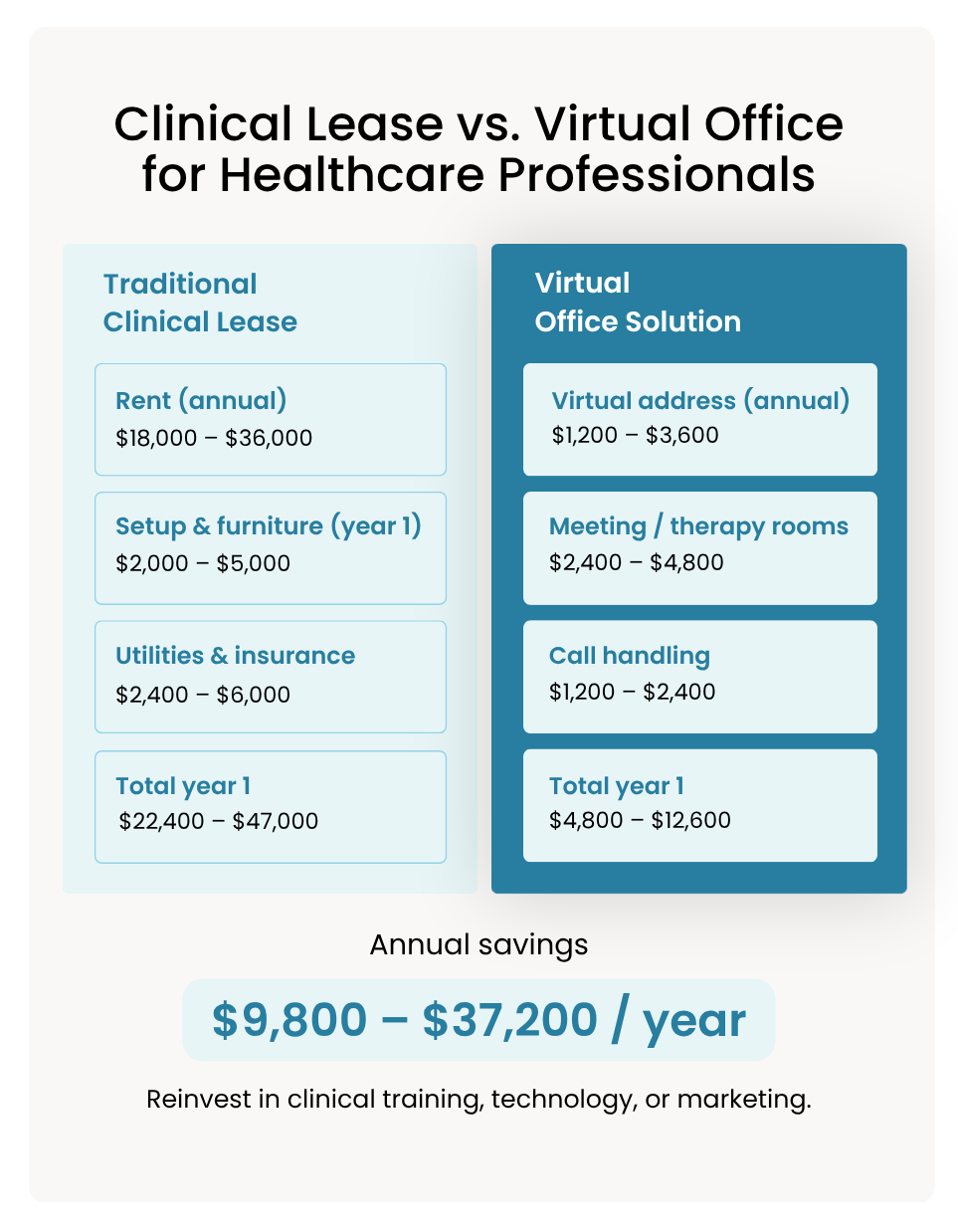
Annual cost: roughly $22,400 to $47,000 in the first year, then $20,400 to $42,000 in subsequent years.
This assumes you’re using the space full-time. If you’re hybrid or mostly operate as telehealth, you’re paying for empty space most days.
Virtual Office Solution
A comprehensive virtual office plan for a healthcare provider might include:
- Professional business address: $100 to $300 monthly
- Mail handling and forwarding: included or $30 to $50 monthly
- Phone service with professional voicemail: included or $50 to $100 monthly
- Meeting room access (10 to 20 hours monthly): $200 to $400 monthly
- Receptionist or call handling: optional, $100 to $200 monthly
Annual cost: roughly $4,800 to $12,600, depending on your specific needs.
Cost Comparison Table
Below is a breakdown of the cost comparisons:
| Cost Category | Traditional Lease (Annual) | Virtual Office Solution (Annual) | Savings |
|---|---|---|---|
| Base Rent/Address | $18,000 to $36,000 | $1,200 to $3,600 | $14,400 to $34,800 |
| Setup & Furniture | $2,000 to $5,000 (Year 1 only) | $0 to $500 | $1,500 to $5,000 |
| Utilities & Insurance | $2,400 to $6,000 | $0 | $2,400 to $6,000 |
| Meeting/Therapy Rooms | Included (full-time space) | $2,400 to $4,800 | Variable |
| Call Handling | Often missing | $1,200 to $2,400 | N/A |
| TOTAL (Year 1) | $22,400 to $47,000 | $4,800 to $12,600 | $9,800 to $42,200 |
| TOTAL (Subsequent Years) | $20,400 to $42,000 | $4,800 to $12,600 | $7,800 to $37,200 |
Virtual office solutions cost significantly less than a traditional commercial lease, and the value extends beyond cost.
The Real Comparison
For a hybrid practice or telehealth-focused provider, the annual savings range from $7,800 to $37,200. Even for a hybrid practitioner using meeting rooms regularly, a virtual office for healthcare professionals is roughly 70 to 80% less expensive than a traditional lease.
Beyond cost, you gain flexibility. With a virtual office for healthcare professionals, you’re not locked into a 12-month commitment, allowing you to scale meeting room access up or down based on your current client load. You can even add additional addresses in other states without exponential cost increases.
Getting Started with a Virtual Office
If you’re a healthcare professional considering a virtual office, the process of establishing one is straightforward. Here’s how you can get started:
Step One: Clarify Your Requirements
Start by identifying what you actually need. Ask the following questions:
Are you working fully remote, or do you need occasional in-person space?
Do you need addresses in multiple states?
Will you use a professional receptionist to handle calls, or do you prefer direct voicemail?
Do you need mail handling services?
Most healthcare professionals prioritize having a business address and mail handling, with meeting room access and phone services often being secondary. Understanding your needs upfront makes plan selection simple.
Step Two: Verify State and Credentialing Requirements
Before selecting a virtual office location, confirm that your state licensing board and insurance credentialing networks accept virtual office addresses. Requirements vary by state and by insurance network. A quick call to your state board or credentialing department prevents surprises later.
You might also check whether your state explicitly lists acceptable address types in their credentialing guidelines. Most accept virtual office addresses without issue, but verification only takes 10 minutes.
Step Three: Choose Your Plan and Location
Select a virtual office provider with the features you need. Location matters: choose an address in a city where your clients are located or where you’re expanding your practice.
Once you’ve selected a location with your virtual office provider, you’ll receive your official business address, documentation for licensing and credentialing, and access to your account for mail management and room booking.
Step Four: Update Licensing and Credentialing
File your address change with your state licensing board. Update your insurance credentialing profiles with your new business address, your professional website, and online directories. It may take a few weeks for all systems to update.
When updating your credentialing information, most networks send verification requests to your business address. Your virtual office provider will handle this process, confirming that you’re an active, legitimate provider.
Step Five: Activate Services as Needed
Start using your business address for all professional documentation. If you booked meeting room access as part of your plan, reserve rooms whenever you need them. If you selected a phone service, start directing your office number to clients.
Most healthcare professionals find the transition seamless. Clients receive better service, including professional phone handling and clean in-person spaces when needed, and regulators are satisfied with your formal address. Your overhead also drops significantly.
The Practical Path Forward: Virtual Office Solutions for Your Healthcare Practice
Building a healthcare practice requires making decisions about space, address, and infrastructure, affecting your costs, professional image, expansion plans, and compliance with licensing requirements.
With a virtual office for healthcare professionals, you’ll get a professional address for credentialing, meeting rooms when you need them, and mail handling, without the cost and commitment of a commercial lease.
For therapists, counselors, clinical social workers, and telehealth providers, this translates to meaningful savings while improving your professional infrastructure. Your patients experience a better service, regulators see formal, compliant practice structure, and your bottom line reflects the efficiency of modern practice management.
The next step involves understanding what you need: Are you looking for your first professional address? Expanding into another state? Adding occasional in-person flexibility to a fully remote practice?
Then you can match your needs to the right virtual office solution. Your practice deserves professional infrastructure that grows with you, not holds you back. A virtual office is designed to do exactly that.
With multiple locations across the United States, Alliance Virtual Offices makes it easy to find a professional address in the geographic market that best serves your practice, providing documentation of address usage to satisfy verification requirements across all state boards and insurance credentialing networks. Flexible meeting room scheduling allows you to scale your in-person capacity as your practice demands change.
Frequently asked questions
Does a virtual office count as a valid address for therapy license credentialing?
How does a virtual office help with HIPAA compliance?
Can I see clients in-person if I use a virtual office?
Do I need a virtual office if I only offer telehealth?
How much can a healthcare provider save with a virtual office vs. a commercial lease?
Further Reading