
- Why Accounting Firms Are Ideal Virtual Office Users
- How CPAs Use Virtual Office Services
- The Tax Season Problem (and How Virtual Offices Solve It)
- Cost Comparison: Virtual Office vs. Traditional Office for a CPA Practice
Q: Can CPAs and accounting firms operate professionally and handle tax-season demand without paying for a full-time office lease?
A: Yes. A virtual office gives CPAs a staffed commercial address, professional phone system, live receptionist support, secure mail handling, and on-demand meeting rooms, allowing firms to maintain credibility and scale during tax season without carrying year-round lease and payroll overhead.
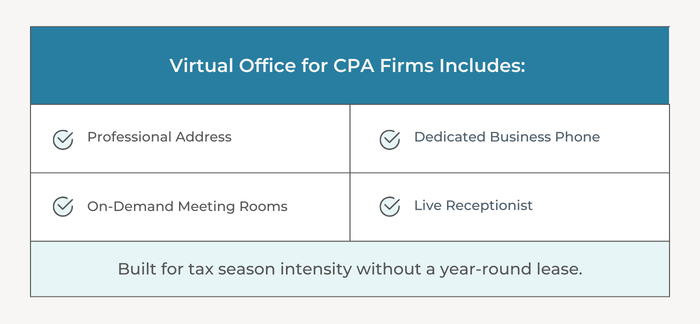
A virtual office gives CPAs and accounting firms a professional business address, dedicated phone number, live receptionist, and on-demand meeting rooms without a traditional office lease. For accounting practices, it solves specific problems: client meetings during tax season, professional credibility for engagement letters, and overflow call handling during your busiest months. When deadlines are fixed and clients are stressed, missing calls or scrambling for meeting space can cost you both revenue and retention.
Many small accounting practices spend $18,000–$36,000 per year on office space, even though their peak in-office demand is concentrated during tax season. The seasonal nature of accounting work makes a virtual office an obvious fit for the profession.
This guide explains how CPAs and accounting firms use virtual offices, what the real costs look like compared to traditional leases, which services matter most for tax practices, and how to handle state board registration requirements. Whether you are launching a solo practice or managing a multi-state firm, this covers the specifics.
Why Accounting Firms Are Ideal Virtual Office Users
Accounting practices have three characteristics that make virtual offices particularly well-suited:
Seasonal Intensity: Tax Season vs. Off-Season
January through April are chaotic. Phone calls triple. Client meetings cram into afternoons. Your team works overtime. Then April 16 arrives and the volume drops by 80%. From May through December, you have steady work, but nowhere near the intensity. A traditional office lease commits you to paying rent for 12 months when you genuinely need that space for 4. A virtual office lets you pay for what you use.
Client-Facing Credibility Requirements
Unlike solo attorneys or freelance consultants who can sometimes work from home, CPAs face explicit client expectations and professional standards. Your engagement letters need to reference a business address. When you schedule a client for a quarterly review or tax planning session, they expect to meet in a professional office, not a coffee shop or your home. That’s where a virtual office comes in, offering a professional setting on demand.
Sensitive Document Handling
Tax returns, financial records, SSNs, bank statements. Client documents contain sensitive information. A dedicated physical office with staff security protocols is better than home-based handling. For many practices, handling sensitive mail through a staffed commercial location is more controlled than routing everything through a home address.
These three factors are why virtual offices are especially common in professional services – particularly for attorneys, CPAs, and advisory practices where credibility, privacy, and responsiveness matter.
How CPAs Use Virtual Office Services
Professional Address
Your business address appears on engagement letters, tax return letterheads, state board of accountancy registration, and client correspondence. A virtual office at an established office building (not a mailbox store) signals professionalism. Some state boards of accountancy specifically require a principal office address. A commercial office building address meets that requirement. A PO box does not.
Mail Handling
Seasonal practices receive thousands of documents during tax season: client files, tax forms, checks, correspondence. Sorting and securely handling this volume at a home address is impractical. A virtual office provides mail receiving, sorting, and secure storage. Staff can scan documents and send them to you digitally or hold sensitive materials in a locked mailroom. Many CPAs appreciate this service specifically for the physical organization and security it provides.
Live Receptionist
During tax season, many practices see call volume spikes dramatically during tax season. In some firms, that can mean several times the normal daily call volume. Adding a temporary receptionist takes weeks to hire and train, and they leave when tax season ends. A live receptionist service ramps up instantly. They answer calls with your firm name, screen callers to separate genuine client inquiries from solicitors, collect information for urgent matters, and route calls appropriately. After April 15, the service scales back down. You only pay for the minutes you use.
Meeting Rooms
Quarterly reviews, tax planning sessions, new client consultations, audit discussions. These meetings require a professional space. Virtual office locations include fully equipped conference rooms. You can book a 1-hour or 4-hour room based on your need. No lease, no furniture to buy, no setup. The rooms are professionally decorated and clients associate you with a thriving office environment.
Virtual Phone
A dedicated business line separate from your personal cell. The receptionist answers with your firm name on this line. Clients dial it, and it routes to your team based on the time of day or caller type. You can create extensions for senior partners and managers. Voicemail is professional and custom-recorded. The virtual phone system handles call forwarding, do-not-disturb rules, and recording (where legal) for quality assurance.
The Tax Season Problem (and How Virtual Offices Solve It)
January through April is the compression cycle for accounting practices:
- Call volume triples. A practice that averages 10 calls per day during off-season might receive 30 calls per day during tax season. January is bad. February is worse. March and early April are chaos.
- Every call could be time-sensitive. A client calling on March 15 might be asking about estimated tax payments due April 15. A client calling in February might have missing documents blocking completion of their return. The receptionist cannot guess which calls matter and which are general inquiries.
- Hiring temp staff is expensive and slow. You need trained staff who understand CPA workflows. Recruiting, onboarding, and training takes 2 to 3 weeks. During that time, calls go unanswered. After tax season ends (April 16), they leave.
- Your team is already working 50+ hour weeks. Adding call handling duties to exhausted staff damages morale and increases errors. The receptionist problem becomes a retention problem.
A live receptionist solves this without hiring. Your volume and workload increase. The receptionist handles the overflow professionally. They collect caller information, note urgency, and make sure important matters reach the right person. You pay for the service only during tax season, then reduce it afterward.
Cost Comparison: Virtual Office vs. Traditional Office for a CPA Practice
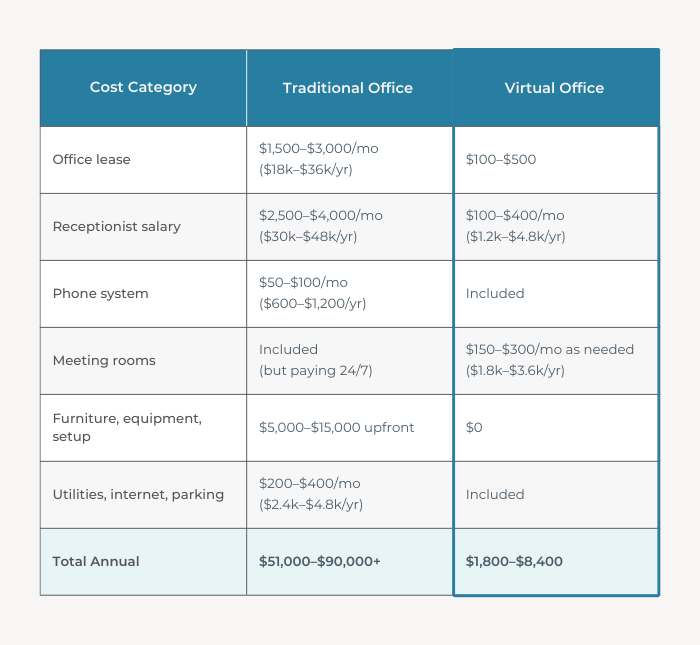
The financial case for a virtual office is straightforward. Here is the annual comparison:
Want to price this out for your firm? Compare virtual office plans by city and see what’s included at each service level.
→ Explore Locations & Plans
Annual savings: $42,600 to $88,200 per year. For a solo practice or small firm, that difference is transformative. A virtual office costs between $149 and $299 per month for the core package. Adding a live receptionist during tax season costs an extra $200 to $400 per month for 4 months. For many small CPA practices, the annual cost can stay in the low thousands, depending on how often you use meeting rooms and receptionist coverage.
Even if you maintain a small office for a partner and handle some overflow with a virtual setup, the savings are substantial.
Practice Scenarios
Scenario 1: Solo CPA Launching a Practice
You have decided to open your own practice. You need a business address for state board registration, a phone number for clients to call, and a professional place to meet clients for initial consultations.
- Traditional route: Lease a small office ($1,500–$2,500/month), buy a desk and filing cabinets ($3,000), set up a phone line ($100/month). Total first-year cost: $24,000 to $33,000.
- Virtual office route: Rent a virtual office at $199/month, use their meeting rooms for client meetings ($50 per session, maybe 8 times per year = $400), add a virtual phone ($50/month). Total annual cost: $2,988. Add business liability insurance and your other startup costs, but the office component is negligible.
Scenario 2: Growing Firm with 3–5 Remote Team Members
You have a successful practice with remote tax specialists, but you need a professional office address, overflow call handling during tax season, and a place to meet clients and team members.
- Virtual office base: $199/month = $2,388/year. Covers your address, mail handling, and access to meeting rooms.
- Live receptionist add-on: $250/month during peak tax season (Jan–April = 4 months) = $1,000. Plus $100/month during off-season for basic call handling = $800 for 8 months. Total receptionist cost: $1,800/year.
- Meeting rooms: Average 6 client meetings per month during tax season, 2 per month during off-season. At $50/hour for 1-hour rooms: $5,400/year.
- Total annual: $9,588. Compare to a traditional office lease at $2,000/month ($24,000/year) plus a part-time receptionist at $2,000/month ($24,000/year) = $48,000. Savings: $38,412/year.
Scenario 3: Multi-State CPA Practice
Your clients are spread across three states. You need a local presence in each state for regulatory compliance and client perception.
- Virtual offices in three locations: $199/month each = $597/month = $7,164/year. You have a professional address and meeting room access in each state.
- Receptionists in each location (tax season only): $250/month each for 4 months = $3,000. Off-season receptionists for basic coverage: $100 each for 8 months = $2,400.
- Total annual: $12,564. A traditional office lease in one state costs $24,000. Leases in three states would cost $72,000 minimum. A virtual presence costs a fraction of that while providing local credibility in each location.
State Board of Accountancy Requirements
Most states require a principal office address for CPA firm registrations. The board’s perspective is simple: they want to know where your practice is located so they can contact you if there are ethical complaints, licensing issues, or regulatory inquiries.
The typical requirement is a “physical office address” or “principal place of business”. The specific language varies by state:
- Some states explicitly allow virtual offices at commercial buildings
- Some states accept any physical business address (commercial office, shared workspace, etc.)
- Some states are ambiguous, and you need to contact the board directly
In many states, a virtual office at a staffed commercial office building can satisfy “principal office” requirements, but you should confirm the exact wording with your state board before filing. Alliance can provide documentation (service agreement, address verification, and location details) that many boards and banks request during registration or account setup. A mailbox store (UPS Store, PostalAnnex) technically provides a physical address but is typically not acceptable because it is not a real office. A PO box is never acceptable.
Before signing up for a virtual office, confirm that the location is staffed during business hours and has a legitimate office presence.
Most professional virtual office providers explicitly market their compliance with state board requirements. If in doubt, contact your state board of accountancy directly. The board office can tell you whether a specific address meets their requirements.
What to Look for in a Virtual Office Provider (CPA-Specific)
Not all virtual office services are the same. The quality difference matters significantly for accounting practices.
- Staffed locations, not mail stores. You need a location with professional staff during business hours, not a franchise mailbox operation. The staff should be trained in document handling and business discretion.
- Professional meeting rooms. Rooms should be fully equipped with conference tables, chairs, phone access, and ideally video conferencing capability. They should be decorated professionally (clients form impressions from the space). Booking should be easy and flexible by the hour.
- Live receptionist quality. If you use the receptionist service, listen to sample calls or read reviews. The receptionist’s tone and professionalism directly reflect on your practice. Generic call centers are not acceptable for client-facing work.
- Mail handling for sensitive documents. The provider should have secure storage, confidentiality policies, and the ability to handle tax forms and financial documents without loss or breach. Ask about data security and document retention.
- Chain-of-custody basics: Ask who receives mail, where it’s stored, who can access it, and how pickups/forwarding are documented—especially during tax season.
- Multi-location network. If you work with clients in multiple states, a provider with locations in those states (or nearby) is more valuable. You can establish local presence without multiple contracts.
- Transparent pricing. Know the base fee, what is included, and what is extra. Some providers charge for meeting room use by the hour; others include limited hours. Live receptionist pricing should be clear: per call, per minute, or flat monthly rate. Get it in writing.
- Digital mail handling. Many CPAs appreciate the ability to have mail scanned and sent as digital files (or held securely). This reduces trips to pick up physical mail during tax season.
Directory Listings and Client Acquisition
When clients search for CPAs online, they look for a local, established practice. A professional address at a real office building helps. Alliance can offer listing management support to help distribute consistent NAP (Name, Address, Phone) data across major directories. Availability can vary by plan and location, so confirm what’s included when you set up service. Google Business Profile eligibility depends on Google’s guidelines and review process.
NAP consistency (Name, Address, Phone) matters for local search visibility. If your address and phone number are inconsistent across directories, search rankings suffer. With a unified listing management service, your information is synchronized across platforms. That consistency improves your visibility to local clients searching for a CPA.
Ask your Alliance representative about directory listing services when you set up your virtual office. It is typically included or available as an add-on.
How a Virtual Office Pairs with Live Receptionist and Other Services
A virtual office becomes more powerful when combined with other services:
Virtual Office + Live Receptionist: Your address signals “real practice” and your receptionist answers professionally. Together, they create a credible first impression.
Virtual Office + Virtual Phone: A dedicated business phone number that routes to your cell or team based on time and caller type. The address and phone together create a complete professional identity.
Virtual Office + Meeting Rooms: You have a professional space to meet clients for quarterly reviews, tax planning, or consultations. Clients see an established office, not a home-based practice.
The combination is more valuable than any single service alone. From a prospect’s perspective, they call your number, a professional answers, they meet you in a professional office, and they see an established practice.
The Bottom Line
Accounting practices pay for 12 months of office space but genuinely need it for 4 months. A virtual office costs between $1,800 and $8,400 annually, depending on services used. A traditional lease costs $18,000 to $90,000+ per year. The math is simple.
CPAs benefit from virtual offices because of the seasonal nature of the profession. Tax season creates specific problems (overflow calls, meetings with clients, secure document handling). A virtual office addresses all three without the overhead and waste of a year-round lease.
Whether you are a solo practitioner launching a practice, a growing firm managing remote staff, or a multi-state practice building local presence, a virtual office is a practical tool that reduces costs, improves client perception, and meets regulatory requirements. Most CPAs who try one for tax season end up keeping it year-round because the value extends beyond the busy months.
Choose a location in your primary market and review receptionist and meeting room options for tax season coverage.
→ View Virtual Office Options
Frequently Asked Questions
Will my state board of accountancy accept a virtual office address?
In most states, yes, provided the virtual office is at a staffed, legitimate commercial office building. A mail store or PO box does not meet the requirement. Before signing up, confirm with your state board. Alliance can typically provide documentation showing that their locations meet professional standards.
How does the live receptionist handle CPA client calls during tax season?
You provide the receptionist with a script or call handling rules. New client inquiry? Collect name, phone, service needed, and deadline. Existing client with a question? “Is this urgent?” If urgent, take a message noting priority. If routine, offer a callback slot. The receptionist sends you a summary after each call. You decide when to call back based on urgency and availability.
Can my team use the meeting rooms for client reviews?
Yes. Meeting rooms are available for your team members to book (typically via an online portal or by calling the office staff). A senior accountant can meet a client for a quarterly review, an audit discussion, or a tax planning session. The rooms are professional and equipped with what you need.
Is a virtual office tax-deductible for CPA firms?
Yes, in most cases. A virtual office is a legitimate business expense. The address, phone, receptionist service, and meeting room rentals are deductible. Keep receipts and documentation. Consult your own accountant on how to categorize these expenses (usually under “Office rent” or “Administrative services”). Tax deductibility varies slightly by jurisdiction and business structure, so verify with a tax professional.
How do I handle sensitive financial documents through a virtual office?
Use the secure mail handling service. Documents arrive and are stored in a locked, staffed mailroom. Many providers offer mail scanning and digital delivery options. Ask how scanning is delivered (email vs portal), who has access, and what handling and retention procedures are in place. Some locations can hold mail for pickup or short-term storage; long-term record retention should follow your firm’s policies and your state’s requirements. Clarify document retention policies and destroy documents according to your state’s retention requirements.