
- What a Virtual Office Actually Includes
- The Real Costs: What You Will Actually Pay
- The Real Cost of Doing This Separately
- Five Scenarios Where a Virtual Office Clearly Pays for Itself
Q: Is a virtual office actually worth the cost, or am I better off using my home address or leasing a small office?
A: For most small business owners and client-facing professionals, a virtual office is worth it because it delivers the credibility of a professional, staffed office address, plus mail handling, phone service, and meeting access, at a fraction of the cost of a traditional lease.
Instead of paying $700 to $2,500 per month for separate services or unused office space, you typically pay $50 to $200 per month for consolidated infrastructure. The value is not just cost savings; it is privacy, professionalism, local visibility, and flexibility without long-term overhead.
If you’re deciding whether to pay for space you won’t use or put your home address on public records, it’s a fair question. For most small business owners and entrepreneurs, yes.
A virtual office typically costs $50 to $200 per month and replaces expenses that would otherwise run $500 to $2,000+, including professional office space, a dedicated business phone, a credible business address, and receptionist services. But the real value goes beyond cost savings.
Attorneys, CPAs, consultants, real estate agents, financial advisors, and IT professionals are among the most common users of virtual offices. They all face the same question: how do you look established and credible without paying for space you do not use five days a week?
This guide breaks down the actual costs, the less obvious benefits, and the specific scenarios where a virtual office pays for itself many times over. It also covers the situations where it might not be the right fit, because not every business needs one.
What a Virtual Office Actually Includes
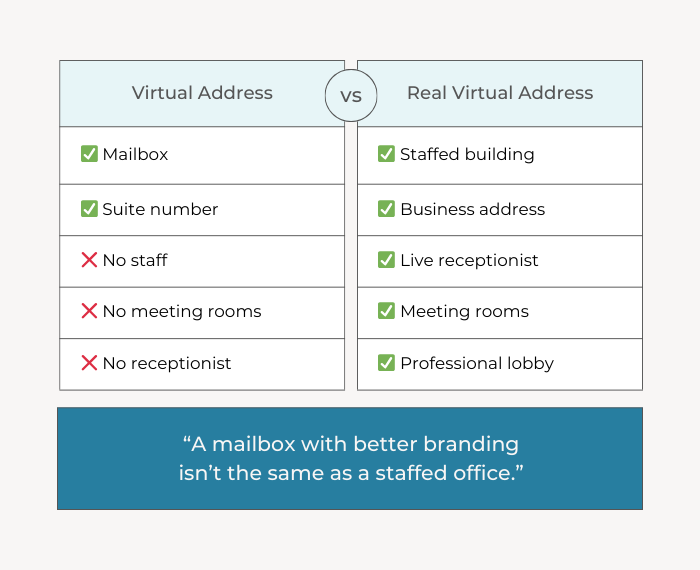
Before running the numbers, it helps to know what you are buying. And just as important, what you are not buying. A lot of services marketed as “virtual offices” are actually virtual addresses: a forwarding address at a retail mail store. That is not a virtual office. That is a mailbox with better branding.
A real virtual office gives you access to a physical, staffed office location and the services that come with it, without locking you into a traditional lease.
A typical plan includes some combination of the following:
- A real business address at a professional office building you can use on your LLC registration, business cards, and website
- Mail handling and forwarding. Your mail arrives at the physical office, where staff receive, sort, and forward it to you or scan it for digital access.
- A dedicated business phone number with a local or toll-free option, call forwarding, and voicemail
- Live receptionist services. A trained receptionist answers your calls with your company name, takes messages, and transfers calls per your instructions
- On-demand meeting rooms and coworking space. When you need to meet a client face-to-face or work from a professional setting, you book space at the same address listed on your business cards
The key distinction: every Alliance Virtual Offices address is a real, staffed workspace. Not a retail mail store. Not a PO box with a suite number. When a client looks up your business address, they see a professional office building. When they visit, someone is there to greet them.
The Real Costs: What You Will Actually Pay
Virtual office pricing varies depending on the provider, location, and services included. Here is what the market looks like:
| Service Level | Monthly Cost | Annual Cost | What’s Included |
| Business address only | $49–$75 | $588–$900 | Address, basic mail handling |
| Address + mail + phone | $100–$150 | $1,200–$1,800 | Above + phone line, voicemail |
| Full virtual office | $150–$300 | $1,800–$3,600 | All services + live receptionist + meeting room hours |
Most small business owners land in the $100 to $200 range, which is the sweet spot for getting a professional address, phone service, and mail handling without overpaying for meeting room hours you might not use.
Hidden Costs to Watch For
Not all providers are transparent about pricing. Before signing up, ask about:
- Setup fees. Some providers charge $50 to $200 upfront. Others, including Alliance, do not
- Mail forwarding charges. Some plans include forwarding; others charge per piece or per shipment
- Meeting room overages. If your plan includes 4 hours per month and you use 6, know the hourly rate in advance
- Contract length and commitment. Most reputable virtual office providers require an initial commitment, typically around six months. This is standard across the industry and for good reason: a legitimate business address is a foundation you build on, not something you swap out every 30 days. After that initial term, plans typically continue monthly, giving you flexibility as your business evolves
The Real Cost of Doing This Separately
The cost question only makes sense in context. Here is what you would pay for the same services individually:
| Business Need | Typical Monthly Cost (If Purchased Separately) | Covered By A Virtual Office Plan? |
| Small office lease (1 person) | $500–$2,000+/month | Included |
| PO box (commercial) | $20–$50/month | Included (upgraded) |
| Business phone line | $25–$50/month | Included |
| Answering service | $100–$300/month | Included |
| Meeting room rental | $50–$100/hour | Hours included |
| Registered agent service | $100–$300/year | Varies by provider |
Add those up and you are looking at $700 to $2,500 per month in individual costs. A $150/month virtual office plan replaces most of that. The math is not close.
And this comparison does not account for the overhead that comes with a physical office: utilities, internet, insurance, furniture, cleaning, commute time. A Stanford University study found that remote workers save an average of 72 minutes per day on commuting alone. That is time you reinvest into your business.
Five Scenarios Where a Virtual Office Clearly Pays for Itself
1. You work from home and need a professional address
Using your home address for business registration means it appears on your LLC filing, your website, court records, and anywhere else your business is listed publicly. That creates two problems: it looks unprofessional, and it puts your personal address on the internet for anyone to find.
This is especially relevant for attorneys, CPAs, consultants, and other professionals whose clients expect a credible business presence. A referral checks your firm online before calling. If your address comes back as a residential apartment, questions form before conversations start.
A virtual office solves both problems. You get a real business address at a recognizable office building. Clients, lenders, and government agencies see a professional location. Your home address stays private.
2. You need to register an LLC or set up your business formally
State filing offices want a real street address, not a PO box. Many services that offer business addresses are actually retail mail stores using forwarding designations that states, banks, and other institutions may treat differently from a real office address.
Every Alliance address is a physical office space with staff on-site during business hours. That distinction matters when you are filing your LLC, applying for an EIN, or establishing your business with government agencies.
3. You want local clients to find you online
Nearly half of all Google searches have local intent. When someone searches for “attorney in Denver” or “bookkeeper near me,” the businesses that show up are the ones with consistent, credible local presence across the web. That presence starts with a real business address.
A virtual office at a staffed office building gives you the foundation for local visibility in several ways:
- Local directory listings. Alliance offers a Listing Management service that distributes your business information across major directories, including Apple Maps, Bing Places, Yelp, Facebook, and dozens of industry-specific sites. The key requirement for these listings is a real, consistent business address. A virtual office at a professional location gives you that. A PO box or retail mail store address does not qualify for most of these directories. Ask your Alliance representative about Listing Management when you sign up
- NAP consistency. NAP stands for Name, Address, Phone. Search engines use consistency across directories as a trust signal. When your business name, address, and phone number match across every listing, it reinforces your legitimacy. A virtual office with a dedicated phone number gives you a stable NAP you can use everywhere
- Your website and social profiles. Having a professional address on your website, LinkedIn, and other profiles builds credibility with both search engines and the actual people checking you out before they call
A note on Google Business Profile. Google has specific requirements for Business Profiles, including that a business be staffed at the listed address during stated hours. Their guidelines are strict, and Google makes acceptance decisions at its sole discretion. PO boxes and addresses at retail mail stores are explicitly ineligible. A real, staffed office address is a stronger foundation, but no virtual office provider in the industry guarantees Google Business Profile acceptance. What you can control is everything else: your directory listings, your NAP consistency, your website, and your reputation across the platforms where local clients are searching. Google Business Profile is one piece of local visibility. It is not the only piece, and for many businesses, the combination of directory listings and a credible web presence drive more local leads than a GBP listing alone.
4. You are spending too much on office space you rarely use
If you have a lease and find yourself working from home three or four days a week, you are paying for space you are not using. A virtual office lets you keep the professional address, the phone number, and the meeting room for access while dropping the lease. For businesses spending $1,000+ per month on rent they barely use, switching to a virtual office can save $10,000+ per year.
5. You serve clients in multiple cities
A consultant based in Austin who also works with clients in Dallas and Houston can set up virtual office addresses in all three cities. Each location gives you a local presence, a local phone number, and meeting rooms you can book when you visit. This is a fraction of the cost of maintaining three physical offices and signals to local clients that you have a real presence in their market. Alliance has 1,400+ locations globally, which means you can add addresses as your business grows without switching providers.
When a Virtual Office Might Not Be Worth It
A virtual office is not the right solution for every business. Here are the situations where it probably does not make sense:
- You need a physical workspace daily. If you require a desk, equipment, or client-facing space every day, a coworking membership or a small lease is a better fit. Virtual offices are built for people who work remotely most of the time
- You receive high volumes of mail or packages. Virtual offices handle standard business mail well. If you are an e-commerce business receiving dozens of packages a day, you need a warehouse or fulfillment center
- Your industry requires a physical office by law. Some regulated industries, such as certain financial services or healthcare practices with patient-facing requirements, mandate a physical office. Check your industry’s specific regulations before committing
- You already have a great office and address. If your current setup covers your needs, there is no reason to add a virtual office. It solves specific problems, and if you do not have those problems, it is money you do not need to spend
ROI Scenarios: Running the Numbers by Industry
The value of a virtual office depends on what your business needs and what it would cost to get those things any other way. Here are three scenarios based on the industries where virtual offices make the most financial sense.
Scenario A: Solo Attorney or Legal Consultant
Law practices are one of the most common and longest-tenured users of virtual offices. Attorneys face a specific set of pressures: clients expect a professional office address, state bar associations may require a physical address for filings, court documents put your business address on public record, and missed calls from prospective clients often mean lost cases. A home address on a bar registration raises questions. A PO box is not accepted by most state bars.
Monthly virtual office cost: $149 (business address + mail handling + dedicated phone + live receptionist)
What it replaces:
- $30/month PO box that cannot be used on bar filings
- $40/month business phone line
- $175/month answering service (critical for a practice where a missed call is a missed client)
- Meeting room rentals at $75/hour for client consultations (4 hours/month = $300)
Monthly savings: $396
Annual savings: $4,752
Additional value: Home address stays off court filings and state bar registration. Clients see a professional office when they verify your firm online. The live receptionist answers calls using your firm name, screens intake calls, and takes messages, which matters in a field where responsiveness often determines who gets retained. Meeting rooms are available for client consultations, depositions, and mediations at the same address on your business cards.
Scenario B: Growing CPA Firm or Consulting Practice (3–5 Remote Team Members)
Accounting firms and consulting practices often start with one person and grow to a small team, all working remotely. The challenge is that clients in these fields expect the appearance of an established firm. A professional address, a receptionist who answers with the firm name, and a meeting room for quarterly reviews or tax planning sessions all contribute to that perception. Paying for a full office lease to get those things does not make sense when the team only needs to be in one place a few times a month.
Monthly virtual office cost: $199 (full plan with live receptionist)
What it replaces:
- $1,500/month office lease (used 4–6 days a month)
- $200/month answering service
- $50/month business phone system
Monthly savings: $1,551
Annual savings: $18,612
Additional value: During tax season or quarterly reporting periods, the live receptionist handles overflow calls without adding headcounts. Team members work from wherever they are most productive and book meeting rooms when clients need to face time. One professional address appears on all client-facing documents, engagement letters, and correspondence. The firm looks and operates like a traditional practice without the overhead of one.
Scenario C: Real Estate Agent or Financial Advisor Serving Multiple Markets
Real estate agents, financial advisors, and insurance professionals often serve clients across two or three metro areas. Having a local presence in each market matters: clients want to work with someone who knows their area, and a local phone number and address reinforce that. Maintaining separate physical offices in each city is expensive and usually unnecessary. A virtual office in each market gives you the local presence without the lease.
Monthly virtual office cost: $250 (two city locations at $125 each)
What it replaces:
- Two coworking memberships at $300/month each
- Separate phone numbers and mail services for each market
Monthly savings: $350+
Annual savings: $4,200+
Additional value: A local phone number in each market, so clients see a local call instead of an out-of-area code. Meeting rooms available for listing presentations, buyer consultations, or portfolio review meetings. A professional address on business cards and marketing materials for each territory. Alliance has 1,400+ locations globally, so adding a third or fourth market does not mean switching providers.
What to Look for When Choosing a Provider
Not all virtual offices are the same. And some things marketed as virtual offices are not virtual offices at all. A forwarding address at a retail mail store with a suite number is a virtual address masquerading as an office. There is no staff greeting visitors, no meeting rooms, no receptionist answering your phone. It is a mailbox. Knowing the difference matters because banks, state agencies, and clients can tell.
Here is what separates a real virtual office from a waste of money:
- Real office locations, not just mailboxes. Ask whether the address is a staffed office or a retail mail store with a suite number. The distinction affects how banks, state agencies, and clients perceive your business. For attorneys and CPAs, this distinction can affect whether state licensing boards accept the address
- A network that grows with you. If you might need addresses in multiple cities, choose a provider with locations across the country and beyond. Alliance has 1,400+ locations globally, so you can add addresses as your business expands without switching providers
- Transparent pricing. No setup fees, no hidden charges, clear per-item pricing for add-on services. Ask for the full cost breakdown before signing up
- A reasonable commitment structure. Most quality providers require an initial commitment of around six months, then transition to monthly billing. Be cautious of providers with no commitment at all; a willingness to take short-term, uncommitted customers can signal that the addresses are being used by businesses that are not building for the long term
- A live receptionist option. This is the service that small business owners say they did not know they needed until they had it. A real person answering your calls with your business name changes how clients perceive you. For professional services firms, it can be the difference between a prospective client leaving a message and hanging up to call someone else
- Meeting room quality. Visit or view photos of the meeting rooms before committing. A poorly maintained conference room creates the wrong impression, especially if you are using it for client-facing meetings
A Note on Banks and Virtual Office Addresses
One question that comes up often: will my bank accept a virtual office address for my business account?
The honest answer is that it depends on the bank. Some traditional banks have tightened their policies around virtual addresses in recent years, and applications that include a known virtual office or retail mail store address can trigger additional scrutiny or rejection. This is not unique to any one provider; it is a broader banking compliance trend driven by Know Your Customer (KYC) and anti-money laundering (AML) requirements.
Here is what we have seen work well for our clients:
- Online banks and fintech companies tend to be more flexible. Banks like Mercury and Brex are built for digital-first businesses and are more familiar with virtual office setups. They are often a better starting point than a traditional bank branch
- Documentation matters. Ask your virtual office provider for supporting documentation: a signed service agreement, a letter confirming your business address, and any proof-of-address documentation the bank might request. Having these ready before you apply makes a significant difference
- Consistency across filings helps. Use the same address on your LLC registration, EIN application, and bank account. Banks look for consistency when verifying business identity
- Call the bank first. Before applying, call your chosen bank and ask whether they accept virtual office addresses for business accounts. A five-minute phone call can save you the frustration of a rejected application
- A real office address gives you an advantage. Addresses at staffed office buildings are treated differently by banks than addresses at retail mail stores. This is one of the most practical reasons to choose a virtual office at a real workspace over a cheaper mailbox service
The banking landscape is evolving, and we encourage clients to do their research on specific banks before applying. What has not changed is that a credible, real office address positions your application better than the alternatives.
The Bottom Line
A virtual office is worth it if you need a professional business address, want to protect your home address, and do not want to pay for office space you will not use five days a week. The math works for most small business owners and entrepreneurs: you spend $100 to $200 per month and save $500 to $2,000+ in the services it replaces.
The value goes beyond the spreadsheet. A real business address at a real office building changes how clients, banks, and search engines see your business. For an attorney, it is the difference between a firm that looks established and one that raises questions. For a CPA or consultant, it is the difference between winning a new engagement and losing it to a competitor with a more professional presence.
The question is not really whether a virtual office is worth it. It is whether the alternative makes more sense for where your business is right now. A PO box limits your options with banks and state agencies. A home address on your LLC goes on the public record. A retail mail store address may not hold up to scrutiny from the clients and institutions you need to impress.
For most professionals reading this, those alternatives cost more in credibility than a virtual office costs in dollars.
See available locations and choose a professional address that matches how you want your business to be perceived.
Frequently Asked Questions
Can I use a virtual office address for my LLC?
Yes, in most states. A virtual office at a real, physical workspace is accepted for LLC registration in the majority of states. Some states have specific requirements for registered agent addresses, so check your state’s rules. Alliance addresses are physical offices with on-site staff, not PO boxes or retail mail stores, which gives you the broadest acceptance.
Is a virtual office tax deductible?
Virtual office expenses are generally tax-deductible as a business expense. Your monthly service fee, mail handling costs, and meeting room charges can typically be written off. Consult your accountant for specifics on how this applies to your situation, as deduction rules vary by business structure and jurisdiction.
What happens if someone visits my virtual office address?
At Alliance locations, staff are on-site during business hours. If a client, vendor, or courier visits your address, they are greeted professionally in a real office setting. Your mail is received and handled. If someone asks you by name, the front desk follows the instructions you have set up for visitor handling.
How is a virtual office different from a PO box?
A PO box gives you a mailbox at a post office. A virtual office gives you a street address at a professional building, with mail handling, phone service, live receptionist, and meeting room access. PO boxes cannot be used for LLC registration in many states or for most business bank account applications. A virtual office in a real workspace can be used for both.
How is a virtual office different from a mailbox at a retail mail store?
They are completely different products, even though some retail mail stores market themselves as virtual offices. A retail mail store gives you a mailing address at a commercial storefront. There is no office, no receptionist, no meeting rooms, no phone service. It is a virtual address, not a virtual office. Banks and state agencies often treat these addresses differently from a real office address, and for good reason. When someone looks up a retail mail store address, they see a storefront. When they look up an Alliance address, they see a professional office building with staff on-site. That distinction matters to the people and institutions evaluating your business.
Do attorneys, CPAs, and other licensed professionals use virtual offices?
Yes. Legal professionals, accountants, financial advisors, real estate agents, and consultants are among the most common users of virtual offices. Attorneys in particular use them to maintain a professional office address for state bar filings, keep their home address off court documents, and have a place to meet clients when needed. The live receptionist is especially valuable for law practices, where a missed call from a potential client often results in that client calling another firm.