
- What Is a Virtual Office and Why Amazon Sellers Use It
- Amazon’s Address Rules Explained
- Virtual Offices That Work for Amazon
- Addresses That Get Flagged (and Why)
Q: Can you use a virtual office for your Amazon Seller account, and how do you make sure it doesn’t get flagged?
A: Yes, you can use a virtual office for Amazon Seller Central as long as it’s a real, commercial-grade business address with on-site staff who can receive Amazon’s verification mail. Amazon rejects PO Boxes, mailbox stores, and unstaffed coworking addresses because they can’t be verified. To stay compliant, choose a staffed virtual office location, use the same address across your EIN and business documents, complete identity verification, and make sure the center can receive and forward your Amazon verification postcard without delays.
If you sell on Amazon, your business address isn’t just another form field. It’s tied directly to identity checks, marketplace trust, payouts, and your ability to stay active as a seller.
That’s why choosing the wrong address can lead to suspended accounts, delayed verification, and frustrating support loops. These problems hit both new sellers and experienced FBA operators expanding into new marketplaces.
Here’s the truth. Not all virtual offices are created equal. Some work perfectly for Amazon Seller Central. Others get flagged instantly.
This guide shows exactly what works, what doesn’t, and how to set up a virtual office the right way so you can protect your storefront and scale with confidence.
What Is a Virtual Office and Why Amazon Sellers Use It
A virtual office gives you a real business address inside a staffed office building without paying for a full-time physical office. It’s very different from a PO Box or a mailbox store because it functions as a legitimate commercial address that can receive mail, business correspondence, and verification documents.
Amazon sellers use virtual offices because they provide:
- A real, professional business address
- Privacy for home-based sellers
- The ability to register a U.S. or international business without renting space
- Mail handling and secure document forwarding
- Added credibility for brand registries, product approvals, and global expansion
A virtual office address can also protect your home address from showing in places like Amazon storefronts, business licenses, and public records.
Alliance Virtual Offices provides 1,400+ staffed, real office locations, each designed for business registration and official correspondence.
Amazon’s Address Rules Explained
Amazon requires that your business address be verifiable, reachable, and aligned with your legal business information. Sellers often run into problems because they don’t understand the specific verification checks Amazon uses.
Let’s break virtual business compliance down.
Amazon typically checks for:
- A real, non-residential street address
- A place Amazon can mail a verification postcard or letter
- Consistency with your EIN, business license, and tax records
- A staffed location that can confirm business presence
Amazon has stated across Seller Central Help and forums that PO Boxes, mailbox stores, and UPS Store addresses often fail verification. They’re not considered legitimate business locations.
Virtual Offices That Work for Amazon
Not every virtual office is Amazon-friendly. Amazon needs to confirm that your business address is a real place where real people work. If the address can’t pass that basic test, Amazon either delays verification or rejects it outright.
A virtual office only works for Amazon Seller Central when it meets Amazon’s standards for a commercial business location. In simple terms, the address has to be real, staffed, and capable of receiving mail at any time during normal business hours.
Here’s what a compliant virtual office looks like:
- A legitimate commercial office building
Amazon wants a physical location, not a mailbox store or an empty coworking room with no staff. - On-site staff who can receive mail
Someone must be available to sign for Amazon’s postcard or any official correspondence. If mail gets returned or refused, verification fails. - The ability to receive and forward Amazon verification postcards
Amazon often sends a physical postcard as part of Seller Central verification. Your provider needs to pick it up, notify you, and forward it right away. - A unique suite or mailbox ID tied to your business
This helps Amazon match your address to your business records, EIN, and any documents you submit. - Support for official legal, banking, and tax mail
Your business address will also be used for licenses, EIN filings, and bank documentation. It needs to be recognized as a real business location across all systems.
When you choose a virtual office that checks all these boxes, Amazon is able to verify your business quickly, which helps you avoid the usual back-and-forth and account delays sellers complain about in the forums.
Alliance Virtual Offices fits everything Amazon expects from a compliant address. Sellers get:
- A real, commercial business address that Amazon accepts
- Reliable, professional mail handling
- Fast forwarding of Amazon verification letters and postcards
- On-demand meeting rooms and workspace if you ever need them
- Optional tools like live receptionist services, business phone numbers, and secure mail notifications
If you want to set up your Amazon storefront with an address that works from day one, you can start here: Do You Need a Business Address for an Online Store?
Addresses That Get Flagged (and Why)
Plenty of address options look legit at first glance, but Amazon’s verification system is incredibly strict. If the address can’t be tied to a real, staffed business location, Amazon flags it. Once that happens, things can snowball quickly.
Here’s what most sellers run into when Amazon can’t verify their business address:
- Verification delays that stretch from days into weeks
- Repeated requests for documents you’ve already submitted
- “We couldn’t verify your information” notices with no clear next steps
- Full account suspension until you update the address and re-verify
Many sellers don’t realize their address is the problem until their account is already locked.
To avoid that, here’s what Amazon commonly rejects:
1. P.O. Boxes
P.O. Boxes fail the moment you enter them. Amazon can’t send a verification postcard to a postal box, and they don’t view them as legitimate business locations. Even if you run your entire business online, Amazon still requires a physical business address.
2. UPS Store Mailboxes
These often look like real street addresses, but Amazon knows the format. UPS Store and mailbox-center addresses follow predictable patterns that Amazon’s system recognizes. Sellers who try using them usually get flagged during the EIN check or postcard verification.
3. Virtual mailbox-only providers
Some companies offer digital mailboxes that only forward mail but don’t operate from an actual office. Amazon sees these as forwarding centers, not commercial business locations. Without on-site staff or a physical suite, these addresses almost always trigger verification issues.
4. Coworking spaces without dedicated mail handling
A hot desk membership might give you a building address, but that doesn’t mean anyone is there to receive your Amazon postcard. Shared mail slots, unstaffed rooms, and limited reception hours can cause your postcard to get lost, returned, or simply never signed for.
5. Addresses where mail can’t be signed for
This is one of the biggest hidden problems. Even if your address is technically valid, Amazon won’t accept it if the location can’t sign for the postcard delivery. If no one is available to receive it, the verification fails and your account gets stuck.
Amazon cares about one thing:
Can this address be verified as a real business location with real people on-site?
If the answer is no, you’ll run into problems.
Avoid Amazon suspension. Here’s how.
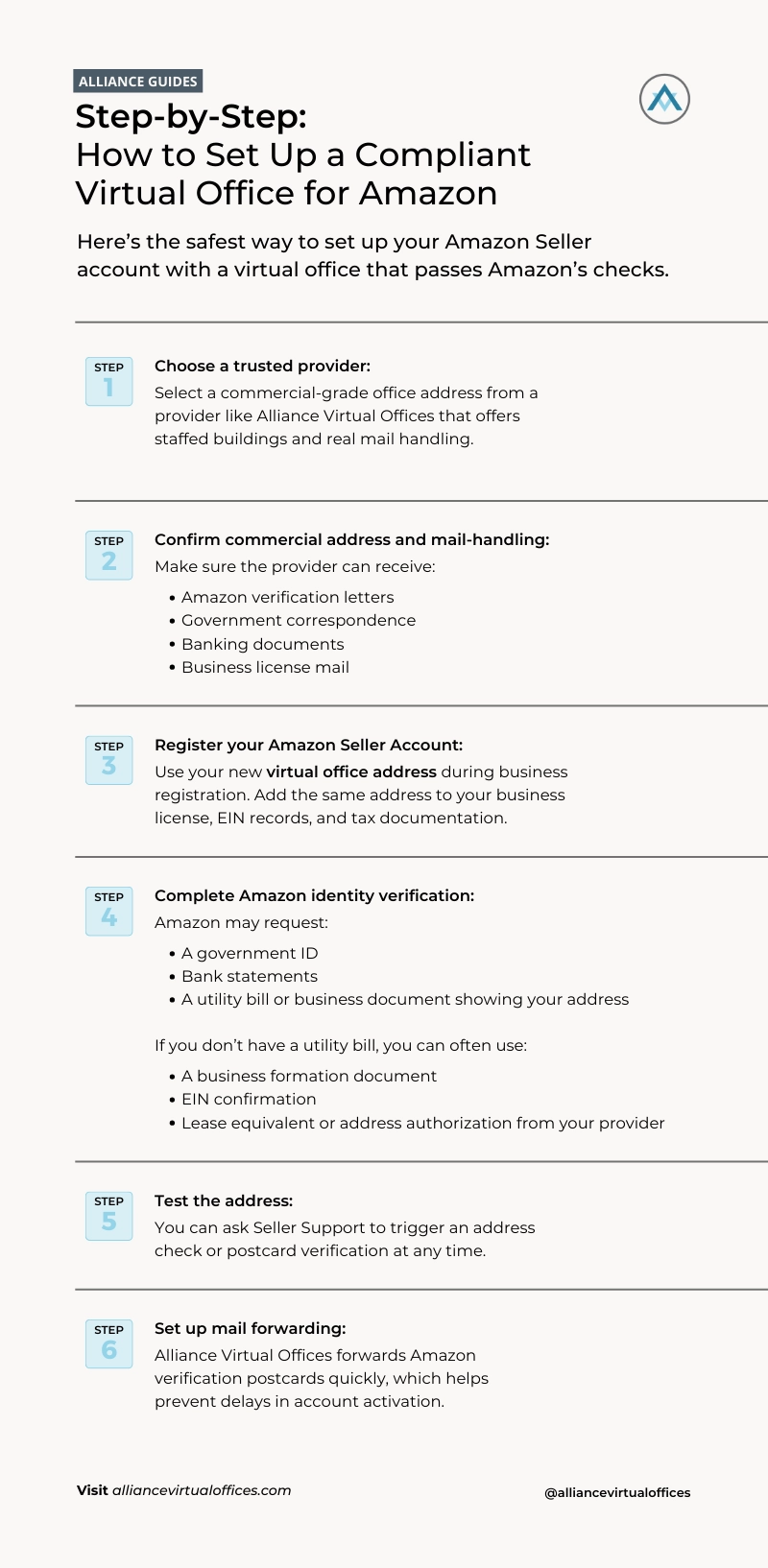
Real-World Case Examples and Common Mistakes
Amazon sellers share the same pattern over and over in forums: the wrong address creates problems nobody expects. These aren’t rare edge cases. They’re everyday issues that stop sellers from getting verified or staying active.
Here’s what actually happens when the address doesn’t meet Amazon’s standards.
Case A: Suspended for using a mailbox store address
A seller set up their account with a UPS Store mailbox because it looked like a real street address. Everything seemed fine at first, but when Amazon synced the business address with the seller’s EIN records, the system flagged it as a commercial mailbox.
Within days, the seller got the dreaded message:
“We couldn’t verify your information.”
Their payouts were frozen, and the account went into suspension until they could provide a compliant business address. After switching to a staffed virtual office and re-verifying, Amazon finally restored the account, but the downtime cost them both revenue and ranking.
Case B: Smooth verification with a staffed virtual office
Another seller chose a virtual office through Alliance Virtual Offices. They completed their setup, Amazon mailed the postcard, and the center signed for it the same day.
The seller got a notification, the postcard was forwarded immediately, and the code was entered in Seller Central within a few days. Their account moved to active status without any back-and-forth or requests for additional documents.
This seller noted the difference in forums: “The address actually mattered more than anything else.”
Case C: Reverification failure that stalled the account for weeks
A seller picked a low-cost virtual mailbox provider that only forwarded mail and didn’t operate inside a real office building. Amazon mailed the postcard, but there was no staff on-site to receive it. The postcard was returned as “undeliverable.”
Because of that, Amazon required the seller to update the address, restart the verification process, and wait for a second round of checks. Reverification pushed their launch date back several weeks and delayed their first FBA shipment from being released.
How Alliance Virtual Offices Ensures Compliance
Alliance Virtual Offices helps Amazon sellers stay verified and supported with:
- Real, staffed office buildings across 1,400+ locations
- Reliable mail handling with prompt forwarding
- Addresses suitable for EINs, business licenses, and Amazon verification
- Optional live receptionist services
- Meeting rooms and workspace for occasional client or team needs
- Secure mail storage and digital notifications
This lets sellers operate confidently while protecting privacy, improving professionalism, and scaling across Amazon’s global marketplaces.
Get your Amazon-compliant virtual office today
Build a Safe, Scalable Amazon Business
Using the right virtual office can protect you from verification delays, account flags, and costly suspensions. Using the wrong type of address can stop your business before it even gets going.
When you choose a real, staffed office location with proven verification support, you set up your Amazon storefront for long-term stability. Alliance Virtual Offices gives sellers a secure, trusted, and Amazon-ready address that keeps accounts active and ready to grow.
Your Amazon business deserves a foundation that won’t get flagged. Start with a virtual office that works every time.
Get started here: Virtual Office | Get Your Business Address Here
Contact our sales and support team here: Contact Alliance Virtual Offices | Expert Virtual Office Solutions & Support