


- Your Address Options: A Side-by-Side Comparison
- Legal Requirements: What Your Business Structure Demands
- How to Get a Business Address for Your Online Business
Q: Which address should I use for my online business?
A: For most online businesses, a virtual business address is a practical choice. It keeps your home address private, meets LLC formation requirements in most states, is typically accepted for IRS and bank verification, and is accepted by marketplace platforms like Amazon and Etsy.
Running an online business from your kitchen table is practical, but using your home address as your business address is where trouble lies ahead. The moment your home address lands on a public Limited Liability Company (LLC) filing or an Amazon seller profile, your privacy is exposed, and it’s difficult to walk back from that.
The stakes are more concrete than they first appear. Amazon requires a valid business address on your seller account. Likewise, the Internal Revenue Service (IRS) uses your address for Employment Identification Number (EIN) correspondence.
Banks verify it when you open a business checking account and, if you formed an LLC, your state requires a physical street address for the principal place of business and the registered agent address. A P.O. Box won’t cover all of these at once.
This guide walks through what each address type allows, what the law requires for your business structure, what marketplace platforms demand, and what to look for when you choose which address you’ll take forward. Pick the right address once, so you’re not untangling privacy and compliance problems later.
Why Your Online Business Needs a Real Business Address
The number of businesses facing this exact decision is enormous. According to the Small Business Administration, there were roughly 36.2 million small businesses active in 2026, with about 82.3% operating without employees.
The Problem with Using Your Home Address
But most new online sellers miss that once a home address appears in LLC public records or a marketplace seller profile, it’s searchable, and in many cases, permanent. In most states, the LLC principal address becomes part of your public filing, which means anyone who looks up your business can find where you live.
There’s a compliance layer too. Under the INFORM Consumers Act, high-volume marketplace sellers are required to disclose contact information to the platform. But that obligation directly collides with the privacy of a home-based seller who never intended to publish a home address. The solution is simple: set up a business address for your online business like those offered by Alliance Virtual Offices.
What a Business Address Does for Your Online Business
A professional business address has several purposes: anchoring your LLC formation filing, receive IRS EIN correspondence, provide other mail handling services, verify your bank account application, and appear on your online marketplace seller profile.
The catch is that not every address type performs every one of those jobs. A home address does most of them, but it sacrifices your privacy. Meanwhile, a P.O. Box handles mail but little else.
It also pays to think ahead. The address you pick today will show up on tax documents, loan applications, and vendor accounts for years. Changing it later will require updating every one of those records, which is slower and more error-prone than choosing well the first time. Treat your professional business address as infrastructure, not paperwork.
NEXT STEPS: Explore Alliance’s Professional Business Addresses
Your Address Options: A Side-by-Side Comparison
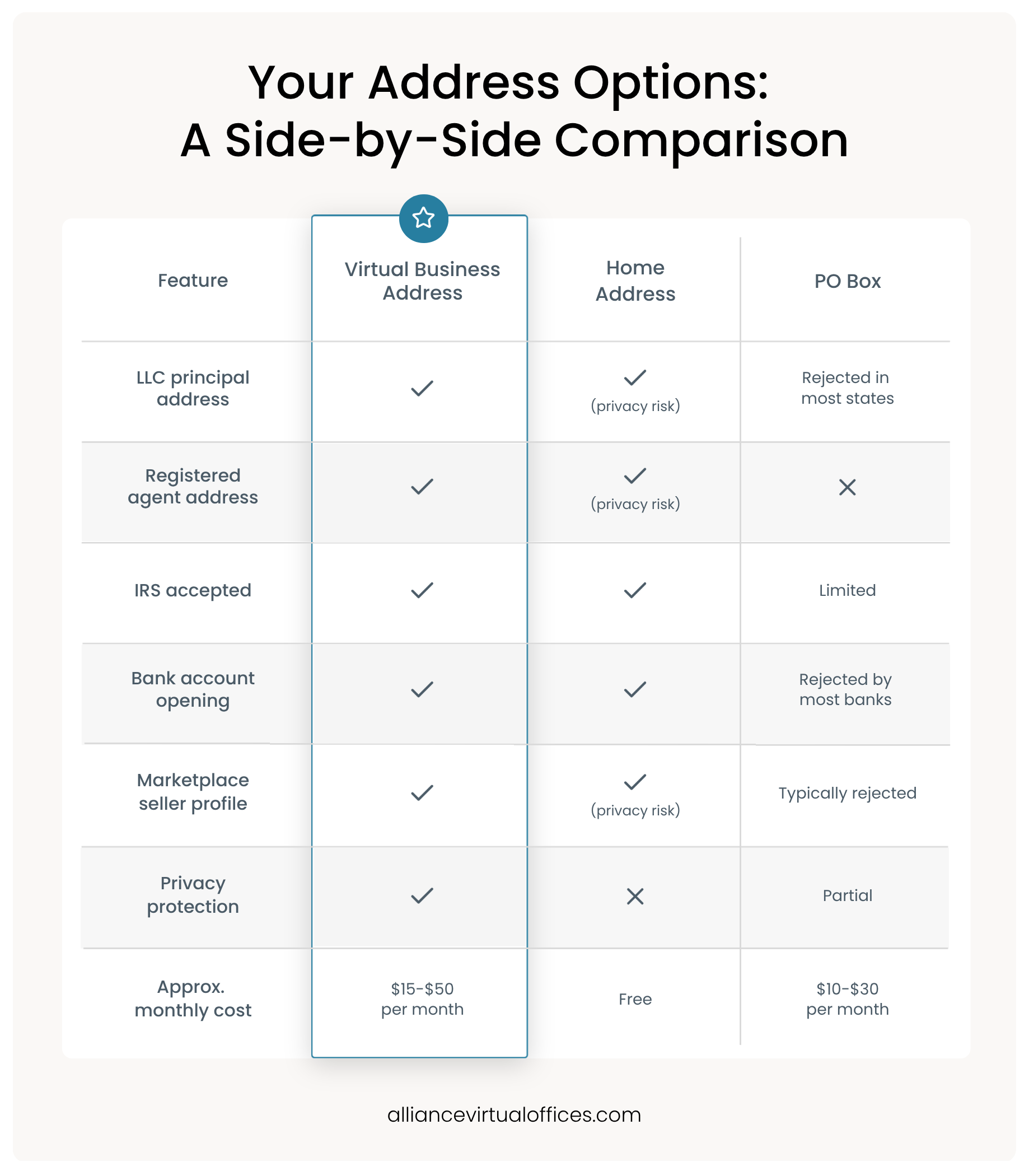
Before you choose a business address for your online business, it helps to see the three realistic options next to each other. The table below compares a home address, a P.O. Box, and a virtual business address across the functions that typically matter most to an online seller:
Home Address: When It Works and When It Doesn’t
A home address works for a sole proprietor who accepts public disclosure, or for someone in the very early stages of setting up their business who has yet to form an LLC.
But it stops working the moment privacy matters. If you form an LLC in a state where the principal address becomes public record, or you list yourself as an online marketplace seller, your home address goes on display. For anyone who wants to keep their personal life and business separate, it’s best to avoid listing your home address.
P.O. Boxes: Why They Often Fall Short
A P.O. Box feels like a privacy fix, but it falls short on most of the tests that count. Most states reject a P.O. Box as an LLC’s principal place of business. Most banks reject it for a business account application. Equally, Amazon and the major marketplace platforms require a verifiable physical street address, which a P.O. Box isn’t.
A P.O. Box handles simple mail receipt. Beyond that, it leaves the compliance and legal boxes unchecked.
Virtual Business Address: The Full Picture
A virtual business address is a real commercial street address at an established location. It’s typically accepted for LLC formation, IRS correspondence, bank account verification, and online marketplace seller profiles, all while keeping your home address off public records. For a home-based online business, that combination is usually a practical decision.
Read More: Should You Use Your Home Address for Your Business?
Legal Requirements: What Your Business Structure Demands
Your business structure decides how strict the address rules get. A sole proprietor has more flexibility, but an LLC has specific obligations that vary by state. Getting them wrong can slow down your formation or your bank application.
LLC Formation: Principal Address and Registered Agent
Most states require a physical street address, not a P.O. Box, for an LLC’s principal place of business. Separately, you need a registered agent address in the state of formation. These two addresses aren’t the same thing, and both typically become part of a public filing.
A registered agent address is where legal documents are served, and it must be an address where someone is available during business hours. By contrast, a principal business address identifies where the business operates. A home-based owner who uses a home address for either one has just published it.
Does the IRS Accept a Virtual Business Address?
The IRS generally accepts virtual business addresses for EIN applications, tax correspondence, and business filings, as long as the address reliably receives and forwards mail. One detail worth knowing is that the address registered on your EIN application becomes the IRS’s address of record, so choose an address you intend to keep long-term and monitor it.
State-by-State Rules for LLC Addresses
Requirements aren’t uniform. Most states require a physical street address in the state of formation for the registered agent, though some allow an out-of-state principal address. Because the rules shift across state lines, check your specific state’s requirements at formation. In practice, a registered agent can hold the agent address while a virtual office address covers the principal place of business.
A few states also publish the principal address in a searchable business registry, while others keep it shielded. If you plan to register your business in more than one state, or you expect to expand later, map out which addresses will be public in each before you file. That small bit of homework saves you from publishing a home address you cannot easily retract.
Read More: Principal Office vs. Registered Agent Address: What’s the Difference?
Unlock Our Current Virtual Office Offers
Enter your email below and we’ll send you the latest available promotions and monthly specials for Virtual Offices, Meeting Rooms, and Live Receptionists.
Marketplace and Platform Address Rules
If you sell items on a marketplace, the platform sets its own address bar, and it’s often higher than you expect. This is where a P.O. Box tends to fail and a home address overshares.
Etsy, Shopify, and Other Platforms
Etsy requires a verifiable address for payment processing. Shopify uses your business address for tax purposes and fraud prevention. Across the major ecommerce platforms, the pattern holds that a legitimate physical street address passes while a P.O. Box usually fails verification.
Amazon Seller Address Requirements
Amazon requires a valid business address on every seller account for tax documentation and the seller profile. A virtual business address typically meets that requirement, while a P.O. Box usually doesn’t. High-volume sellers usually fall under the INFORM Consumers Act disclosure.
The INFORM Consumers Act: What Marketplace Sellers Need to Know
The INFORM Consumers Act took effect in 2023, and it changed what information online marketplaces must collect. Platforms are now required to collect and verify contact information from high-volume third-party sellers, defined as those with 200 or more transactions and at least $5,000 in annual gross revenue.
As per FTC consumer guidance, sellers may provide details on their country, state, phone, and email rather than a full home address when privacy concerns exist. A virtual business address gives marketplace sellers a compliant, professional address that separates your personal address from your business address.
Will Banks Accept a Virtual Business Address?
In most cases, national banks and business-focused online banks accept a virtual business address for a business checking account. The requirement they care about is a real, verifiable commercial street address, not a P.O. Box.
Some institutions ask for proof-of-address documentation, such as a service agreement from your virtual office provider. Requirements vary by bank, so confirm with the specific institution before you apply. Walking in with your documentation at the ready tends to make the process much smoother.
How to Get a Business Address for Your Online Business
Getting set up with a business address for your online business is straightforward once you know what to look for. The two things that trip people up are choosing a provider that meets compliance requirements and using the address consistently everywhere.
What to Look for in a Provider
A reliable virtual business address provider like Alliance Virtual Offices will give you a real commercial street address in an actual building, not a residential one.
For any provider, look for mail scanning and forwarding services, compliance documentation for LLC formation and banking, and USPS CMRA (Commercial Mail Receiving Agency) compliance. Addresses in established business districts tend to carry more credibility with banks and the IRS.
Setting Up and Using Your Address Consistently
Once you’ve set up your business address, apply it everywhere the same way, across your LLC formation documents, IRS EIN application, bank account, marketplace seller profiles, and business licenses. Consistency isn’t a nice-to-have here. Discrepancies across filings can create friction with banks and tax authorities, so match the address exactly across every record.
For online businesses that need a verified commercial street address, a virtual office address from a national provider supplies the address, mail handling, and compliance documentation that banks and the IRS look for.
Choosing the Right Business Address for Your Online Business
For most home-based and ecommerce sellers, the address decision comes down to whether you want to tie your personal address to your business filings, marketplace profiles, and public LLC records. For most online business owners, the answer is no, and a virtual business address is the practical path forward.
Alliance Virtual Offices offers commercial street addresses in hundreds of US cities, with mail scanning, forwarding, and the documentation most banks and state filing offices request, starting at just $49 per month.
The right business address for your online business is the foundation everything else sits on. Get that decision right early, and it simplifies the rest of your setup.
You can browse virtual office locations across the US by city and state to find an address that fits your online business.
Frequently Asked Questions
Does the IRS accept a virtual address for business?
Will banks accept a virtual business address?
Can I use my home address for my LLC?
What is the INFORM Consumers Act and how does it affect ecommerce sellers?
Further Reading


