
- Amazon’s Address Rules: What’s Allowed & What Isn’t
- How to Use a Virtual Address in Amazon Seller Central (Step-by-Step)
- Risks & Red Flags That Trigger Suspensions
- Best Practices for Long-Term Seller Compliance
Q: Can I use a virtual address for my Amazon Seller Central account without getting suspended?
A: Yes, but only if the virtual address is a real, staffed commercial office and is used consistently across your Amazon account, EIN, and business filings. Amazon does not accept PO Boxes, UPS/mailbox stores, or disposable digital mailbox services.
Sellers get suspended when their address cannot be verified, appears as a CMRA, or does not match official business documents. A properly structured virtual office address solves privacy concerns while meeting Amazon’s verification and KYC requirements.
Selling on Amazon means playing by Amazon’s rules, especially when it comes to business verification. One of the fastest-growing causes of seller suspensions today is address-related noncompliance.
As Amazon tightens identity verification, re-verification, and KYC enforcement, sellers are increasingly being flagged not for selling violations, but for using the wrong type of business address.
KYC Enforcement: The process Amazon (and other marketplaces) uses to verify who you are, that your business is real, and that it can be held accountable.
Home-based sellers want privacy. International sellers want a U.S. presence. Growing brands want to look legitimate without leasing unnecessary office space. That’s why virtual addresses are appealing.
But not all virtual addresses are created equal.
Amazon allows virtual business addresses—but only when they represent a real, verifiable commercial location tied to an actual business. Mailbox services, PO Boxes, and low-quality digital address providers are a common trigger for account reviews and sudden suspensions.
This guide explains exactly what Amazon accepts, what raises red flags, and how to use a compliant virtual office address safely in Seller Central without putting your account at risk.

Can You Use a Virtual Address with Amazon Seller Central?
Short answer: yes, but only if it’s a real commercial address tied to an actual business location.
Amazon does not prohibit virtual addresses. What Amazon prohibits are addresses that cannot be verified as legitimate business locations.
That distinction matters.
A compliant virtual office address is:
- A real, commercially zoned office building
- Staffed during business hours
- Associated with a legitimate business service agreement
A non-compliant address is typically:
- A PO Box
- A UPS Store or private mailbox
- A digital mailbox provider with no real office presence
Amazon’s verification systems are designed to confirm that a real business exists behind the account. As Amazon expands its KYC (Know Your Customer) processes, address checks have become stricter, not looser.
That’s why choosing the right provider matters from day one.
Amazon’s Address Rules: What’s Allowed & What Isn’t
Amazon does not publish a simple checklist, but enforcement patterns are consistent across Seller Central suspensions and re-verification requests.
Addresses Amazon Generally Accepts
- Commercial office addresses
- Virtual offices located in real office buildings
- Addresses with onsite staff who receive mail
- Addresses that match EIN, LLC, and tax records
These work because Amazon can verify them through public databases, postal records, and third-party validation tools.
Addresses That Trigger Problems
- PO Boxes (explicitly prohibited)
- UPS Stores and mailbox stores
- CMRA addresses not aligned with business filings
- Temporary or disposable digital mailbox services
- Addresses that appear across dozens of unrelated sellers
Mismatches are one of the fastest ways to trigger an account review. If your Amazon business address doesn’t match your EIN letter, LLC registration, or tax forms, Amazon’s systems flag it.
For a deeper breakdown of risky address types, see this guide on CMRA address risks:
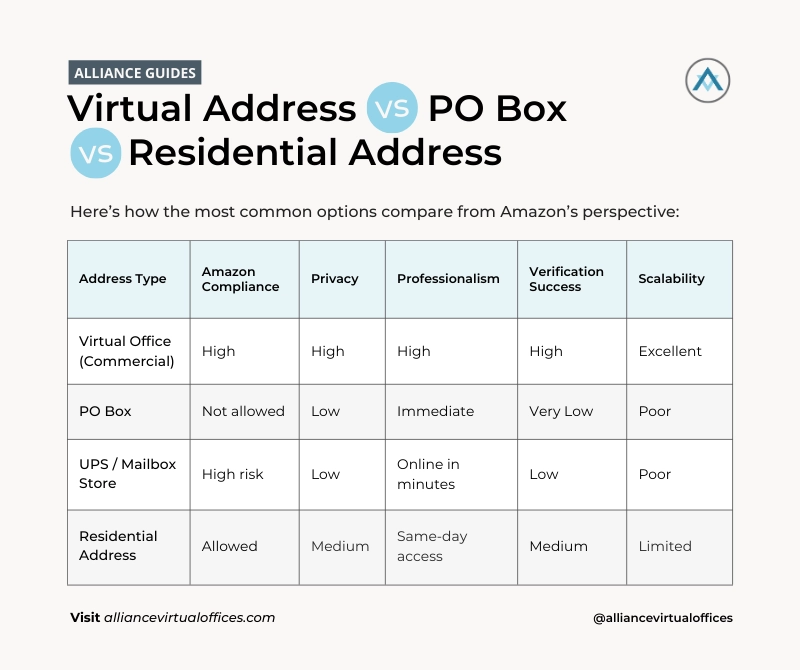
Residential addresses technically work, but many sellers avoid them due to privacy risks and long-term scaling limitations.
A compliant virtual office gives you a professional business presence without exposing your home address or renting unnecessary space.
To understand how a legitimate virtual office is structured, see this virtual business address guide: https://www.alliancevirtualoffices.com/virtual-office-blog/virtual-business-address/
How to Use a Virtual Address in Amazon Seller Central (Step-by-Step)
Using a virtual address incorrectly is just as risky as using the wrong one. Here’s how to do it properly.
Step 1: Obtain a Compliant Virtual Office
Choose a provider offering a real commercial office location with staff onsite. Avoid mailbox-only services.
A true virtual office address looks and functions like a traditional office address in public records.
Learn more about what qualifies as a proper virtual office address here: https://www.alliancevirtualoffices.com/virtual-offices/
Step 2: Update Your Business Address in Seller Central
In Seller Central:
- Go to Settings → Business Information
- Update your Legal Business Address
- Ensure the formatting matches your legal documents exactly
Avoid abbreviations or variations that differ from your EIN or LLC records.
Step 3: Update Your Return Address
Amazon treats return addresses separately.
- Navigate to Shipping Settings
- Update your default return address
Many sellers overlook this step, creating mismatches during audits.
Step 4: Align EIN and LLC Filings
Your Amazon address should match:
- IRS EIN confirmation letter
- State LLC or corporation registration
- Tax forms submitted to Amazon
If your filings still show a home address, update them before Amazon requests re-verification.
Helpful reference: https://www.alliancevirtualoffices.com/virtual-office-blog/llc-business-address/
Step 5: Monitor Account Health
Check your Account Health dashboard regularly. Address-related notifications often appear here before formal suspension notices.
Compliance: What Amazon Checks During Verification
Amazon may verify your address through multiple methods, often without telling you which one triggered the review.
Common checks include:
- Commercial building databases
- USPS and CMRA registries
- Public business registration records
- Third-party KYC providers
Amazon may also send physical mail to your address to confirm occupancy. Missing or ignoring this verification mail is a common cause of sudden account suspension—especially for sellers using unstaffed or poorly managed mailbox services.
What Happens During Amazon Re-Verification
Amazon may re-verify your business at any time, often without warning. These checks can occur during initial setup, after account updates, or months—or even years—later. In many cases, re-verification is triggered by routine audits, internal system updates, or changes to Amazon’s risk models rather than seller behavior.
Amazon does not always disclose what triggered the review, which makes address stability and documentation consistency critical.
What Counts as Acceptable Proof of Address
Amazon looks for documents that clearly demonstrate your business operates from a real, commercially zoned location and that the address is actively associated with your company.
Documents Amazon Commonly Requests
- Utility bill
- Lease or virtual office service agreement
- EIN confirmation letter
- State business registration
A quality virtual office provider supplies documentation specifically designed for marketplace verification.
This is where low-cost mailbox services fail. They cannot produce acceptable agreements or proof of commercial tenancy.
Risks & Red Flags That Trigger Suspensions
Address-related suspensions are often preventable. Most stem from the same patterns.
Address-Related Issues That Put Accounts at Risk
High-Risk Behaviors
- Using PO Boxes or UPS Stores
- Frequent address changes
- Document mismatches across platforms
- Using addresses shared by many unrelated sellers
- Ignoring verification mail
- Inconsistent business names or licenses
How to Reduce Risk
- Choose a staffed commercial address
- Keep one stable address long term
- Align all legal documents
- Respond to Amazon requests immediately
Amazon prioritizes stability and traceability. The more consistent your records, the lower your risk.
Best Practices for Long-Term Seller Compliance
Address compliance isn’t a one-time task. It’s an ongoing discipline.
Best practices include:
- Maintaining the same business address for at least 12 months
- Keeping address formatting identical across Amazon, EIN, and state filings
- Updating IRS and state records promptly when changes are required
- Using mail forwarding so verification notices aren’t missed
- Avoiding address updates during audits or high-risk selling periods
- Keeping current digital copies of service agreements and verification documents
- Reviewing Account Health monthly and after major account changes
Sellers who treat address management as infrastructure, not an afterthought, experience fewer disruptions and fewer verification-related account reviews.
Why Choose Alliance Virtual Offices
Alliance Virtual Offices provides virtual office addresses designed with marketplace verification in mind, making them a strong fit for Amazon sellers who need a stable, compliant business address.
What sets Alliance apart:
- Real, staffed commercial office locations
- Address documentation accepted by major marketplaces
- Nationwide and international coverage
- Long-term address stability
Beyond the address itself, sellers can add:
- Mail forwarding to catch verification notices
- On-demand meeting rooms for vendors or partners
- Live receptionist services to strengthen legitimacy
Explore available meeting rooms here: https://www.alliancevirtualoffices.com/meeting-room-locations
Learn about live receptionist support: https://www.alliancevirtualoffices.com/live-receptionist/
For sellers expanding across states or into the U.S. market, Alliance provides a scalable foundation without long-term leases.
For Amazon-specific guidance, see: https://www.alliancevirtualoffices.com/virtual-office-blog/amazon-seller-business-address/
Choose the Right Address, Protect Your Amazon Business
Amazon does allow virtual addresses, but only when they’re real, verifiable commercial locations.
Most address-related suspensions come from shortcuts: mailbox services, mismatched documents, or unstable providers.
A properly structured virtual office solves privacy concerns while meeting Amazon’s verification standards.
If you want a stable, Amazon-safe business address designed for long-term compliance, explore Alliance Virtual Offices and set your Seller Central account up the right way from the start.