
- Why Appointment Setting Is More Than Booking a Call
- The Psychology of Where Sales Meetings Happen
- How Meeting Rooms Improve Appointment Quality
- When B2B Teams Should Move Beyond Zoom
Q: Why does the meeting environment matter in a B2B appointment setting strategy, and how does it impact deal quality and close rates?
A: Because professional meeting rooms increase buyer trust, focus, and commitment, turning scheduled appointments into higher-quality conversations that close faster—especially in high-value B2B sales.
Most B2B teams spend an enormous amount of time refining their appointment setting strategy.
They optimize outbound sequences.
A/B test subject lines.
Fine-tune discovery questions.
Invest in CRMs, call analytics, and enablement tools.
But there is one variable that rarely gets the same attention.
Where the meeting actually happens.
Harvard Business Review research has shown that buyers form trust and credibility judgments early in business interactions, often before a solution is fully evaluated.
In high-value B2B sales, the environment of a sales conversation plays a much bigger role than most teams realize. The setting signals credibility, seriousness, and authority before a single word is spoken.
A polished pitch delivered from a kitchen table does not land the same way as the same pitch delivered in a professional meeting room.
This article breaks down why meeting rooms are an overlooked but high-impact part of a modern B2B appointment setting strategy, when teams should move beyond Zoom, and how Alliance Virtual Offices helps sales teams turn booked meetings into closed deals.
Why Appointment Setting Is More Than Booking a Call
At a surface level, appointment setting often looks like a volume game. Teams track how many calls are booked, how many demos are scheduled, and how full the calendar becomes over time.
But calendar density is not the same thing as sales progress.
A strong B2B appointment setting strategy is not about filling time slots. It is about creating qualified, engaged, decision-ready conversations that actually move deals forward.
When teams focus too heavily on low-friction booking alone, problems surface quickly. Prospects show up distracted or underprepared. Meetings feel exploratory instead of commercial. Decision-makers delegate attendance to junior stakeholders, and calls often end with vague follow-ups like “send me more information” rather than clear next steps.
This is rarely a script issue or a follow-up cadence problem. More often, it is a context problem.
Sales conversations do not happen in isolation. Buyers interpret seriousness, intent, and authority based on signals that extend well beyond what is being said. One of the most influential signals is the environment in which the meeting takes place.
An appointment setting strategy that ignores where conversations happen leaves conversion on the table, especially as deal size and complexity increase.
Appointment Setting as Deal Qualification, Not Lead Handling
Many teams still treat appointment setting as a front-of-funnel function, where the goal is simply to book the call, hand it off, and move on to the next lead.
In more mature B2B sales organizations, appointment setting plays a much more strategic role. It is already part of deal qualification.
The way a meeting is positioned, scheduled, and hosted sends signals about how serious the opportunity is long before pricing or proposals enter the conversation. Meetings that are booked casually tend to be treated casually, while meetings framed as business discussions are approached with more focus and intent.
This is where meeting environment quietly reinforces buying readiness.
Studies indicate that first impressions in B2B settingsform rapidly and strongly influence buyer perception and trust — and because trust is a primary factor in complex buying decisions, early interaction signals matter nearly as much as what’s discussed in the meeting itself.[EE1]
When a prospect agrees to meet in a professional setting, they are signaling readiness to engage at a higher level. They are more likely to prepare, bring relevant stakeholders, and allocate real decision-making time.
From a revenue perspective, this means appointment setting is not just a pipeline activity. It is a filtering mechanism that separates curiosity from buying intent.
Meeting rooms help enforce that distinction.
The Psychology of Where Sales Meetings Happen
B2B buyers are not immune to psychology just because decisions are framed as rational.
In fact, the more money, risk, and accountability involved, the more buyers rely on environmental cues to reduce uncertainty.
Environment as a Trust Signal
Professional settings communicate stability.
A neutral, well-run meeting room signals that the business behind the pitch is established, organized, and invested in the outcome. It suggests that the seller expects serious conversations with serious buyers.
Sales research from platforms like Gong and HubSpot shows that early meeting signals — including professionalism and structure — strongly influence buyer engagement and deal momentum.
By contrast, informal or personal environments introduce friction.
Background noise, visual clutter, interruptions, and casual settings subtly undermine authority. Even when buyers do not consciously notice these elements, they influence how credible and committed the seller feels.
Authority Is Perceived Before It Is Earned
In B2B sales, authority is not established only through expertise. It is also inferred from context.
Research shows that 81% of B2B buyers won’t move forward unless they trust a company — meaning early signals in meetings matter almost as much as messaging itself.
Buyers subconsciously ask:
Is this company established?
Do they work with clients like us?
Are they used to serious conversations?
The meeting environment answers these questions immediately.
A professional meeting room suggests repeatability. It implies the seller has done this before, many times, with many clients. That perception lowers buyer resistance and shortens trust-building cycles.
This matters most in competitive deals.
When buyers are choosing between comparable solutions, they often choose the option that feels safer, more credible, and more established. The environment reinforces that feeling even when products and pricing are similar.
Meeting rooms do not replace proof points.
They make proof points easier to believe.
Why Professional Spaces Increase Commitment
When a prospect agrees to meet in a professional environment, they are making a psychological investment. They are more likely to allocate real time to the conversation, prepare intentionally, and approach the meeting as a business discussion rather than a casual call.
This is one reason in-person or professionally hosted meetings tend to produce higher engagement and stronger follow-through. The act of showing up already filters for seriousness and intent.
Neutral Space Reduces Risk Perception
Meeting rooms remove personal context from the equation.
The focus stays on the business problem, the solution, and the decision. There are fewer distractions and fewer signals that blur the line between personal and professional.
This is especially important in first meetings, proposal reviews, and negotiations, where buyers are evaluating both the offer and the organization behind it.
How Meeting Rooms Improve Appointment Quality
Professional meeting rooms do not just change how meetings look. They change how meetings function.
Higher Show Rates
A scheduled meeting room creates accountability. There is a defined location, a set time, and a clear expectation around attendance, which makes meetings feel harder to casually cancel or postpone.
For sales teams, this results in fewer wasted slots and more productive calendars.
Fewer Distractions, Better Focus
Distraction is one of the biggest killers of modern sales conversations.
Notifications.
Multitasking.
Side conversations.
Professional meeting rooms create a controlled environment where attention stays on the discussion. This is especially valuable when presenting complex solutions or pricing structures.
Clearer Authority Positioning
Meeting rooms subtly reinforce who is leading the conversation.
They create a host-guest dynamic rather than a peer-to-peer video call. This matters in consultative selling, where authority and confidence directly affect buyer trust.
Stronger Closing Momentum
Deals often stall when meetings feel exploratory instead of decisive.
Professional environments encourage structured agendas, clearer next steps, and more confident asks. The setting supports progression rather than ambiguity.
For late-stage conversations, this can be the difference between “we’ll think about it” and “let’s move forward.”
Meeting Rooms as a Signal of Buying Stage
Not every meeting deserves the same level of production.
High-performing sales teams intentionally match meeting format to deal stage.
Early conversations prioritize speed and volume.
Later conversations prioritize depth and commitment.
Meeting rooms act as a clear transition point between those stages.
What the Signal Looks Like to Buyers
When a seller proposes moving a conversation into a professional setting, buyers often interpret it as:
“This deal is real.”
“This conversation matters.”
“This is no longer exploratory.”
That shift changes how buyers show up.
They bring questions instead of curiosity.
They bring objections instead of interest.
They bring decision-makers instead of note-takers.
From a strategy standpoint, meeting rooms help sellers control deal pacing. They prevent late-stage conversations from feeling like early-stage calls and reduce the risk of deals stalling due to ambiguity.
This is especially powerful for remote-first teams that otherwise struggle to create clear stage separation.
When B2B Teams Should Move Beyond Zoom
Zoom is not the enemy. It is a powerful tool when used intentionally.
The mistake many teams make is treating Zoom as the default for every stage of the sales process.
Meeting rooms should not replace virtual calls entirely. They should be used as leverage at key moments.
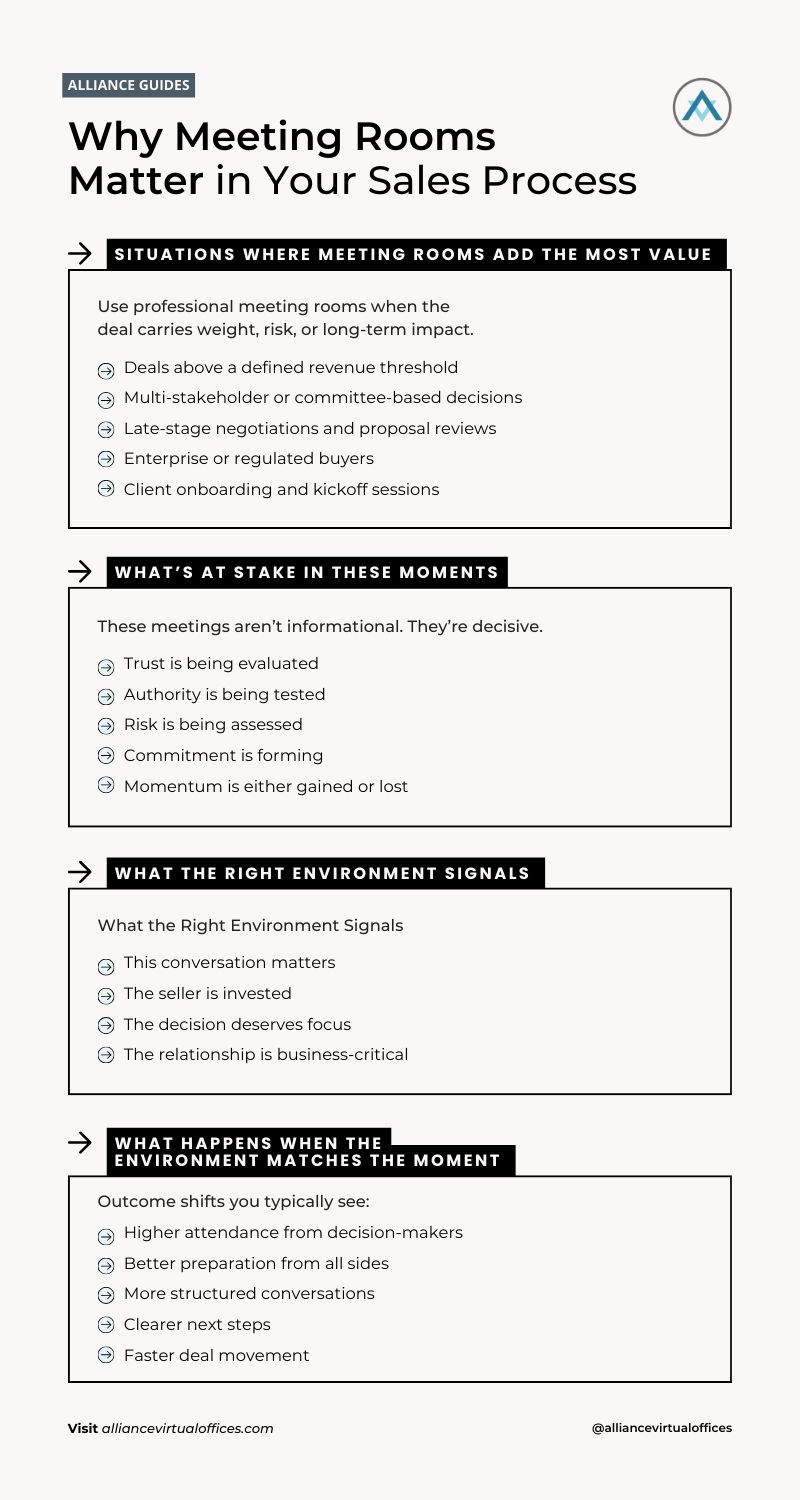
In these moments, environment amplifies intent.
The buyer understands that the conversation matters.
The seller signals investment and professionalism.
The meeting becomes an event, not just another call.
A Hybrid Sales Strategy That Scales
The most effective teams blend virtual efficiency with physical presence.
Early discovery can happen over Zoom.
High-stakes conversations move into professional meeting rooms.
Follow-ups and coordination return to virtual channels.
This approach keeps costs flexible while maximizing impact when it matters most.
Meeting rooms become a strategic tool rather than an overhead expense.
Zoom Fatigue Is a Real Sales Risk
Buyers today are inundated with video calls, from internal meetings and vendor demos to status updates and sales pitches. As a result, many sales conversations blur together in the buyer’s mind. Even strong presentations can feel interchangeable when they are delivered through the same medium.
Professional meeting rooms help break that pattern by creating a distinct memory, resetting attention, and elevating the conversation above routine calls.
For late-stage deals, memorability matters. Buyers are more likely to recall conversations that felt different, intentional, and focused.
Using a professional meeting room is one of the simplest ways to stand out without changing your messaging or offer.
Real-World B2B Scenarios Where Meeting Rooms Win
The impact of professional meeting space becomes even clearer when applied to specific sales contexts.
Consultants Pitching Six-Figure Retainers
When consultants present strategic frameworks, timelines, and pricing in a professional setting, the conversation shifts from exploration to partnership.
The environment supports the perception of expertise and long-term value.
Agencies Presenting Strategy Decks
Agencies often compete on similar capabilities. The meeting experience becomes part of the differentiator.
A polished room, a structured presentation, and a focused discussion elevate perceived quality before creative work is even reviewed.
SaaS Teams Running Enterprise Demos
Enterprise buyers expect professionalism at every touchpoint.
Running demos or architecture reviews in a professional meeting room aligns with how large organizations make decisions and signals readiness to operate at scale.
Legal, Financial, and Regulated Sales
For industries where trust, confidentiality, and precision matter, meeting environment is not optional.
Professional settings reinforce security, seriousness, and accountability in ways virtual calls cannot always match.
Local Presence Without Local Offices
Meeting rooms allow national or global sales teams to meet clients locally without maintaining full offices.
A rep can host meetings in multiple markets while presenting a consistent, professional brand experience.
Onboarding as the First Retention Event
Many teams think about meeting rooms only in the context of closing.
But onboarding is often where long-term revenue is secured or lost.
Client kickoff meetings held in professional environments establish expectations around structure, accountability, and partnership. They frame the relationship as a business engagement, not a transactional service.
This is especially important for retainers, long-term contracts, and enterprise agreements.
When onboarding feels intentional, clients are more likely to:
- Engage consistently
- Respect boundaries and timelines
- Perceive value earlier
Meeting rooms turn onboarding into a trust-building milestone rather than a procedural step.
How Alliance Virtual Offices Supports High-Converting Sales Meetings
Alliance Virtual Offices is built to support sales teams that need flexibility without sacrificing credibility.
With thousands of meeting rooms available worldwide, sales teams can host professional meetings wherever their prospects are.
Designed for Geographic Flexibility Without Brand Drift
One of the biggest challenges for distributed sales teams is maintaining consistency across markets.
Distributed sales teams often struggle with consistency across markets, from different reps and cities to varying client expectations. Alliance Virtual Offices addresses this by offering access to professional meeting environments that feel consistent regardless of location.
Sales leaders can standardize how high-stakes meetings are run without forcing teams into permanent offices. This allows organizations to scale geographically while protecting brand perception.
For revenue teams, that consistency reduces risk.
Deals feel predictable.
Meetings feel repeatable.
Outcomes become easier to forecast.
This is why Alliance Virtual Offices functions as sales infrastructure, not just workspace.
Built for Modern Sales Teams
Meeting rooms are available by the hour, half day, or full day, with flexible, on-demand booking across major business markets worldwide. This allows sales teams to scale their presence as needed without locking into long-term commitments.
You can explore available meeting rooms here:
https://www.alliancevirtualoffices.com/meeting-room-locations
Professional Front-Desk Experience
First impressions do not start when the meeting begins. They start the moment a prospect arrives — and research shows that initial perceptions form within seconds and influence how interactions unfold. Studies of social interaction suggest that people form lasting judgments very early in a meeting, shaping how they engage afterward.
Professional reception, clear signage, and smooth check-in reinforce brand credibility before the conversation even starts.
Consistent Brand Presence Across Markets
Whether meeting in New York, London, or Los Angeles, the experience remains professional and predictable.
This consistency matters for distributed sales teams serving enterprise and high-value clients.
More Than Workspace
Alliance Virtual Offices supports sales teams with more than just rooms.
Virtual office solutions, receptionist services, and professional addresses work together to create a complete sales infrastructure.
For hybrid sales teams, this means credibility without overhead.
For growing teams, it means presence without friction.
Learn more about virtual office solutions here:
https://www.alliancevirtualoffices.com/virtual-offices-locations
Preparing for High-Stakes Sales Meetings
Using a meeting room effectively requires more than booking a space.
Preparation matters.
- Agenda clarity
- Room setup
- Technology checks
- Printed materials or shared screens
For a practical breakdown, this meeting room rental checklist is a useful reference:
https://www.alliancevirtualoffices.com/virtual-office-blog/hourly-meeting-room-rental-checklist/
When environment and preparation align, meetings feel intentional rather than improvised.
The Fastest Way to Improve Deal Quality Without Changing Your Pitch
B2B appointment setting is not about booking more calls.
It is about moving deals forward.
Professional meeting rooms help sales teams:
- Increase meeting quality
- Build trust faster
- Position authority more clearly
- Create momentum toward close
In a sales environment where buyers are overwhelmed with options, details matter. The setting of a conversation is one of the most underrated details of all.
If your team is already generating leads and booking meetings, the next optimization is not another script or tool.
It is upgrading the environment where decisions are made.
High-performing sales teams do not leave critical variables to chance.
They control messaging.
They control timing.
They control environment.
If your team is already investing in lead generation and appointment setting, upgrading where those conversations happen is one of the highest-leverage moves available.
Alliance Virtual Offices gives sales teams the ability to meet anywhere, present professionally, and close confidently without locking into fixed office costs.
When the deal matters, the room should match.
For your next high-stakes sales conversation, consider booking a professional meeting room through Alliance Virtual Offices:
https://www.alliancevirtualoffices.com/meeting-room-locations