
- What Is a Virtual Address and Virtual Office?
- How to Get a Virtual Address for Your LLC
- Privacy & Safety: Why Your Home Address Isn’t Enough for Your LLC
Q: Why do you need a virtual address when setting up an LLC in 2026?
A: A virtual office gives your LLC a real, verifiable business address without a lease. It keeps your home address off public filings, meets state rules that reject P.O. Boxes, supports bank and platform verification, and gives you a stable address as you grow.
If you’re forming an LLC in 2026, your business address is no longer a formality. It’s part of how banks verify you, how platforms approve you, and how credible your company appears from day one.
A home address creates privacy risks.
A P.O. Box fails verification.
And mail-only solutions often fall apart when real-world validation is required.
That’s why many modern businesses start with a virtual office. It’s a real commercial business address backed by physical workspace, onsite staff, and proper mail handling.
This 2026 guide explains:
- why the importance of virtual office for business setup has increased
- how a virtual address supports LLC registration, banking, and verification
- why address stability now matters as much as cost savings
- how to choose a provider that won’t limit you later
Why Your LLC Needs a Virtual Business Address
For startups, the importance of virtual office for business setup can’t be overstated. It provides:
- Compliance with state rules prohibiting P.O. Boxes.
- A professional image that builds trust with clients, investors, and banks.
- Privacy by keeping your home address out of public records.
- Lower startup costs compared to traditional office leases.
- Flexibility to expand into new markets without moving.
In today’s business environment, a virtual address for new business is more than a convenience. It’s an essential foundation.
See what plan fits your startup. Explore flexible plans.
What’s New in 2026: Why Business Addresses Matter More Than Ever
In earlier years, virtual offices were mainly about convenience and cost. In 2026, they play a much bigger role in how businesses are verified, trusted, and allowed to operate.
Here’s what’s changed:
Verification is stricter
Banks, payment processors, marketplaces, and licensing bodies increasingly verify addresses. Residential addresses and mailbox-style services are flagged more often.
Address stability matters
Businesses are expected to maintain a consistent, professional address over time. Changing addresses frequently can delay approvals and trigger reviews.
Remote-first is assumed
Most service businesses, consultants, and startups no longer plan around full-time offices. Infrastructure is built for flexibility first.
Credibility is evaluated instantly
Your address appears across filings, contracts, websites, invoices, and databases. A commercial address tied to real space signals legitimacy immediately.
Physical backing differentiates providers
In 2026, the difference between a “virtual address” and a virtual office with real workspace access is no longer subtle. It affects approvals, trust, and long-term usability.
A virtual office is no longer a workaround. It’s baseline infrastructure for modern LLC formation.
With a virtual business address, you don’t need to lease expensive office space to protect your home, or to get that all-important professional exterior.
With a virtual office, you get a recognized business address, a place to receive mail, and flexible access to professional onsite space, without having to pay for full-time office rental.
Note: We are not lawyers and cannot give advice. We advise that you speak to an appropriate tax advisor or lawyer to help you best understand your options to protect your personal assets such as any savings, your home, etc., when setting up your business.
What Is a Virtual Address and Virtual Office?
A virtual address is a recognized street address at a physical office location. The location is staffed, and personnel handle incoming mail, greet visitors, and provide access to meeting rooms or workspaces when needed.
When you purchase a virtual office plan, you gain the right to use that commercial address for your business. This allows you to:
- Register your LLC with state authorities.
- Apply for local business licenses.
- Open a business bank account.
- Build credibility with clients and vendors.
A virtual office often includes more than just an address. Depending on the plan, you may also have access to mail forwarding, live receptionist services, or hourly/daily workspace. This combination gives you the benefits of a traditional office without the ongoing costs of a lease.
How to Get a Virtual Address for Your LLC
Getting a virtual address for your LLC takes a few steps, and most of them happen online. Here’s the typical process:
- Choose a location in the state where you plan to form your LLC or do business.
- Pick a plan that includes mail handling, plus meeting rooms or a business phone number if you need them.
- Complete USPS Form 1583, which authorizes the provider to receive mail on your behalf. It must be notarized.
- List the address on your Articles of Organization as your principal business address, and name a registered agent for service of process.
- Update your records, including your bank, IRS records, website, invoices, and contracts, so your address stays consistent everywhere.
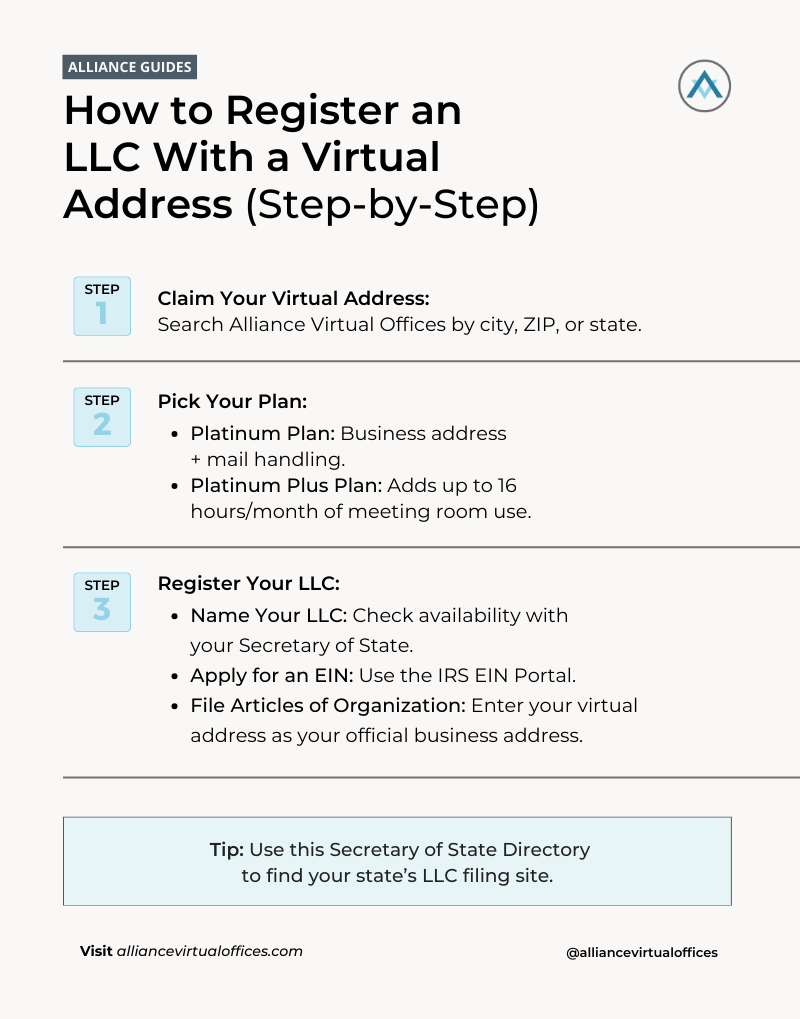
For a full walkthrough, see our guide on how to set up a virtual business address for LLC registration.
The Importance of a Virtual Office for Business Setup
The importance of a virtual office for business setup extends well beyond basic compliance. For new businesses, it provides a solid foundation in three critical areas: credibility, privacy, and flexibility.
First, it offers a professional image. Whether you are a solo consultant or a growing startup, presenting a real commercial address instead of a home or P.O. Box helps build trust with clients, investors, and regulators.
Second, it protects your privacy. Your Articles of Organization and other registration documents are public record. Using a virtual office prevents your home address from being exposed.
Finally, it creates flexibility. Instead of committing thousands of dollars to a lease, you can start your business with a low-cost virtual plan and add services as you grow.
Privacy & Safety: Why Your Home Address Isn’t Enough for Your LLC
While you can use your home address to register an LLC, it creates a series of challenges that outweigh the savings.
When you file Articles of Organization with your state, that document becomes public record. Anyone can search your business and see the address you listed. For some, this may only mean more junk mail. For others, it could mean clients showing up unannounced at their residence or even security risks if disputes arise.
A home address also makes your LLC look less professional. Invoices, contracts, and websites that display a residential location often give the impression of instability. Potential partners may question whether your business is credible.
Perhaps most importantly, using your home address can blur the line between your personal and business lives.
In the event of a lawsuit, this lack of separation could allow an opposing attorney to argue that your business is not truly independent from you personally. If successful, they may gain access to your personal assets, a situation known as “piercing the corporate veil.”
Registered Business Address: Why a PO Box Doesn’t Qualify

A P.O. Box might seem like a logical solution, but states will not accept it for LLC registration.
State authorities require a physical street address where official mail and service of process (SOP) documents can be delivered. Because a P.O. Box is not staffed in the same way, it does not satisfy these requirements.
The limitations of a P.O. Box go beyond registration. You cannot receive SOP mail there, which could cause you to miss critical legal notices.
Banks also typically refuse to open business accounts for companies that list P.O. Boxes. Even some licensing authorities reject applications that list a P.O. Box instead of a commercial address.
By contrast, a virtual address for LLC registration provides a real street address backed by a staffed office. This ensures compliance while offering privacy and credibility.
Address Verification in 2026: Why “Mail-Only” Solutions Fall Short
In 2026, many founders discover too late that not all virtual addresses are treated equally.
Mail-only services and mailbox-style providers may offer privacy, but they often lack:
- staffed business centers
- workspace access
- proper handling for official notices
- credibility during bank or platform verification
When an address can’t be verified as a real place of business, approvals stall.
A virtual office backed by physical space solves this by providing:
- a legitimate commercial address
- onsite staff during business hours
- meeting rooms and offices tied to the address
- long-term address stability as your business grows
This distinction matters more in 2026 than ever before.
Building Trust: Credibility & Professional Image
Professional image is one of the strongest arguments for using a virtual office.
When clients or vendors look up your company, they will see a recognized commercial address. This signals stability and professionalism in a way that a home or P.O. Box cannot.
On business websites, invoices, and contracts, the presence of a professional address reassures stakeholders that your company is legitimate. For industries like accounting, law, and consulting where trust is essential, this can make the difference between winning and losing clients.
Even banks and credit providers are more likely to approve applications when your business lists a real commercial address.
Administrative Efficiency: Mail, Calls, Meeting Room Access
One of the often-overlooked benefits of virtual offices when starting a business is administrative efficiency.
Instead of juggling mail at your home or making trips to a P.O. Box, your virtual office provider handles everything for you. Incoming business mail is received, stored securely, and can be forwarded to you on a schedule that fits your needs.
Many virtual office providers also offer optional business phone numbers and live receptionist services. These features create a more polished experience for callers and save you the time of fielding business calls personally.
When you do need to meet with clients in person, you can book conference rooms or day offices at the same address. This gives you the ability to host professional meetings without paying for space you don’t use daily.
- Mail Handling & Storage: Providers receive, sort, and securely store your business mail.
- Mail Forwarding: Choose to have mail forwarded weekly, monthly, or on demand.
- Optional Phone & Receptionist Services: Bundle a business phone number or Live Receptionist plan.
- Meeting Rooms: Book onsite conference rooms by the hour for client-ready professionalism.
This combination of services streamlines operations so you can focus on growing your LLC.
Scaling & Virtual Office Cost Savings: Pay-as-You-Go Flexibility
Traditional office leases come with long-term contracts, large deposits, and ongoing utility expenses. For a new business, these overhead costs can be overwhelming.
With a virtual office, you enjoy:
- Cost Savings: Average monthly plans start at $49. That’s a fraction of lease costs.
- Flexibility: After a short initial term, Alliance Virtual Offices switches to month-to-month billing.
- Add-On Options: Scale up by adding services like receptionist support, coworking passes, or additional addresses as needed.
A virtual office provides the same professional benefits for a fraction of the cost. Plans start at around $49 per month and typically switch to a simple monthly contract after an initial term. This allows you to budget more easily and invest your savings into growth.
Because virtual offices are modular, you can also add or remove services as needed. Want to test a new market? Add another address in that city. Need more support? Add a Live Receptionist or coworking access.
This pay-as-you-go model allows you to scale at your own pace.
Supporting Remote & Distributed Teams
Today’s businesses rarely operate from a single office. A virtual address helps remote-first and distributed teams by:
- Providing a central hub for mail, legal notices, and business records.
- Offering occasional meeting rooms for hybrid collaboration.
- Supporting multi-state operations without multiple leases.
- Maintaining a consistent business identity across regions.
Your company can maintain one central hub for mail, licensing, and legal notices while team members work from anywhere. When occasional in-person collaboration is required, meeting rooms can be reserved by the hour.
For companies expanding into multiple states, virtual addresses also make it possible to establish a presence without signing local leases. This flexibility is particularly valuable for real estate investors, logistics operators, and consultants who work across state lines.
Using a Virtual Address as a Registered Agent
In most states, you must provide two addresses:
- A business address for your LLC (where a virtual office is acceptable).
- A registered agent address, where someone is available during business hours to receive SOP mail.
While you can technically serve as your own registered agent, doing so requires being available at your listed address every business day. This is impractical for most small business owners.
That’s why many entrepreneurs outsource the role to professional services. Providers like Alliance (through Anderson Advisors) bundle registered agent services with virtual offices.
Failing to properly handle SOP mail can result in default judgments, state fines, or administrative dissolution. Hiring a professional agent ensures compliance and peace of mind.
NEXT STEPS: Learn the 6 Benefits of a Registered Agent
Pros and Cons of Virtual Offices
Pros
- Cost-effective compared to leasing office space.
- Flexible contracts without long commitments.
- Professional image with a credible address.
- Transparent billing and optional add-ons.
- On-demand meeting rooms.
Cons
- Shared space rather than private office.
- Less in-person networking.
- Google Business Profile restrictions in some cases.
Business Entity Types: Why LLCs Stand Out
When choosing a structure, entrepreneurs usually consider three options: sole proprietorship, LLC, or corporation.
A sole proprietorship is the easiest to start but offers no liability protection. Your personal assets are at risk if the business is sued.
A corporation provides strong protection but requires more paperwork and ongoing compliance.
An LLC offers the best of both worlds: liability protection for personal assets, simpler compliance requirements, and flexibility in taxation. That’s why LLCs are the most popular choice for small businesses.
Virtual Addresses for Licensing, Banking, and Credit
Business Licensing
Most states and municipalities require a commercial address on license applications. A virtual address for new business prevents rejections.
Banking
Banks typically verify addresses. P.O. Boxes fail, but a virtual office address meets compliance standards for opening business accounts.
Business Credit
To establish credit:
- Form your LLC or corporation.
- Apply for an EIN.
- Use a commercial business address and phone line.
- Open a business bank account.
- Build trade credit with vendors that report to bureaus.
- Keep records consistent.
- Pay bills on time.
A virtual office supports steps 3 and 4, giving you the credibility needed with banks and bureaus.
Real-World Use Cases
- Consultants & Freelancers: Protect home privacy while projecting professionalism.
- E-Commerce Sellers: Meet marketplace rules that prohibit P.O. Boxes.
- Real Estate Investors: Establish a presence in multiple states without relocating.
- CPAs & Financial Advisors: Stay compliant with boards of accountancy.
- Transport & Logistics Operators: Use virtual addresses to meet DOT/FMCSA compliance.
Broader Benefits of Virtual Offices
Beyond LLC registration, the importance of virtual office for business setup extends to:
- Sustainability: Reduced commute and energy waste.
- Geographic Expansion: Operate in multiple states without multiple leases.
- Remote Team Support: Provide a consistent hub for mail and occasional in-person meetings.
- Productivity: Focus on clients and growth instead of office logistics.
Looking for a virtual office provider?
Alliance Virtual Offices has supported businesses since 2007, with access to 1,400+ business locations nationwide. Thousands of companies use Alliance addresses to register LLCs, manage mail, and access professional workspace without long-term leases.
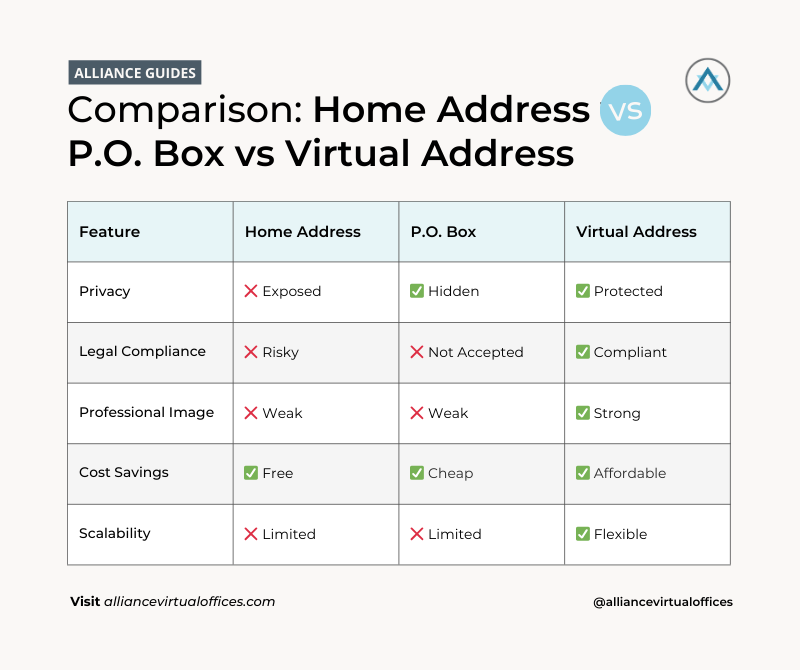
Analysis
- A home address is free but exposes you to risks.
- A P.O. Box hides your home but isn’t compliant.
- A virtual office balances affordability with compliance, credibility, and scalability.
How to Choose the Right Virtual Address Provider
Look for:
- Staffed, licensed commercial locations.
- Reliable mail handling and forwarding.
- Onsite workspace options.
- Nationwide coverage for multi-state presence.
- Transparent monthly pricing with no hidden fees.
Alliance Virtual Offices meets all these criteria with 1,400+ U.S. locations.
Start Your LLC With Confidence in 2026
Don’t risk your privacy, compliance, or credibility with a home address or P.O. Box. With a virtual office for LLC registration, you’ll protect your personal details, stay compliant, and project a professional image at a fraction of traditional lease costs.
See how a virtual office works in practice
Explore what’s included and how businesses use virtual offices for registration, mail, and meetings.
Frequently Asked Questions
Can I use my home address for my LLC?
Can I use a P.O. Box as my LLC business address?
Can a virtual address be my registered agent address?
Can I open a business bank account with a virtual address?
Further Reading