
- Who Qualifies for a Coworking Space Tax Deduction
- What Coworking Expenses Are Tax Deductible
- How to Claim Coworking Expenses on Your Tax Return
Q: Are coworking spaces tax deductible for self-employed professionals?
A: Yes, in most cases. If you’re self-employed, a freelancer, or a small business owner, your coworking space membership fees typically qualify as a deductible business expense under the IRS “ordinary and necessary” standard. Report the expense on Schedule C of your tax return.
If you’re a freelancer, independent contractor, or small business owner working out of a coworking space, you’re likely paying a meaningful monthly cost for that workspace. The good news: your coworking space tax deduction is typically straightforward to claim, and it can meaningfully reduce your taxable income.
Tax rules around workspace deductions can feel opaque, especially in light of recent legislative updates. However, once you understand who qualifies, what expenses are deductible, and how to properly document and report them, the rules become far more straightforward for most self-employed professionals.
This guide covers everything you need to know about claiming a coworking space tax deduction in 2026.
Who Qualifies for a Coworking Space Tax Deduction
If you work for yourself, you almost certainly qualify for a coworking space tax deduction. But the details matter, especially if you operate through a specific business entity or have both W-2 employment and self-employment income.
Self-employed individuals, including freelancers, independent contractors, and gig workers, can typically deduct their coworking membership as a business expense deduction on Schedule C. When the space is used for business purposes, the Internal Revenue Service (IRS) considers workspace costs an “ordinary and necessary” business expense.
However, the rules differ depending on your employment and entity type. Look for the following against your business entity:
| Business Entity | Can Deduct Coworking? | How to Deduct | Notes |
|---|---|---|---|
| Sole Proprietor | ✓ Yes | Schedule C, Line 18 or 27a | Most straightforward; deduct as sole proprietor business expenses |
| Single-Member LLC | ✓ Yes | Schedule C (same as sole proprietor) | LLC is a disregarded entity for tax purposes |
| Multi-Member LLC | ✓ Yes | Form 1065 (partnership return) | Deducted at the partnership level |
| S-Corporation | ✓ Yes | Corporate tax return (Form 1120-S) | Company reimburses shareholder-employee |
| C-Corporation | ✓ Yes | Corporate tax return (Form 1120) | Deducted as a corporate business expense |
| W-2 Employee | ✗ Generally No | N/A (federal) | TCJA suspended misc. itemized deductions; some states allow |
The critical distinction is the W-2 employee limitation. The Tax Cuts and Jobs Act of 2017 suspended the miscellaneous itemized deduction for unreimbursed employee expenses, and subsequent legislation, including the One Big Beautiful Bill Act signed in 2025, has extended that limitation. W-2 employees generally cannot deduct coworking costs on their federal return.
If your employer doesn’t reimburse your coworking costs, you generally cannot deduct them on your federal return.
However, some states, including California and New York, allow state-level deductions for unreimbursed employee expenses. If you’re a W-2 employee using a coworking space, check your state tax rules or consult a tax professional as to whether your coworking expenses are tax-deductible.
The 2026 Coworking Deduction: What Changed This Year
The “One Big Beautiful Bill Act” was signed into law on July 4, 2025. It introduced a range of changes affecting federal taxes, credits, and deductions for individuals and businesses, including updates that may impact self-employed taxpayers.
Some tax professionals and industry publications have discussed how broader changes in the law may eventually influence how freelancers and self-employed workers treat workspace-related expenses. However, IRS guidance on coworking-specific deductions has not yet been formally defined in a standalone provision. Consult a qualified tax professional to understand how current rules apply to your situation.
For self-employed professionals who already deduct coworking as a standard business expense on Schedule C, the existing deduction framework remains intact. Coworking memberships, day passes, and workspace costs continue to be deductible as necessary business expenses, with no specific cap on the standard business expense deduction for eligible self-employed work use.
The changes introduced in the 2025 legislation may have broader implications for gig workers, freelancers, and remote professionals, particularly in how flexible work expenses are treated over time. However, the exact application depends on final IRS guidance and individual tax circumstances.
In this transition period, document all coworking-related expenses thoroughly and work with a qualified tax professional who is actively tracking IRS updates as they are released.
Coworking Deduction vs. Home Office Deduction
Many self-employed professionals maintain a home office and coworking membership. Understanding how these two deductions interact, and when one makes more financial sense than the other, can help maximize your write-offs.
How the Home Office Deduction Works
The IRS offers two methods for calculating the home office deduction:
| Method | How It Works | Maximum Deduction | Best For |
|---|---|---|---|
| Simplified Method | $5 per square foot of home office space | $1,500 (300 sq ft max) | Simple calculation, lower record-keeping burden |
| Regular Method | Percentage of actual home expenses (rent, utilities, insurance, repairs) | No fixed cap; based on actual costs | Higher expenses, larger dedicated office space |
To qualify for either method, the space must be used “regularly and exclusively” for business. A corner of your kitchen table typically doesn’t qualify. You need a dedicated workspace.
Can You Claim Both a Home Office and Coworking Deduction?
In many cases, yes. The IRS doesn’t explicitly prohibit claiming both deductions, provided each expense meets the “ordinary and necessary” standard for your business. Your home office is your primary workspace; your coworking membership serves a distinct business purpose for client meetings, focused work sessions, or team collaboration.
However, both expenses must be legitimate business costs with clear documentation. Track the purpose and frequency of your coworking usage separately from your home office records.
When Coworking Makes More Financial Sense Than a Home Office
A coworking membership of $200 to $500 per month ($2,400 to $6,000 annually) is fully deductible as a business expense with no square footage calculations and no exclusive-use requirement for the space. Unlike the home office deduction, coworking expenses don’t require calculating a business-use percentage of your home or meeting exclusive-use requirements tied to a residential space.
For sole proprietors and freelancers who spend most of their working time outside the home, a coworking space tax deduction is often the simpler and more valuable write-off.
Read more: Coworking vs. Meeting Room Bookings
What Coworking Expenses Are Tax Deductible
Not every dollar you spend at a coworking space qualifies as a tax deduction. The IRS standard is clear: the expense must be “ordinary and necessary” for your business.
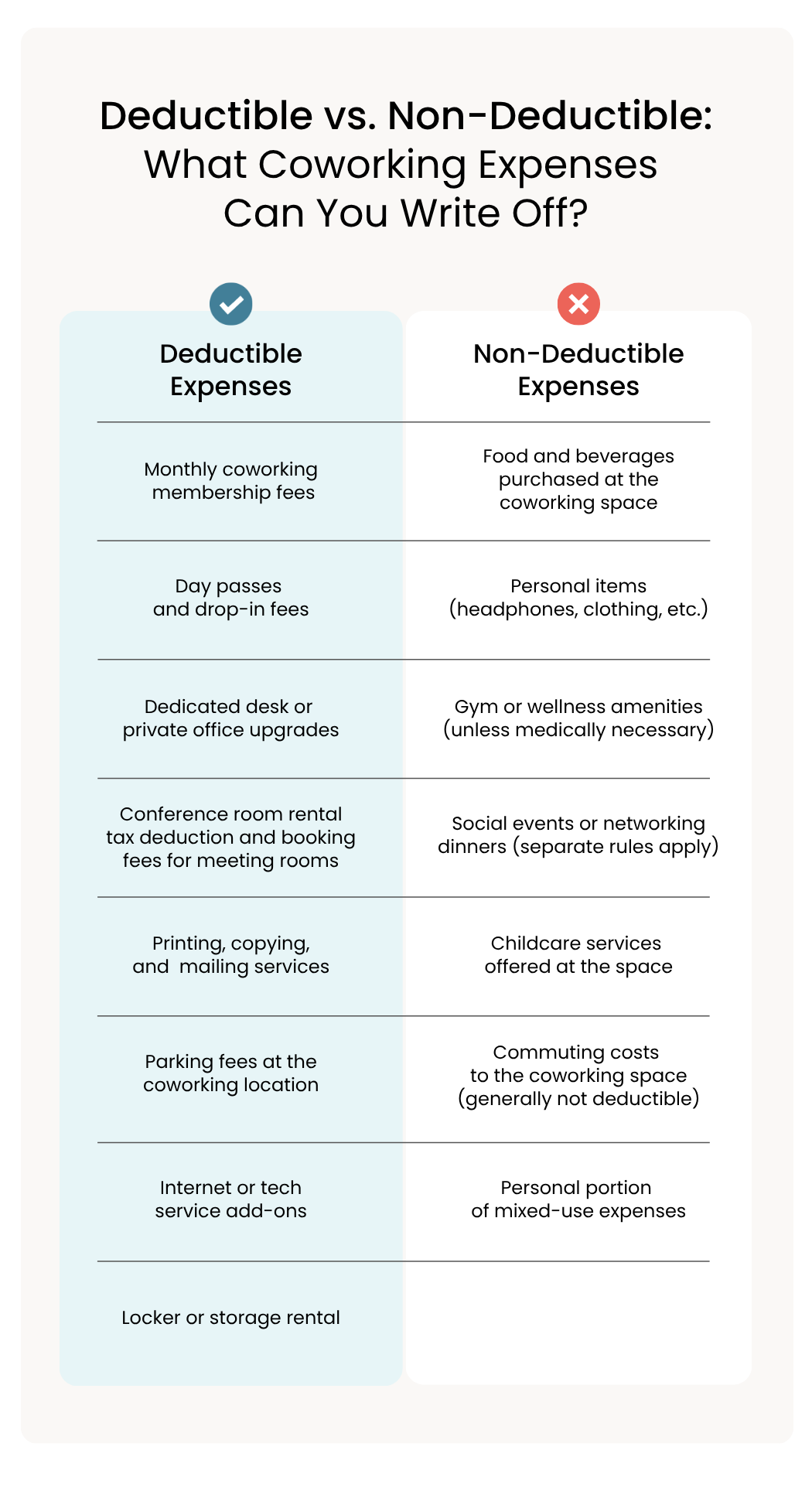
Here’s what typically qualifies, and what doesn’t:
| Deductible Expenses | Non-Deductible Expenses |
|---|---|
| Monthly coworking membership fees | Food and beverages purchased at the coworking space |
| Day passes and drop-in fees | Personal items (headphones, clothing, etc.) |
| Dedicated desk or private office upgrades | Gym or wellness amenities (unless medically necessary) |
| Conference room rental tax deduction and booking fees for meeting rooms | Social events or networking dinners (separate rules apply) |
| Printing, copying, and mailing services | Childcare services offered at the space |
| Parking fees at the coworking location | Commuting costs to the coworking space (generally not deductible) |
| Internet or tech service add-ons | Personal portion of mixed-use expenses |
| Locker or storage rental | N/A |
To help determine “ordinary and necessary” expenses, use IRS Publication 535 as your guide. An expense is ordinary if it’s common and accepted in your trade or business. An expense is necessary if it’s helpful and appropriate. It doesn’t have to be indispensable.
If your coworking membership includes bundled services (like coffee, printing, and Wi-Fi), the full membership fee is typically deductible as a single business expense.
Everything You Need to Grow Your Business

That’s what you get with a custom
Virtual Office Plan from Alliance
Select:
- Virtual Office
- Live Receptionist
- Virtual Phone
- Meeting Rooms
- Coworking
- Full Time Office
How to Claim Coworking Expenses on Your Tax Return
Good documentation practices throughout the year make filing your tax return straightforward. Follow these four steps to properly claim your coworking space tax deduction:
Step 1: Track and Categorize Costs
Start a dedicated tracking system for all workspace expenses. Whether you use accounting software like QuickBooks, a spreadsheet, or a dedicated expense tracker, categorize every coworking expense separately from other business costs.
Save all receipts; digital receipts from your coworking provider work fine. Note the date, amount, business purpose, and whether the expense was for workspace access, meeting rooms, or additional services.
Step 2: Report on Schedule C (Line 18 or 27a)
For sole proprietors and single-member LLCs, coworking expenses go on Schedule C of your federal tax return. The most common placement is Line 18 (“Office expense”) for recurring membership fees, or Line 27a (“Other expenses”) with a description like “Coworking space membership.”
Either line works; the important thing is consistency. Pick one approach and use it every year to make your records easy to follow.
Step 3: Calculate Proportional Use
If you use the coworking space for both personal and business purpose, you must calculate the business-use percentage and deduct only that portion.
For most professionals with a coworking membership, 100% business use is the norm. If you occasionally bring your laptop to the coworking space for personal projects, document the split and deduct only the business portion.
Step 4: Keep Supporting Documentation
The IRS recommends keeping records for at least three years from the date you file your return. Maintain the following documents as part of your records:
- Monthly membership invoices or receipts
- Conference room booking confirmations
- Payment records (credit card or bank statements)
- A log of business purpose for each visit (if mixed use)
- Coworking provider contract or terms of service
- Any correspondence about service changes or upgrades
Virtual Office Deductions: A Tax-Smart Alternative
For self-employed professionals who need a professional business address and occasional meeting space, but not a daily coworking desk, a virtual office plan can be a more cost-effective and equally tax-deductible alternative.
Here’s how the tax treatment compares:
| Factor | Coworking Space | Virtual Office |
|---|---|---|
| Monthly Cost | $200–$500+ | $49–$100 |
| Annual Deduction | $2,400–$6,000+ | $588–$1,200 |
| Business Address Included | Varies by space | ✓ Yes (at multiple locations) |
| Meeting Rooms | Included or pay-per-use | On-demand (can start at $10/hr) |
| Mail Handling | Rarely included | ✓ Yes, including mail forwarding |
| Live Receptionist | ✗ Not available | Optional (can start at $125/mo) |
| Tax Deductible | ✓ Business expense | ✓ Business expense |
| Schedule C Reporting | Line 18 or 27a | Line 18 or 27a |
The virtual office model is designed for professionals who don’t need a physical desk every day but want the professional infrastructure that supports a legitimate business presence, such as a business address, phone, meeting rooms, and receptionist. For self-employed individuals and business entities, every component of a virtual office plan is treated as a deductible business expense.
For professionals currently paying for a coworking membership primarily to have a business address and occasional meeting space, switching to a virtual office can cut workspace costs by 50-80%, while improving your professional image and tax deduction.
Read more: How Much Does a Virtual Office Cost in 2026?
Making the Most of Your Coworking Space Tax Deduction
Claiming your coworking space tax deduction is one of the more straightforward business write-offs available to self-employed professionals.
- If you’re self-employed, a sole proprietor, or operating an LLC, S-Corp, or C-Corp, your coworking expenses are typically deductible as ordinary and necessary business expenses.
- W-2 employees generally cannot deduct coworking costs on their federal return due to the limitations set by the Tax Cuts and Jobs Act of 2017. However, some states offer state-level deductions.
- Track all workspace expenses and report them on the appropriate tax form for your entity type.
- Consider whether a virtual office offers a more cost-effective alternative for your specific needs over a coworking space, especially if you primarily need a business address and occasional meeting space rather than daily desk access.
- Monitor evolving IRS guidance and legislative changes that may create additional deduction opportunities for freelancers and gig workers.
Tax Disclaimer: This article is for informational purposes only and doesn’t constitute tax or legal advice. Tax laws vary by jurisdiction and individual circumstances. Consult a qualified tax professional before making decisions based on the information in this guide.
A virtual office from Alliance Virtual Offices typically costs $49 to $100 per month depending on location, compared to $200 to $500+ per month for a coworking membership. Both are fully deductible as business expenses for self-employed individuals.
Explore Alliance Virtual Offices to find a workspace solution that fits your business and tax strategy.
Frequently Asked Questions
Is a coworking space tax deductible for self-employed?
Can I claim a home office deduction and a coworking membership?
What coworking expenses are tax deductible?
Is the $1,500 coworking deduction new for 2026?
How do I deduct a coworking membership on my taxes?
Further Reading