
- Why a Virtual Office Builds Trust for Financial Advisors
- Compliance Checklist: Address, Records, Supervision, and Client Meetings
- Implementation Blueprint: 7 Steps to Launch Cleanly
Q: Is a virtual office legitimate for financial advisors, or will it hurt credibility with clients and regulators?
A: A virtual office is fully legitimate for financial advisors when it is set up correctly. That means a real street address inside a staffed commercial center, documented mail handling through a CMRA-compliant provider, and on-demand private meeting rooms for client engagements.
The setup needs to align with Form ADV address requirements, support your recordkeeping obligations, and deliver a consistent, professional experience at every client touchpoint. Done right, it is not a workaround. It is a modern operating model.
DECISION SUMMARY: Which plan fits your practice?
Address only: You need a professional address for Form ADV, state licensing, your website, and client-facing materials, but you do not yet receive significant mail volume or meet clients in person.
Address + mail handling: You receive client correspondence, regulatory notices, or sensitive documents and need a documented, secure intake process that supports your compliance program.
Address + mail handling + meeting rooms + live receptionist: You meet clients regularly, want every touchpoint to signal credibility, and need a full professional presence without a full-time lease. This is the compliance-ready setup most independent advisors need.
The Real Tension Independent Advisors Face
Clients want to work with someone established. Regulators expect documented controls. And a full office lease, often $3,000 to $8,000 a month in a major market, is an overhead commitment that does not make sense for most independent or hybrid advisory practices.
That tension is exactly why virtual offices have become a serious infrastructure choice for RIAs and independent advisors. But “virtual office” means different things depending on the provider. In the advisor context, it means one specific thing: a real business address inside a staffed office center, paired with compliant mail handling and access to private meeting space when you need it.
It is not a mailbox store. It is not a P.O. box. And it is not a shared coworking desk with a lobby you cannot actually use for client meetings.
One more thing to establish upfront: Form ADV requires a physical street address for your principal office and place of business. The form explicitly instructs advisors not to use a P.O. box. Your virtual office setup needs to meet that standard from day one. (SEC/IARD Form ADV Part 1A Instructions)
NEXT STEPS: Not sure what a virtual office actually includes? Start with what a virtual office is and how it works before going further.
Why a Virtual Office Builds Trust for Financial Advisors
What Clients Actually Look For
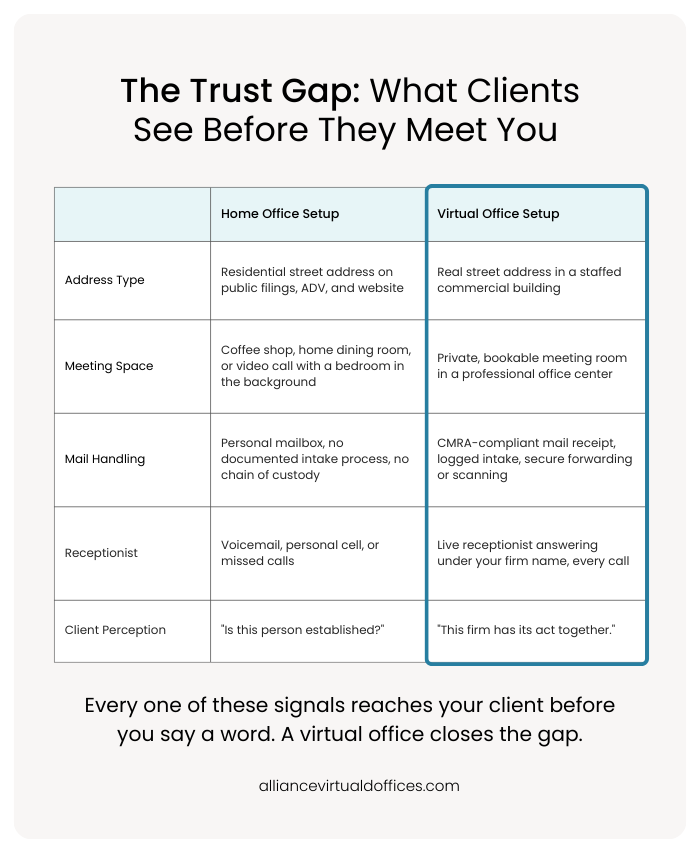
Trust in financial services is built on signals, and most of them happen before a prospect ever sits down with you. Here is what clients are subconsciously evaluating:
A verifiable business address. When a prospect Googles your firm, they want to see a real building in a real location, not a residential street or a strip-mall mailbox center. A professional address in a recognizable commercial building passes that test immediately.
A professional meeting environment. Annual reviews, onboarding meetings, and sensitive financial conversations deserve a private, quiet, consistent setting. A booked meeting room communicates that you take the client relationship seriously.
A staffed front desk. Missed calls and voicemail-only experiences erode trust before it is ever built. A live receptionist answering under your firm name signals that someone is always available.
Privacy for both of you. Using a home address on public business filings, your ADV, website, or email footer, exposes your personal information and raises questions about your firm’s stability. A dedicated business address fixes both problems.
Before and After
Consider two versions of the same advisor. In the first, she works from home, lists her residential address on her ADV, and meets clients at a local coffee shop for reviews. She is competent and licensed, but every touchpoint undermines the perception she is trying to build.
In the second version, she has a professional address in a downtown commercial center. Her mail is handled securely. She books a private meeting room for client reviews. A receptionist answers her calls. Nothing about her setup has changed except the infrastructure around it, but the client experience is completely different.
That is the value of a well-implemented virtual office. It does not change your practice. It frames it correctly.
“The virtual office does not change what you do. It changes how clients perceive what you do before you ever say a word.”
NEXT STEPS: See how a virtual business address builds credibility for client-facing professionals.
Compliance Checklist: Address, Records, Supervision, and Client Meetings
This is your save-and-share section. Use it to audit your current setup or build your compliance file from scratch.
Disclaimer: This section is informational and does not constitute legal or compliance advice. Consult your compliance counsel or CCO to confirm how these requirements apply to your specific registration and operating model.
A. Address and Disclosure Readiness
- Form ADV Part 1A asks for your principal office and place of business and instructs you not to use a P.O. box. Your virtual office address must be a real street address at a staffed commercial location. (SEC/IARD Form ADV Part 1A Instructions).
- If you conduct advisory business from multiple locations, you may need to disclose additional office addresses on your ADV. Confirm this with your CCO. (SEC).
- Your address must be consistent across your ADV, your website, your email footer, client onboarding documents, and custodian records. Inconsistency is a compliance flag and a trust signal in the wrong direction.
- If you change providers or locations, update your ADV promptly. Address changes that lag behind your actual operating setup create unnecessary exam risk.
B. Books and Records Access and Retention
- SEC Rule 204-2 requires registered investment advisors to maintain specific records and make them available for inspection. (eCFR)
- Practical readiness means knowing where your records live, typically a secure cloud system, and being able to produce them quickly during an exam.
- Your virtual office setup should support, not complicate, that process. Mail intake logs, meeting room invoices, and vendor agreements all belong in your compliance file.
C. Supervisory Controls for Dispersed or Hybrid Teams
- The SEC has highlighted supervision of dispersed and branch office environments as a recurring exam focus, particularly for firms with advisors operating across multiple locations. (SEC Multi-Branch Adviser Initiative)
- Written supervisory procedures should reflect how your virtual office fits into your operating model, who handles mail, how client meetings are documented, and how communication is monitored.
Operating Under a Broker-Dealer? If you operate under a broker-dealer, your location may be subject to FINRA office classification rules, including branch vs. non-branch designations under FINRA Rule 3110. These classifications affect supervision requirements and what your BD must document about your location. Check with your broker-dealer compliance team before selecting or changing your office address.
D. Compliance Program Governance
- SEC Release IA-2204 requires registered advisors to adopt and implement written compliance policies and procedures, and to review them at least annually. (SEC)
- A virtual office does not create compliance. It supports a compliant operating model. Your written supervisory procedures and annual review notes should reference your address setup, mail handling process, and client meeting protocols as part of your operating controls.
E. Client Communications and Mail Handling
- If your virtual office provider operates as a CMRA (Commercial Mail Receiving Agency), clients and senders must complete USPS Form 1583 to authorize mail receipt on your behalf. This includes identity verification.
- CMRA-compliant mail handling creates a documented chain of custody for every piece of mail, which supports your confidentiality obligations and gives you an audit trail if questions arise.
A virtual office does not create compliance by itself. It is the professional wrapper around a compliant operating model. The policies, procedures, and documentation are still your responsibility.
How to Choose a Compliance-Ready Virtual Office
Not all virtual office providers are built for professional services. Here is what to verify before committing.
Must-have criteria for advisors:
- Staffed office center, not a mailbox storefront or unmanned kiosk
- Mail handling that follows USPS/CMRA requirements, including Form 1583 authorization and ID verification
- Private meeting rooms you can book for client reviews, not just open coworking areas
- Clear policies for mail scanning, forwarding, and chain-of-custody documentation
- Signage or directory listing options where available, for client-facing verifiability
- Phone and receptionist support for first impressions and call handling
- Documentation you can retain for your compliance file, including service agreements, mail authorization records, and written procedures
NEXT STEPS: Compare virtual office costs to understand what a compliance-ready setup actually runs versus a traditional lease.
Implementation Blueprint: 7 Steps to Launch Cleanly
Step 1: Pick your location based on client geography and credibility. A central business district (CBD) address carries weight, but proximity to your client base matters more. Choose a location your clients can reach and recognize.
Step 2: Set address usage rules across every touchpoint. Your virtual office address should appear consistently on your ADV, website, email footer, onboarding documents, and custodian records. Document this standard in writing.
Step 3: Complete mail authorization and ID verification. Work through the Form 1583 workflow with your provider. This is your CMRA compliance baseline and a required step before mail can be received on your behalf.
Step 4: Create a client meeting standard. Define how you book rooms, how clients check in, what privacy protocols apply, and what a consistent meeting experience looks like. Write it down and follow it every time.
Step 5: Define your mail and document intake process. Who opens mail? Who scans it? Who logs it? Who files it? These questions need written answers before your first piece of mail arrives.
Step 6: Set receptionist and call handling rules. Define what your live receptionist answers, what gets escalated, and how messages are relayed. A first impression is only as good as the person handling it.
Step 7: Update your compliance documentation. Add your virtual office setup to your written supervisory procedures, your vendor oversight notes, and your next annual review agenda. (SEC IA-2204)
“Seven steps is all it takes to go from a home address and a voicemail to a compliance-ready, client-facing practice.”
Common Mistakes Advisors Make
Choosing a Mailbox-Only Address
If your address resolves to a UPS Store or an unmanned kiosk on Google Maps, clients and regulators will notice. Choose a staffed commercial center.
Inconsistent Address Usage
Your ADV says one thing, your website says another, your email footer says a third. This pattern creates compliance flags and erodes client trust simultaneously. Standardize from day one.
No Documented Mail Intake Process
Who touched the mail, when, and what happened to it? Without a written process and a log, you have no audit trail. That is an exam risk and a liability.
Relying on Public Spaces for Client Conversations
Coffee shop meetings are not appropriate for discussions involving account details, financial plans, or sensitive personal information. A private meeting room is not optional for advisors with fiduciary obligations.
Treating Meeting Rooms as Optional
Meeting rooms are not a nice-to-have. They are a trust multiplier and, in many client scenarios, a compliance requirement. Build them into your standard operating model.
Not Updating ADV After a Provider Change
If you switch virtual office providers or locations, your ADV needs to reflect the change promptly. Lagging address updates are a straightforward exam finding that is entirely avoidable.
Misunderstanding Branch Classifications Under FINRA
If you operate under a broker-dealer, your virtual office location may trigger branch office classification requirements under FINRA Rule 3110. Confirm with your BD compliance team before selecting a location.
Why Alliance Virtual Offices Fits Advisor Workflows
Alliance Virtual Offices is built around the infrastructure independent advisors actually need.
Real addresses in staffed centers across all 50 states. Every Alliance location is a legitimate commercial address capable of receiving USPS, FedEx, and UPS deliveries, and suitable for Form ADV disclosure.
CMRA-compliant mail handling. Alliance manages the Form 1583 process, ID verification, and documented mail intake, so your chain-of-custody is clean from the start. Learn more about CMRA compliance.
On-demand private meeting rooms. Book a client-ready space when you need it, without paying for it when you do not. Find meeting room locations near your clients.
Live receptionist services. A professional answering your calls under your firm name, every time, without the overhead of a full-time hire. See live receptionist options.
Documentation for your compliance file. Service agreements, mail authorization records, and written procedures, all available to support your vendor oversight requirements and annual review.
NEXT STEPS: Explore Alliance Virtual Offices locations and find the right setup for your practice.
A Modern Practice Runs on the Right Infrastructure
The advisors building sustainable, credible practices today are not the ones with the largest offices. They are the ones who have made deliberate decisions about how their infrastructure reflects their professionalism.
A virtual office, implemented correctly, gives you a verifiable address, a compliant mail process, a client-ready meeting environment, and a first impression that holds up under scrutiny from both prospects and regulators.
That is not a compromise. That is a competitive advantage.
Recommended Reading
- What Is a Virtual Office and How Does It Work?
- CMRA Compliance Explained: What USPS Actually Requires
- Form 1583 Setup Guide
- Virtual Business Address: What It Is and Why It Matters
NEXT STEPS: Book a compliant virtual office or speak with an Alliance team member about the right plan for your advisory practice.