
- How a Virtual Office Actually Works Day to Day
- What a Virtual Office Costs
- How to Get Started with a Virtual Office
Q: What is a virtual office, and how does it work for businesses?
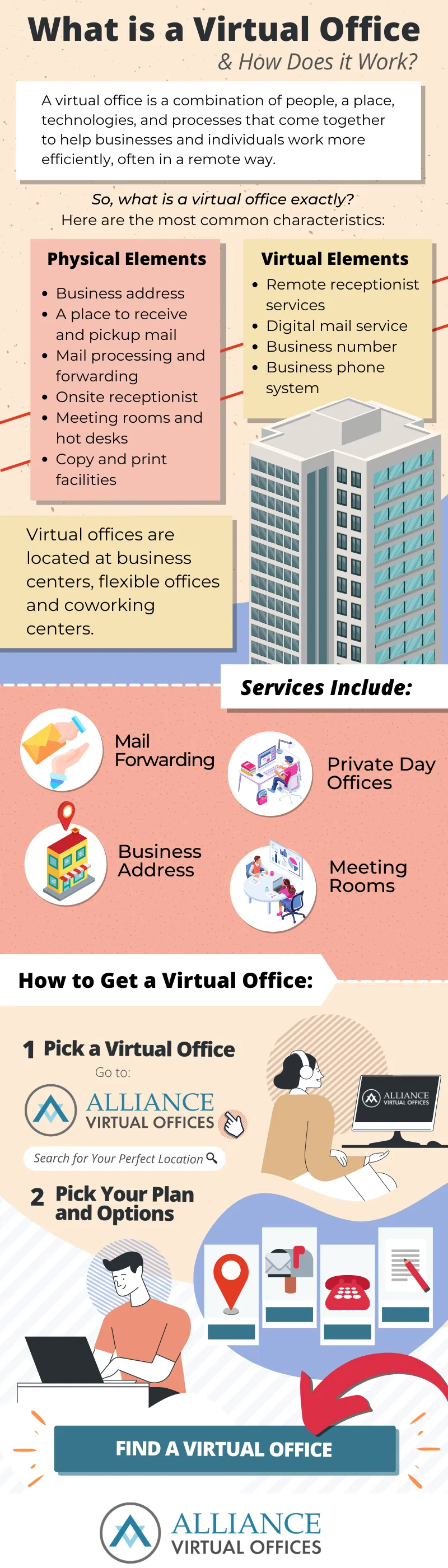
A: A virtual office is a service that gives your business a professional address, phone number, mail handling, live receptionist, and access to meeting rooms – without requiring you to lease full-time office space. It works by letting you use real, staffed office infrastructure only when you need it, so you can operate remotely while maintaining the credibility and presence of a traditional office at a fraction of the cost.
At its core, a virtual office is a service that gives your business a professional address, phone number, mail handling, live receptionist, and access to meeting rooms, without requiring you to lease physical office space full-time. It allows you to operate remotely while maintaining the credibility and infrastructure of a traditional office.
The virtual office meaning often gets confused because the word “virtual” suggests something that does not exist. In reality, the office is very real. It is a physical, staffed workspace in a commercial building. The difference is that you use the address and services when you need them, instead of paying for a lease you use every day.
If you’ve ever wondered how a virtual office works, what virtual office services are included, or whether the virtual office benefits outweigh the cost of a traditional lease, this guide breaks it down clearly. We’ll explain what’s included, how it works day to day, who uses one, and how to decide if it makes sense for your business.
Unlock Our Current Virtual Office Offers
Enter your email below and we’ll send you the latest available promotions and monthly specials for Virtual Offices, Meeting Rooms, and Live Receptionists.
What’s Included in a Virtual Office
Virtual office plans vary by provider, but a full-service plan from a quality provider typically includes five core services. Think of these as the building blocks of a professional business presence without the physical footprint.
1. A Professional Business Address
This is the foundation. You get a real street address at a commercial office building that you can use on your LLC filing, website, business cards, invoices, and anywhere else your business address appears. Clients, banks, and state agencies see a professional location when they look you up.
Why this matters more than it sounds: your business address shows up in more places than you might expect. LLC registration records, court filings, Google search results, directory listings, vendor applications, and contracts. A home address on all of those creates a different impression than an address at a professional office building in a recognized business district.
An important distinction: Some services marketed as “virtual offices” are actually just mailing addresses at retail mail stores. They give you a suite number at a storefront that handles UPS shipments and sells packing tape. That is not a virtual office. That is a virtual address masquerading as an office. Banks, state agencies, and clients can tell the difference, and it matters when your credibility is on the line.
2. Mail Handling and Forwarding
Your business mail arrives at the physical office where staff receive, sort, and manage it based on your preferences. Depending on the plan and provider, you can have mail forwarded to you on a schedule, pick it up in person, or get scanned copies sent to your email for digital access.
For businesses that receive checks, legal documents, or time-sensitive correspondence, this is more than convenience. It means your mail is handled by real people at a real office, not sitting in a PO box until you remember to check it.
3. A Business Phone Number
You get a dedicated business phone number, either local or toll-free, with call forwarding, voicemail, and a professional greeting. Calls to your business number can route to your cell phone, your laptop, or any other device you choose. Clients call one number and reach you wherever you are.
This keeps your personal phone number off your business cards and marketing materials. It also means you can answer business calls during work hours and let them go to a professional voicemail after hours, instead of mixing business and personal calls on the same line. Alliance’s Virtual Phone service gives you a complete phone system with features like auto-attendant and call screening.
4. Live Receptionist Services
A trained receptionist answers your business calls using your company name, following the instructions you set up. They can take messages, transfer calls to you or your team, screen callers, and handle basic inquiries. Your callers hear a real person, not an automated menu.
This is the service that small business owners and professionals say changes their business the most. For attorneys, a live receptionist means a potential client calling about a case talks to a real person instead of leaving a voicemail (and then calling the next firm on their list). For consultants and advisors, it means you never miss a call during a client meeting. For any growing business, it means you look and sound like a large, established company.
5. On-Demand Meeting Rooms and Coworking Space
When you need to meet a client face-to-face, conduct a presentation, hold a team meeting, or just work from a professional setting for the day, you book space at your virtual office location. Most providers offer private meeting rooms by the hour, full-day office rentals, and coworking space with dedicated desks.
Alliance Virtual Offices locations also include coworking space for the days when you want a change of scenery or need a quiet, professional environment to focus. You can book a meeting room for a client consultation in the morning and work from the coworking area for the rest of the afternoon. Everything is at the same address that appears on your business cards.
How a Virtual Office Actually Works Day to Day

Here is what a typical day looks like for someone using a virtual office:
Morning: You check your email and see a notification that two pieces of mail arrived at your business address yesterday. One is a check from a client; you request that it be forwarded to your home. The other is junk mail; staff discards it per your standing instructions.
Mid-morning: A potential client calls your business number. Your live receptionist answers with “Thank you for calling [Your Company], how may I help you?” The caller asks about your services. The receptionist follows your script, takes the caller’s information, and sends you a message with the details. You call back 20 minutes later from your home office.
Afternoon: You have a meeting with an existing client at 2 PM. You booked a meeting room at your virtual office address yesterday. You arrive 10 minutes early, the front desk greets you by name, and you walk into a professional conference room. The client sees the same address from your website, your contract, and your business card in the building directory. After the meeting, you head home.
End of day: Your virtual phone number received three more calls. Two went to your live receptionist (one was a sales pitch, screened out; one was a client with a question, message taken). One was after hours and went to your professional voicemail. You review the messages and decide which to return tomorrow.
That is it. No commute to an office you do not need. No lease payment for the space you used for one hour. No receptionist’s salary. No phone system to maintain. You used the services you needed and skipped the rest.
Who Uses Virtual Offices (and Why)
Virtual offices are not a niche product for one type of business. They serve a wide range of professionals and companies, but certain industries and business types get the most value.
Solo Attorneys and Small Law Firms
Attorneys are among the most common users of virtual offices and tend to keep them the longest. The reasons are specific to the profession: state bar associations often require a physical address for registration; court filings put your business address on public record, and clients expect an office presence. A home address on a bar registration raises questions. A PO box is rejected by most state bars. A virtual office at a professional building solves all three problems while costing a fraction of a traditional office lease.
The live receptionist is especially valuable for law practices. When a potential client calls about a case, they are often calling two or three firms. The one who answers with a real person gets the conversation. The one that sends them to voicemail gets passed over.
CPAs, Bookkeepers, and Accounting Firms
Accounting professionals deal with sensitive financial documents, client meetings during tax season, and the need for a credible business address on engagement letters and correspondence. A virtual office gives them a professional address, secure mail handling for sensitive documents, and meeting rooms for client reviews without maintaining a year-round lease they only fully use during busy periods.
Real Estate Agents and Financial Advisors
These professionals often serve clients across multiple cities and need a local presence in each market. A virtual office in each metro area gives them a local phone number, a local address, and meeting rooms for client presentations and listing appointments. Alliance Virtual Offices has 1,400+ locations, so adding a second or third city does not require switching providers.
Consultants and Freelancers
Independent consultants, IT professionals, marketing agencies, and other service providers use virtual offices to look established from day one. When a prospective client googles your business and sees a professional address, a dedicated phone number, and a receptionist who answers with your company name, they assume you are a well-run operation. That perception wins work.
Startups and Growing Companies
Early-stage businesses use virtual offices to establish credibility before they can afford (or need) physical space. As the team grows, the virtual office scales with them: add a second location, upgrade to include more meeting room hours, and bring on live receptionist services. When you eventually need full-time office space, the transition is straightforward because your business address, phone number, and client relationships are already established.
Out-of-State Businesses
If you are forming an LLC or expanding into a new state, you need a physical address in that state for registration purposes. A virtual office gives you that address plus the operational support (mail handling, phone, registered agent) without relocating or leasing space. This is particularly common for businesses registering in states like Delaware, Wyoming, or Nevada for their favorable LLC laws while operating from elsewhere.
Virtual Office vs. the Alternatives
A virtual office is not the only option for businesses that do not need a full-time lease. Here is how it compares to the most common alternatives.
| Feature | Virtual Office | PO Box | Coworking | Mail Store | Office Lease |
| Professional address | ✓ | ✗ | ✓ | Limited | ✓ |
| Live receptionist | ✓ | ✗ | ✗ | ✗ | Self-hired |
| Business phone | ✓ | ✗ | ✗ | ✗ | Self-setup |
| Mail handling | ✓ | Basic | Varies | ✓ | ✓ |
| Meeting rooms | ✓ | ✗ | ✓ | ✗ | ✓ |
| Coworking access | ✓ | ✗ | ✓ | ✗ | N/A |
| LLC registration | ✓ | Usually no | ✓ | Varies | ✓ |
| Monthly cost | $50–$300 | $20–$50 | $200–$500+ | $15–$40 | $500–2,000+ |
The key takeaway: A virtual office is the only option that bundles a professional address, phone, receptionist, mail handling, meeting rooms, and coworking into one package.
A PO box gives you a mailbox.
A retail mail store gives you a mailing address (and calls it a virtual office, which it is not). Coworking gives you a desk.
An office lease gives you everything, but costs five to ten times more.
The virtual office sits in the middle: all the credibility of a real office, none of the overhead.
Virtual Office vs. Coworking: A Closer Look
This comparison comes up a lot because the two overlap. Coworking memberships give you a place to work every day with a professional address. Virtual offices give you the address, phone, receptionist, and meeting rooms without requiring you to show up.
If you need a desk every day, coworking makes more sense. If you work from home most days and need the professional infrastructure (address, phone, receptionist, meeting rooms) without a daily commute, a virtual office is the better fit. Many Alliance clients use both: a virtual office as their business foundation and coworking access for the days they want to work on-site.
What a Virtual Office Costs
Virtual office pricing depends on the provider, location, and which services are included. Here is the general range:
| Plan Level | Monthly Cost | What’s Included |
| Business address only | $49–$75 | A professional address, basic mail handling |
| Address + mail + phone | $100–$150 | Above + dedicated business phone number, voicemail, call forwarding |
| Full virtual office | $150–$300 | All of the above + live receptionist + meeting room hours + coworking access |
For context, a small office lease in most metro areas runs $500 to $2,000+ per month before utilities, internet, insurance, and furniture. A virtual office gives you the professional infrastructure at a fraction of that cost.
Most small business owners and entrepreneurs land in the $100 to $200 range. That gets you the address, phone number, and mail handling that form the backbone of a professional business presence. Add live receptionist for another $50 to $100 per month, and you have a complete front office without hiring anyone.
How to Choose a Virtual Office Provider
The virtual office market includes everything from premium providers with professional office buildings to resellers offering a forwarding address at a retail storefront. The difference matters.
Here is what to evaluate:
- Is the address a real office with on-site staff? Ask whether the location has on-site staff during business hours, or if it is a retail mail store using a suite number. A staffed office building is treated differently by banks, state agencies, and clients than a mailbox at a strip mall. This is the single most important question when evaluating a provider.
- What is the location network? If you might need addresses in multiple cities now or later, choose a provider with a national (or global) network. Alliance has 1,400+ locations, which means you can add markets without switching providers or managing multiple accounts.
- Is a live receptionist available? Not all providers offer this service, and it is the one that makes the biggest difference in how clients perceive your business. A real person answering your phone with your company name changes the entire experience for callers.
- Are meeting rooms and coworking included? Some plans include hours; others charge separately. Know what is included before you sign up, so you are not surprised by add-on fees.
- What does the phone system include? A basic voicemail line is different from a full virtual phone system with auto-attendant and call screening. Ask what features come with the phone number.
- Is pricing transparent? No hidden setup fees, no surprise charges for mail handling, clear pricing for add-ons. Get the full cost breakdown before committing.
- What is the commitment structure? Quality providers typically require an initial commitment of around six months, then transition to monthly billing. A business address is foundational. Providers who structure plans with an initial term tend to attract businesses building for the long term.
How to Get Started with a Virtual Office
Setting up a virtual office is straightforward once you know what you need. Here is the process:
Step 1: Figure out what you need. Start with the basics: Do you need an address for LLC registration? A phone number for clients? A receptionist? Meeting rooms? Most businesses start with an address and phone number, then add services as they grow.
Step 2: Choose your location. Pick an address that makes sense for your business and your clients. If you serve local clients, choose an address in their market. If you are building a multi-market presence, start with your primary city and add others as needed.
Step 3: Select your plan. Match the plan to your actual needs. If you rarely meet clients in person, you may not need meeting room hours included. If phone presence matters for your industry (legal, consulting, advisory), the live receptionist plan is worth the upgrade.
Step 4: Set up your services. Once your plan is active, configure your phone forwarding rules, mail handling preferences, and receptionist instructions. Most of this takes 15 to 30 minutes and can be done online or with a representative.
Step 5: Update your business records. Use your new address on your LLC registration, EIN filing, bank accounts, business cards, website, and directory listings. Consistency matters. The same address across every touchpoint reinforces your credibility with both search engines and the people checking you out before they call.
Frequently Asked Questions
Is a virtual office a real office?
Yes. Every Alliance Virtual Offices location is a physical, operated workspace in a professional building. The “virtual” part means you are not leasing full-time space. You use the address, services, and meeting rooms when you need them. When someone visits your address, they find a real office with real people.
Can I use a virtual office address on my LLC filing?
In most states, yes. A virtual office at a real, staffed commercial business address is accepted for LLC registration by the majority of states. Some states have specific requirements for registered agent addresses, so check your state’s rules before filing. Alliance addresses are physical offices, not PO boxes or retail mail stores, which gives you the broadest acceptance.
Will banks accept a virtual office address?
It depends on the bank. Online banks and fintech companies like Mercury and Brex tend to be more flexible with virtual office addresses. Traditional banks vary. The key is having an address at a real, staffed office (not a retail mail store), keeping your address consistent across all filings, and having supporting documentation from your provider ready when you apply. Call your bank first to ask about their policy before submitting an application.
How is this different from working at a coffee shop?
Working from a coffee shop gives you a table. A virtual office gives you a professional business address for your LLC, a dedicated phone number, a live receptionist answering calls with your company name, mail handling, and meeting rooms when you need them. One is a place to sit; the other is a business infrastructure.
Do I have to sign a long-term contract?
Most quality providers require an initial commitment of around six months, then transition to month-to-month billing. This is standard across the industry. A business address is something you build on, and switching addresses frequently creates problems with banks, state agencies, and directory listings. After the initial period, you have full flexibility.
What happens to my phone calls after business hours?
After-hours calls go to a professional voicemail with a greeting you customize. You can also set up call forwarding rules to route calls to your cell phone during specific hours. The system is flexible enough to handle different rules for different times of day, days of the week, and caller types.
The Bottom Line
A virtual office gives you the professional infrastructure of a traditional office, the address, the phone number, the receptionist, the meeting rooms, without the lease, the commute, or the overhead. It is not a gimmick or a workaround. It is how hundreds of thousands of businesses operate today, from solo attorneys to growing consulting firms to multi-market real estate teams.
The businesses that get the most value from a virtual office share a few things in common: they work remotely most of the time, their clients expect a professional presence, and they would rather invest in their business than in rent for space they barely use. If that sounds like your situation, a virtual office is probably the right fit.
If you are still on the fence, start with the basics: a professional address and a phone number. Use it for a few months. See how clients respond. Most business owners who try a virtual office keep it, and most end up adding services as they discover what a live receptionist or on-demand meeting rooms do for their business.
Explore available virtual office locations near you and compare plans.