
- Do consultants need an LLC?
- LLC vs. Sole Proprietorship vs. S Corp for Consultants
- How to Set Up an LLC for Consulting Business Owners
Q: Do consultants need an LLC?
A: No law requires one, and a consultant can work as a sole proprietor and report income on a personal tax return. An LLC for consulting business owners adds liability protection between personal assets and business debts or claims, and some clients prefer to contract with a business entity.
Your first client paid you on a handshake and a Venmo request. Now a larger client wants a signed contract, a W-9, and a business name, and you’re wondering whether an LLC for consulting business owners like you is the next step or an expensive formality.
The answer depends on how much risk your work carries, how much you earn, and how much paperwork you’re willing to take on. If you run a virtual consulting practice from home, you also have to decide which address goes on the filings.
None of it is as complicated as the formation websites make it sound. Most consultants choose among three setups: a sole proprietorship, a single-member LLC, or an LLC taxed as an S corporation.
Do Consultants Need an LLC?
Legally, no. If you do work for clients and nothing else, you’re already a sole proprietor by default, and the IRS treats your business income as yours.
Most independent businesses start this way. The SBA Office of Advocacy counts 36,207,130 small businesses in the U.S., and 82.3% of them (29,811,495) have no employees.
Among those nonemployer firms, 86.7% are sole proprietorships.
What a sole proprietorship means in practice
A sole proprietorship costs nothing to form and needs no state filing. The cost shows up when something goes wrong, because the SBA says a sole proprietor can be held personally liable for the business’s debts and obligations.
For a consultant, that exposure usually looks like a client dispute, a contract claim, or a lease or equipment loan signed in your own name. Professional liability insurance addresses part of that risk, and an entity addresses another part.
A business name is a separate question
Many new consultants assume they need an LLC to operate under a business name. A sole proprietor can usually register a trade name instead (a “doing business as” or DBA name) with the state or county, depending on where you live.
The registration gives you a name, but it doesn’t create a separate legal entity. The liability question and the naming question have different answers.
What an LLC changes
An LLC creates a separate legal entity that owns the business. The SBA says LLCs protect you from personal liability in most instances, and that profits and losses pass through to your personal income without corporate taxes (pass-through taxation).
Taxes, on their own, rarely justify forming one. An LLC owner who does the work is still treated as self-employed and pays self-employment tax, so the LLC changes your risk profile more than your tax bill.
Forming an LLC also puts a business address on public state records. Alliance Virtual Offices walks through those address choices in its guide to a virtual business address for an LLC.
LLC vs. Sole Proprietorship vs. S Corp for Consultants
The IRS sets the default tax treatment by the number of owners. A single-owner LLC is treated as a sole proprietorship (a disregarded entity), and an LLC with two or more owners is treated as a partnership.
An LLC can also elect to be taxed as an S corporation by filing Form 2553. That election is the third option on the table, and it’s the one that changes how much tax you pay.
Quick comparison
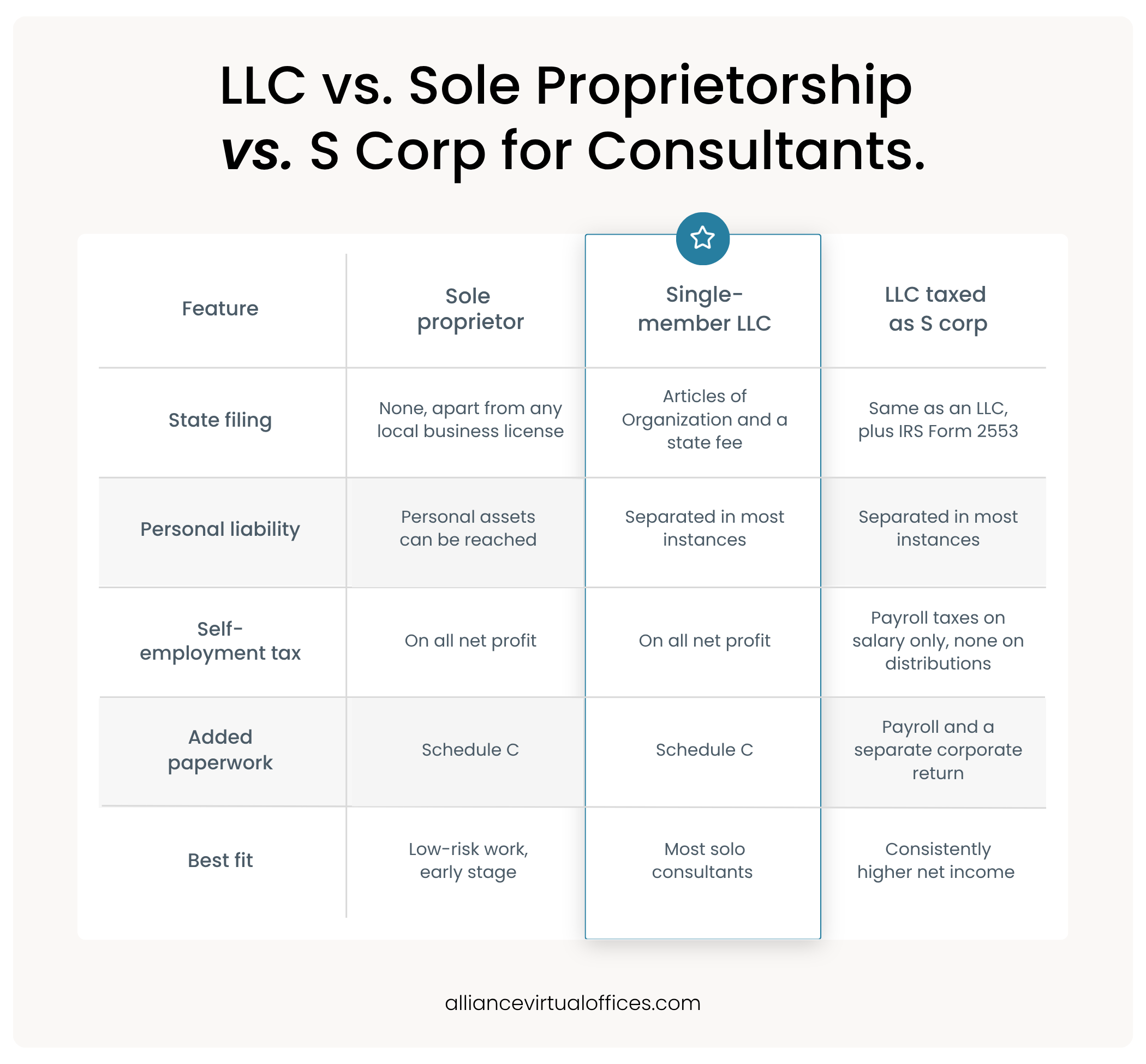
Single-member LLC basics
For most solo consultants, a single-member LLC is the practical middle. You keep filing a Schedule C, you don’t need payroll, and you gain the liability separation.
The cost is a state filing fee and, in some states, an annual fee. The SBA puts the total cost to register an LLC at less than $300 in most cases, though fees vary by state, and California charges every LLC an annual tax of $800 under the Franchise Tax Board.
When the S corp election starts to pay
Self-employment tax is 15.3% of net earnings, made up of 12.4% for Social Security and 2.9% for Medicare. The Social Security portion applies up to the 2026 wage base of $184,500.
An S corporation lets you pay yourself a salary and take the rest as distributions. The salary runs through payroll, but the distributions aren’t subject to self-employment tax.
The IRS expects the salary to be reasonable. It weighs factors such as training, duties, and time devoted to the business.
There’s no single break-even point. SDO CPA puts it around $50,000 to $60,000 of consistent net income, and says the savings only become clear at about $100,000.
The difference comes down to compliance costs. The same firm estimates payroll at $500 to $2,000 a year and the separate Form 1120-S return at $1,000 to $2,500, for added compliance costs of $1,500 to $4,500 a year.
Treat any single threshold as a guideline and ask a CPA to run your numbers before you file Form 2553. The IRS requires an S corporation to have no more than 100 shareholders and one class of stock, which a solo consultant meets easily.
When staying a sole proprietor is enough
The case against forming an LLC is real. You pay a state filing fee, possibly an annual fee, and you take on a separate bank account and cleaner bookkeeping.
If you consult on the side, work with a handful of low-risk clients, and have no employees or large contracts, those costs may not buy you much yet. Revisit the decision when a contract grows, a client asks for a business entity, or your income climbs high enough that the S corp math is worth running.
Read More: LLC for the Digital Entrepreneur: What You Need to Know When Traveling
How an LLC Affects Liability and Credibility
An LLC protects you from business debts and many claims, but it doesn’t protect you from your own professional mistakes. If your advice causes a client a loss, you can still be named personally.
That’s why many consultants pair an LLC with professional liability insurance. The LLC covers the contract and debt side of the risk, and the insurance covers the advice side.
Keeping the protection intact
The protection depends on treating the business as separate. Open a business bank account, sign contracts in the LLC’s name, and keep business and personal money apart.
Mixing the two is a common way owners weaken the separation. A court can look at how you operated as well as what you filed.
Contracts, leases, and personal guarantees
An LLC separates you from the business’s obligations, but only if the paperwork says so. Sign client agreements in the LLC’s name, and read any lease, loan, or credit application for a personal guarantee, which makes you personally responsible no matter what entity signs.
Small businesses are often asked for guarantees when they borrow or rent space. The LLC still helps with ordinary vendor and client disputes, but it won’t override a guarantee you agree to.
Credibility with clients
Some clients, especially larger companies, prefer to sign with a business entity and to see a business name on the invoice. An LLC also gives you a business name and a business bank account, which many procurement teams expect when they onboard a vendor.
It’s a preference, and many consultants win work as sole proprietors. An LLC won’t replace a strong referral.
Everything You Need to Grow Your Business

That’s what you get with a custom
Virtual Office Plan from Alliance
Select:
- Virtual Office
- Live Receptionist
- Virtual Phone
- Meeting Rooms
- Coworking
- Full Time Office
Keeping Your Home Address Off Public LLC Filings
Forming an LLC puts your business name on state records, and the filings usually include an address. Registered agent addresses and formation documents are typically public, so a home-based consultant can end up with a home address attached to the business.
In practice, you can list your home address, name a registered agent service and a separate mailing address, or use a business address that handles mail at a staffed location.
A virtual business address falls in the third group. It gives clients a professional address for the business, and mail goes to a real front desk instead of your front door.
It doesn’t replace a registered agent, and whether you can list it on formation documents depends on your state and entity type. Check what your state publishes and confirm its address requirements with the Secretary of State before you file.
Read More: Should I Use My Home Address for My LLC?
How to Set Up an LLC for Consulting Business Owners
Setting up the LLC is mostly state paperwork, and doing it in this order avoids rework.
- Pick a name. Search your state’s business name database and include “LLC” or the abbreviation your state requires.
- Choose a registered agent. This is the person or service with a physical address in your state that receives legal notices during business hours.
- File Articles of Organization. Submit them to your Secretary of State with the filing fee, and check whether your state also requires an initial report or a publication notice.
- Get an EIN. The IRS issues one free of charge and warns against paying for one. Many consultants put it on a Form W-9 instead of a Social Security number.
- Write an operating agreement. A single-member LLC doesn’t always need one by law, but it documents that you treat the business as a separate entity.
- Open a business bank account. Route every client payment and business expense through it.
Also check whether your city or state requires a business license for your type of consulting. Some professions, such as engineering or accounting, carry separate licensing rules.
Budget for the filing fee, any annual state fee, and a registered agent service if you use one. Keep the Articles of Organization, your EIN letter, and the operating agreement in one folder, since banks and clients tend to ask for them.
NEXT STEPS: See virtual business address options for your LLC
Is an LLC for Consulting Business Owners Worth It?
For most consultants with real clients and real contracts, an LLC is worth the filing fee. It separates your personal assets from business debts, gives you a business entity to contract through, and keeps the S corp election open for when your income grows.
It isn’t required, and it doesn’t replace insurance. If you consult part time, have no employees, and carry little contractual risk, staying a sole proprietor is a legitimate choice.
Tax and fee figures change, and none of this is tax or legal advice, so confirm your numbers with a CPA or an attorney in your state.
If you do form one, an Alliance Virtual Office gives your consulting LLC a professional business address, with client and state mail handled at a staffed location instead of your home. Plans start at $49/mo, and because address rules for formation documents vary by state, confirm yours with the Secretary of State before you list it.
Frequently Asked Questions
Do consultants need an LLC?
Is an LLC or S corp better for a consulting business?
How much does it cost to form a consulting LLC?
Can I be a 1099 consultant without an LLC?
Do I need an EIN for my consulting LLC?
Further Reading