
- Why Therapists Need a Business Address
- Can You Register a Therapy Business with a Virtual Address?
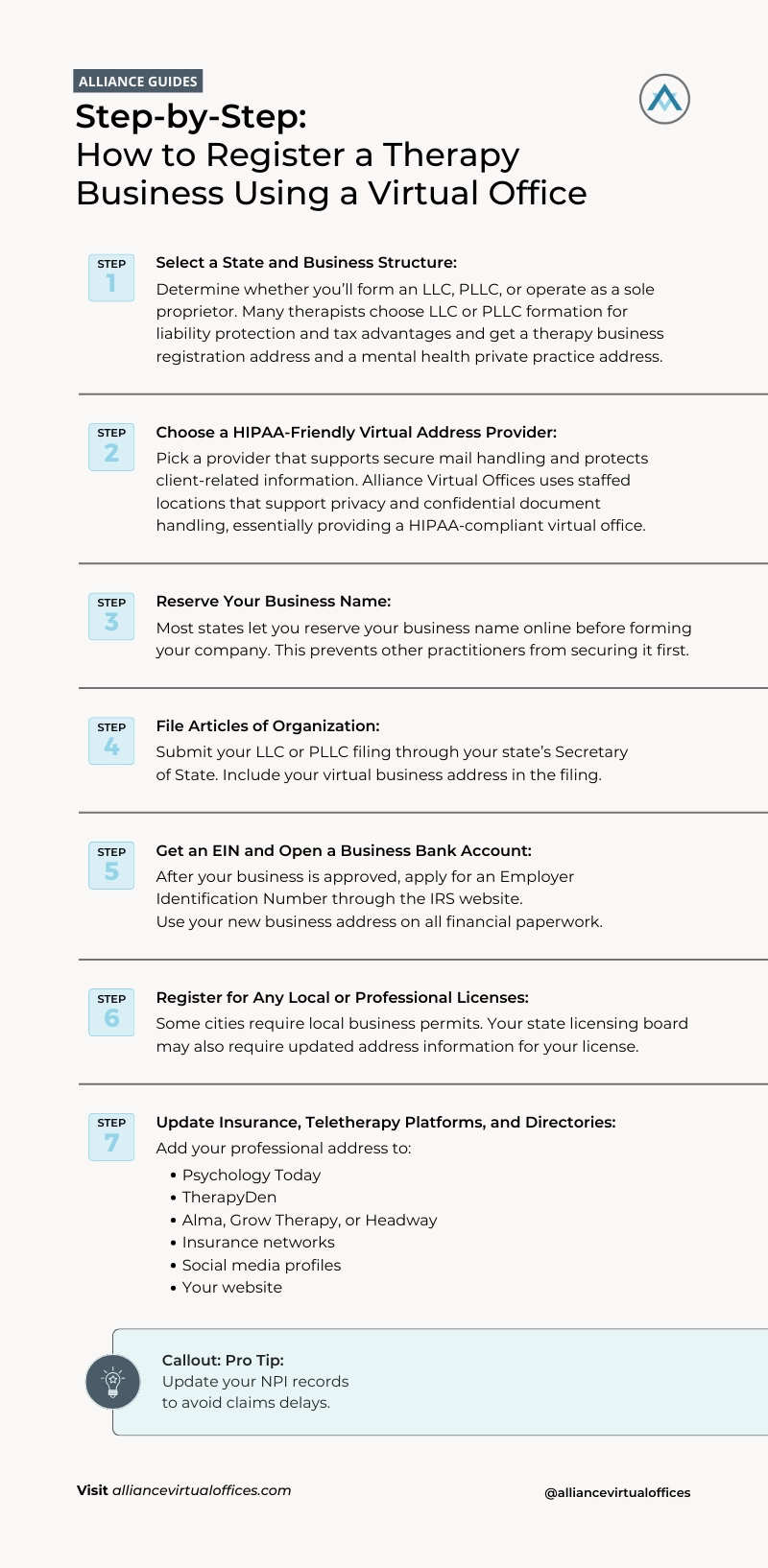
- Step-by-Step: How to Register a Therapy Business Using a Virtual Office
- Ensuring Licensing, HIPAA, and Privacy Standards
Q: Can I legally register my therapy or counseling business using a virtual address?
A: Yes. As long as the virtual address is a real, staffed street address (like the ones provided by Alliance Virtual Offices), therapists can use it to register an LLC or PLLC, update their state license, handle insurance credentialing, and protect their home privacy. It’s a practical, secure way to establish a professional business presence without renting a full-time office.
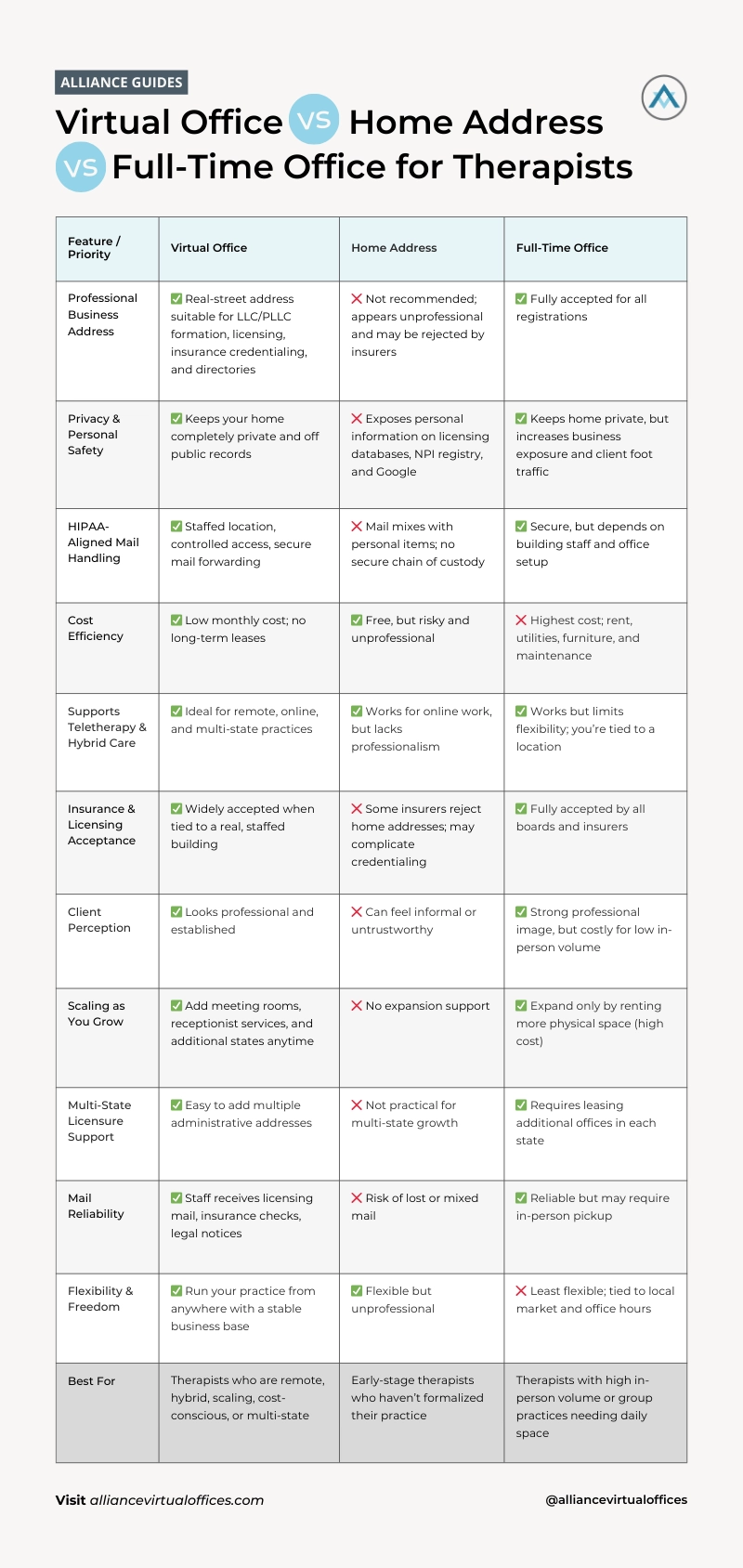
Starting a therapy practice takes more than a skill. You also need a credible, secure business address to register your company, manage insurance billing, communicate with clients, and meet state licensing expectations.
Most therapists don’t want to use their home address. It exposes private information, invites unwanted mail, and can appear unprofessional to clients and insurance networks.
A virtual office gives therapists a practical, cost-effective alternative. You get a real business address that protects your privacy, supports multi-state work, and helps you meet the registration and documentation requirements of running a mental health practice.
This guide walks you through everything you need to know to register a therapy business using a virtual address.
Why Therapists Need a Business Address
Legal Tip
Always confirm your address requirements with your state licensing board before filing your LLC or PLLC. Most boards accept a real-street virtual business address from a staffed location, but they may still require your practice location or mailing address for specific forms. Using a trusted provider like Alliance Virtual Offices helps you meet these expectations while keeping your home address private and off public records.
Business Registration Requirements
Whether you’re forming an LLC, PLLC, or sole proprietorship, almost every state requires you to provide a verifiable business address during setup. This address becomes part of your official record and appears on documents you’ll use throughout your practice, including:
- Articles of Organization
- State licensing applications
- Insurance credentialing packets
- Business bank account applications
- Client-facing materials, directories, and NPI records
A professional address also helps you meet expectations from the U.S. Small Business Administration and most state boards, which prefer a stable, physical business location tied to your practice.
Why Home Addresses Aren’t Ideal
Many therapists run hybrid or fully remote practices, but they still need a reliable administrative address. Using a home address can create avoidable challenges like:
- Privacy risks (your home becomes public record)
- Safety concerns, especially for therapists working with vulnerable or high-risk populations
- Limited geographic flexibility, making it harder to operate across state lines
- Lower perceived professionalism, which can affect client trust, referrals, and insurance approvals
A dedicated business address signals legitimacy, protects your personal information, and helps your practice operate smoothly.
Legal Requirements to Keep in Mind
Even if your therapy practice is entirely online, most licensing boards expect a physical business address on file. This doesn’t mean you need a full-time office; it simply needs to be a legitimate, staffed commercial location.
A virtual business address meets this need when it comes from a real office building with on-site personnel who can securely handle documents, licensing mail, and insurance correspondence. Unlike P.O. boxes or retail mail centers, these addresses are typically accepted for:
- LLC and PLLC formation
- State licensure records
- Insurance credentialing
- Tax registration
- Banking and financial compliance documents
Can You Register a Therapy Business with a Virtual Address?
You can register your therapy, counseling, or wellness practice using a virtual business address, as long as the address meets your state’s requirements for business formation and professional licensing. This is one of the most common ways therapists protect their privacy while starting an online or hybrid practice.
A virtual business address gives you a professional, real-street location for your LLC or PLLC paperwork, directory listings, tax registration, insurance credentialing, and NPI records without renting a physical office you may never use.
What Counts as a Virtual Business Address?
A legitimate virtual business address is a real, physical street address at a staffed business center. It’s not a P.O. box, UPS Store mailbox, or mail drop location. The key features of a true virtual business address include:
- A real commercial building
- On-site personnel who receive and handle mail
- Secure mail storage and forwarding
- Verifiable street address suitable for official documents
- A professional environment that represents your practice
Providers like Alliance Virtual Offices offer stable, recognizable business locations where trained staff securely process your mail and support your practice operations. This makes the address acceptable for business registration and gives your practice a more credible image.
State Board Acceptance
Most state licensing boards allow therapists to use a virtual business address as their administrative address as long as it connects to a real, staffed office. This is because the address serves as the official point of contact for licensing mail, legal notices, and insurance documents.
Virtual addresses are widely accepted for:
- LLC and PLLC formation
- State and city business licensing
- Tax registration at the state and federal level
- Insurance credentialing and contracting
- NPI records and CAQH profiles
- Teletherapy platforms and client directories
Every board and jurisdiction has its own terminology, but in practice, a legitimate, verifiable street address fulfills the requirement for most administrative filings. Still, it’s always a good idea to confirm your exact state regulations before submitting applications.
Legal Tip
Most state boards don’t differentiate between a “business address,” “mailing address,” or “administrative address.” They simply require an address that’s real, stable, and capable of receiving official mail. A virtual business address from a staffed location meets this need without putting your home address in public records.
How Virtual Addresses Differ from P.O. Boxes
P.O. boxes, UPS Store mailboxes, and other retail mail centers are often rejected by:
- State licensing boards
- The IRS
- Insurance companies
- Banks
- Vendor or payer systems
This is because these locations don’t offer real commercial street addresses, a virtual address for therapists, or staffed handling. In many states, they’re explicitly prohibited for business formation and professional licensing, creating “register therapy business, virtual address” issues.
A virtual office for counseling practices from Alliance Virtual Offices is different because it’s tied to a real building with on-site personnel, making it suitable for:
- Business registration
- Licensing documents
- Financial paperwork
- Insurance correspondence
- Legal notices
This gives therapists a much more stable and credible foundation for launching or expanding their practice.
Ensuring Licensing, HIPAA, and Privacy Standards
Running a therapy practice means balancing legal requirements, client confidentiality, and your own personal safety. A virtual business address can meet these needs when it comes from a legitimate, staffed location that protects sensitive documents and supports regulated workflows.
Your Licensing Board
Every state licensing board requires therapists to maintain an official administrative address for communication, renewals, and legal notices. Most boards don’t require your home address or address to be publicly visible, and they don’t require you to rent a physical office if your practice is remote or hybrid.
A legitimate virtual office satisfies the administrative address requirement as long as it’s a real, staffed physical location where mail can be delivered securely. This allows you to register your LLC or PLLC, update your license, and complete insurance credentialing without exposing personal information.
If you’re comparing address options, you can read more about choosing the right business address for therapists and online service providers.
HIPAA Considerations
HIPAA doesn’t have rules about which business address you use, but it does require you to protect PHI, client identities, and any documents connected to your practice. Your address choice should support those confidentiality standards.
A high-quality virtual office helps you maintain privacy by providing:
- Staffed locations where trained personnel receive and store mail
- Controlled access to mail and packages (no open mail bins or retail counters)
- Secure mail forwarding options so sensitive documents go directly to you
- Confidential handling that reduces the risk of exposure
For a deeper breakdown of how virtual offices align with therapist privacy needs, see our guide on HIPAA compliance for virtual offices.
Legal Tip
Even if you’re fully remote, you’re still responsible for safeguarding PHI that arrives by mail. Choosing a staffed, professional address gives you a secure chain of custody for licensing mail, insurance checks, claim documents, and other sensitive items.
Privacy Protection
One of the biggest reasons therapists choose a virtual office is personal safety. A virtual address keeps your home:
- Off public licensing databases
- Out of insurance directory listings
- Off your NPI registry
- Out of client-facing materials and search results
This protects your privacy, supports personal boundaries, and helps you maintain a professional image, especially if you provide teletherapy or work with higher-risk populations.
A virtual office allows you to present your practice to the world with credibility and confidence while keeping your private life separate.
Common Mistakes to Avoid
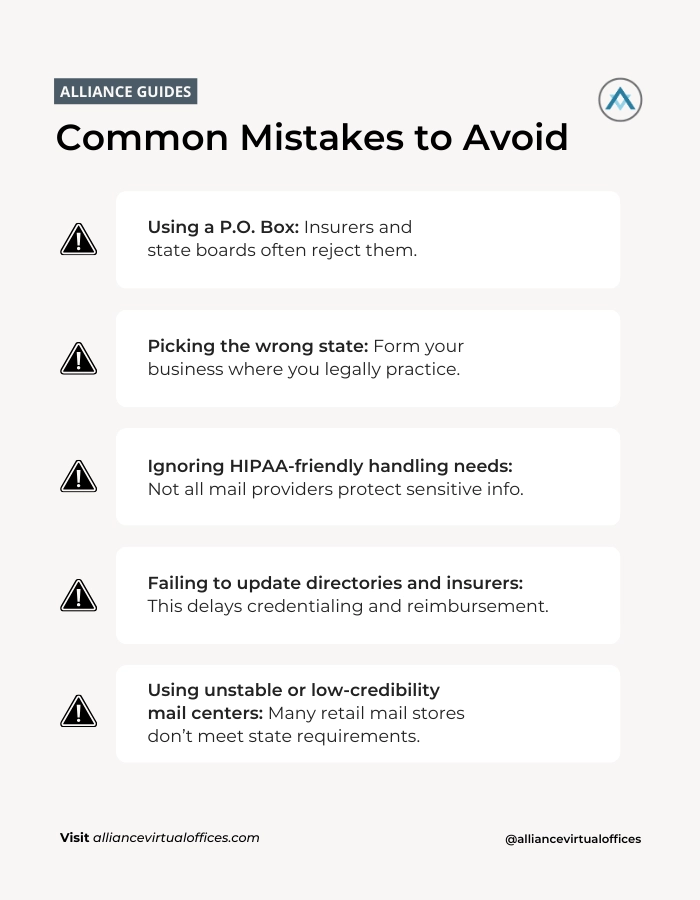
Launching or updating a therapy practice involves a surprising number of administrative details. A virtual office can simplify much of this, but there are a few common mistakes therapists often make during setup. Avoiding these will save you time, stress, and potential delays with licensing or insurance credentialing.
Using a P.O. Box
Why it’s a problem:
State licensing boards, the IRS, and major insurance networks almost always reject P.O. boxes and UPS Store mailboxes. These addresses don’t qualify as a “place of business,” and most payer systems flag them automatically during credentialing.
What can go wrong:
- Your LLC or PLLC filing may get rejected.
- Insurance credentialing can stall for months.
- You may have to re-file paperwork and pay additional fees.
- NPI registration issues can prevent claims from processing.
Better option:
Use a real-street virtual business address tied to a staffed location. It meets nearly all business registration and licensing requirements without the cost of a full-time office.
Picking the Wrong State
Why it’s a problem:
Some therapists try to form their business in a “cheaper” or “easier” state, or the state where their virtual office happens to be located. But for mental health professionals, your business must be formed in the state where you legally practice therapy.
What can go wrong:
- Licensing conflicts
- Tax complications
- Insurance panel rejections
- Delays in updating your state license
- Needing to dissolve and re-register your business
Tip:
Only form your LLC/PLLC in a state where you’re licensed or actively practicing, even if you use teletherapy.
Ignoring HIPAA-Friendly Mail Handling
Why it’s a problem:
HIPAA doesn’t regulate your business address, but it does regulate how sensitive information is handled. Some virtual address providers have open-access mail bins, untrained staff, or insecure storage, none of which align with a therapist’s confidentiality needs.
What can go wrong:
- Exposure of PHI or client-related documents
- Returned or lost insurance checks
- Missed licensing notices or renewals
- Administrative headaches and client trust issues
What to look for instead:
A staffed business center with:
- Controlled access to mail
- Trained personnel
- Secure mail forwarding
- Locked storage for sensitive documents
This keeps your practice organized and supports confidentiality standards.
Failing to Update Directories and Insurers
Why it’s a problem:
Once you register your new business address, you must update it everywhere—otherwise, systems start to mismatch. Insurance network portals, Psychology Today, and NPI records all use your listed address to verify your identity and billing legitimacy.
What can go wrong:
- Claim denials
- Delayed reimbursements
- Credentialing freezes
- Wrong address showing up in search results
- Confusing or unprofessional experience for clients
Where to update quickly:
- CAQH
- NPI Registry
- State licensing portal
- Insurance panels (BCBS, Aetna, Cigna, etc.)
- Teletherapy platforms (Alma, Grow Therapy, Headway)
- Directories (Psychology Today, TherapyDen, GoodTherapy)
A consistent address across all platforms prevents small administrative issues from snowballing.
Using Unstable or Low-Credibility Mail Centers
Why it’s a problem:
Not all virtual address providers are equal. Retail mail centers, coworking spaces without staffing, and “digital mailbox” shops often lack the credibility and reliability required for healthcare businesses.
What can go wrong:
- Boards or insurers reject the address
- Mail gets misplaced or lost
- No staff is available to verify receipt of time-sensitive documents
- Poor professional image when clients search for the address
- Risk of shutdown or instability at low-cost locations
What to choose instead:
A virtual office provider with real, well-established business centers and on-site staff trained to handle business mail—so your licensing documents, insurance checks, and legal notices are always handled properly.
Benefits of a Virtual Office for Therapists
A virtual office isn’t just a convenient alternative to a physical office. For therapists, counselors, and mental health professionals, it solves several pain points that traditional addresses and home setups can’t. It protects your privacy, strengthens your professional presence, supports HIPAA-aligned workflows, and gives you the flexibility to operate a modern, client-centered practice.
Below are the core benefits therapists experience when using a virtual office for their business and licensing needs.
Protect Your Privacy
Therapists carry a unique responsibility to create safe boundaries. When your personal address becomes part of your public business record, that boundary is instantly blurred.
A virtual office shields your personal life by keeping your home address out of:
- State licensing databases
- Business registration records
- Insurance network directories (e.g., CAQH, Availity, payer panels)
- Psychology Today and TherapyDen profiles
- NPI registry listings
- Google Business Profiles and search results
- Client referrals and professional correspondence
This matters in mental health more than in almost any other field. Whether you’re supporting individuals in crisis, doing trauma work, or handling high-conflict family cases, your personal safety must never be compromised.
A stable virtual office address ensures clients only see your professional location, not where you live, protecting your home, your family, and your peace of mind.
Build a Professional Image
Your address shapes how clients and institutions perceive your credibility. A real-street business address from a professional office building helps you:
- Appear more established and trustworthy online
- Meet client expectations for professionalism, especially in healthcare
- Strengthen your brand as a private practice or wellness provider
- Improve how your practice appears on directories, insurance portals, and websites
- Present clean, consistent branding across all online platforms
For many clients seeking therapy, credibility and safety are major factors when choosing a provider. A professional business address plays a small but powerful role in reinforcing that sense of trust.
This becomes especially important for new private practices trying to stand out among hundreds of local listings or teletherapy practices needing to show stability in a fully digital model.
Manage Mail Securely
Therapists receive essential mail, including:
- Licensing notices and renewals
- Insurance checks and EOBs
- Credentialing and revalidation documents
- Legal correspondence
- Session-related mail or documents from collaborative providers
- NPI updates and state-level notifications
A virtual office ensures these materials are handled securely, privately, and efficiently.
With a staffed location, you get:
- Controlled access to your documents
- Secure storage until you pick them up or request forwarding
- Professional handling of sensitive materials
- Less risk of misdelivered or lost mail
- A reliable point of contact for state boards and payers
This is especially important for therapists working remotely who don’t want business mail arriving at their home or who need to avoid unpredictable mail delays.
Support Remote and Hybrid Care
Today’s therapy landscape is more flexible than ever. Many practitioners split their time between teletherapy sessions, working from home, visiting coworking spaces, and occasionally meeting clients in person.
A virtual office supports this reality by giving you:
- A permanent administrative address, regardless of where you physically work
- A central location for licensing, insurance, and regulatory communication
- The ability to operate a multi-state teletherapy model
- A consistent, credible address across all client-facing platforms
- A way to avoid renting a full-time office that may sit largely unused
If you’re building an online-first practice, expanding across states, or reducing overhead while maintaining professionalism, a virtual office is the simplest way to stay organized and compliant without being tied to a location.
Scale as You Grow
One of the biggest advantages of a virtual office is scalability. Your practice may start as a solo teletherapy operation, but over time, you may add:
- Occasional in-person sessions
- Psych assessments
- Couples or family therapy
- Group sessions
- Supervision for new clinicians
- Small workshops
- Additional therapists or contractors
A virtual office gives you room to expand at your own pace.
With Alliance Virtual Offices, you can gradually add:
- Meeting rooms for evaluations, in-person sessions, or periodic client visits
- Live receptionist services to handle calls, intake inquiries, appointment setting, or client screening
- Additional virtual office locations for multi-state licensure
- Coworking or day-office access for administrative days, team planning, or quiet workspace
- Mail forwarding services that scale with your volume
Whether you stay fully remote or grow into a multi-provider group practice, a virtual office adapts to your needs without forcing you into long-term leases or expensive overhead.
Extra Benefit for Therapists: Multi-State Flexibility
Many therapists are now licensed in multiple states or offer teletherapy across state lines. A virtual office with nationwide coverage allows you to:
- Keep a consistent brand across multiple states
- Maintain state-specific administrative addresses if required
- Expand gradually without physical office commitments
- Test new markets before making financial investments
For therapists expanding their telehealth operations, a virtual office is one of the most cost-effective tools for an authentic, compliant, multi-state practice.
Why Choose Alliance Virtual Offices
Alliance Virtual Offices supports more than 1,400 real-street locations that therapists can use for business formation, licensing, insurance credentialing, and day-to-day practice needs.
Therapists choose Alliance because:
- Addresses are accepted by most licensing boards
- Staffed locations protect privacy and confidentiality
- Mail forwarding and scanning support secure document handling
- Live receptionist services help manage calls professionally
- Meeting rooms are available for in-person sessions or assessments
- Nationwide coverage supports multi-state teletherapy practices
Alliance also offers guided setup to make registration easy for new practice owners.
Take the Next Step Toward a Secure, Professional Therapy Practice
Registering your therapy business with a virtual address is not only possible but often the best move for privacy, professionalism, and flexibility. A virtual office helps you work remotely, handle sensitive mail securely, and present a trusted image to clients and insurance networks.
If you’re ready to set up your practice, find your secure, therapist-friendly business address today with Alliance Virtual Offices.