
Q: Should I use my home address for my business?
A: While technically possible, using your home address for business registration carries real risks: privacy exposure, credibility damage, zoning violations, and potential LLC liability issues. For most businesses, a virtual business address resolves all four at a fraction of the cost of physical office space.
One of the first questions many new business owners ask is whether to use their home address for company registration, mail, and their public profile. It sounds like a small detail. It isn’t. The choice affects your privacy, your legal standing, your credibility with clients and banks, and in some cases your ability to register at all.
More people are working from home than ever, and home-based businesses are genuinely normalized. In many situations, using a home address is perfectly fine. In others, it creates complications that are entirely avoidable. This guide walks through both sides: when a home address works, when it creates problems, and how a virtual business address eliminates the downside without adding cost or complexity.
By the end, you will know exactly which option fits your situation and how to get a professional business address set up today.
Why Using Your Home Address Can Be Risky
At face value, using your home address saves a step. In practice, it opens several doors you probably want to keep closed.
Your Address Appears Everywhere
A business address is not just for mail. An average company in the modern era provides its address in a surprising number of situations:
- Bank accounts: every business account you open requires a registered address, and many businesses hold accounts with multiple financial institutions
- Business registration: government filings for LLCs, corporations, and sole proprietorships require a physical mailing address that appears in public records
- Domain registration: your domain registrar requires a physical address, which may be publicly visible in WHOIS records unless privacy protection is added
- Loan applications: every business loan or line of credit application requires a registered business address
- Google Business Profile: local SEO requires a business address, and a home address in a residential area sends mixed signals to potential customers
- Website and communications: your business address may be legally required on your website depending on your industry and jurisdiction
- Stakeholder and supplier correspondence: contracts, invoices, and official communications all reference your registered address
Picture all of that mail arriving at your home mailbox: tax documents, government notices, bank statements, legal filings, supplier contracts, customer correspondence. The volume alone becomes a management problem, and that is before you factor in growth.
Privacy and Personal Safety
Putting your home address into public business filings means it can be found. Anyone who searches your business name, checks public records, or reads your website footer can potentially find where you live.
For most businesses this is a nuisance. For some it is genuinely dangerous. E-commerce businesses, service businesses with high complaint volume, and any business with a public-facing profile carry real risk of a disgruntled customer showing up at a residential address. The same applies to unsolicited salespeople who appear in person once your address is indexed online.
Key Takeaway: Your business address appears in public filings, WHOIS records, Google profiles, and websites. Once it is public, it stays public. A home address cannot be un-indexed once it is out.
Legal and Compliance Issues
Many people form LLCs specifically to protect personal assets from business liability. That protection depends on maintaining a clear legal separation between personal and business activities. Using the same address for both weakens that separation.
In business litigation, the argument that a business and its owner are effectively the same entity is called “piercing the corporate veil.” Using your home address for your business registration is one of the factors that can support that argument. It is not a guaranteed problem, but it is an unnecessary risk.
Zoning regulations add another layer. Many residential areas prohibit or restrict commercial activity. Running a client-facing business, receiving regular deliveries, or having employees come to a home address may violate local bylaws. The rules vary by municipality, but the safest approach is to consult a legal professional before assuming your residential address is an acceptable commercial registration address.
Impact on Business Credibility
Credibility is built on signals, and your business address is one of them. A residential address in a suburb sends a different signal than a commercial address in a recognized business district.
This is especially true for service businesses working with corporate clients, professional services firms, or any company seeking investment or high-value contracts. Clients comparing vendors may factor in perceived scale and permanence. An address that maps to a house or apartment suggests a different scale than a commercial address in a central business location.
Case Example: Amazon requires sellers to provide a valid business address for account verification and tax compliance. A home address can work technically, but many sellers find that a commercial address reduces friction during verification and adds credibility with buyers reviewing seller profiles. For e-commerce businesses at any scale, a dedicated business address for your online store is worth considering from the start.
NEXT STEPS: Business address for online stores
Benefits of a Virtual Business Address
A virtual business address is a professional commercial address you use for business registration, mail, and your public profile, without leasing physical office space. You get the address benefits of a commercial location at a fraction of the cost. For a full overview, see what a virtual business address includes.
Professionalism and Credibility
A virtual business address lets you choose from established commercial locations in major cities. A New York, Los Angeles, or Chicago address signals a different level of presence than a residential zip code. For tech startups, financial consultants, legal professionals, and agencies working with corporate clients, location perception directly affects how the business is received.
Privacy Protection
With a virtual address, your personal home address stays out of public filings, WHOIS records, and business listings. Clients, suppliers, and anyone searching your business name will find a commercial address. No one arrives at your home because no one knows where you live.
Mail Handling and Forwarding
Mail addressed to your virtual business address is received, processed, and either held for pickup or forwarded to any address you choose. Most quality providers send email notifications when mail arrives. See mail forwarding for business for a full breakdown of how mail handling works.
This eliminates the problem of business mail mixed with personal mail. Your company correspondence arrives separately, is handled professionally, and reaches you without requiring a trip to a physical location.
Flexibility Across Multiple Locations
A virtual address lets you establish a business presence in any city, regardless of where you live. Businesses serving multiple markets can register in different jurisdictions. Freelancers and remote founders can project presence in a market before they have any physical footprint there.
LLC and Compliance Requirements
Many states require a physical street address (not a P.O. box) for LLC formation and registered agent designation. A virtual business address at a commercial location satisfies this requirement. It also keeps your personal assets clearly separated from your business registration, preserving the liability protection an LLC is designed to provide.
| Factor | Home address | Virtual business address |
| Privacy | Home location exposed | Personal address protected |
| Credibility | Residential, may raise concerns | Commercial, professional location |
| Cost | Free | Low monthly plan |
| Mail management | Mixed with personal mail | Dedicated, forwarded or notified |
| LLC compliance | Potential liability exposure | Clean legal separation |
| Meeting space | Not available | On-demand access available |
| Geographic flexibility | Fixed to home location | Any city, any market |
NEXT STEPS: See mail forwarding options
Choosing the Right Virtual Address for Your Business
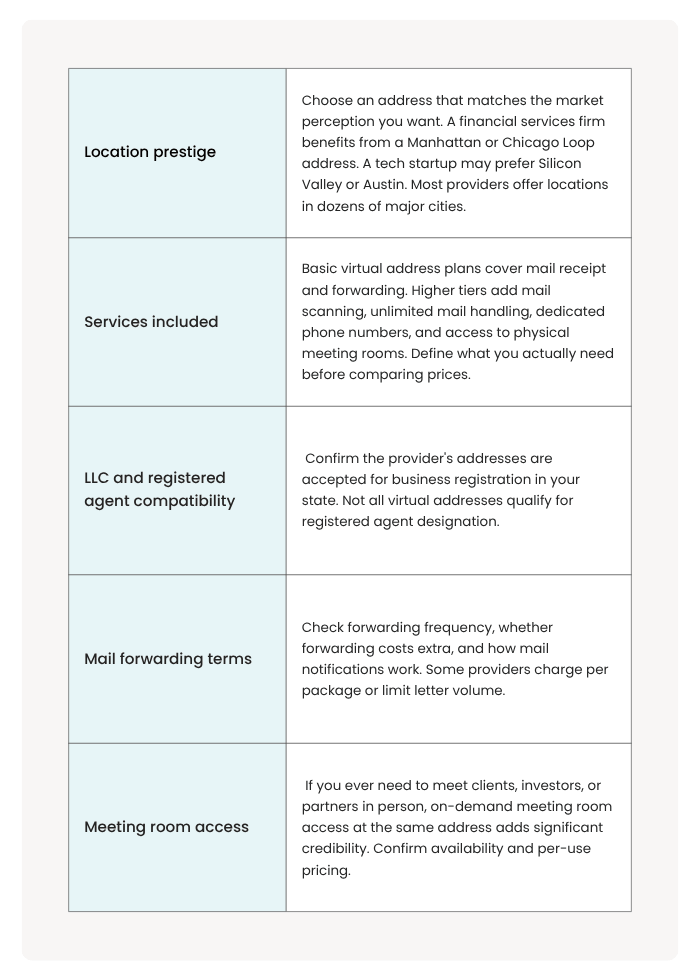
Not all virtual address providers are the same. Before committing, see how to choose a virtual office address for a full comparison framework. The five factors below cover the most common decision points.
- Location prestige. Choose an address that matches the market perception you want. A financial services firm benefits from a Manhattan or Chicago Loop address. A tech startup may prefer Silicon Valley or Austin. Most providers offer locations in dozens of major cities.
- Services included. Basic virtual address plans cover mail receipt and forwarding. Higher tiers add mail scanning, unlimited mail handling, dedicated phone numbers, and access to physical meeting rooms. Define what you actually need before comparing prices.
- LLC and registered agent compatibility. Confirm the provider’s addresses are accepted for business registration in your state. Not all virtual addresses qualify for registered agent designation.
- Mail forwarding terms. Check forwarding frequency, whether forwarding costs extra, and how mail notifications work. Some providers charge per package or limit letter volume.
- Meeting room access. If you ever need to meet clients, investors, or partners in person, on-demand meeting room access at the same address adds significant credibility. Confirm availability and per-use pricing.
Get Your FREE Guide Today!
How to Start a Business in a Recession

Free vs. Paid Virtual Business Address
Free virtual address options exist, but they come with trade-offs worth understanding before committing. For a detailed breakdown, see free virtual business address explained.
- Free options: typically come with limited mail handling, restricted forwarding, fewer location choices, and minimal support. Often tied to co-working or service upsell models.
- Paid plans: start from around $49/month and include professional addresses at established commercial locations, mail forwarding, notifications, and often meeting room access.
- The gap in practice: a free address that is not accepted for LLC registration or that maps to an obviously shared mailbox space defeats the purpose. The savings disappear if you cannot actually use the address for your core needs.
Before you sign up, confirm the provider can:
- Accept mail at a real commercial street address (not a P.O. box)
- Be used for LLC or business registration in your state
- Forward mail to any address you choose
- Send notifications when mail arrives
- Provide access to meeting rooms if needed
- Handle packages, not just letters
- Scale with your business as volume grows
NEXT STEPS: Understand virtual office costs
How a Virtual Business Address Works
Setup is straightforward. Most businesses are using their new address within one to two business days.
- Choose your address location. Select from available cities based on the market presence you want to project. You can filter by city, neighborhood, or zip code depending on the provider.
- Register and activate your plan. Sign up online and complete any identity verification required. Your address is active as soon as verification is complete.
- Start using the address. Update your business registration, bank accounts, Google Business Profile, website, domain registration, and any other records. The address works for all of them.
- Receive mail notifications. When mail arrives, you are notified. Depending on your plan, you can request forwarding, pickup, or in some cases scanning of the contents.
- Book meeting space when needed. If you need to meet clients or hold interviews in person, reserve a professional room at the same address on demand. You pay only when you use it.
NEXT STEPS: Get a virtual office address
Get Your FREE Guide Today!
How to Start a Business in a Recession
Why Alliance Virtual Offices
Alliance Virtual Offices is one of the largest virtual office providers in the United States, with over 1,400 locations across major cities including New York, Los Angeles, Chicago, Miami, Dallas, Houston, San Francisco, Atlanta, Las Vegas, and Orlando. For a complete look at what is included, see the virtual address plans.
What Is Included
- Professional commercial addresses accepted for business registration, LLC formation, and bank account setup
- Unlimited mail receipt on even basic plans, which is not standard across all providers
- Mail forwarding to any address, with notification when mail arrives
- On-demand meeting rooms at the same address, booked per use with access to internet, printing, onsite staff, and office amenities
- Live Receptionist add-on: combine your virtual address with professional call answering, lead capture, and appointment scheduling starting at $125/month
Pricing
Alliance Virtual Offices plans start from $49/month. That includes a professional commercial address, unlimited mail receipt, and mail forwarding. No long-term lease. No physical office overhead. No setup fees that eliminate the value of the first few months.
For comparison, leasing even the smallest shared desk in a commercial building in a major city typically runs hundreds of dollars per month with a 12-month minimum. A virtual address delivers the address benefit without any of that commitment.
NEXT STEPS: Explore virtual address plans
Should You Use Your Home Address for Your Business?
In a few specific situations, yes: a holding company with no public presence, a contractor working with a small, trusted client base, or a business that genuinely has no need for a commercial address. In most situations, the privacy, legal, and credibility risks make a virtual business address the smarter choice.
The good news is that the solution is simple and affordable. A professional address, mail handling, and the flexibility to work from anywhere costs less per month than most software subscriptions. The downside of using your home address is real and ongoing. The cost of fixing it is low and one-time.
Alliance Virtual Offices has 1,400+ professional business address locations across the United States. Plans start from $49/month. No lease. Privacy protected. Mail forwarding included. Browse virtual business addresses.
Further Reading
- Mail Forwarding for Business — How business mail forwarding works and what to look for in a provider.
- Business Address for Online Store — Address requirements for e-commerce sellers on Amazon and other platforms.
- Free Virtual Business Address — What free virtual address options include and where they fall short.
- How to Get a Virtual Office Address — Step-by-step guide to setting up your virtual business address.