
- What’s a Satellite Office? Definition and Examples
- Satellite Office vs. Branch Office vs. Home Office
- What a Satellite Office Costs (and a Lower-Cost Way to Open One)
Q: What’s a satellite office?
A: A satellite office is a smaller workspace a company operates in a different location from its main headquarters. It stays connected to HQ for strategy, budgets, and admin while giving teams a dedicated place to work closer to employees, clients, or a new market.
Your company has reached the point where one address no longer covers everyone. A few employees live two hours from headquarters, a promising client cluster sits in another metro, and your hiring radius keeps bumping into commute limits.
That’s usually when you start thinking about opening a satellite office: a standard model for bringing people closer to where work happens without moving your main headquarters. This guide explains what a satellite office is and walks through a lower-cost way to open one.
What’s a Satellite Office? Definition and Examples
A secondary workspace operating at a distance from a company’s main office, the name “satellite office” fits. It’s like a satellite orbiting a planet. In practical terms, a satellite office is any company-run workspace that’s geographically separate from headquarters but not independent from it.
Strategy, finance, HR, and major decisions still live at the main office, but satellite offices are productive spaces for employees, which might be located closer to a concentration of employees, key clients, or inside a talent market you want to hire from.
A satellite office can be a two-person desk arrangement inside a shared building or a 40-person floor in another city.
Real-World Examples of Satellite Offices
Here’s what satellite offices look like in practice:
- A regional sales hub. A Denver-based software company opens a small Dallas office for its sales team to meet Texas clients instead of flying in for every pitch.
- A talent outpost. A New York firm that keeps losing engineering candidates to relocation requirements opens a small Austin workspace where those hires already live.
- A client-proximity office. A consulting practice opens a workspace near a major client’s campus, giving the remote team a professional place to gather during multi-month engagements.
- A government services office. A contractor headquartered in California maintains a small Washington, DC presence for agency meetings and proposal work.
In each case, the pattern is the same. The main office keeps running the business while the satellite handles presence, proximity, and access.
The Hub-and-Spoke Shift
You’ll also hear satellite offices called spoke offices, remote offices, or secondary offices. Some companies use the term regional office when the location serves a defined territory.
The “spoke” label comes from the hub-and-spoke model, where a central headquarters acts as the hub and smaller satellite workspaces serve as the spokes. The terms hub-and-spoke and satellite office overlap heavily, with companies using them interchangeably in everyday conversation.
Why Companies Open Satellite Offices in 2026
Satellite offices aren’t new, but the case for them has changed in recent years. Distributed teams, hybrid schedules, and expensive leases on headquarters have pushed companies to rethink how much office space they need and where it should be located.
A Robert Walters study found that 37% of business leaders were considering downsizing their primary office in favor of smaller satellites located closer to where employees live. The same research found that 85% of employees expect continued flexibility to work from home. Companies are meeting that expectation by trading one large central lease for a network of smaller workspaces closer to employees.
Hybrid Work by the Numbers
Hybrid schedules make it even harder to justify the cost of a single big office. According to Searchlab’s remote and hybrid work statistics, 54% of global knowledge workers are working hybrid in 2026, with the US leading at 58%. Today, the average employee comes into the office just 2.4 days per week.
These figures help explain why US office vacancy rates are averaging around 19.6%, the highest level since the 2008 financial crisis (as per Searchlab analysis). Paying full price for a headquarters that sits one-third empty is exactly what satellite offices are designed to solve.
Commute and Talent Advantages
Location flexibility is also a hiring lever, as saving commute time is seen as a top advantage of flexible arrangements. Savills Research on what workers want found that 63% of workers wouldn’t accept more than 15 extra minutes of commuting, even for an ideal workplace.
Location also works as a recruiting lever. A satellite office placed where candidates already live removes the relocation barrier and widens the talent pool you can realistically hire from.
Read more: The Future of Workplaces – Virtual Addresses, and On-Demand Spaces
Satellite Office vs. Branch Office vs. Home Office
People use these terms loosely, but the differences between a satellite office, branch office, and home office matter when you’re planning budgets, reporting lines, and doing headcount. Here’s how to keep them straight.
Satellite Office vs. Branch Office
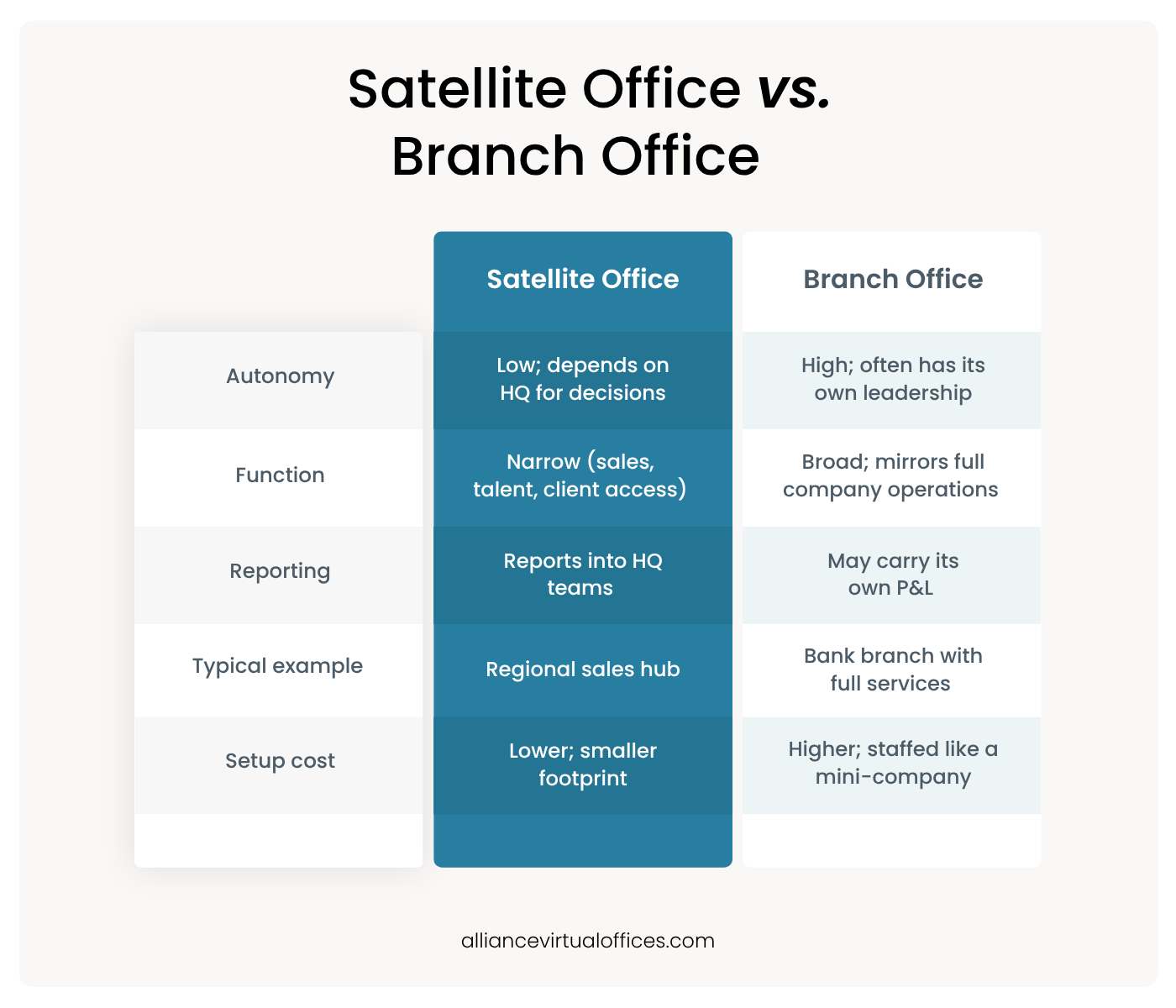
A branch office operates like a small version of the whole company, often with its own leadership, profit and loss (P&L) responsibility, and full business functions. Meanwhile, a satellite office serves a narrower purpose and leans on headquarters for nearly everything else.
If workers in your second location will make their own decisions and run their own books, you’re planning a branch office. If it exists to put people somewhere strategic, it’s a satellite office.
Here’s a breakdown of how this works in principle:
Satellite Office vs. Home Office
Plenty of companies skip the second office entirely and let distant employees work from home, as home offices are basically free to run. That can work for some employees, but it leaves gaps you can’t replicate over video calls.
Satellite offices cost more, but they give a remote team structure, including a consistent place to collaborate, host clients, and separate work from home life. They build local presence and team culture, signaling commitment to a market in a way a scattered set of home offices doesn’t.
Many companies blend the two. The satellite office serves as an anchor point where the local team gathers two or three days a week, while they work from home to cover the rest of their schedule. That arrangement keeps the cohesion benefits without paying for desks that sit empty. It also pairs naturally with a lower-cost setup model.
Unlock Our Current Virtual Office Offers
Enter your email below and we’ll send you the latest available promotions and monthly specials for Virtual Offices, Meeting Rooms, and Live Receptionists.
What a Satellite Office Costs (and a Lower-Cost Way to Open One)
For most small and mid-sized businesses, office space cost is a deciding factor. The traditional route is more expensive than most first-time buyers expect, and the line items add up before anyone sits at a desk.
What a Traditional Satellite Office Costs
A conventional satellite office starts with a commercial lease, with small-office leases in most US metros typically running $3,000 to $10,000 per month, depending on market and size. That’s before you consider any additional recurring costs.
Here’s a breakdown of costs in a traditional office setup:
Terms prove a bigger risk. Multi-year leases lock you into a market before you know whether the satellite will earn its keep, and breaking a commercial lease early is rarely cheap.
However, a leased satellite is sometimes the right call. Large permanent teams, regulated industries with strict workspace requirements, and offices with daily client foot traffic generally justify dedicated space.
The Virtual Office and On-Demand Meeting Room Model
You don’t need a lease to establish a satellite presence; a virtual office solution can give your business a real, professional address in your target market, with mail handling and workspace access, starting around $49 per month.
When the team needs to meet in person, use on-demand meeting rooms in the same markets, which you can typically rent for between $30 to $75 per hour. You pay for presence continuously and for space only on the days you use it.
For an expanding business, start by browsing virtual office locations in your target city, establish the address, and test the market for months instead of committing to years. The benefits of using a virtual office extend beyond cost, but the cost alone can impact expansion.
Read more: Meeting Room Rental Rates – What You Should Expect to Pay
How to Choose a Satellite Office Location
Once you’ve settled on the satellite office model, you’ll next decide on location. Choose a satellite office based on what the workspace is for, and what’s most suitable for your team, not which deal looks best.
Match the Location to Its Purpose
Start with the job the office needs to do. A sales satellite office that’s 20 minutes from your three biggest accounts typically outperforms a cheaper space across town. Meanwhile, a talent outpost in the wrong suburb recreates the commute problem you were hoping to solve. Consider the following:
- Client access: Pick the metros where your revenue is concentrated and prioritize proximity to client offices over your own convenience.
- Talent: Choose cities where your candidates already live, then check what their commute times might look like.
- Coverage: For support or operations teams, weigh time zones and regional logistics over prestige addresses.
Evaluate Before You Commit
Don’t sign anything until you’ve pressure-tested the location. Work through this checklist first:
Satellite Office Evaluation Checklist
- Visit the building in person or send someone you trust to view it.
- Confirm the business address presents well on your website, LinkedIn, and Google Business Profile.
- Check transit access and parking for employees who’ll use it.
- Price up at least three comparable options before opening negotiations.
- Confirm meeting space availability for the days you’ll need it.
- Start with the shortest commitment the market test allows.
Setting Up Your Satellite Office the Smart Way
A satellite office is a smaller, HQ-dependent workspace that brings your company closer to employees, clients, or new markets. It differs from a branch office in terms of autonomy, and from a home office in terms of structure and presence.
While a traditional office lease can cost $3,000 to $10,000 per month before fit-out and staffing, which is locked behind multi-year terms, the lower-commitment version pairs a virtual office address from around $49 per month with meeting rooms by the hour. This lets you establish presence first and add space as the market proves out.
Whichever route you take, let the purpose of your new workspace help you choose the most suitable location, and test it before you commit. Expansion decisions are easier to make when the downside is a monthly plan instead of a five-year lease.
To find on-demand meeting rooms near your team, search for plans from Alliance Virtual Offices.
Frequently Asked Questions
What’s a satellite office?
What’s the difference between a satellite office and a branch office?
What’s an example of a satellite office?
What’s another name for a satellite office?
Further Reading