
- What Does an Enterprise Virtual Office Solution Include?
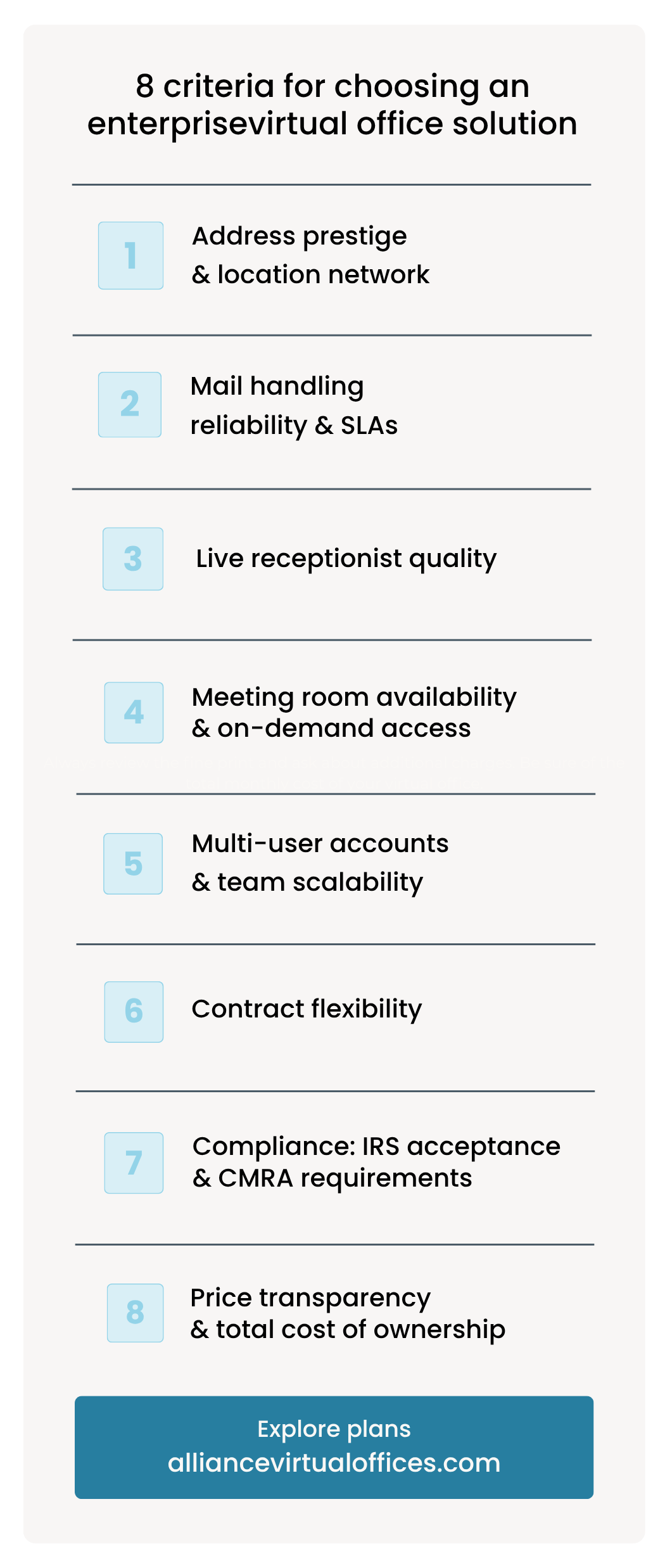
- 8 Criteria for Choosing an Enterprise Virtual Office Solution
- Top Enterprise Virtual Office Providers Compared
Q: What should I look for in an enterprise virtual office solution?
A: A strong enterprise virtual office solution should include a prestigious business address, reliable mail handling, professional live reception, on-demand meeting rooms, and the flexibility to scale across multiple locations. Look for month-to-month contracts and transparent pricing.
Growing companies are moving away from traditional office leases. Cost efficiency, hybrid work infrastructure, and geographic scalability are all driving the adoption of virtual office solutions from enterprises.
For decision-makers at growing companies, the question is no longer whether to consider a virtual office solution, but how to go with the right provider. Choosing the wrong virtual office solution creates real operational problems, such as compliance exposure, inconsistent mail handling affecting client communications, meeting room scarcity in operational markets, and pricing structures that punish growth.
This guide covers the eight criteria that enterprise buyers must evaluate before selecting a virtual office provider.
What Does an Enterprise Virtual Office Solution Include?
The term “virtual office solution” covers a wide range of services. Understanding the spectrum is essential before evaluating providers. At the basic end, a virtual office is a simple mail-forwarding address, giving you a street address and mail forwarding service.
A full virtual office solution for business combines several functional layers on top of a prestigious business address at a professional location and daily mail notification and forwarding.
It also provides a live receptionist service, answering in your company name, access to on-demand meeting rooms and conference facilities, and multi-user account management allowing different enterprise employees to access the same services under a single account.
Virtual office solutions also vary in how well they support compliance requirements. This means that understanding what is a virtual office in full, not just the address component, is the prerequisite for making a well-informed provider comparison.
A decision-maker comparing providers based only on address price is comparing the wrong variable. The real value of a virtual office solution lies in how effectively it replicates the operational functions of a physical office: mail, phone, meetings, and compliance, without the fixed cost of a lease.
Read more: What Is a Virtual Office? How It Works and What’s Included
8 Criteria for Choosing an Enterprise Virtual Office Solution
The criteria below represent the decision framework that enterprise buyers use when evaluating virtual office services. Each criterion includes specific questions to ask potential providers before signing.
1. Address Prestige and Location Network
The business address you choose functions as a signal of credibility to clients, partners, investors, and regulators. A central San Francisco address reads differently than a suburban strip mall address. Enterprise buyers understand that distinction. Evaluate not just the prestige of a single address, but the breadth of your chosen provider’s location network.
Multi-location enterprises need to be able to set up presence in new markets quickly, without switching providers or renegotiating contracts. A virtual office provider with access to hundreds or more locations internationally gives enterprise teams entering new markets, or managing distributed operations, a direct operational advantage.
2. Mail Handling Reliability and Service Level Agreements (SLAs)
Mail handling is often the most underestimated criterion in virtual office selection. For enterprise operations, mail handling failures create client communication problems, regulatory exposure, and operational friction. Delayed notifications, lost packages, and slow forwarding are the most common complaints.
Evaluate mail handling providers on the following five dimensions:
- Daily mail notification.
- Scanning capabilities.
- Forwarding speed and carrier options.
- Package receipt.
- SLA commitments.
Ask providers specifically about their mail notification service level agreement, whether you can receive digital scans of first-class mail, what carriers are used for forwarding, and the additional costs. Enterprise buyers should expect to receive clear answers and documented SLAs, rather than vague commitments about a “prompt” service.
3. Live Receptionist Quality
A virtual office solution that includes a professional live receptionist service converts your business address into a fully-staffed front of house. Callers reach a real person who answers in your company name, screens calls, routes to the right person, and takes detailed messages.
The alternative, such as directing callers to an interactive voice response (IVR) menu or voicemail, creates a different brand impression that enterprise buyers often underestimate.
Evaluate receptionist services on the following three dimensions:
- Whether receptionists are US-based or offshore.
- How custom scripts are built and maintained.
- What happens when call volume spikes.
Offshore services are often cheaper but can introduce language barriers and inflexibility that creates friction, impacting the enterprise client experience. US-based live receptionist services with flexible scripting typically command a premium experience for enterprise use cases.
4. Meeting Room Availability and On-Demand Access
For enterprise teams that work remotely but occasionally need a professional space for client meetings, investor presentations, or team gatherings, on-demand meeting rooms are a core service layer. Evaluate providers on room availability in your operating markets, the booking process (app-based vs. phone/email), hourly rates, and whether day offices are available for longer work sessions.
Ask specifically about whether meeting rooms are available in the cities you need most, the required booking lead time, and whether there are any hidden fees beyond the hourly room rate. For enterprise buyers with teams in multiple markets, a provider with a nationwide meeting room network, rather than one with just a few flagship cities, is the only viable option.
5. Multi-User Accounts and Team Scalability
Enterprise virtual office buyers aren’t single users, but account administrators who manage services for distributed teams. Evaluate whether a provider supports multi-user account structures, so you can add team members to an account without renegotiating a new contract.
Also check whether different users access service tiers under a single corporate account, and if there’s a management dashboard that gives you visibility across all users.
For remote teams, scalability is directly tied to how easily you can add users to new markets without operational friction. Providers that treat each new user as a new standalone customer aren’t enterprise-ready, but platforms that support team accounts, centralized billing, and admin-level control over services are the right fit for growing organizations.
6. Contract Flexibility
Enterprise procurement teams have learned that long-term service contracts carry hidden costs, including the operational overhead of managing locked-in providers, the switching cost when service quality degrades, and budget inflexibility when headcount changes. In 2026, month-to-month contract terms are the enterprise standard expectation for virtual office services.
For growing companies where virtual office needs may shift significantly over 12 months, due to entering new markets, changing team sizes, and in acquisition scenarios, month-to-month flexibility has real economic value.
Unlock Our Current Virtual Office Offers
Enter your email below and we’ll send you the latest available promotions and monthly specials for Virtual Offices, Meeting Rooms, and Live Receptionists.
7. Compliance: IRS Acceptance and CMRA Requirements
Compliance is the most misunderstood criterion in enterprise virtual office selection. The two key compliance questions are whether the Internal Revenue Service (IRS) accepts virtual addresses, and does the address meet Commercial Mail Receiving Agency (CMRA) requirements for LLC registration and state filings.
Provided the virtual office address is CMRA-compliant, the IRS accepts them for most business purposes, including Employer Identification Number (EIN) applications and LLC registration. CMRA compliance means that the address provider has registered with the United States Postal Service (USPS) as a commercial mail receiving agency and that clients complete USPS Form 1583 to authorize mail receipt.
When establishing a virtual office for LLC formation, confirm CMRA compliance explicitly with your provider, as not all address services meet this standard.
For enterprise buyers with regulated industry exposure, such as those in healthcare, financial services, and legal industries, additional address compliance may be required beyond having standard CMRA certification. Confirm your specific compliance requirements with legal counsel before selecting a provider.
8. Price Transparency and Total Cost of Ownership
Hidden fees are the most common enterprise complaint about virtual office providers. Setup fees, mail handling surcharges, forwarding fees, additional charges for package receipts, and per-call receptionist fees aren’t included in base pricing. In fact, these costs transform an apparently low monthly plan into a materially higher total cost of ownership.
Evaluate providers on the full cost structure, not just the advertised starting price. Businesses utilizing virtual offices can save on operating costs, compared to traditional office spaces, but only if the virtual office cost structure is evaluated completely, not just the headline monthly rate.
Top Enterprise Virtual Office Providers Compared (2026)
The table below provides a breakdown of services offered by virtual office providers:
Pricing shown reflects approximate entry-level plans available as of mid-2026. Enterprise buyers should verify current pricing and contract terms directly with each provider before finalizing their evaluation.
| Provider | Network Size | Live Receptionist | Meeting Rooms | Contract | Starting Price | Best For |
|---|---|---|---|---|---|---|
| Alliance Virtual Offices | 1,400+ locations (US, Canada, international) | Yes; US-based, add-on | Yes; nationwide network | Month-to-month | ~$48/month | Cost-efficient, flexible enterprise solution |
| Regus | 3,500+ locations globally | Yes; included in higher tiers | Yes; premium global locations | Typically 12-month | ~$60/month | Global enterprise presence, premium locations |
| iPostal1 | 3,500+ locations (US + international) | Limited | Limited | Month-to-month | ~$9.99/month | Budget address solution, limited full-service offering |
| DaVinci Virtual | 1,000+ locations | Yes | Yes | Month-to-month available | ~$49/month | Address + receptionist bundle |
Alliance Virtual Offices is a beneficial provider for enterprises, as it provides transparent month-to-month pricing, a 1,400+ location network (operating month-to-month without long-term commitment), CMRA-compliant addresses, a US-based live receptionist add-on, and a nationwide meeting room network.
Read more: How to Choose a Virtual Business Address
The Right Virtual Office Solution Sets the Foundation for Scalable Growth
Why enterprises choose virtual offices in 2026 comes down to applying the eight criteria systematically, across address prestige and network breadth, mail handling reliability, receptionist quality, meeting room access, multi-user scalability, contract flexibility, CMRA compliance, and full-cost pricing transparency.
A provider that performs well across all eight criteria is a genuine long-term partner for your business infrastructure. The right decision is the one grounded in your specific compliance requirements, team structure, and target markets, not the lowest headline price.
Alliance Virtual Offices is particularly suitable for enterprise buyers at growing companies who need a professional address without the friction of long-term contracts or hidden fees.
Explore current plans and locations to start your virtual office search.
Frequently asked questions
What are virtual office solutions?
Does the IRS accept a virtual address?
How much does a Regus virtual office cost?
What is the difference between a virtual office and a registered office?
Is a virtual office good for an enterprise business?
Further Reading