
- Freight Broker vs. Freight Forwarder Roles at a Glance
- What’s a Freight Broker?
- Which Role Should You Use or Start In?
Q: What’s the difference between a freight broker vs. freight forwarder?
A: A freight broker arranges transportation between a shipper and a carrier but never takes possession of the goods. A freight forwarder takes possession, consolidates shipments, often handles international customs, and assumes responsibility for the freight while it moves.
If you’re comparing logistics partners or deciding which type of logistics business to start, you might start looking at being a freight broker vs freight forwarder. Although these two roles sound similar, they carry very different responsibilities, liabilities, and licensing requirements.
This guide looks into the two roles in the freight industry and provides a side-by-side comparison with additional avenues to consider. This helps you pick the right partner or business model, with the most suitable set up, such as establishing a professional business address with Alliance Virtual Offices.
Freight Broker vs. Freight Forwarder Roles at a Glance
Before diving into definitions, there are more roles to consider than just a freight broker vs. freight forwarder. Add freight dispatchers, freight agents, motor carriers, and third-party logistics providers (3PLs) to the mix, and the picture gets blurry fast.
Each role occupies a specific spot in the supply chain, and the differences between them come down to the following three questions:
- Who takes possession of the freight?
- Who’s liable if it’s lost or damaged?
- How does each party get paid?
Here’s how the six freight industry roles compare across the attributes that matter most. Use this table as your quick reference, then read the sections below for the detail behind each row:
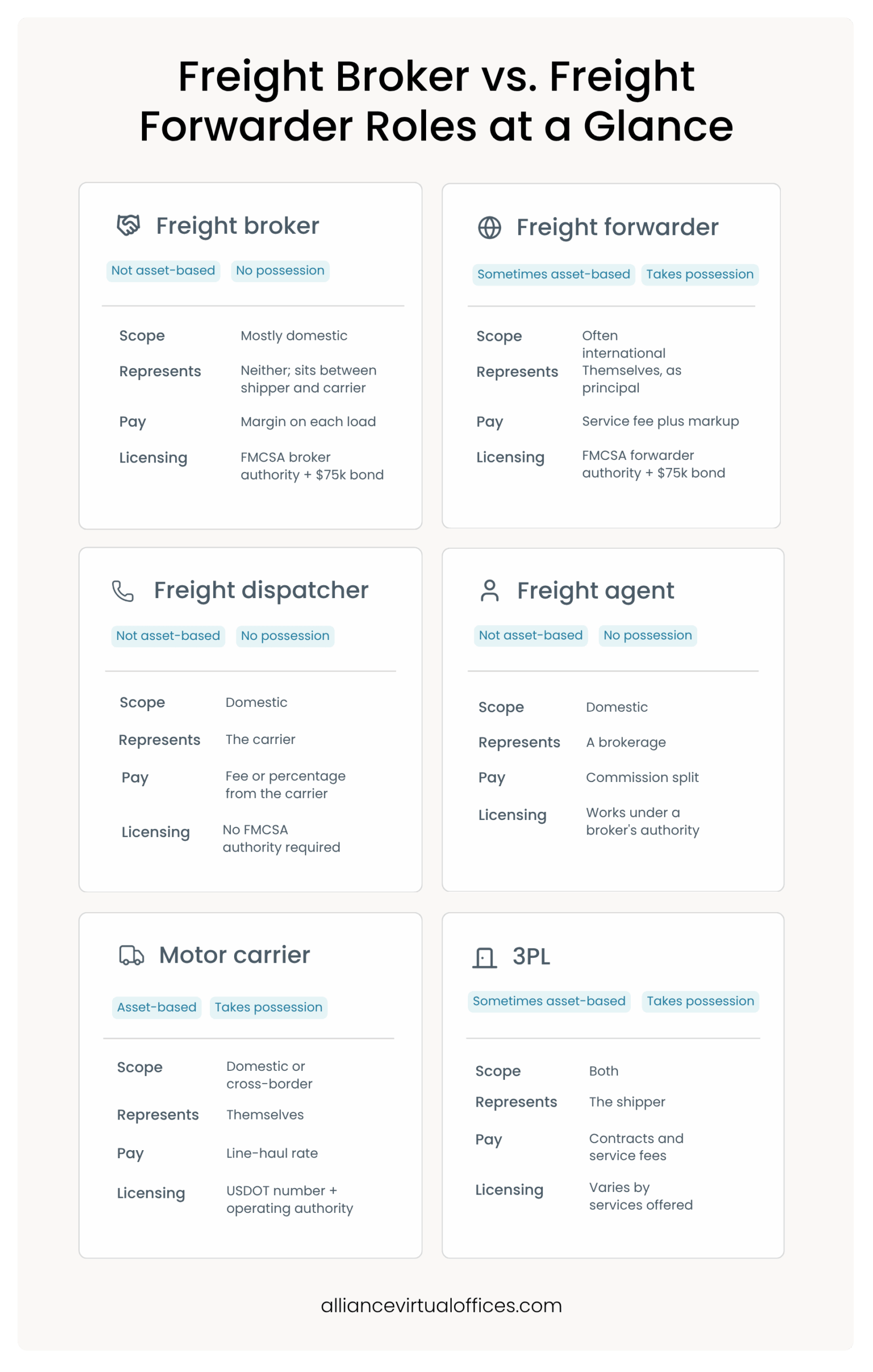
The single most useful distinction in this table is possession. Freight brokers, dispatchers, and agents never touch the freight, while forwarders and carriers do, and that fact determines who carries cargo liability.
The second distinction to watch is who each party represents. A freight broker is neutral between shipper and carrier, a dispatcher and an agent each represent one side, and a carrier represents only itself.
What’s a Freight Broker?
A freight broker is the middle person between a shipper and a motor carrier, who arranges transportation for a fee but doesn’t own trucks, employ drivers, or take possession of the freight itself.
As a freight broker only arranges the move, they’re generally not liable for cargo loss under the Carmack Amendment, which applies to carriers and freight forwarders. A broker, by contrast, is usually liable only where negligence can be proven, such as poor carrier selection.
Freight brokers earn a margin, which is the difference between what the shipper pays and what the carrier is paid. To operate legally, a broker needs Federal Motor Carrier Safety Administration (FMCSA) broker authority and must maintain a $75,000 surety bond.
Most broker freight moves domestically over the road, matching truckload and less-than-truckload shipments with carriers across the country. It’s high-volume work and all about developing relationships, since a broker’s income depends on moving many loads reliably rather than on owning any equipment.
It’s worth clarifying what the commission and margins are, because the two often get confused. A broker keeps a margin, which is the spread it controls on each load, while an agent working under a broker earns a commission split of that margin.
Read More: Best Cities for Transportation Companies
What’s a Freight Forwarder?
Unlike a freight broker role, a freight forwarder organizes shipments and takes possession of goods. Freight forwarders assemble and consolidate freight, arrange break-bulk and distribution, and assume responsibility for the transportation process.
This is the core of the freight broker vs freight forwarder distinction. As a freight forwarder takes possession of the freight itself, the role carries responsibilities, such as cargo liability while the goods are in its control, whereas a broker doesn’t.
Freight forwarders are especially common in international shipping, where they manage customs documentation, the bill of lading, and the handoffs between ocean, air, and ground carriers.
Like freight brokers, forwarders need FMCSA authority and a $75,000 financial guarantee, but their liability exposure is considerably higher because they act as a principal of cargo, rather than an intermediary.
Consolidation is a defining forwarder function. By combining smaller shipments from multiple customers into a single larger load, a freight forwarder can secure better rates and then distribute the goods at the destination, a service brokers don’t provide.
The domestic vs international shipping split is a useful rule of thumb. If a shipment stays within the country and simply needs a truck, a broker often fits. If it crosses borders, needs consolidation, or requires customs handling and a bill of lading, a forwarder is usually the better match.
What Does a Freight Dispatcher Do vs. a Freight Broker?
A freight dispatcher works on behalf of a carrier, not between the shipper and carrier. The dispatcher finds loads for the trucks they represent, negotiates rates for the carrier, and handles booking and scheduling.
The freight broker vs dispatcher difference is representation. A freight broker is neutral and sits in the middle, while a dispatcher is an agent of the carrier and works in that carrier’s interest.
Dispatchers don’t need FMCSA broker authority because they’re managing loads for a specific carrier rather than brokering freight to the public. That’s why freight dispatching has a lower barrier to entry than getting into the freight brokerage business.
In practice, a freight dispatcher often handles the administrative load a small carrier can’t manage alone, such as searching load boards, negotiating with freight brokers, and keeping the truck scheduled. They typically charge the carrier a flat fee per load or a percentage of the line-haul rate.
Shippers rarely deal with freight dispatchers directly. A dispatcher’s customer is the carrier, not the shipper, so from a shipper’s point of view the relevant choice is usually broker, forwarder, or 3PL.
Get Your FREE Guide Today!
How to Start a Business in a Recession

Freight Agent, Motor Carrier, and 3PL Explained
The remaining three roles in the freight industry round out the supply chain. Each one relates to the freight broker in a specific way, so it helps to see them side by side with the broker as the reference point.
Freight Agent vs. Freight Broker
A freight agent sells and services freight under an established brokerage’s authority and bond. The difference between a freight agent and a freight broker comes down to ownership of the authority, as an agent operates on someone else’s license, while the freight broker holds its own.
Freight agents earn a commission split rather than the full margin, and they avoid the upfront cost of a bond and FMCSA registration. This is the most common entry point for newcomers to the freight industry.
The trade-off is control. A freight agent relies on the parent brokerage for compliance, factoring, and back-office support, but gives up a share of every load’s margin in exchange. Many freight agents treat the arrangement as a paid apprenticeship, building relationships and volume before deciding whether to file for their own authority and keep the full spread.
Motor Carrier
A motor carrier is asset-based. It owns or operates the trucks, employs or contracts the drivers, and physically hauls the freight, which means it takes possession of goods and holds cargo liability.
Meanwhile, freight brokers, dispatchers, and agents are non-asset based, because they coordinate freight without owning equipment. Motor carriers are asset-based because the trucks are theirs.
Motor carriers hold a USDOT number, which is a unique identifier collected by the FMCSA to monitor safety information, track compliance, and conduct audits for commercial vehicle operators. They also take on the operational cost and safety responsibility that comes with running vehicles. That heavier footprint is exactly what the non-asset roles are designed to avoid.
What’s a 3PL?
A third-party logistics provider, or 3PL, offers a bundle of logistics services to the freight industry. That can include brokerage, warehousing, fulfillment, and transportation management.
Some 3PLs are asset-based, and own warehouses and trucks, while others don’t have any assets and coordinate everything through partners. The difference between a 3PL and a freight broker comes down to scope, as a broker arranges individual loads, while a third-party logistics provider manages broader, ongoing logistics operations for a shipper.
Hiring a freight broker is like booking a single ride. Meanwhile, engaging a 3PL is closer to outsourcing your whole transportation department.
Many growing shippers start with brokers for flexibility, then move on to establish a 3PL relationship as their volume and complexity increase.
Which Role Should You Use or Start In?
For shippers, the right partner depends on the job you need done. Consider engaging with a freight broker for individual loads and flexible capacity, a forwarder for international or consolidated shipments, and a third-party logistics provider when you need to outsource broader logistics on an ongoing basis.
For entrepreneurs deciding which business to start, the choice usually comes down to capital and risk tolerance. Non-asset roles such as brokering, agenting, and dispatching are lighter to launch, while asset-based carrier operations require vehicles and carry more liability.
Within the non-asset group, the on-ramp usually runs from agent to broker. Starting as a freight agent lets you learn the business under an established brokerage’s authority, then move to your own FMCSA broker authority once you’ve established carrier relationships and a book of freight.
Freight dispatching is another low-cost entry point into the industry, though it ties your income to the carriers you serve rather than to a neutral position in the market.
If you’re starting a non-asset logistics business, a professional business presence matters from day one because carriers and shippers vet who they work with. Having a commercial business address for your LLC from Alliance Virtual Offices helps a new brokerage or dispatch operation look established rather than running your operations from a home address.
NEXT STEPS: Explore virtual office plans with Alliance
Choosing Between a Freight Broker, Forwarder, Dispatcher, and 3PL
The freight broker vs. freight forwarder decision, and the wider comparison across dispatchers, agents, carriers, and 3PLs, always returns to the same three questions. These are:
- Who takes possession of the freight?
- Who holds the cargo liability?
- How does each party get paid?
Freight brokers and dispatchers coordinate without touching the goods, forwarders and carriers take possession and carry liability, and 3PLs bundle several of these functions together. Once you map out a role against those attributes, choosing the right partner or business model in the freight industry becomes far simpler.
If you’re launching one of these businesses rather than partnering with one, having a dedicated business address gives your operations a credible footing with the carriers and shippers you depend on.
Establish a professional business address with Alliance Virtual Offices, starting at only $49 per month.
Frequently Asked Questions
Is a 3PL the same as a freight broker?
What does a freight dispatcher do versus a broker?
Who’s liable: the broker or the forwarder?
What’s the difference between a freight agent and a freight broker?
Further Reading