
- How many Americans are actually leaving?
- What breaks when you move out of the US
- How to keep your US presence from anywhere
Q: Can I keep my US LLC if I move abroad?
A: Yes, as long as you keep a US business address, a registered agent, and your state filings current. Your company’s home and your home do not have to be the same country.
The one-way ticket is booked, the lease is wrapping up, and life is down to two suitcases. Then the founder checklist starts: the LLC, the business bank account, the client phone line, and the mail.
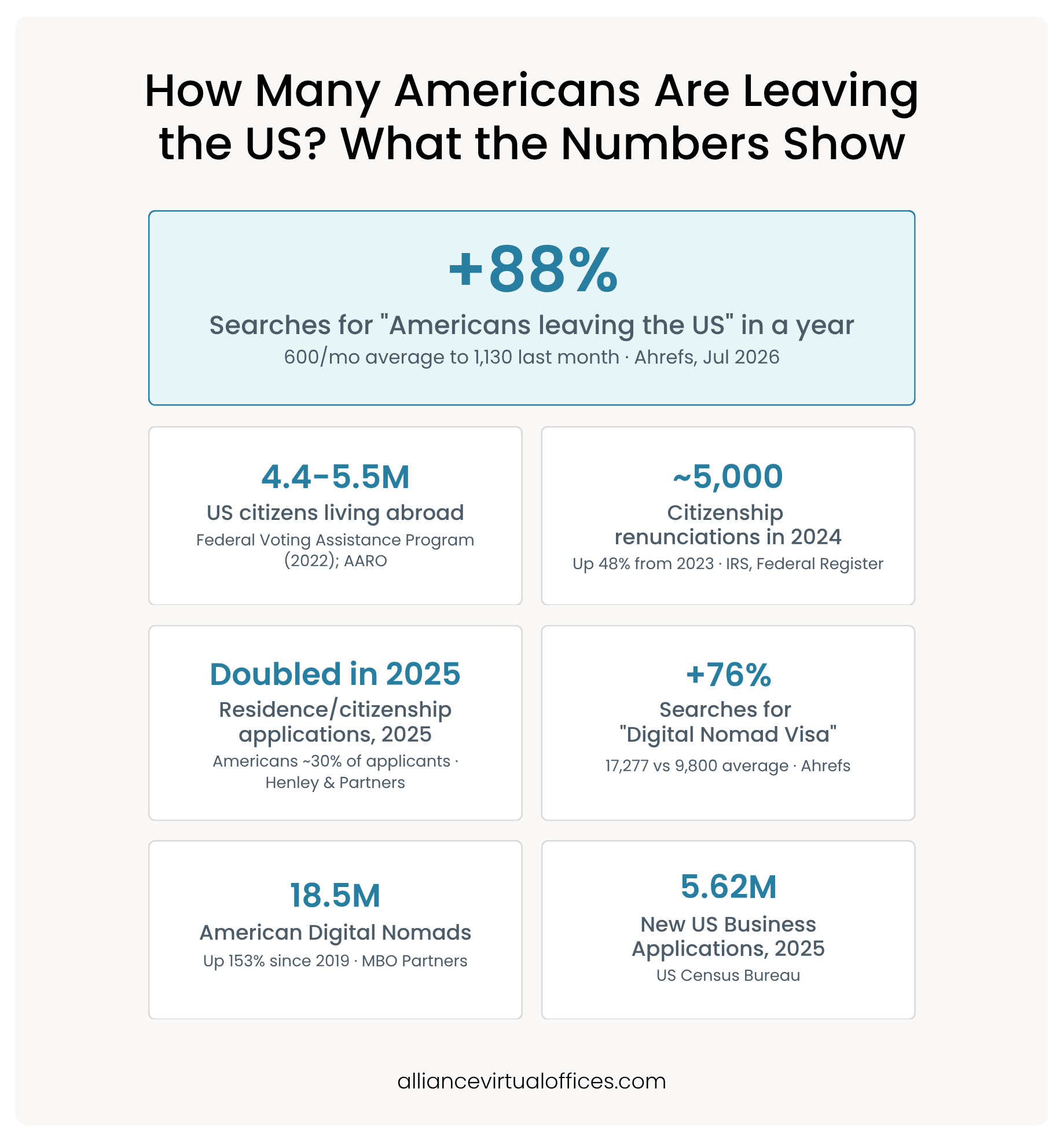
That checklist is getting longer for a lot of people. US searches for “Americans leaving the US” nearly doubled over the past year, climbing from an average of 600 per month to 1,130 last month, according to Ahrefs data pulled in July 2026.
Here’s what that search spike misses: moving out of the US does not mean moving your business out of the US. Your company can stay fully American while you work from Lisbon, Mexico City, or Chiang Mai, as long as a few pieces of stateside infrastructure stay in place.
This guide covers what the numbers actually show, what breaks when you go, and how founders keep a US business running from anywhere. Politics stays out of it, because the logistics are complicated enough.
Key Takeaways
- Searches for “Americans leaving the US” are up 88% in a year, climbing from a 600 monthly average to 1,130 last month.
- An estimated 4.4 to 5.5 million US citizens live abroad, yet only about 5,000 formally renounced citizenship in 2024.
- Citizenship renunciations were up 48% in 2024, the third-highest annual total on record.
- Applications from US nationals for residence and citizenship programs doubled in 2025, with Americans making up roughly 30% of applicants.
- The US now counts 18.5 million digital nomads, up 153% since 2019, and searches for “digital nomad visa” jumped 76% in a month.
- Americans still filed 5.62 million new business applications in 2025, proof they are leaving the country, not their companies.
How Many Americans Are Leaving the US? What the Numbers Show
Nobody can give you an exact count, and that’s worth saying plainly. The State Department stopped standing behind its old estimate of citizens abroad because Americans are not required to register when they move overseas.
Up 88%
US searches for “Americans leaving the US” climbed in a single year, from a 600 monthly average to 1,130 last month.
Source: Ahrefs, July 2026
The Census has the same blind spot, since the decennial count does not include private citizens living outside the country. Anyone quoting a precise number of Americans abroad is estimating, and the honest sources say so.
The independent estimates cluster in a believable range. The Federal Voting Assistance Program put the civilian figure at 4.4 million in its 2022 overseas citizen population analysis, while the Association of Americans Resident Overseas estimates around 5.5 million.
Formal exits are rarer, and the government does track those. The IRS publishes a quarterly expatriation list in the Federal Register, and those lists show nearly 5,000 people gave up US citizenship in 2024, a 48% jump over 2023 and the third-highest annual total on record.
Nearly 5,000
Americans renounced US citizenship in 2024, up 48% from the year before and the third-highest total on record.
Source: IRS quarterly expatriation lists, Federal Register
Millions of Americans live abroad, yet only a few thousand a year formally cut ties: the overwhelming majority stay American citizens with American tax IDs and, very often, American companies.
The demand side is climbing too. Henley & Partners reported in its January 2026 Global Mobility Report that applications from US nationals for residence and citizenship programs doubled in 2025, making Americans the firm’s single largest applicant group at roughly 30%.
Remote work is what makes the math work. MBO Partners counted 18.5 million American digital nomads in its 2025 State of Independence research, up 153% since 2019, and more than 60 countries now offer digital nomad visas to attract them, according to Global Citizen Solutions’ 2026 index.
18.5M
Americans now work as digital nomads, up 153% since 2019.
Source: MBO Partners, 2025
Not all of them are freelancers with backpacks, either. MBO Partners found that nomads holding traditional jobs grew 10% in 2025, meaning a growing share of the people working from abroad still hold US employment, US payroll, and US obligations.
Search behavior tells the same story from the demand side. Interest in “digital nomad visa” jumped 76% in the latest month alone, from a 9,800 monthly average to 17,277 searches, per the same July 2026 Ahrefs pull.
And through all of it, Americans keep founding US companies at a near-record pace. The Census Bureau’s Business Formation Statistics logged 5.62 million new business applications in 2025, up from 5.2 million the year before.
5.62M
new US business applications were filed in 2025, even as more Americans moved abroad.
Source: US Census Bureau, Business Formation Statistics
Put the two trends side by side and they look contradictory, until you realize they describe the same people. The founder searching for how to move out of the United States is often the same founder who filed one of those 5.62 million applications.
So here’s the pattern underneath the headlines: Americans aren’t leaving America. They’re untethering from it. They’re keeping the LLC, the bank account, and the client base stateside while the founder works from somewhere else.
That untethering only works if the US side of the business stays anchored somewhere real. For most founders, that anchor is a virtual office location with a real commercial address that stays put while they move.
What Breaks When You Move Out of the US
Moving out of the US is a logistics project, and the business side breaks in predictable places. Knowing where helps you fix each one before wheels-up instead of after.
Four things break.
Your mail stops finding you first. USPS requires anyone moving abroad to submit their change of address in person at a Post Office, and its forwarding options were built for domestic moves. Premium Forwarding Service Residential, the paid option, ships your accumulated mail only to US addresses, per USPS’s own service terms.
That matters more than it sounds. IRS notices, state annual report reminders, and bank correspondence still arrive on paper, and a missed deadline notice does not care that you were in Portugal.
Third-party international forwarding services exist, but they add cost, delay, and a customs layer to every envelope. A tax notice that takes three weeks to reach you has already spent most of your response window in transit.
Your business bank account gets fragile. Most US banks ask for a physical US address on business accounts, and a PO Box typically will not satisfy the requirement. Founders who switch their account address to a foreign residence sometimes trigger account reviews they did not see coming.
Payment platforms follow similar logic. Many verify a US address and a US bank account for US-based merchant accounts, so the address change can ripple into how you get paid.
Your state still expects a registered agent. The Small Business Administration notes that LLCs and corporations must maintain a registered agent with a physical address in their state of formation, available during business hours to receive legal and government documents. Move abroad without one and your company can slip out of good standing without you noticing.
Your credibility takes a quiet hit. US clients and vendors read a foreign address as a change in the relationship, even when nothing else changed. A consultant who moves from a Denver suite to an overseas apartment address looks like a different vendor on paper.
The friction shows up in small places. Contracts ask for a US notice address, W-9s ask for a US address, and procurement teams pause on invoices from unfamiliar countries.
None of these problems are fatal, and that is the point of naming them. Each one has a known fix, and every fix runs through the same piece of infrastructure: an address that stays in the US when you do not.
Read More: Should I Use My Home Address for My LLC? What to Know
The Untethered Playbook: Keeping a US Presence From Anywhere
Now for the fix. Every item that breaks has a stateside replacement, and together they form a simple playbook for leaving the US without loosening your company’s grip on it.
A real US business address
This is the keystone, because the bank, the state, the IRS, and your clients all key off it. A virtual office gives your company a real business address in a commercial building, with a real suite number, that is typically accepted for LLC registration and business banking.
The distinction from a mail drop matters. An address backed by actual offices and meeting rooms reads as a place of business, which is exactly what a virtual business address for your LLC needs to do while you are nine time zones away.
There is a practical bonus for the trips home, too. When you fly back to meet a client or a banker, the address you have been using all year comes with meeting rooms you can book at that same location.
Mail handling that crosses borders
A business address only helps if the mail reaches you. Look for mail handling that receives everything at your US address, then scans, holds, or forwards it on your schedule, including internationally.
That turns the paper problem into an easily viewable email. The IRS notice that would have sat in a dead mailbox instead lands in your inbox as a scan the week it arrives.
Set the defaults before you leave, not after. Decide what gets scanned automatically, what gets shredded, and what gets forwarded to wherever you are that quarter, so nothing waits on a decision you have to make from another hemisphere.
A registered agent and clean state filings
Keep your registered agent in your state of formation and put annual report dates on a calendar you actually check. Some founders use their virtual office address for state filings and a separate registered agent service, an approach covered in our guide to using a business address for state LLC filings.
State rules differ on what each filing requires. Ten minutes on your Secretary of State’s site before you leave beats a reinstatement fee after.
Timing is the trap here, not complexity. Annual reports are simple forms, but they arrive on state schedules that have nothing to do with your travel calendar, so automate the reminders now.
A US phone presence
Your US clients want to call a US number during US business hours, and time zones make that hard to staff yourself. A dedicated business phone number keeps the line American, and a Live Receptionist answers it professionally while you sleep.
Consider what the alternative looks like from the client’s side. They call at 2 p.m. Eastern, reach voicemail because it is 3 a.m. where you are, and quietly start wondering whether you are still in business.
Here’s the quiet benefit founders mention later: calls get answered better abroad than they did at home, because a live person covers the line during US hours. The move forces a discipline that most home-office founders never had.
Unlock Our Current Virtual Office Offers
Enter your email below and we’ll send you the latest available promotions and monthly specials for Virtual Offices, Meeting Rooms, and Live Receptionists.
What It Costs (and Saves) to Keep Your Business Stateside
Founders weighing a move usually compare three paths, and the price gaps are wider than most expect. It helps to walk through them honestly, because each path fits a different situation.
Path one: keep a US presence remotely. A virtual office with mail handling runs a predictable monthly rate, and adding a business phone line or Live Receptionist scales the cost with your needs. It is a fixed line item you can budget from anywhere.
Path two: fly back to fix things. Handling a bank verification, a notarization, or a stack of held mail in person several times a year means airfare, lodging, and lost working days. One trip can cost more than a year of stateside infrastructure.
The bigger problem with this path is that it is reactive. You fly back when something has already gone wrong, which usually means the cheap version of the fix expired weeks earlier.
Path three: dissolve and re-form later. Closing the LLC means state dissolution filings, final returns, and a closed bank account, and re-forming means new filing fees, a new EIN, and a business history that starts over from zero. If you are genuinely winding the business down, dissolution is the right call, but doing it just because you are moving is usually the expensive option.
There is also the cost nobody itemizes: what the business loses while its infrastructure is broken. A missed client call during a bank freeze or a compliance lapse does not show up on any invoice, but it is the most expensive line on this list.
The honest comparison favors keeping the company alive and anchored for anyone who intends to keep operating. The costs are known, the paperwork is lighter, and the business you built keeps its age, its bank relationship, and its name.
NEXT STEPS: Explore virtual office locations across 1,400+ centers
Compliance Corner: What Still Follows You Abroad
A few obligations travel with you no matter where you land, and pretending otherwise gets expensive. None of this is legal or tax advice, but all of it belongs on your pre-departure list.
US taxes are citizenship-based. The IRS expects US citizens to file federal returns on worldwide income even while living abroad, though exclusions and credits often reduce what is owed. A cross-border tax professional is worth the fee in your first year overseas.
Foreign financial accounts can add a reporting step of their own under US Treasury rules. This is squarely professional-advice territory, so put it on the list for that same tax conversation.
Your old state may not let go quickly. Some states continue to treat you as a tax resident until you clearly establish domicile elsewhere, and the rules differ widely. Confirm your state’s requirements before you assume the move ended the relationship.
Mail handling comes with a form. USPS requires PS Form 1583 before any commercial mail receiving agency can accept mail on your behalf, with identity verification included. It is a one-time step, and reputable providers walk you through it.
States vary, so verify. Registered agent rules, annual report schedules, and address requirements differ by state, and what is typically accepted in one may not align with another’s requirements. Check with your state authority before you rely on any single setup.
None of this should scare you off the move. It is a checklist, not a wall, and founders clear it every day.
Americans Leaving the US Can Keep Their Businesses Right Here
Americans leaving the US are not closing their companies; they are giving them a permanent stateside anchor and running them from further away. If a move abroad is on your horizon, set up the US address, the mail handling, and the phone presence before the flight, and the business will barely notice you left.
Explore virtual office locations when you are ready to see what your company’s US anchor could look like.
Further Reading
- How to Become a Digital Nomad and Work From Anywhere
- How to Set Up a Virtual Business Address for LLC
- Remote Working Statistics, Updated
- Working From Home Increases Cyberattack Frequency by 238%